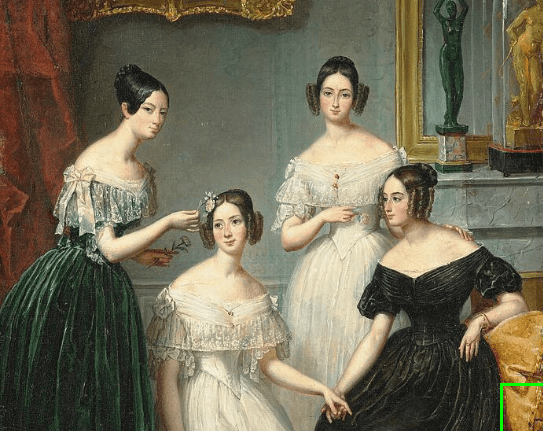
Made you look! But seriously, this really is a post about four women called Fanny (well, technically, they were all called Frances, but the nickname ‘Fanny’ appears in several records). As for why it’s a cautionary tale, you’ll have to read on to find out…
Two Wives
I was recently asked by a client to research the life of Charles Gordon GRAY (c. 1760-1822), whose monument can be seen on the wall of St Vigor’s, Stratton-on-the-Fosse, Somerset. I unearthed a wealth of information about him, but wanted to find out more about his wife, Frances, who is also mentioned briefly on the monument. All that the inscription revealed about Frances Gray was that she died on 6 January 1856, in her 85th year — details that matched the death registration index entry — meaning she must have been born in about 1770.
Searches for a marriage record produced, rather puzzlingly, two marriage register entries between Charles Gordon Gray and Frances HUGHES, 11 years apart. Since I was able to view digitised images of the parish registers for both, I confirmed that they were definitely marriage register entries rather than records of banns or bonds for marriages that had never actually taken place. The first marriage was held on 10 October 1782 in the parish church of Chitterne, Wiltshire. The second, on 30 April 1793 in Stratton-on-the-Fosse. Both marriages were solemnised by licence.
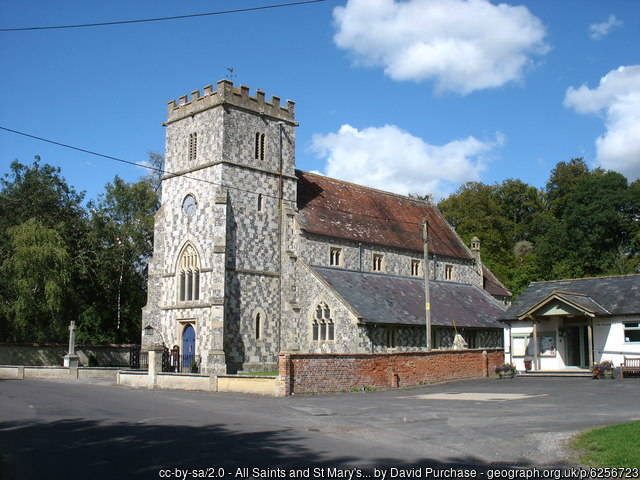
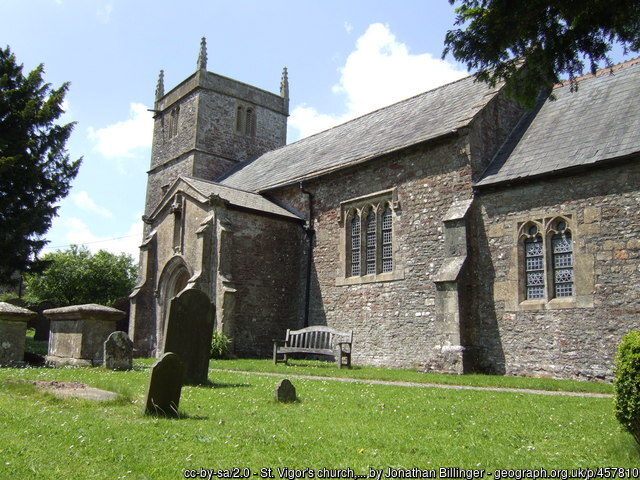
I compared the marriage register entries. Neither included any information about marital status. The wife’s name in both was ‘Frances Hughes’, and in both registers, Frances signed her own name. Frances’s signatures are not identical, but neither are Charles’s.
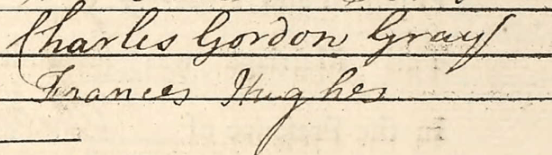
‘Wiltshire, England, Church of England Marriages and Banns, 1754-1924’, Ancestry [accessed 4 Oct 2026].
Original record: Wiltshire and Swindon Heritage Centre, Ref: 1109/1b.
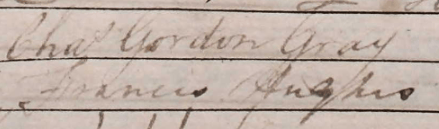
‘Somerset, England, Marriage Registers, Bonds and Allegations, 1754-1924’, Ancestry [accessed 4 Oct 2026].
Original record: South West Heritage Trust, Ref: D/P/Str.on.F./2/1/4.
In 1782, Charles was a resident of the parish of Chitterne, where the marriage took place, and Frances of Warminster. In 1793, Charles was of Hill Deverill in Wiltshire, and Frances of Stratton-on-the-Fosse, where the marriage took place. There’s no mention of parental consent in either record. The first marriage had four witnesses, including a possible relation, John Hughes, and the second had two witnesses.
Glancing at some other online family trees that included Charles Gordon Gray, I saw that all of them had added both marriage records to his profile, and to the profile of his wife. This wasn’t surprising, since Ancestry Hints were also enticing me to add both of the records to Charles’s and Frances’s profiles. But a couple did not usually marry twice. Something was clearly amiss. Not only that, but if Frances was indeed born in about 1770, she would only have been 12 at the time of the first marriage. 12 was the minimum legal age for a girl to marry, but marriage at such a young age was highly unusual.
I began to ask myself some questions…
- Could one of the marriages have been to a different Charles Gordon Gray?
No. The only other men with that unusual name I had come across in my research were his son (b. c. 1785) and his grandson (b. 1823). His son was only a young child in 1793, so cannot have been the groom in the second marriage.
- What could the baptisms of their children tell me?
I had located baptisms of 10 children to Charles Gordon Gray and Frances Gray between 1783 and 1810. In 1783, Frances would have been about 16. There was a noticeable nine-year gap between the second baptism in 1785 and the third in 1794 (a year after the second marriage) but I knew that Charles conducted his business overseas, so could have been absent from home for long periods.
- What could censuses reveal about Frances’s age?
Since Frances Gray died in 1856, she would have been enumerated in the 1841 and 1851 censuses. Sure enough, I was able to find entries for Frances: In 1841 she was living in Stratton House, Stratton-on-the-Fosse — financially independent, aged 70 (per the age-rounding rules for that census she could have been between 70 and 74), and born in the same county as her residence (Somerset). In 1851, she was still in Stratton, aged 81, a Gentlewoman, b. Abingdon Street, Westminster. These ages matched her reported age at death. Although possible that she was consistently lying about her age, it was unpleasant to consider the alternative possibility that she was telling the truth, and had been just a child when she married an adult man 10 years her senior.
- What possible reasons could there have been for two marriage ceremonies?
Had Frances eloped without parental consent the first time around and pretended to be of full age? (It would surely have been difficult to convince a clergyman that she was 21, but a bribe might have helped persuade him.) Had the first ceremony later been found to be invalid? Could the gap in baptisms have been due to an enforced separation until she was old enough to marry Charles legally? By 1793, when the second marriage took place, she would have been about 23. It was a reasonable theory, but soon ruled out…
- Were the marriages reported in newspapers?
Yes. Both were reported in regional newspapers (see below). This makes it highly unlikely that Frances had married without parental consent.

Findmypast [accessed 10 Jun 2026]. Content provided by THE BRITISH LIBRARY BOARD. ALL
RIGHTS RESERVED.

Findmypast [accessed 10 Jun 2026]. Image © Reach PLC. Image created courtesy of THE
BRITISH LIBRARY BOARD.
So far, I hadn’t established a reason for two ceremonies. However, both marriages were performed by licence, so my next step was to see if bonds and allegations (records required to apply for a licence from the diocese) had survived. These records would have been submitted to Salisbury Diocese for the first marriage and Bath and Wells for the second. Fortunately, some of these documents have survived for both marriages. And as luck would have it, they can be found online — a transcription of the bond of 1782 is available in Findmypast, and the allegation and bond of 1793 have been digitised and made available via Ancestry. These records contain some very different details, which I have summarised below.
| Year of marriage | Frances’s age | Charles’s age | Frances’s marital status | Charles’s marital status | Bondsman |
| 1782 | 19 – married with father’s consent | Full | Spinster | Bachelor | John Hughes of Warminster (bride’s father?) |
| 1793 | Full (21+) | Full | Spinster | Widower | Edw[ard] BOWEN of St Michael Bath China Dealer |
I couldn’t review the original document of 1782 to check the transcribed information, but if Frances was a minor of 19, she would have been born c. 1763 — seven years earlier than other records had inferred. Lying about her age at that time or later in life was still a possibility. However, Frances’s father had consented to her marriage, which confirms that the couple hadn’t eloped. And if Charles and Frances had remarried to legitimise their relationship for any reason, I couldn’t see any advantage to his claming to be a widower.
Considering this evidence, it now seemed more likely that the long childless gap after 1785 was caused by the death of his first wife… which meant that Charles had two wives, both called Frances, and both with the maiden name Hughes. If so, there must be a burial record for the first Frances Gray.
The first marriage and first two baptisms had taken place in Chitterne, but the parish register for Chitterne had no other entries for the family, and a broad search in Ancestry found no other likely records. However, a search for burials in Wiltshire parish registers via Findmypast found a transcribed burial record for Fanny Gray, aged 23, wife of Charles Gordon [Gray], in Warminster, 13 April 1786. Tragically, searching for baptisms in the same database revealed that the day after Fanny’s burial, a daughter of Charles and Fanny, Sarah Maria Gray, was baptised in the same place. I was then able to browse the Warminster registers in Ancestry to find the digitised versions of these records (which for some reason hadn’t surfaced in Ancestry searches or Hints).
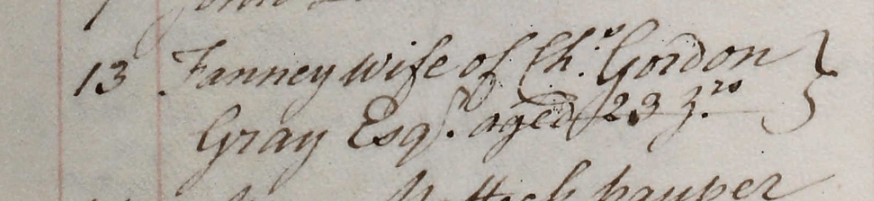
‘Wiltshire, England, Church of England Baptisms, Marriages and Burials, 1538-1812’, Ancestry [accessed 4 Oct 2026].
Original record: Wiltshire and Swindon History Centre, Ref: 2144/24.

‘Wiltshire, England, Church of England Baptisms, Marriages and Burials, 1538-1812’, Ancestry [accessed 4 Oct 2026].
Original record: Wiltshire and Swindon History Centre, Ref: 2144/7.
I now knew for sure that Charles Gordon Gray had married two women called Frances Hughes. The first Frances (Fanny) was born in about 1763 and sadly died after childbirth in 1786. The second Frances was born in about 1770 in Westminster and was buried at Stratton-on-the-Fosse in 1856, aged 85.

‘Somerset, England, Church of England Burials, 1813-1924’, Ancestry [accessed 4 Oct 2026].
Original record: South West Heritage Trust, Ref: D/P/Str.on.F/2/1/8.
It was quite common in wealthy families to marry a relation, so I wondered if Charles might have remarried to his wife’s cousin. The first Frances was the daughter of John Hughes, an attorney of Warminster. I was able to find a baptism of his second wife in Westminster, 1769, to William Hughes and Elizabeth Bentley Hughes (née CUMBERLAND) and I discovered, through their marriage bond of 1759, that Elizabeth’s parish of residence was Kilmersdon, Somerset (close to Stratton-on-the-Fosse). So, Charles’s second wife had a local Somerset connection. However, William Hughes was living in Middlesex at the time of his marriage. Even if he also came from Kilmersdon originally, that was 15 miles from Warminster.
I hoped that the fathers’ Wills would yield some clues. The Will of John Hughes included a bequest of £200 to ‘Frances Hughes, wife of Charles Gordon Gray Esq.’ However, she never received the money, because she died two years before her father. No further family names were included. No Will has yet been found for William Hughes.
Hughes is a very common name, so the wives’ identical names could simply be a bizarre coincidence. But evidence from various records leaves no doubt that they were two separate individuals, despite all of the Ancestry Hints to the contrary!
Two Daughters
Before discovering that Charles Gordon Gray had two wives with the same name, I had found that Charles Gordon Gray and Frances Gray baptised a daughter called Frances Gray in 1783 and a daughter called Frances Mary Georgiana Gray in 1794. Since both daughters were baptised with the first name Frances, I assumed that the first child had died. However, the few records I was able to find about Frances Gray as an adult just didn’t add up.

‘Wiltshire, England, Church of England Baptisms, Marriages and Burials, 1538-1812’. Ancestry [accessed 3 Oct 2026].
Original record: Wiltshire and Swindon History Centre, Reference: 1109/1.
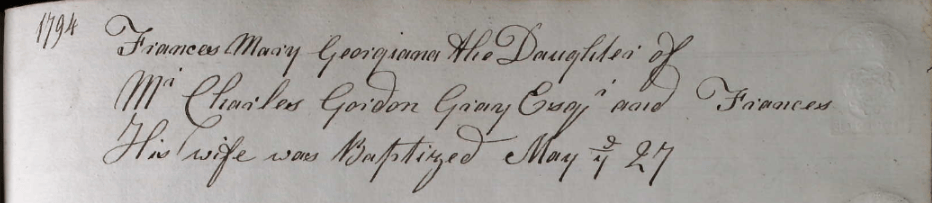
‘Wiltshire, England, Church of England Baptisms, Marriages and Burials, 1538-1812’. Ancestry [accessed 3 Oct 2026].
Original record: Wiltshire and Swindon History Centre, Reference: 18/4.
I had a marriage record for Fanny Gray and William MERCER at Stratton-on-the-Fosse in June 1814. Fanny was a spinster of that parish, and they had married by licence with consent of parents. A marriage in 1814 seemed to fit perfectly with a birth in about 1793. No middle names were included for Frances, but the entry of her name as ‘Fanny’ suggested a rather lax approach to filling out the marriage register! The marriage register stated that William Mercer was a Merchant of St Olave’s Old Jewry. I was able to find two baptisms for children of William and Fanny Mercer: at Olave Jewry, 1817, William Remington Mercer and at Stratton, 1820, Charles Alexander Mercer.
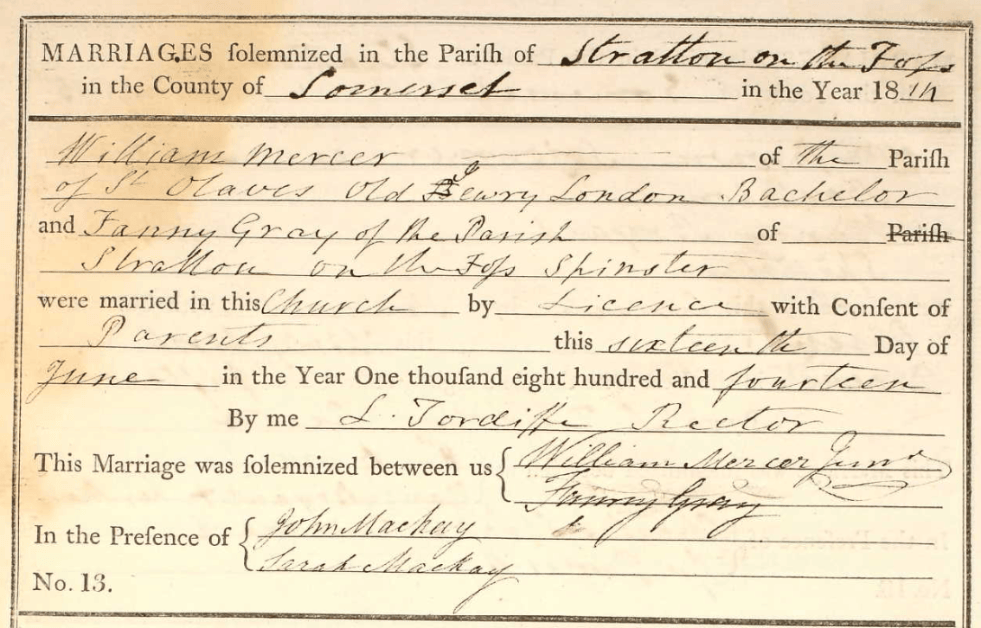
‘Somerset, England, Marriage Registers, Bonds and Allegations, 1754-1924’, Ancestry [accessed 4 Oct 2026].
Original record: South West Heritage Trust. Ref: D/P/Str.on.F./2/1/7.
However, I also had a burial, corresponding death registration index and a newspaper announcement for ‘Frances Mary Georgiana Gray’ in 1850. The first names were exactly right, and the age at death, 56, also fitted. Furthermore, the newspaper announcement’s description of her as the ‘third daughter’ matched the position of Frances Mary Georgiana, following her older sisters Frances and Sarah.
But why was her name at death Frances Gray, and not Frances Mercer? Could this have been a rare case of divorce from the early 19th century? If so, I couldn’t find any evidence of a divorce taking place.
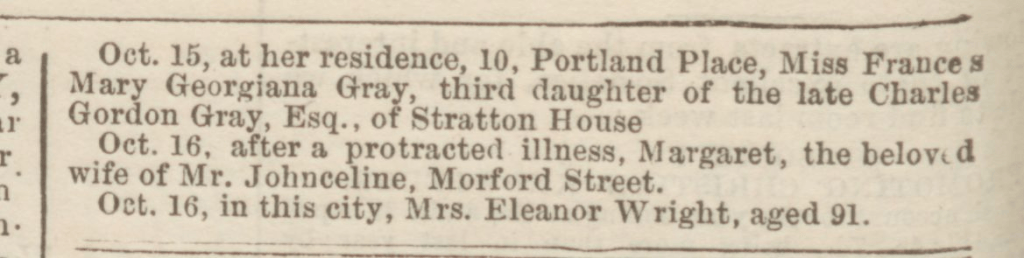
Via Findmypast [accessed 4 Oct 2026]. Image © Reach PLC. Image created courtesy of THE BRITISH LIBRARY BOARD.
Just as other Ancestry trees had only shown one wife for Charles, many of them had only included one daughter called Frances (or Frances Mary Georgiana) Gray, and had added the marriage and death to that one profile. Even though I had established that there were two daughters with that name, Ancestry Hints kept encouraging me to add the two events to both of their profiles, despite the records being clearly incompatible.
Charles Gordon Gray’s Will, available online, was the key to solving this puzzle. Charles left equal shares of his property to his children, including ‘Frances the Wife of William Mercer Esquire’ and ‘Mary Frances Gray’. So, both of Charles’s daughters named Frances survived to adulthood. The first, Frances Gray, known as Fanny, married William Mercer, and the second, Frances Mary Georgiana Gray, remained a spinster. The younger sister was referred to in the Will as ‘Mary Frances’ rather than ‘Frances Mary’; it could have been the clerk’s error, or perhaps, even though she was baptised ‘Frances Mary’, she used the first name ‘Mary’ to avoid confusion with her older half-sister.

‘England & Wales, Prerogative Court of Canterbury Wills, 1384-1858’. Ancestry [accessed 15
Jul 2026]. Original record: The National Archives (UK), reference: PROB 11/1665/159.
A set of mortgage documents of 1835 for property inherited by Charles Gordon Gray’s children (held at The National Archives) show the different legal processes that applied to the two Franceses: Frances Mary Georgiana Gray, a single woman, was assumed to have agreed to the terms independently (although it was clear that she and her other unmarried sisters were largely represented by their only surviving brother). In contrast, the married daughters of Charles Gordon Gray, including ‘Frances otherwise Fanny’ Mercer, were each interviewed by a magistrate separately from their husbands to ensure that they had a full understanding of the agreement and gave their consent of their own free will.
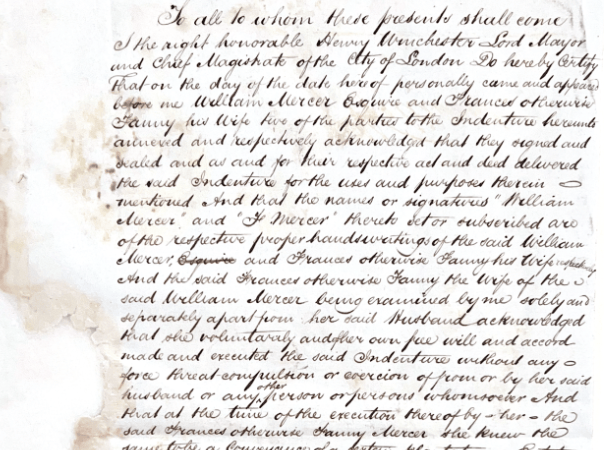
The National Archives (UK). Ref: PWLB 11/85/5.
Once I also knew that Charles had married twice, I realised that Frances ‘Fanny’ Gray/Mercer was the eldest daughter of Charles’s first wife, whereas Frances Mary Georgiana Gray was the eldest daughter of Charles’s second wife.
Hopefully, a family tree will help to clarify these relationships:
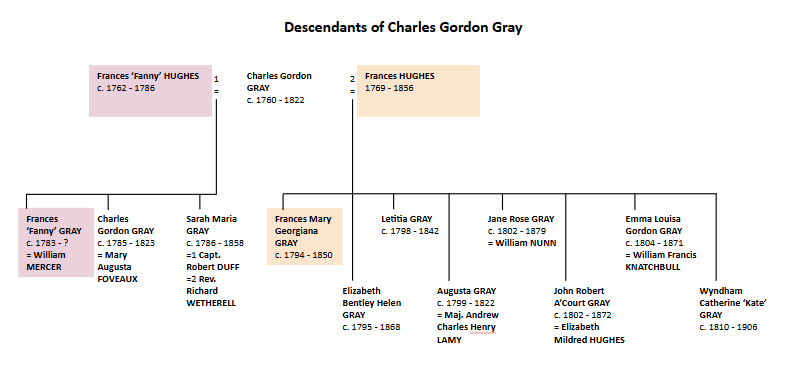
A Tale of Four Frances Grays
My original title was slightly misleading. To begin with I assumed that the use of Frances or Fanny for one woman was interchangeable. But when I looked more closely at the records, I noticed that Charles’s first wife, and the daughter named after her, both used the name ‘Fanny’ in multiple documents; in contrast, all the records I’ve found for his second wife and younger daughter consistently used ‘Frances’. It would be easy to ignore this additional evidence pointing to separate people, who may well have chosen to differentiate themselves from each other by using their formal name or nickname.
Four Individual Lives
Once I had established the existence of four individual women, I hoped to gather more details about their lives. I’ve been able to add more colour to the life of Charles’s second wife, Frances Hughes/Gray (c. 1769-1856). She had some illustrious ancestors and relations on her maternal side, including bishops, academics, writers and philosophers. Sadly, Frances’s mother died the year after she was born, and she was raised, along with six sisters, by her mother’s sister Mary ALCOCK (née Cumberland). Alcock was a vicar’s wife, but her husband’s mental health problems led to the breakdown of their marriage, and by the time she took in her seven nieces she lived alone in Bath, where she was known as a poet, essayist and philanthropist. When Mary died in 1798 she made a touching bequest to Frances, leaving her ‘as a token of remembrance my brilliant diamond ring set round with small ones also my yellow diamond ring set round with small rubies and my pearl earrings I also give to my said niece my longest framed drawing’. While researching Charles, I had discovered that he subscribed to a posthumous book of Mary Alcock’s poetry in 1799, while Mrs Gray had subscribed to two copies. Only after researching Frances’s own background did I realise that Mary Alcock was essentially Frances’s mother, having raised her since she was a baby.
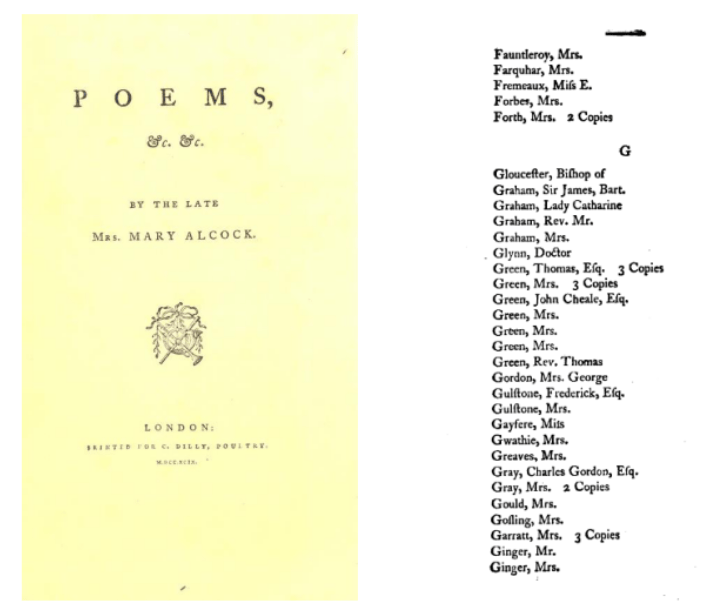
and inside, Charles Gordon Gray and Mrs Gray (presumably Frances) in the list of subscribers.
Via Internet Archive. Whole book available online at
https://archive.org/details/poemsetcetc00alcoiala/page/n3/mode/2up [accessed 11 Jun 2026].
Conclusion
Ancestry Hints and many online family trees would lead us to believe that Charles had one wife called Frances Hughes and one daughter called Frances Gray. In fact, he had two of each.
The records of these four women offer excellent examples of how ignoring conflicting evidence can lead to mistakenly merging two individual lives into one. This does of course lead to errors in our family tree, but it also means that we miss out on the pleasure of investigating the mystery! In my opinion, the facts that just don’t seem to fit are some of the puzzles that make researching family history so fun and rewarding. To make sense of them, we need to expand our research into other records, other databases, and sometimes to archives, which is a lot more satisfying than simply accepting a suggested record.
Furthermore, the lives of women who lived centuries ago are already much more difficult to trace than men’s, but can be absolutely fascinating; they deserve the additional effort by family historians to question hints, delve deeper, and tell their individual stories.
Other titles considered for this blog:
- The Fanny Trap
- Help! One of my Fannies is missing!
- The Fanny-tastic Four
- The Great Fanny Fiasco
- No Fannies left behind
Some more Fannies who feature in my blogs:
- Fanny Talmer (accused of infanticide)
- Former owner of my house, Fanny Gammon
- Vicar’s daughter, Fanny Evill
The main image for this blog is taken from a Group portrait of four young ladies in an interior by Francois Quesnel (public domain).


Fascinating and so clearly explained, I learned so much from this – thank you! As part of my OPS family studies, I have noted that it was usual for wealthier people to marry relatives and certainly people of the same social or financial standing as themselves, business people to business people, land owners to land owners (often those owning adjoining land), humble nailers to humble nailers, though it appears, in the little village I have been working on, that the rules on consanguinity were carefully observed and there is oral evidence that amongst humble folk there at least, the ‘grandmothers’ preserved the relevant knowledge of family trees and warned off unsuitable pairings. A very enjoyable piece which I shall read again as it has so many useful pointers for future research.
LikeLike
Thank you very much. I’m glad you found it useful. I’ve certainly found that the landowning class almost always married first or second cousins, with the aim of keeping their land and income within the family. If you’ve seen the spoof Downton Abbey type drama Fackham Hall on Netflix this is a central theme. I’ve often wondered whether people in a village who shared ancestors more than a couple of generations back knew how they related. But perhaps they would have simply avoided marrying anyone with the same surname!
LikeLike