The war widow, the cadet, the geodesist and the history buff
The land and property now known as ‘Forge Cottage’ in Drayton, Oxfordshire (my home) was rented, owned or occupied by one family, the Hydes, for more than a century. The Hyde family — Drayton’s blacksmiths — began renting the plot from the Lord of the Manor before 1815, purchased it freehold for use as a garden by 1829, and built a workshop and house there by 1851. Following the death of the original owner, John Hyde, in 1834, his son, grandsons and great grandsons worked at the village smithy on this site. The last of the Hyde blacksmiths left in the 1890s. In Part 1, I shared the story of the Hydes of Forge Cottage, up to the end of the nineteenth century.
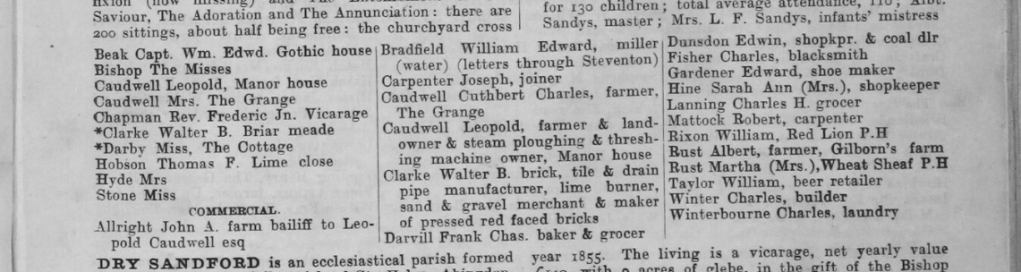
By the turn of the century, the owner was Charles Parker — son of the late Elizabeth Parker (née Hyde) — and the resident blacksmith was Charles Fisher. In the 126 years since, at least ten more families have made Forge Cottage their home.
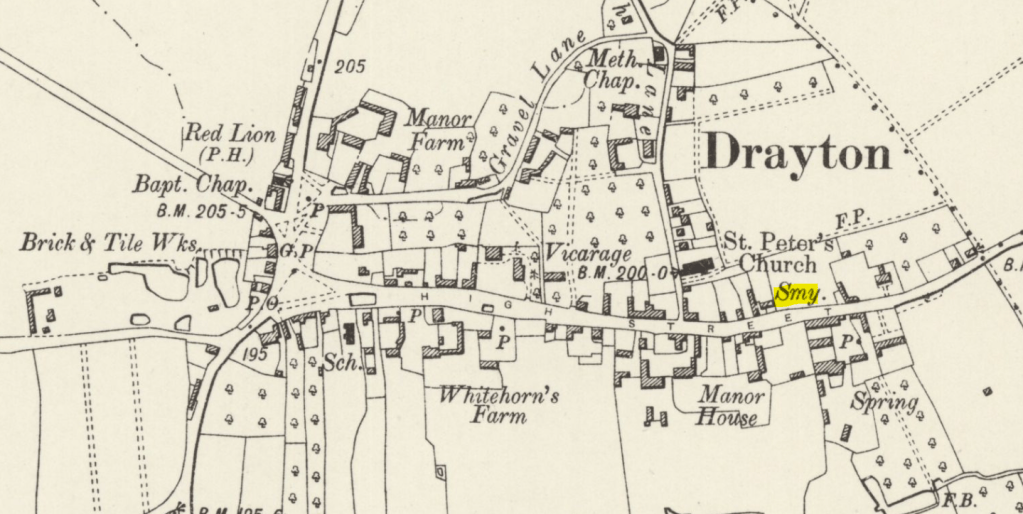
The Fishers (tenants of cottage c. 1898-bef. 1910 & of workshop c. 1898-1920s?)
In the 1901 census, my house — numbered 38 High Street — was occupied by the Fisher family. Blacksmith Charles Fisher was 33, and had been born in Kintbury, between Newbury and Hungerford. His wife, Annie Louisa (née Dawson), aged 27, was from Didcot. Their children were Ethel Sarah, 4, Mabel Louise, 3, and Dorothy May, 1. Ethel and Mabel were born in Warfield, near Bracknell, but Dorothy was born in Drayton, so the family must have relocated to Drayton between Mabel’s birth in Q4 1897, and Dorothy’s birth on 22 September 1899. Dorothy’s birth certificate shows that Charles was a Master Blacksmith.

In 1891, Charles had been lodging in a farm in Warfield, 30 miles from his birthplace of Kintbury, while working as a blacksmith. Charles wasn’t from a smithing family — his father was an Ag Lab — so he might have been apprenticed to a blacksmith there. Charles and Annie married in Wallingford in 1895. In October of the following year, Charles, a smith of Warfield, took part in a horse shoeing competition run by Berkshire Farriery School at a veterinary infirmary in Reading. ‘The competition was open to smiths who had made not less than eight attendances in one of the Farriery Schools since August 3rd’.1 Charles won second prize in the cart horses category, taking home £2. Not long afterwards, the Fishers moved 28 miles (as the crow flies) to Drayton. Perhaps they heard about the opening at Drayton’s smithy through the Farriery School.
By 1910, the Fishers had moved out of the house; the ‘Domesday’ Valuation Survey of 1910 reveals that the ‘House & Smiths shop’ (valued at £130) was owned and occupied by Frances Parker. In the 1911 census, Frances was the occupant of ‘The Smithy’ — the name then given to the cottage. (more about Frances below).
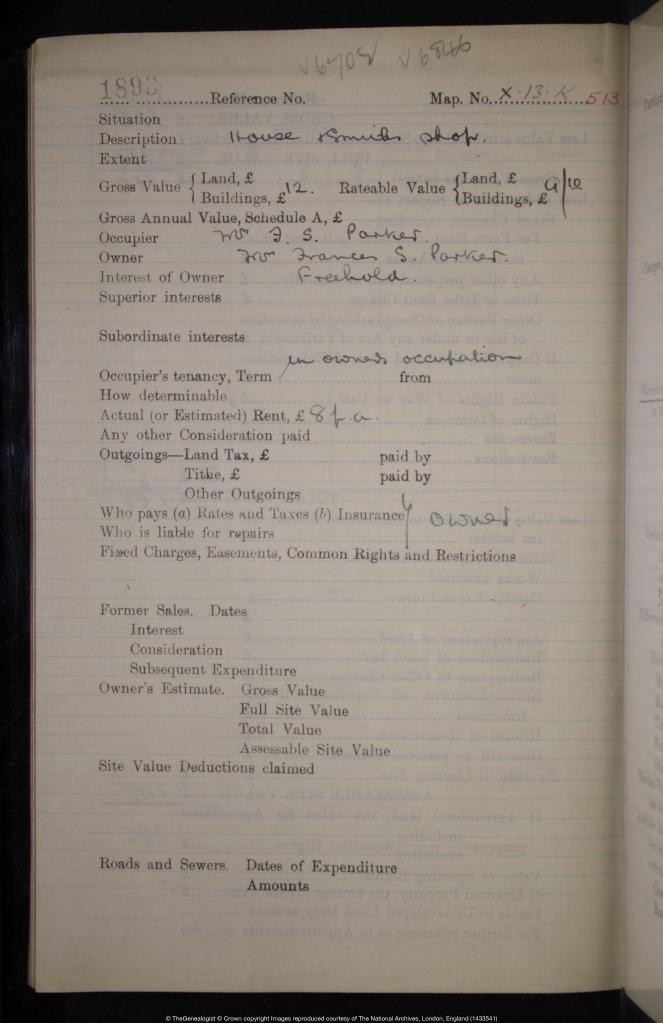
Original record: The National Archives, IR 58.
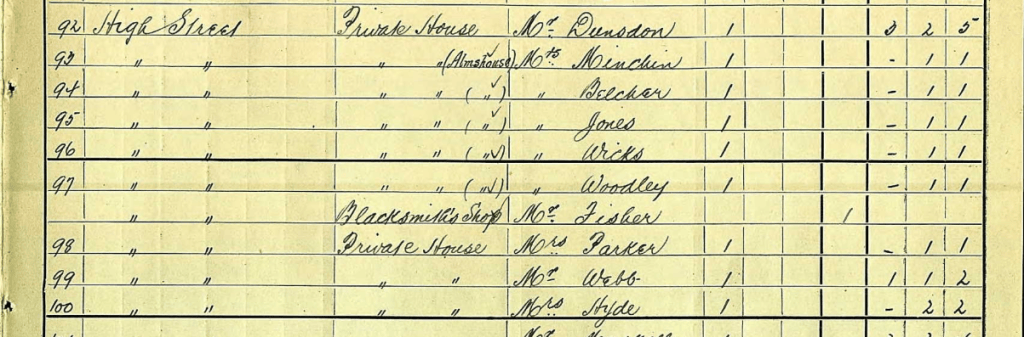
However, the household schedule in the census doesn’t give the full picture. If we also look at the 1911 enumerator’s census summary books (ESBs), we see that there is also an entry for the adjacent blacksmith’s shop, which was in fact still occupied by Mr Fisher. Meanwhile, the Fishers, now a family of nine, lived in a four-room property just around the corner, on Church Lane.
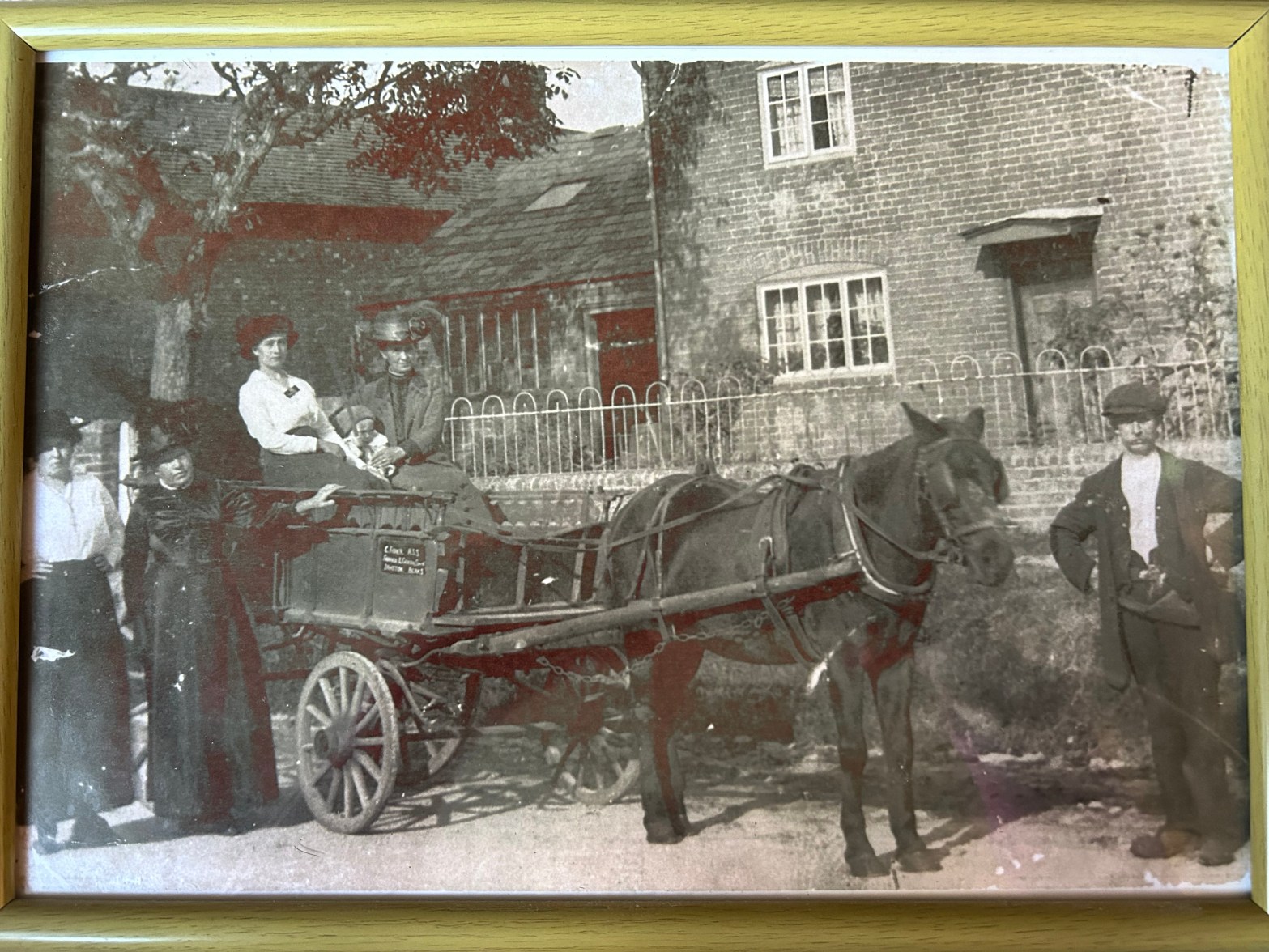
I am incredibly lucky to have a copy of a photograph of the Fishers in front of Forge Cottage in about the period of WW1. The ladies are dressed in fine feathery hats, including Ethel Fisher and Annie Fisher in the cart, while Charles (right) looks to be in work clothing. A label on the cart reads ‘C FISHER ASS Farrier & ? Drayton Berks’. The two women on the left, Mrs Didcock and Mrs Wells, were occupants of the cottage (see more on them below).
In 1921 the Fisher family was still living on Church Lane (number 5). Charles was a ‘General Smith’ working on his own account ‘at home’ — suggesting that by then he had moved his workshop to Church Lane.
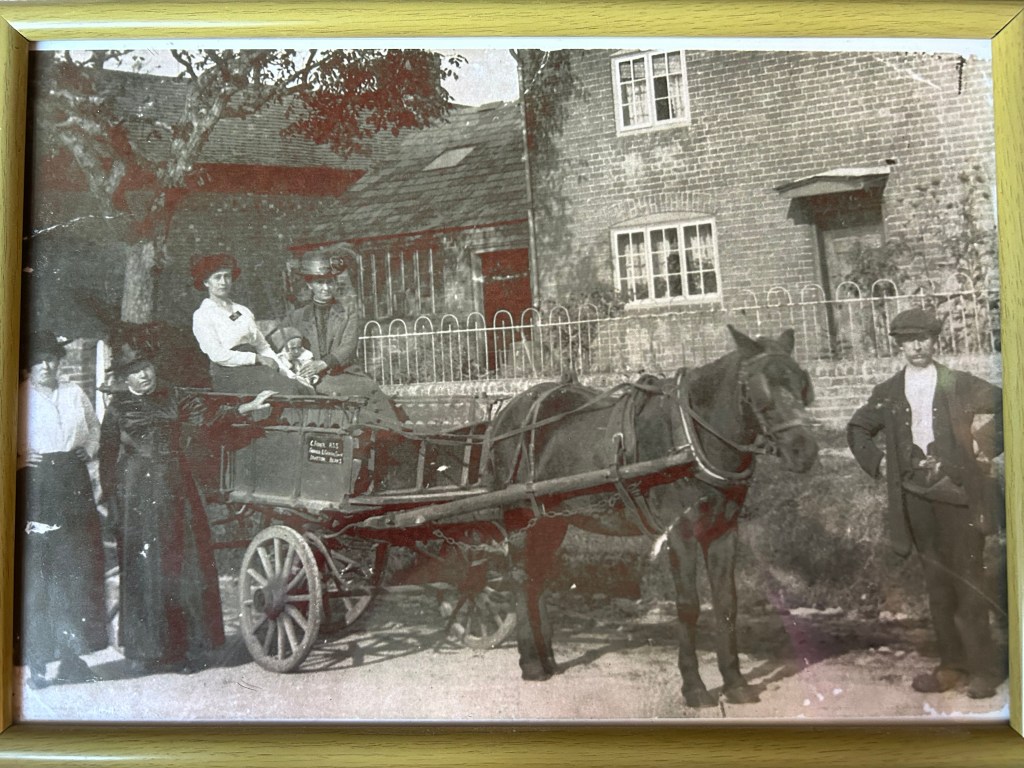
A note about the date: The photograph in the Drayton village archive is accompanied by notes identifying the people as (from L to R): ‘Mrs Flo Didcock (daughter of Mrs Wells)’, ‘Mrs Wells’, ‘Ethel Fisher’, ‘Raymond Fisher’, ‘Fisher’ [probably Annie] and ‘Charles Fisher’. Mrs Wells and Mrs Didcock were occupants of the cottage while the Fishers were the tenants of the forge. Little Reginald, a son of Charles and Annie, was born in about May 1914, and looks about two years old, so that gives a date for this photograph of about 1916-17. However, it is also possible that the little boy was in fact Ethel’s illegitimate son, Peter Montague Fisher (b. 29 July 1917), dating the photograph to about 1919; if Ethel herself identified the subjects she might not have wanted to mention Peter. Since Mrs Didcock was widowed in the summer of 1916 it’s possible she is in fact the woman dressed all in black, with her mother on her left. However, if the photograph was taken in about 1919, Mrs Wells was then a widow herself.
In 1988, two members of Drayton History Group interviewed Charles’s daughter Ethel, who was 92 years old, about her memories of Forge Cottage and the High Street in around 1900. Thanks to her extraordinary memory, I have a lively description of the cottage and blacksmith’s business. I particularly like picturing the thirsty carters having a beer while their horses were shoed (all car washes should offer the same service!)
‘THE STORY OF HIGH STREET AS TOLD BY MRS ETHEL RUSSELL (nee FISHER)
Then came Forge Cottage where Annie and Charles Fisher lived with their family. He worked as the village blacksmith and Mrs Russell (his daughter) has vivid memories of the blacksmith’s shop. The cottage was on the right with the central doorway leading straight in and up the stairs. The blacksmith’s shop was on the left with large doors opening outwards. On the right of the door was the sitting room, to the left was the kitchen with stone steps to the rear leading down to a cellar. Over the cellar was a kind of platform where sides of bacon and lard were stored. There was also a stone copper and a cask of beer. When the carters brought their horses for shoeing they needed to quench their thirsts! In front of the blacksmith’s shop was a walnut tree to which the horses were tied whilst the shoeing was taking place. Between the tree and the wall of the Almshouses was a stone circle where the wheels of the wagons were laid to have their ‘tyres’ fitted. The circle fitted the wheels exactly and there was a centre point for the hubs of the wheels. At the front, leaning against the Almshouse wall, was a penny-farthing bicycle on which the children were allowed to play. To the rear, behind the shop were two stables (again backing onto the Almshouse garden wall) and behind this a hay rick. In the other righthand corner was another huge walnut tree. Mrs Russell’s father Charles came from a strong Wesleyan family and had a lot to do with the Wesleyan chapel.‘
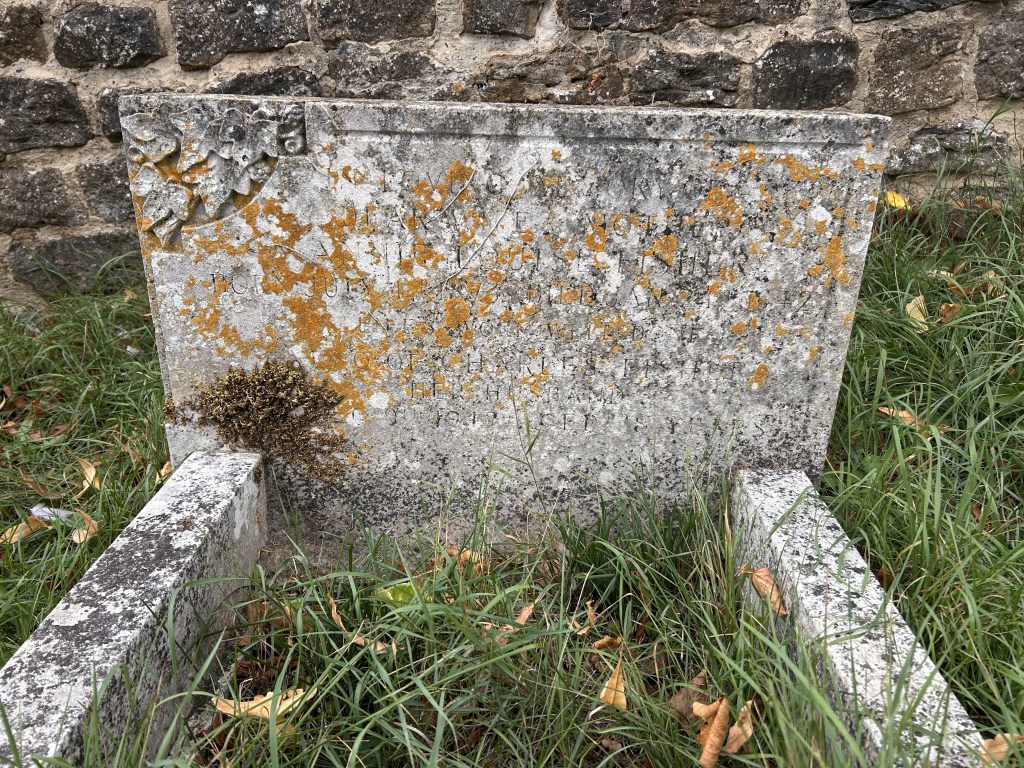
At the outbreak of WW2, Charles Fisher, almost 70 years old, was still a Master Blacksmith living at 12 Church Lane. By then, the smithy on this site was no longer in operation. Charles’s wife Annie died in 1942, and Charles died in 1949. They share a gravestone in Drayton Churchyard, close to their former home and to the Wesleyan Chapel (which is now a private residence).
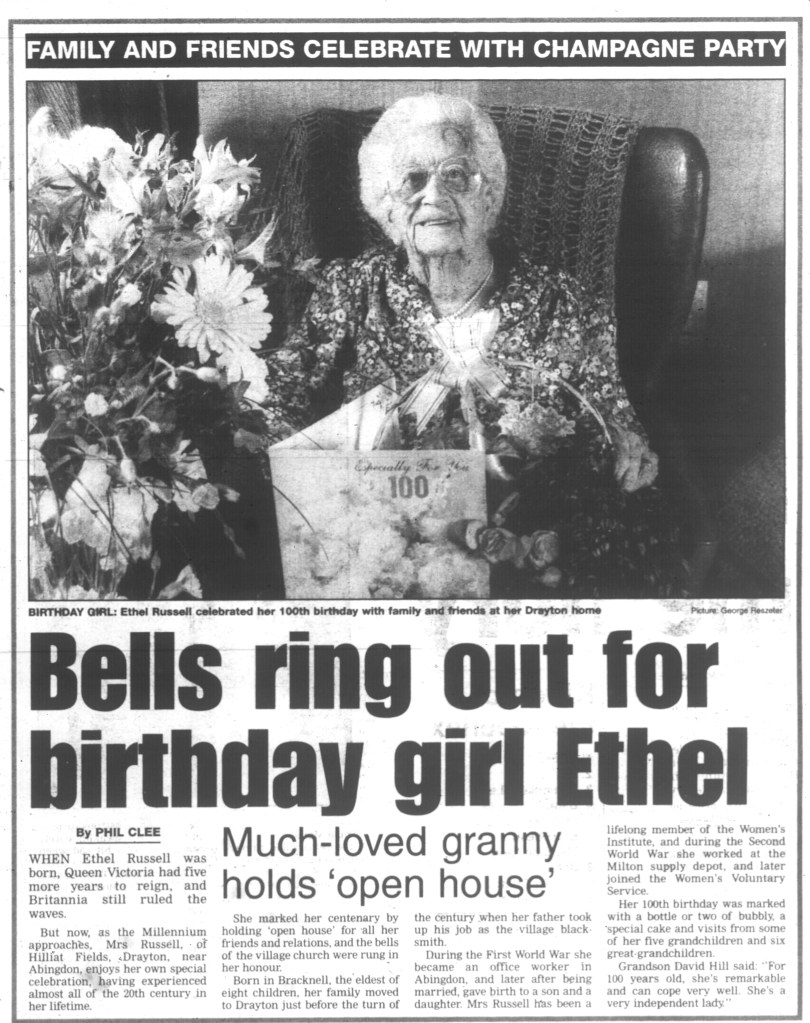
Mrs Ethel Russell lived to the age of 100; Drayton’s church bells were rung to celebrate her centenary on 17 May 1996. An article in the Oxford Mail reveals that she was an office worker during WW1 and in WW2 she worked at Milton Supply Depot and joined the Women’s Voluntary Service. Ethel died in 1997.
The Parkers (owners, 1879-1914; residents, c. 1900s-1914)
Frances Sarah Parker (née Gammon) became the owner of the cottage and shop on the death of her husband, Charles, in 1906. Although they were living in Lambeth in 1901, the probate index record for Charles (below) gives his address as High Street Drayton, suggesting that they moved into the cottage between 1901 and 1906.

Frances, known as ‘Fanny’, was originally from Frant in Sussex, and had worked as a domestic servant in Tunbridge Wells (for Horatio and Thirza Stephens, grocers) before marrying mason Charles Parker in 1866. They had three sons: Arthur, b. 1866, Charles, b. 1872 and Henry, b. 1875. However, Arthur died in 1907.
Frances died at The Smithy on 1 March 1914. In her will she appointed her son Charles, a civil servant living in Balham, Surrey, as her executor. Frances instructed that her ‘freehold property situate in High Street Drayton’ should be sold, and the proceeds divided equally between Charles and Henry Parker.
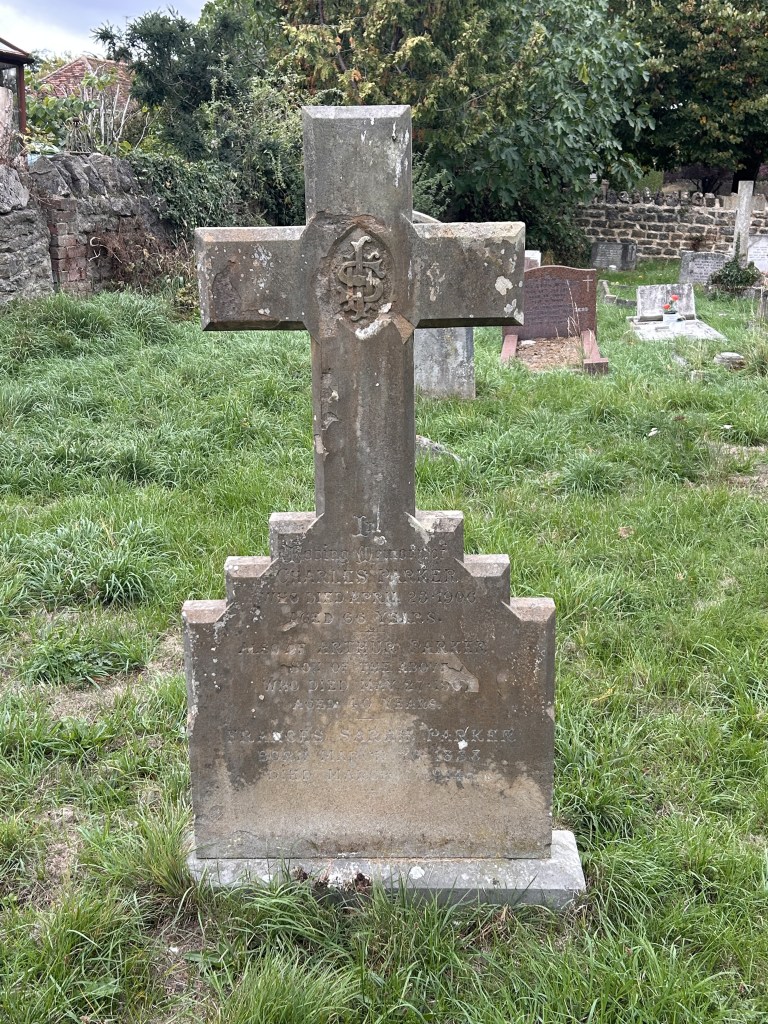
Charles and Frances Parker and their oldest son Arthur are buried in Drayton churchyard.
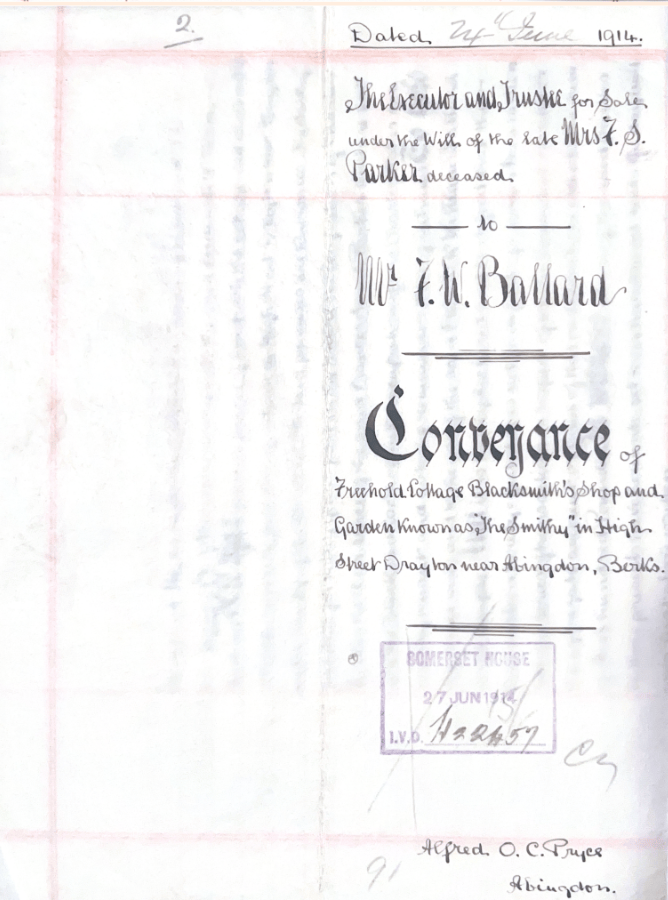
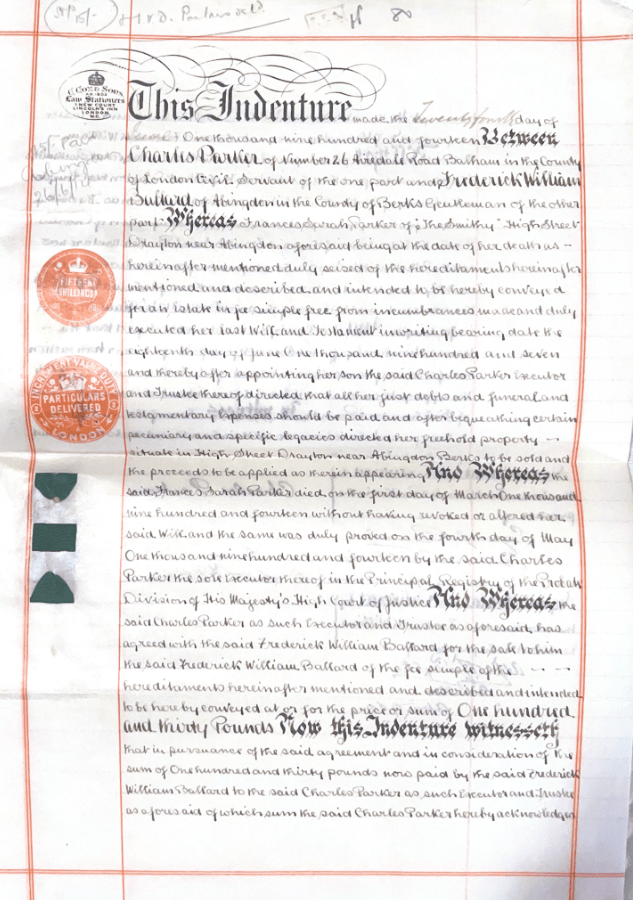
On the brink of WW1, Charles Parker, Jr. sold the ‘Freehold Cottage Blacksmith’s Shop and Garden known as ‘The Smithy’ to Frederick William Ballard, an ironfounder.
I’m fortunate to have the original conveyance deed for this purchase, so I know that the cost was just £130. In today’s money this is not much more than £13,000. At the time of the transaction, the blacksmith’s shop was in the occupation of Charles Fisher as a weekly tenant, at the rent of £7.11.8 per annum, and someone called Mrs Cooke was renting the adjoining cottage paying 6/3 per week. I assume that Mrs Cooke began renting the cottage following the death of Mrs Parker, but I haven’t been able to find any other records about her.
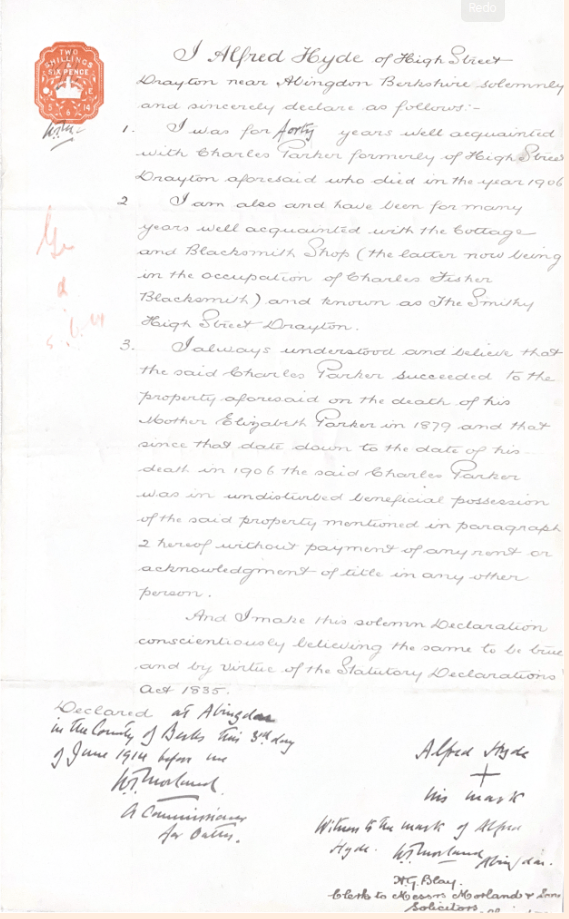
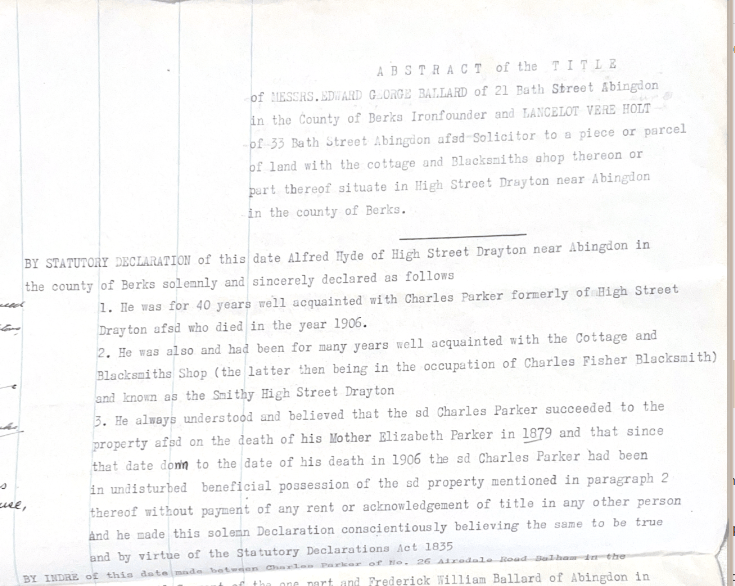
Accompanying the deed was another document, the ‘Declaration of Mr Alfred Hyde’. Neighbour Alfred Hyde, a brickmaker, testified that he had known Charles Parker (Sr), formerly of High St Drayton, for 40 years, and was well acquainted with ‘The Smithy’, which Charles had inherited when his mother died in 1879, and held until his death in 1906. Alfred, who signed the document with his mark, was in fact the son of Stephen Hyde, who had once worked at the smithy. Stephen was Charles Parker’s half brother.
The Hydes were deeply rooted in Drayton, but for the first time in Forge Cottage’s history, they were neither its owners nor its tenants.
The Wellses (tenants in 1921; start and end of tenancy unknown)
In the 1921 census, we find a new family living in ‘Forge House’: The head of the family was 22-year-old Charles Wells, an alum leather slaker employed by The Pavlova Leather Company in Abingdon. His wife, Alice, was not yet 20. Both were local, from neighbouring villages. Their son, Kenneth, was just five months old. Charles’s widowed mother, Mary Ann Wells, also lived them.
The Pavlova Leather Syndicate was founded in 1912, and after liquidation in 1918 it was rebranded as the Pavlova Leather Company. According to a BBC article, the business expanded dramatically in WW1, producing belts, straps and harnesses for horses pulling guns and coaches full of equipment, as well as leather boots and helmets for pilots. Most of the work during the war was carried out by women. After the war, production shrank, and some of the factory was taken over by William Morris’s car manufacturing, including his new luxury MG range.2
The relationships of the other family members — Florence Didcock, 37, Reginald Brewer, 15, Beatrice Didcock, 13 and Frederick Didcock, 4 — required some untangling.
Florence Ethel Didcock was the widow of Frederick J Didcock. Florence and Frederick had been married in 1906, and in 1911 they lived in Abingdon. Frederick was a career soldier from Drayton, who enlisted in the army in 1898. His surviving 22-page service record shows that he served in Egypt and in the Boer War; in the latter conflict he was slightly injured, and also court-martialled. Sergeant Frederick Didcock was killed in action in WW1 while serving with the Royal Berkshire Regiment 1/4th Battalion. He died on 23 July 1916, aged 37, and is commemorated in Thiepval, France.3 His name is included on the WW1 memorial tablet in St Peter’s church, which is located behind Forge Cottage.
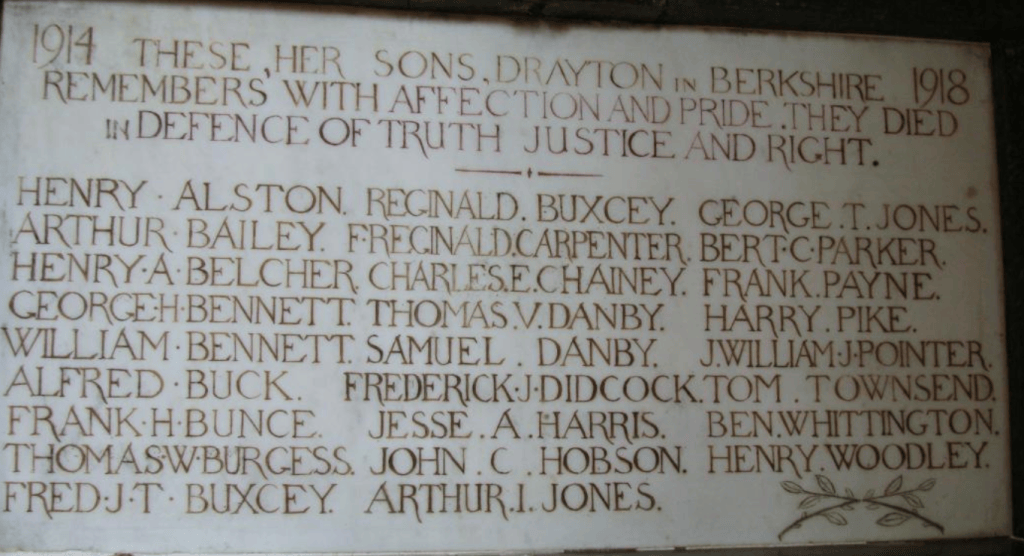
In the 1911 census, the family of Frederick and Florence Didcock included Reginald Brewer, Frederick’s ‘love child’. This quaint and rather touching terminology implies that he was the biological son of Frederick and Florence, but had been born before they were married, so used his mother’s maiden surname, Brewer. In 1921, Reginald was a white leather dyer, working at Pavlova alongside Charles. Beatrice and Frederick were legitimate children of Florence and Frederick. It’s poignant to see the note next to all three of Florence’s children: ‘Father dead’. Frederick’s age, four years and 11 months, means that he was born in about July 1916 — the same month in which his father had been killed. The photograph of Forge Cottage from about 1916-19 (above) includes Mrs Didcock and Mrs Wells on the left, suggesting that they were living there at that time.
The 1891 and 1901 censuses reveal that Charles Wells and Florence Didcock were half-siblings. Their mother, Mary Ann, had been married to George Brewer (father of Florence) and after George’s death she had married Charles Wells (father of Charles). Charles Wells Sr. had worked as a blacksmith in Drayton in 1901 and in nearby Marcham in 1911. He died in 1919, just two years before the Wells family was recorded in Forge Cottage, and it seems highly likely that he too lived or worked here.
The Wells/Didcock/Brewer family exemplifies the blended families that became more common after the tragic losses and financial strain of the First World War. Three years after the Armistice, the eight rooms of my house were home to seven extended family members AND a lodger, 73-year-old Robert Marshall (no occupation). But wait, there’s more! … Just three weeks after the 1921 census was taken, war widow Florence gave birth to another child; Leslie William Didcock was born at ‘The Forge’, Drayton, on 13 July 1921. The section for father’s name in Leslie’s birth certificate is blank, and his paternity is a mystery. Florence remarried in 1930.

Birth certificate of Leslie William Didcock (digital download from GRO).
The Ballards (owners, 1914-1938)
Abingdon ironfounder Frederick William Ballard, ‘Gentleman’, purchased Forge Cottage in 1914. However, he already had a connection to the property: In 1911, Ethel Fisher, teenage daughter of blacksmith Charles Fisher, was working for the Ballard family as a domestic servant at their home on Bath Street, Abingdon. Ironfounders would have had business connections with blacksmiths in the area, so perhaps Charles Fisher had sourced materials from the Ballards. The Ballards were well established ironfounders, and their trade name can still be seen in several iron items around the town.
Frederick Ballard died in September 1922 and was buried in Spring Road Cemetery, Abingdon. A short obituary tells us more about his reputation and personality. As a singer myself, I was delighted to read that he was a devoted choir member.
Early on Saturday Morning last, the death occurred at his residence in Bath Street of Mr Frederick William Ballard, head of the widely known firm of Ballard & Son, iron founders and agricultural implement agents. No townsman could be more highly respected, his gentle and unassuming manner bringing him many friends. He was forty -eight years a valued member of St Helen’s Choir.4
Forge Cottage passed to Frederick’s trustees: his wife Alice Louisa, son Edwin George, and a friend, George Staniland, a Solictor’s Clerk. There’s no evidence that members of the Ballard family ever lived in the house. Rather, they rented the cottage and blacksmith’s shop to tenants. After the death of Staniland in 1927 and Alice in 1938, Edwin George Ballard, an ironfounder like his father, sold the property to Mrs Noël Bolton for £350.
The Boltons (1938-1949)
The sale in 1938 marked the end of an era for Drayton’s smithy. The blacksmith’s shop, cottage and garden became a single, domestic property – ‘Forge Cottage’. From this time onwards, the owners also lived in the property.
Electoral records show that the Bolton family had lived at ‘Vine Cottage’, Abingdon from 1927-1937 and then ‘Chimneys’, Drayton Road, before moving into Forge Cottage. Clearly, they liked houses with quaint names!
Unusually, Forge Cottage was owned by a married woman, and not by her husband. Noël Bolton (née Cullen)’s parents had died in Abingdon in 1934 and 1937, leaving an estate in excess of £19k (more than £1m today). The 1939 Register, a civilian census taken at the outbreak of WW2, tells us more about the Bolton family shortly after they moved in. By that time, the house had been renumbered to 55 High Street, which is still the address today.
Francis George Bolton, b. 30 March 1890 (in Bangor), was a Motor Engineer, and his wife Noël, b. Christmas Day 1900, was occupied with ‘unpaid household duties’. Those duties included caring for their only child, Francis Bryan Noël Bolton, who was about 10 years old. (Francis Jr.’s entry is redacted in the register, even though he died almost 80 years ago). Francis and Noël had been married for more than a decade, but Francis seems to have been their only child.
A descendant of Noël’s brother Sydney kindly allowed me to share photographs of Noël and Francis Sr.
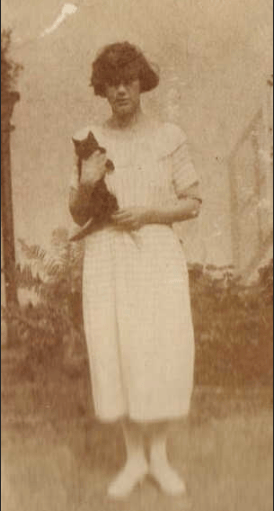
(photograph shared with permission of her relation Nancy Cullen)
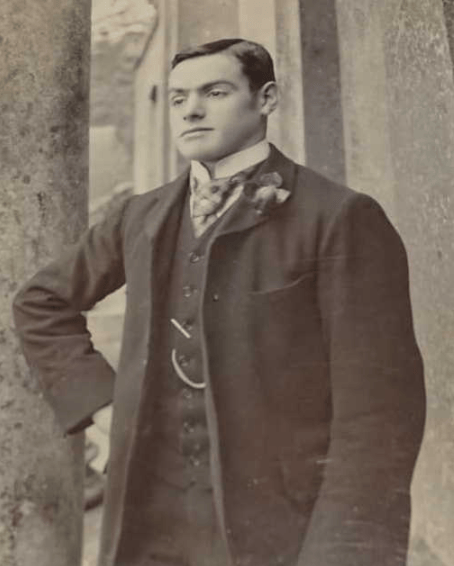
(photograph shared with permission of his relation Nancy Cullen)
Francis Bolton Jr. was too young to be conscripted in the war, but by 1947 he had joined the Merchant Navy and was serving on the F. J. Wolfe, a motor tanker owned by the Anglo-American Oil Company. During the war the ship had been purchased by Britain from Panama, damaged by German torpedoes, and endured a collision with a British steamship.5 In peace time, it was operating between Curacao and Liverpool, transporting oil (presumably) and passengers.
Tragically, Francis Bolton was killed on board in an accident on 2 May 1947.
The Register of Deceased Seamen reveals that Cadet Francis Bolton, 18, and Second Mate William John Kennedy, 26, died on the same day, and the cause of death for both was asphyxiation and concussion. The coordinates place their deaths in the middle of the Atlantic ocean, halfway between North Africa and the Southern United States.


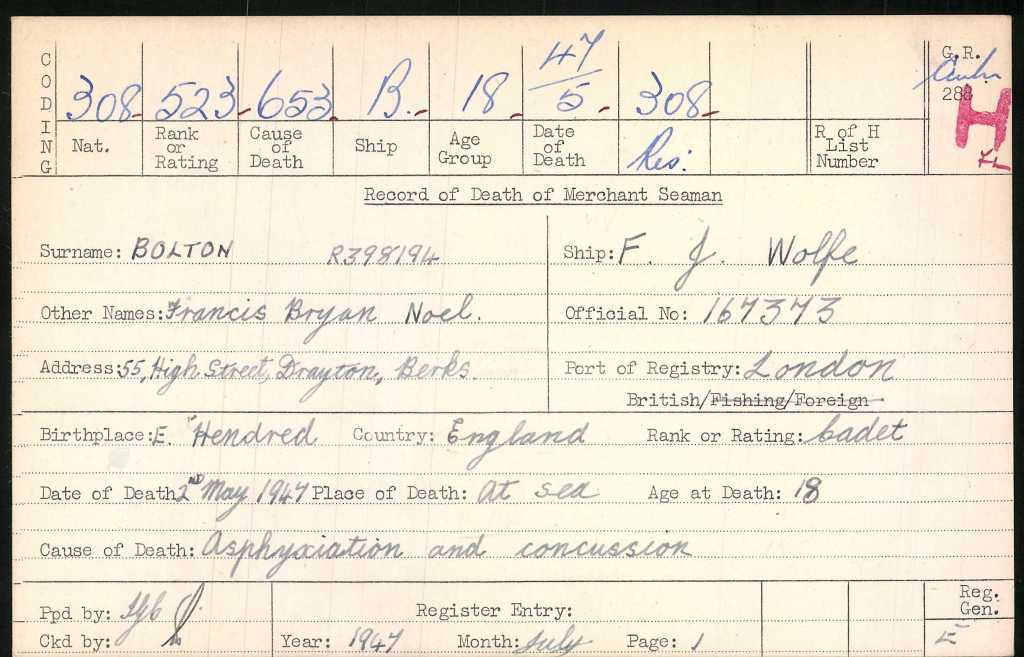
A memorial to Francis Bolton is displayed on the north wall of the nave of St Peter’s church.
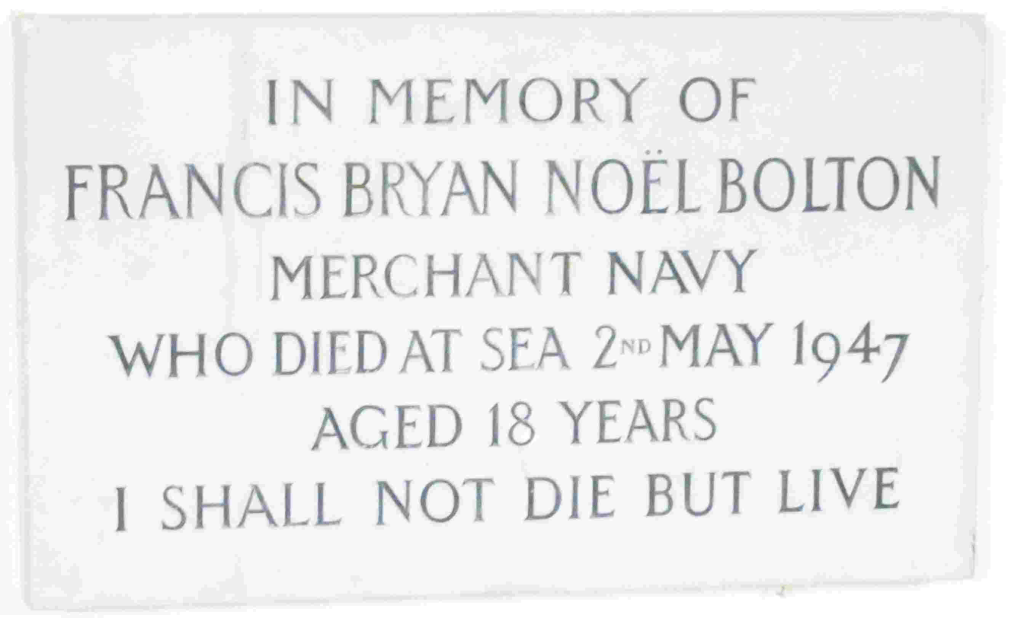
Mrs Noël Bolton had also lost her oldest brother, Percy, to pneumonia at 22, and her youngest brother, Gordon, had been killed in WW1 aged 20. Two years after the death of her only child, she sold Forge Cottage.
The Robbinses (1949)
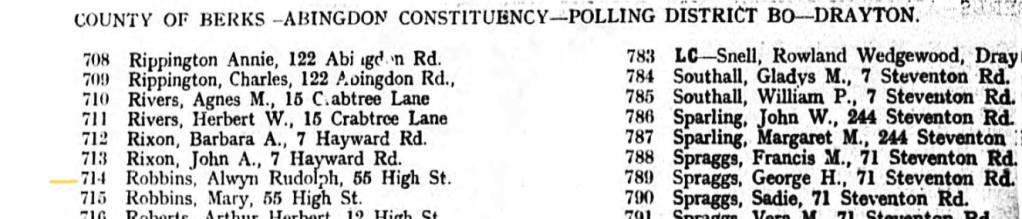
Dr. Alwyn Rudolph Robbins only owned Forge Cottage for six months, from February to July 1949. However, he is the only resident/owner of my house who has a Wikipedia page.
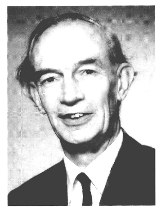
Robbins (1920-2002) was a British geodesist, a former chairman of the Royal Society subcommittee on geodesy, and held multiple positions within the International Association of Geodesy. Geodesy is the science of accurately measuring and understanding the Earth’s geometric shape, orientation in space, and gravity field.
Robbins’ research and work took him around the world; he was a surveyor in West Africa during WW2, taught in the United States, Ghana and New Zealand, and carried out work in Pakistan and Canada. In 1947 he was appointed to his first academic post as a Demonstrator in the Department of Surveying at Oxford. When he purchased Forge Cottage he was a University Lecturer.
In 1965 Dr Robbins became a founding fellow of St Cross College at the University of Oxford; he became a Reader Emeritis there on his retirement in 1980. By one of life’s many odd coincidences, my husband Peter studied for his PhD at St Cross College.
Robbins published on geodesy and photogrammetry, with additional contributions to geodetic astronomy and the development of clocks, including the chronochord (printing crystal clock). In 1949, he published ‘A method of finding gradients from air photographs with no control’ in Photogrammetric Engineering.
Obituaries in Survey Review, Geomatica and the St Cross Record (link via Wayback Machine) detail his impressive resume and outstanding contributions to scientific knowledge, but also add provide a window into his personal life.
Alwyn will be remembered by his many friends, colleagues and students not only as an outstanding geodesist and an excellent teacher and advisor, but also as a kind, warm hearted and cheerful person, with a sense of humility and fairness in the best British tradition. He will be greatly missed by his wife Mary, his children Rowena and Mike, and his two grandchildren.6
Alwyn Robbins had married Mary Seale at Exeter three years before purchasing Forge Cottage, and they lived here together. Their children were born later, in 1952 and 1957.
The Robbins family possibly left Drayton when Alwyn was offered a post as a Visiting Professor of Geodesy at Ohio State University.
The Hansons (1949-1955) and The Griersons (1955-1966)
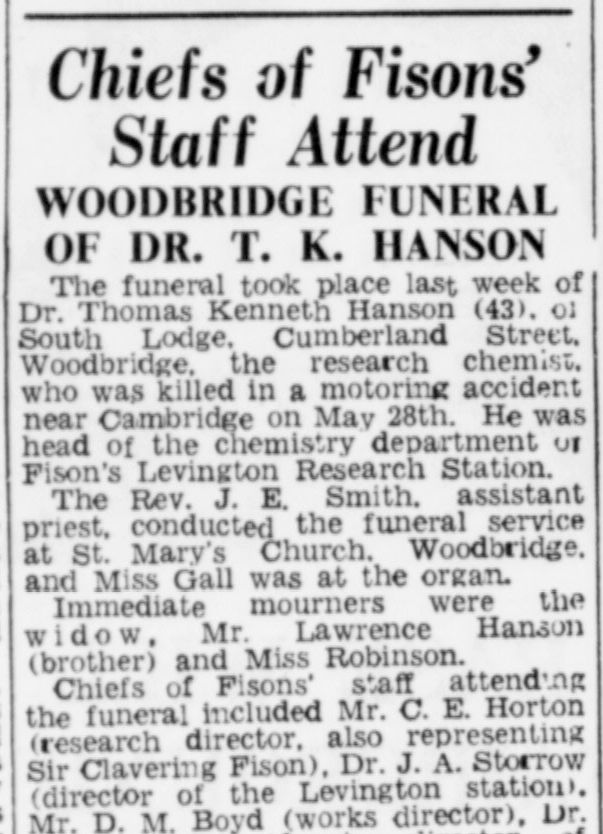
Robbins was followed by another scientist — this time a Research Chemist. Dr Thomas Kenneth Hanson (b. 1913, Halifax, Yorkshire) and his wife Margaret Joceyln (née Wigg) moved into Forge Cottage in 1949 with their young daughters, Jocelyn S. Hanson, b. 1941 and Gillian M. Hanson, b. 1942. At the time of his marriage in 1939, Thomas was an ‘Oil Technologist’. A passenger list of that year (from New York) reveals that he stood 6’3.5″ tall.
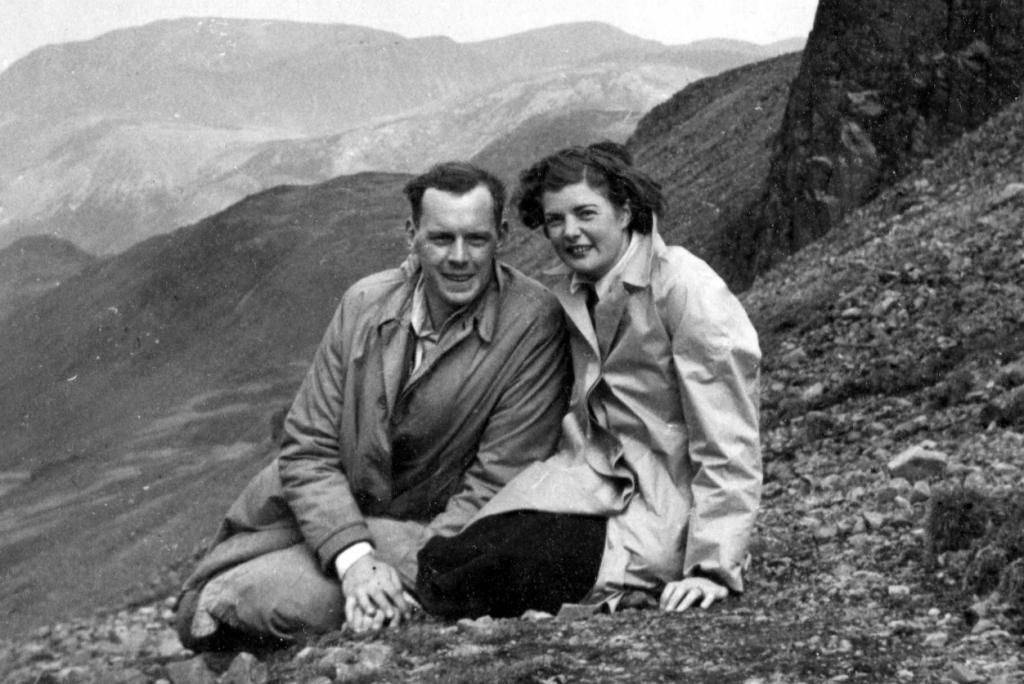
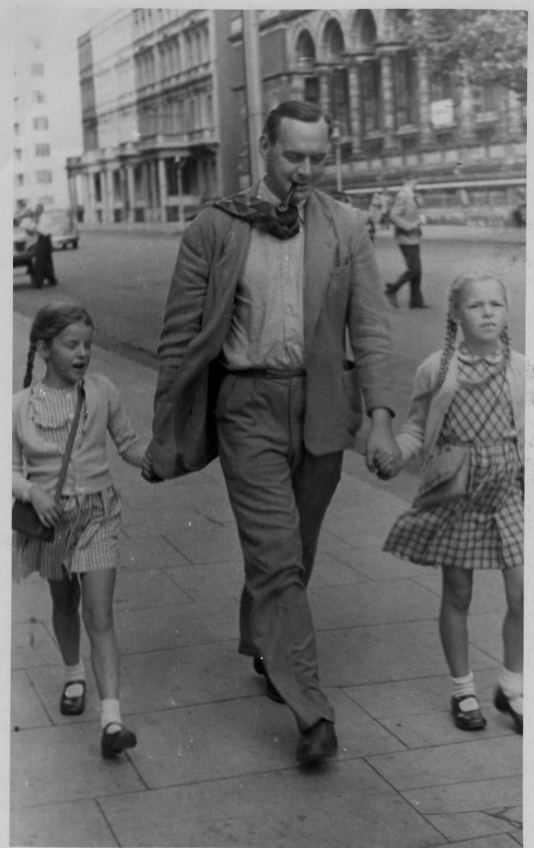
The end to their time at Forge Cottage in 1955 coincided with divorce. Thomas remarried in December 1955, but just 18 months later, in summer 1957, he was tragically killed in a car accident near Cambridge.
Via Findmypast. Successor rightsholder unknown.
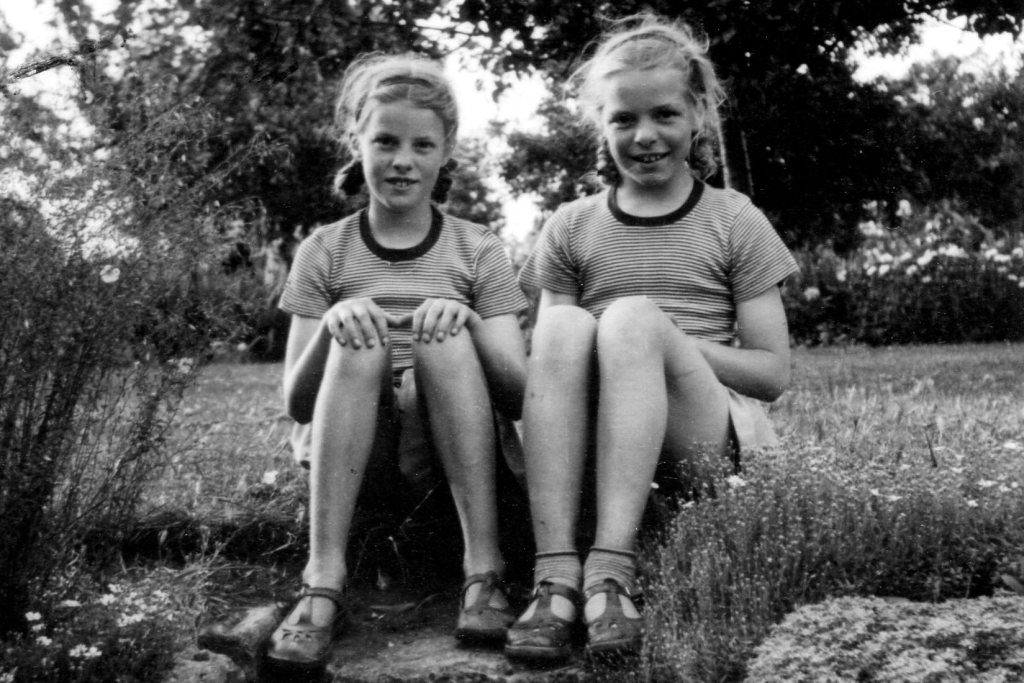
Thomas and Margaret’s grandson Marcus posted photographs of the Hansons in Ancestry. Through him I was absolutely thrilled to connect with his mother Jocelyn, who now lives near Ottowa. Chatting with Jocelyn over Zoom, I learned that after she and Gillian attended boarding school in Berkshire, Jocelyn lived in France, London, Nigeria and Kenya before settling in Canada. Her sister emigrated to Australia, and is a best-selling author (Gillian Rubinstein).
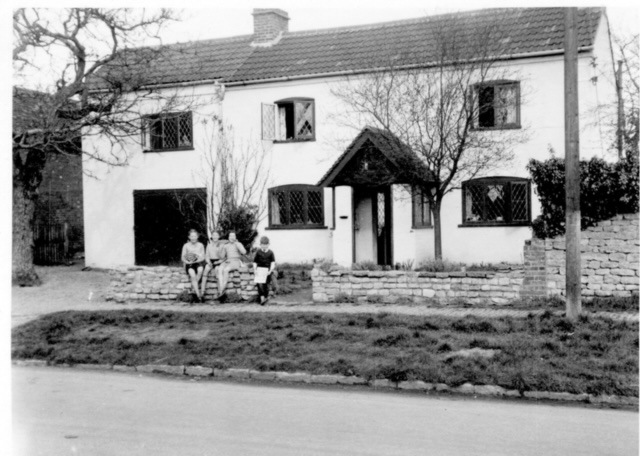
Jocelyn, now 85, described their childhood at Forge Cottage more than 70 years ago, where they had the freedom to climb trees, cycle around the local villages, swim in the river, and play with good friends in neighbouring streets. They were fond of their babysitter Mrs Faulkner, “Faulky”, who lived in an almshouse next door. Jocelyn was kind enough to share several photographs with me of her family (and even her dogs, Sparky and Remus) in Forge Cottage and its garden in the early ’50s. I was amazed at how little the house has changed from the front; Jocelyn explained that the old forge had only recently been converted to a garage when they moved in, and that the Hansons built a bedroom above it. In front of that bedroom window you can see the branches of the old walnut tree which had once been used to tether horses.
The Hansons were followed by another young family, also with connections to oil: the Griersons.
John William Grierson was a Petroleum Sales Instructor. He and his wife Doreen (née Williams) were newly-weds, having married in Dorset in 1954. They soon had two children: Michael J. Grierson was born in 1955 and Joanna L. Grierson in 1957. Hopefully this was a very happy time for the growing family.
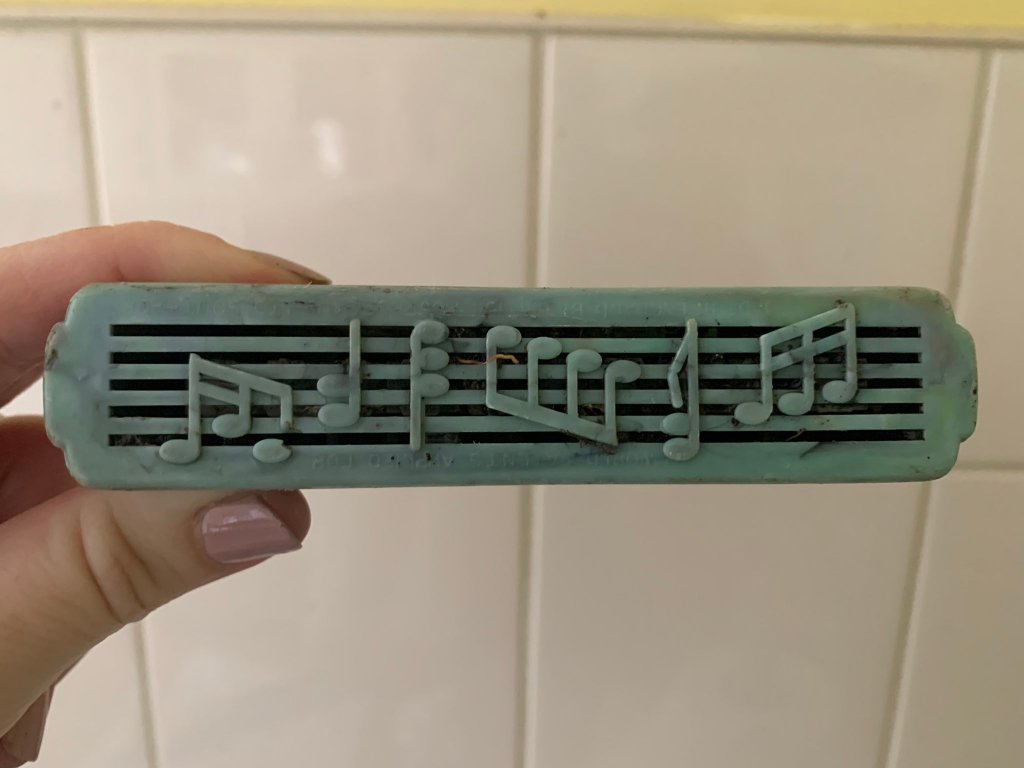
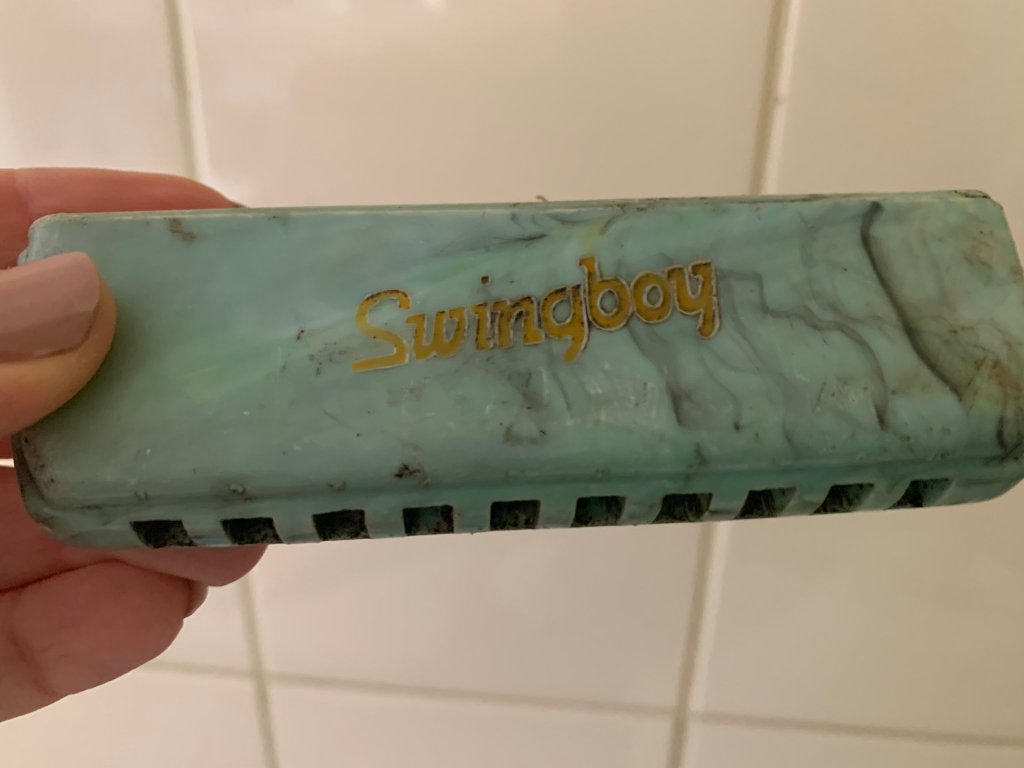
A few years ago I dug up a bakelite (?) harmonica in the back garden which was made by British Mouth Organs Ltd., Southport in about 1956. It could have belonged to the Grierson children. The family lived at Forge Cottage until 1966.
The Davieses (1966-1990)
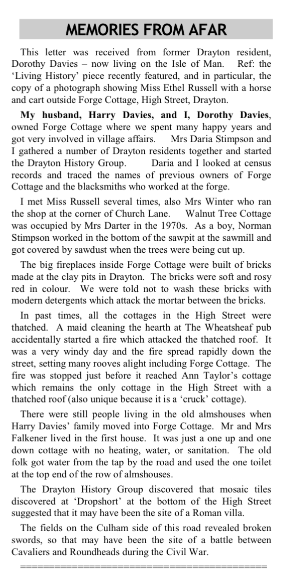
Dorothea Mary Seppings Davies (known as Dorothy) was a founding member of Drayton History Group in the 1980s. She and her husband Harold ‘Harry’ Davies lived at Forge Cottage for nearly a quarter of a century, from 1966-1990. During her time here, Dorothy and a few fellow village history buffs researched the previous occupants of Forge Cottage, but unlike me, Dorothy didn’t have the Internet to help her!
In 2007, Dorothy wrote to the Drayton Chronicle from her new home in the Isle of Man in response to a recent piece in the magazine about Forge Cottage. Some of her letter, as published, is included below:
During their time at Forge Cottage, the Davieses carried out significant changes, including extensions which received planning permission in 1979 and 1985.
Dorothy passed away the year that I moved into Forge Cottage. She was clearly a kindred spirit, and I wish I could have met her and exchanged stories about our shared home. I hope that I have been able to add even more colour to what she found out before me.
1990 to today
The final two families to live at Forge Cottage before us were Geoff and Judy Bott (1990-2014), who built a red brick shed behind the house; and the Bruce-Reid family (2015-2018), who added a hefty tree trunk mantel above the inglenook fireplace.
We have been lucky to call Forge Cottage our home since 2018. I can’t help but wonder who will follow in our footsteps here in the future.
Select References
- Reading Mercury, 31 October 1896. via FindMyPast [accessed 8 Sep 2026].
- ‘World War One at Home: Abingdon, Oxfordshire: Pavlova Leather Factory’. https://www.bbc.co.uk/programmes/p02b3490 BBC [accessed 8 Sep 2026].
- Entry for Frederick Didcock. CWGC. https://www.cwgc.org/find-records/find-war-dead/casualty-details/756977/frederick-didcock/ [accessed 8 Sep 2026]. Note: This says his parents were William and Florence Ethel but in fact his parents were William and Sarah, and his wife was Florence Ethel.
- ‘Abingdon 100 years ago – September 1922’. Abingdon Blog. https://abingdonblog.co.uk/?p=29679 [accessed 10 Sep 2026].
- ‘F. J. Wolfe’. uboat.net. https://uboat.net/allies/merchants/ship/2140.html
- Geomatica, Volume 56, Issue 1 (January 2002), pp. 81-83.
Forge Cottage in Censuses (1901-1939):
1901: Household of Charles Fisher (digitised image of census). ‘1901 England Census’. Ancestry [accessed 1 Oct 2026]. Original record: The National Archives (UK), Reference: RG 13/1134, Folio 24, Page 5.
1911: Household of Frances Sarah Parker (digitised image of census). ‘1911 England Census’. Ancestry [accessed 1 Oct 2026]. Original record: The National Archives (UK), Reference: RG 14/6472, Sch 98.
1921: Household of Charles Wells (digitised image of census). ‘1921 England Census’. Ancestry [accessed 1 Oct 2026]. Original record: The National Archives (UK), Reference: RG 15/5912, ED 4, Sch 10
1939 Register: Household of Francis George Bolton (digitised image of register). ‘1939 England and Wales Register’. Ancestry [accessed 1 Oct 2026]. Original record: The National Archives (UK), Reference: RG 101/2063B, Sch 157.
Updated 9 October 2026 with information and photographs from Jocelyn Rait and 21 October 2026 with more details on the subjects of the photograph of the Fisher family.


As we celebrate Canadian Thanksgiving, I am extremely grateful to Clare Kirk for having connected with my family through her extensive and meticulous research.
LikeLike