A blacksmithing dynasty
In 2018 I moved into my new house. Or rather, my old house. After years living in the San Francisco Bay Area, where my oldest home dated from the 1920s, I was delighted to be the owner of ‘Forge Cottage’, especially as the keys to the house came with an envelope of historic property deeds, the personal memoir of a former occupant, and even an old photograph of the house in the downstairs loo! As the house’s name implies, it was once the village blacksmith’s — the village being Drayton near the ancient market town of Abingdon on Thames in the Vale of White Horse (historically in Berkshire but part of Oxfordshire since 1974).
In tracing my house history, I’ve discovered the identities of the people who gardened, lived and worked here from the Georgian era up to my arrival. In this blog I’ll be sharing the story of the extended family of blacksmiths who built the house and lived and worked here for most of the 19th century. And in part 2 I’ll write about the eclectic families that followed them in the 20th century.
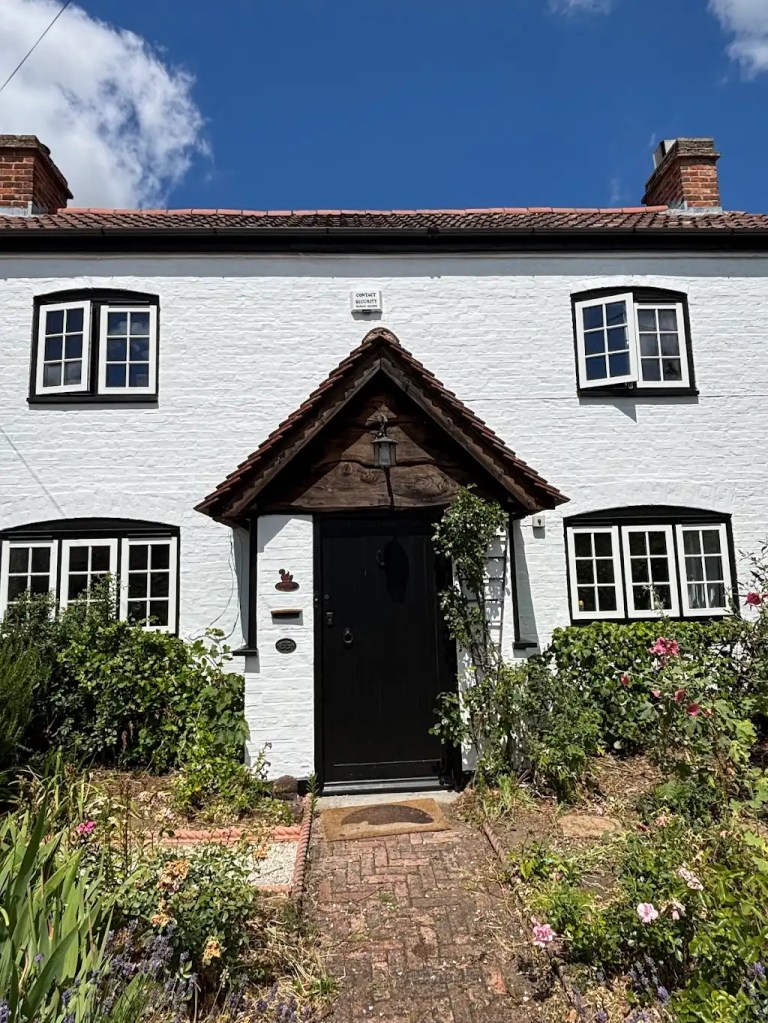
Lord Stafford’s Land
My research into Forge Cottage goes back to the late 18th century. Three maps of Drayton made within 26 years reveal a significant change in ownership and land usage. The earliest, produced in 1789, shows that the land where my house now sits, which had no description, was the property of Sir William Jerningham. Sir William, de jure 7th Baron Stafford, was Lord of the Manor of Drayton from 1758 until his death in 1809. Technically, the Manor of Drayton was the east manor; Drayton was divided into two manors — east and west — before the Norman Conquest. The Jerningham family seat was Costessey Hall in Norfolk, but the family also held estates in Staffordshire, as well as the [east] manor and rectory in Drayton. My house is actually situated very close to the Tudor manor house of the west manor, which was historically held by New College, Oxford. However, the Jerninghams owned a significant amount of land all over Drayton.
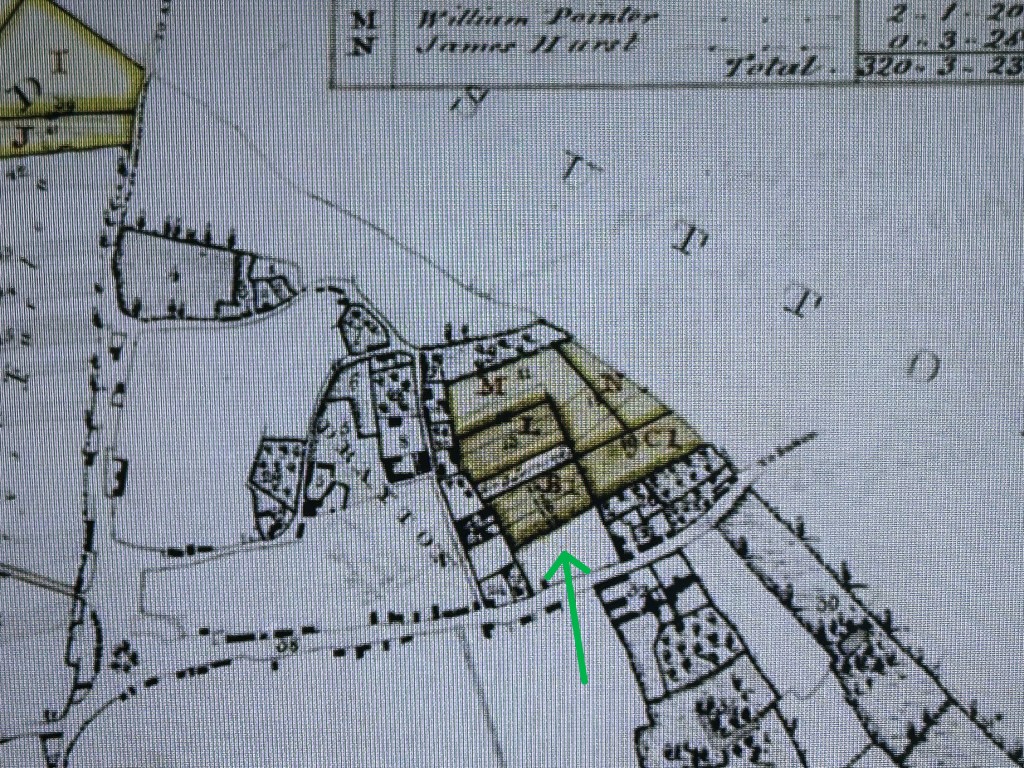
Photo of digitised map, viewed at Oxford History Centre (POX0082749)
By the first decade of the 19th century, an area of land that included our plot was labelled as ‘Houses & Gardens’. Then in 1815, the land in Drayton was enclosed, and a map of the ‘Parish of Drayton … as divided allotted and enclosed’ recorded the ‘old inclosures’ (indicating land that had already been enclosed prior to parliamentary acts)1. A list of enclosed parcels of land beneath the map shows that my plot of land (no. 79) was a garden, one rood (1/4 acre) in size, held by John Hyde. John also had a cottage a short distance away (50a). Both were ‘lifeholds under Sir G. [George] Jerningham’. Sir George was William’s son and heir, who inherited his father’s land in Drayton in 1809, and officially became 8th Baron Stafford in 1824.
TIP: Berkshire enclosure maps and awards can be viewed online at a high resolution for free at berkshireenclosure.org.uk.
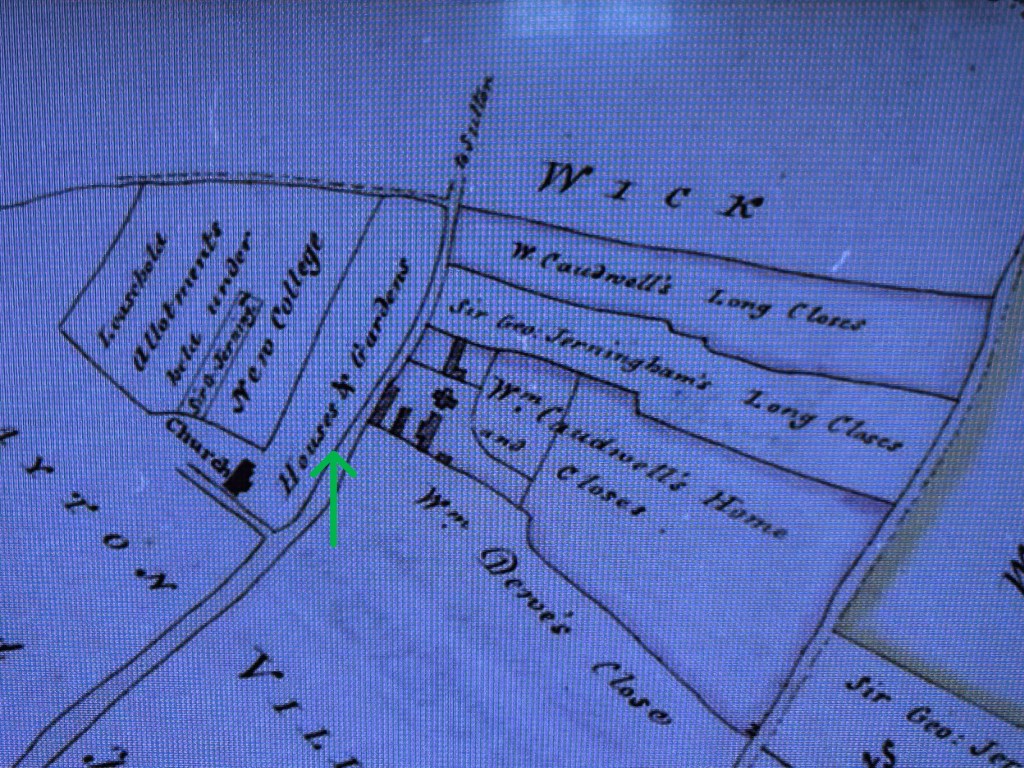
Digitised map viewed at Oxford History Centre (POX0082718).
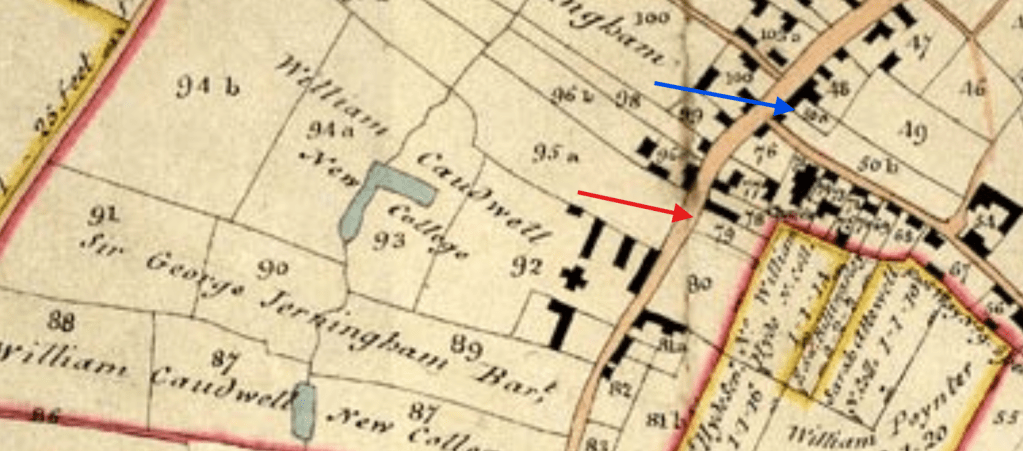
An original copy is held by the Oxfordshire History Centre (PC335/1/H1/1). Berkshire enclosure maps can also be searched and viewed online for free at https://www.berkshireenclosure.org.uk/find_via_map.asp, courtesy of the Royal Berkshire Archives.
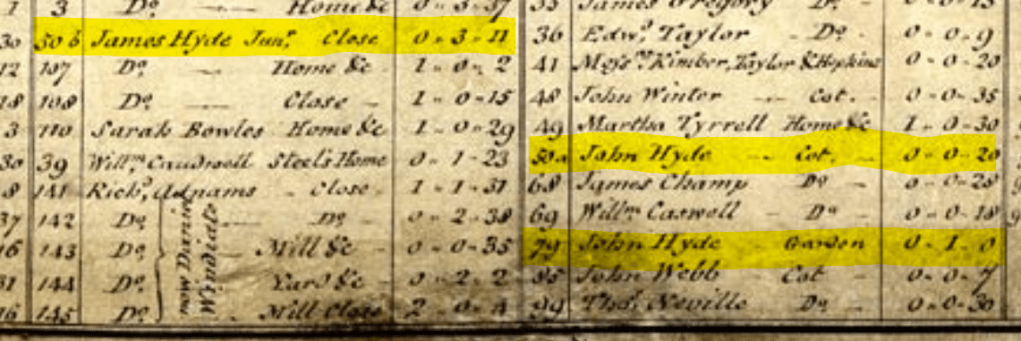
The listing includes John Hyde’s garden (79) and his cottage (50a) within James Hyde’s close (50b) – highlighted
From John Hyde’s Will of 1829 (proved 1834) I know that this piece of land was a ‘freehold piece of garden ground’ that he had ‘lately purchased of Lord Stafford’. So, between 1815 and 1829, John had purchased the land that he’d previously rented. By the time John wrote his Will, Sir George had sold the manor; from 1826 the owner of the east and west manors was Lewis Loyd, a Nonconformist-minister-turned-London-banker. It seems likely that Sir George sold this parcel of land to John at the same time. Unfortunately, I was unable to find any details of the sale among Jerningham family papers in the Royal Berkshire Archives, and manorial records— which are held at the Staffordshire Record Office — only go up to 1793.
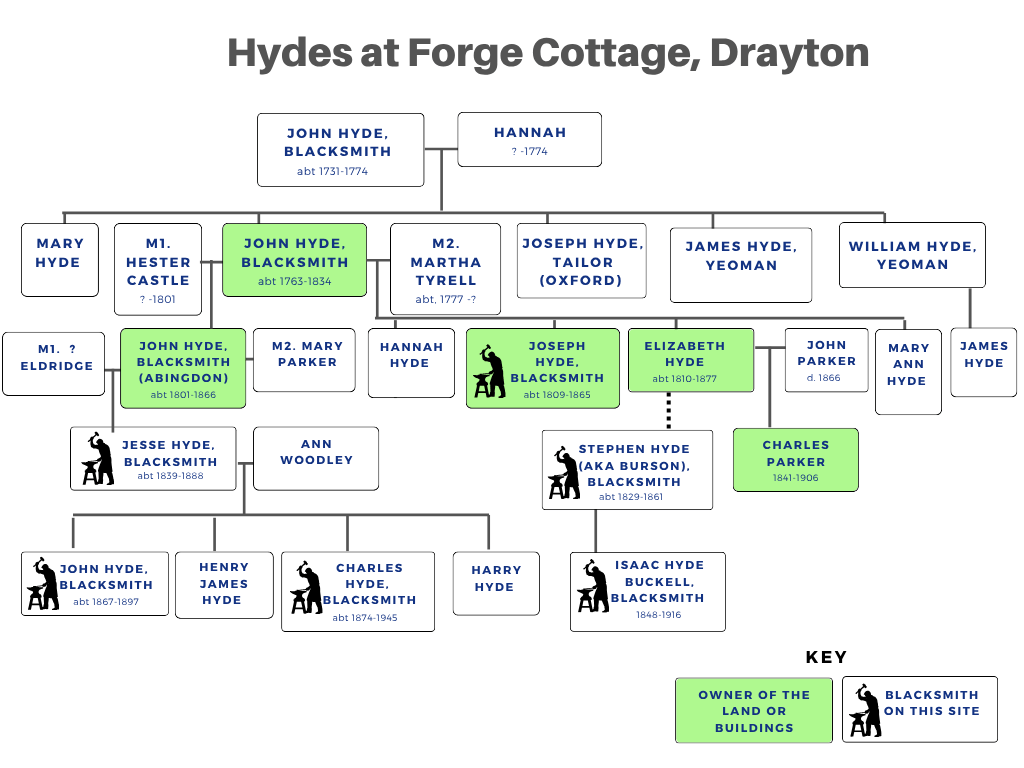
When John Hyde purchased the garden plot in about 1826, he began 100 years of ownership by the Hyde family, including many of the blacksmiths who plied their trade here. There are lots of names, so to help readers make sense of this Drayton dynasty, you can find a family tree towards the end of this blog. You’ll also find a list of resources there for learning more about 19th-century blacksmiths.
John Hyde, Blacksmith (c1763-1834)
John Hyde was baptised in Drayton in 1763, and was the eldest son of John Hyde (b. c1731, Drayton), and Hannah (née Cheer). I believe John Sr. was the first of the Hydes in Drayton to become a blacksmith, as he was apprenticed to Joseph Hunt, blackmith of Drayton, in 1748.

Board of Stamps: Apprenticeship Books: Series IR 1; ancestry.co.uk. Original record: The National Archives (UK); 1R 1/18.
Tragically, John and Hannah died within a few weeks of each other in 1774 — their gravestone can still be seen in the churchyard behind our house. They left five orphans (a girl and four boys) under 13 years of age. The two eldest sons, John and Joseph, soon learned trades: John followed his father into blacksmithing, and I believe that he learned the trade from a woman blacksmith! An entry in the Register of Duties paid for Apprentices’ Indentures shows that a John Hyde was apprenticed to Martha Hanns, a blacksmith of East Hendred, in 1776. East Hendred is just four miles from Drayton. As a female ‘master’ of a male apprentice, Martha must have been the widow of a blacksmith. She may well be the same Martha Anns [sic] who died in 1802 in East Hendred at the age of 100!2 In 1777, Joseph (b. c1766), was apprenticed to an Oxford tailor called William Davenport (coincidentally, the previous year, Davenport had been elected to Oxford’s City Council along with one other man, who was also a tailor; his name was Thomas Benwell and he was my husband’s 6x great grandfather!).

Board of Stamps: Apprenticeship Books: Series IR 1; ancestry.co.uk. Original record: The National Archives (UK); 1R 1/28.
In 1780, Drayton was ‘nearly exterminated by a terrible fire’2. The ‘Great Fire of Drayton’ detroyed more than 30 homes in the village within half an hour, as flames swept down the High Street from one thatched roof to the next. Among the afflicted residents was John Hyde, whose damages were valued at £109 10s 4d (about £17k today) — possibly John’s grandfather. The home of Rev. Wright also burned down, along with all of Drayton’s parish registers.
In 1796, blacksmith John was living in St Thomas’s, Oxford, when he married Esther (or Hester) Castle in that parish. Sadly, Esther died in Drayton in 1801, when their son John was just one month old. In 1804 John married again, to Martha Tyrrell. With Martha, he had four children in Drayton, including a son, Joseph, born in about 1809, and three daughters: Hannah, Elizabeth and Mary Ann.
As John’s family grew, it makes sense that he leased a garden plot where he and Martha could cultivate fruits and vegetables and perhaps keep some livestock, and as the enclosure map shows, this was not far from his cottage. In his Will, John also mentions his shop (i.e. workshop) in Drayton; there are no clues to its location in the Will or enclosure map, but in 1838, his son’s smithy shop and cottage were both in plot 50a – where John’s cottage had been located in 1815.
John’s property was close to land and buildings in the heart of the village that were owned by three other Hydes. The land behind the garden was rented by William Hyde, John’s younger brother, who lived in allotment 77. John’s cottage was within a close held by his nephew James Hyde Jnr, son of William, whose home was at 82. Both William and James farmed large areas of land throughout Drayton (most of it owned by New College). James Hyde Snr, another of John’s younger brothers, had allotments 81a and 81b and also a modest area of farmland.
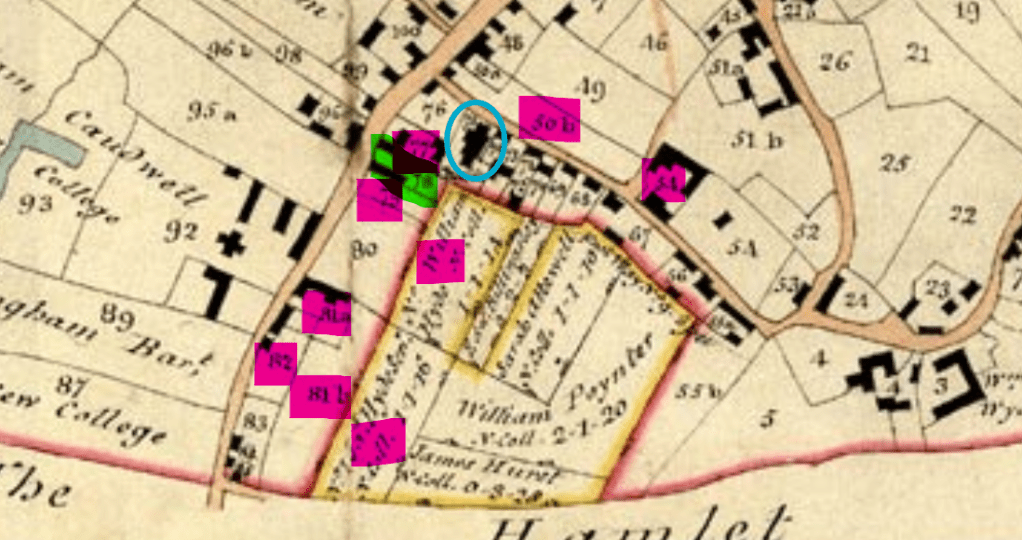
The green highlight shows the village’s almshouses and the blue circle shows the location of Drayton’s medieval church and churchyard.
For a long while, I couldn’t connect the Hydes of Forge Cottage to these other, wealthier Drayton Hydes. But a few years ago I had an amazing stroke of luck: At a small antiques fair in our village hall I met a stall owner who traded in old documents. He had made the trip from Dorset to Drayton because he had a large stash of 19th-century documents from one family: the Hydes of Drayton! Thanks to this collection, which included manorial records of property transfer, and legacy receipts, I was able to connect the Hyde families in Drayton. But a significant mystery remains: Given that John and his brother Joseph were apprenticed into trades, how did their two younger brothers James and William became prosperous yeoman farmers whose sons were listed as Gentry in local directories? I can only theorise that they were taken in as young children by well-to-do relations, possibly grandparents. Another researcher into the Hyde family has found that an earlier generation included several wealthy tradespeople and farmers, and indeed John’s oldest sibling, Mary, benefited from being the sole legatee of a grocer uncle (and later married a grocer as well). Joseph also did very well for himself, progressing from the trade of tailor to being an Oxford innkeeper and ‘Gentleman’. Of the five Hydes who were orphaned in 1774, John the blacksmith, though able to afford my parcel of land, seems to have been the least prosperous.
When John died in 1834 aged 69, he divided his money equally between his three surviving children, John, Joseph and Elizabeth (two had died in childhood). His household goods were divided between Joseph and Elizabeth. Joseph also received the garden ‘with the appurtenances thereto’ and ‘all the smithing tools stock of iron and everything else belonging to my business in and about the shop where I carry on the said business’. Surprisingly, his wife Martha wasn’t mentioned at all, but she lived comfortably with her niece and nephew (farmers, and children of her brother-in-law William Hyde) until her death in 1844.
John Sr. also added a codicil just before his death. To his son John, he left his ‘wearer parroles’ (clothing). John Jr. was also a blacksmith, whose smithy was in Abingdon. Presumably he already had the tools of the trade so had no need for his father’s equipment. John Sr. also added a bequest of £20 to Elizabeth’s illegitimate son, Stephen Hyde, to ‘prentis him if his ankel Darkel thenk wel to larn him his on tread this my own hand riten’. (apprentice him if his Uncle [?Darkwell] think[s] well to learn him his own trade this [in] my own hand written’). William Caudwell and James Hyde, yeomen, vouched for the codicil being in John’s own handwriting, as they had ‘frequently seen him write’. John had clearly received some elementary education, but he used mostly phonetic spellings. In contrast, his brother James, who hadn’t been apprenticed in his youth, was more literate. This is a registered copy of John’s Will and it would be lovely to see his handwriting in the original.
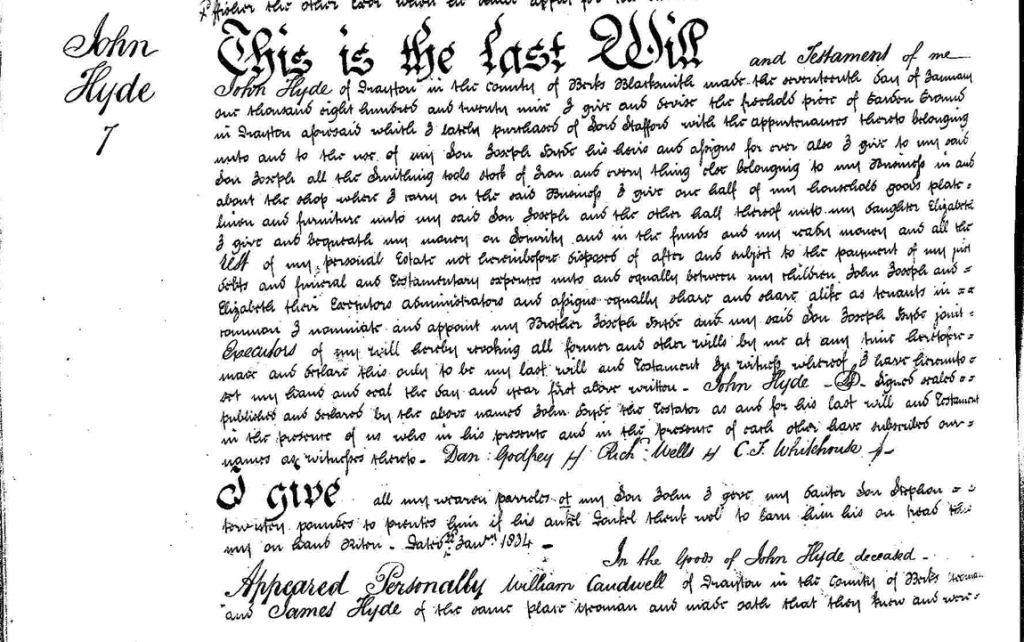
(registered copy Will from the Prerogative Court of Canterbury (PCC); The National Archives (UK); PROB 11 Piece: 1840 )
Joseph Hyde, Blacksmith and Constable (c1809-1865)
Joseph was about 25 years old when he inherited the garden land along with his father’s tools. Although I have no records of exactly when our house was constructed, I believe that Joseph had it built, and perhaps even built it himself.
In 1838, poor rates for Drayton recorded the property and land held by Joseph Hyde. Very conveniently, they used the same numbering system as the enclosure map, so I know that Joseph had three holdings: a) the garden of one rood (allotment 79) with no mention of buildings, b) land in Culham Close, measuring 3 roods and 11 perches, and c) a house, shop (workshop), offices and another garden at 50a, in 20 perches of land (only 1/10 of an acre). The garden had a gross estimated rental of £2 7s 6d and ratable value £1 10s.
Given that the parcel of land with the cottage, workshop and offices was very small, I believe that Joseph chose to move his home and workshop to the larger garden plot, probably in the 1840s. Unfortunately, I’ve not been able to pin down an exact year. Two potential sources of information from the 1840s are tithe maps and the 1841 census, but frustratingly, there is no tithe map for Drayton (as tithes there were extinguished by enclosure), and the 1841 census for Drayton is vague on household locations.
In 1841, Joseph was a blacksmith in Drayton, living with his 11-year-old nephew Stephen Hyde, and a domestic servant, Martha Howse. Stephen’s baptism record named his father as Josiah Burson (there are several candidates for his father in the local area). His mother Elizabeth had married a stone mason called John Parker when Stephen was little, and moved to the nearby village of Marcham. (John Parker was the brother of Elizabeth’s sister-in-law, Mary Parker — the wife of Abingdon blacksmith John Hyde. The Parker family will be important later in this story.)
Although Joseph’s father John had left money for Stephen to be apprenticed to an ‘Uncle ?Darkwell’, he seems to have learned the blacksmith trade from his uncle Joseph. My collection of Hyde papers reveals that Stephen was also set to inherit a lifehold in Drayton from father and son John and Joseph Hyde — wealthy drapers in Abingdon (John’s son John, also a draper, became Mayor of Abingdon). John was probably a first cousin of John, the father of blacksmith Joseph — another example of more affluent Hydes helping their poorer cousins. On draper Joseph’s death Stephen would acquire ‘One Messuage or tenement and seven acres more or less of arable land and one butt and one parcel of Meadow called an Hock or Ham lying in Littlemoor and Common of Pasture for one Cow with the appurtenances lying within this Manor’ (except for two cottages).
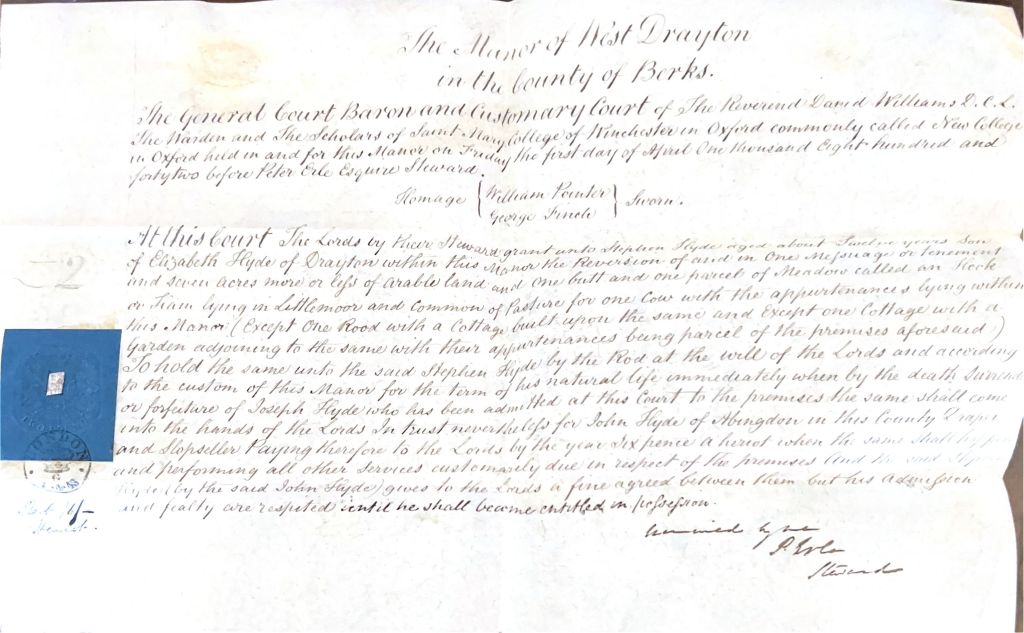
(my own document)
In Kelly’s Berkshire Directory, 1848, Joseph was the only blacksmith listed in Drayton, but there was another blacksmith in the village in the 1840s. William Hopkins, alias William Lambourn, was mentioned in a newspaper in 1840 (when a fatal accident befell a pear picker in his garden) and in 1850 (by which time he had died). He also appeared in the 1841 census.
The 1851 census shows that Stephen had left Joseph’s home to start his own family, leaving Joseph alone with his servant Martha (by then 70 years old). The Post Office Directory of Berks …, 1854 shows that both Joseph and Stephen were blacksmiths in Drayton, possibly working independently — though typically, a small village like Drayton could only sustain one smithy.
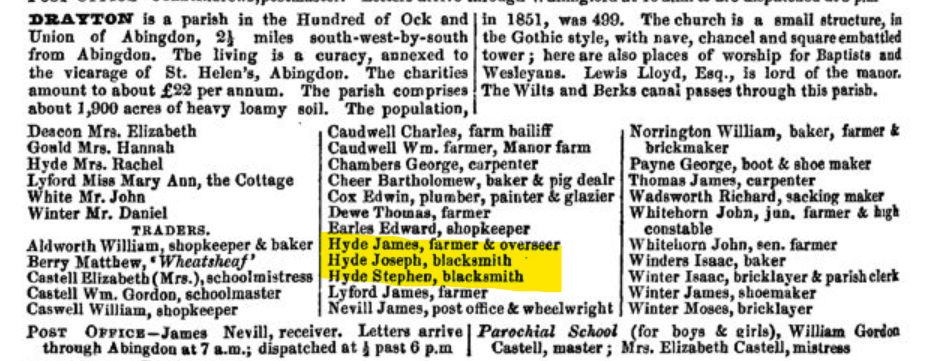
via University of Leicester Special Collections Online
Joseph’s elderly servant Martha died in 1854 and by 1860 Joseph had a new servant called Thirza Giles. Unfortunately, the only reason I know about Thirza is that she stole half an ounce of tea and six ounces of sugar from her master and was sentenced to two months’ imprisonment. Thirza was only about 16 when she lived in my house. I was delighted to find a photograph of an older Thirza in an Ancestry family tree. According to that tree, she married Levi Smith in 1866 and they had 12 children.
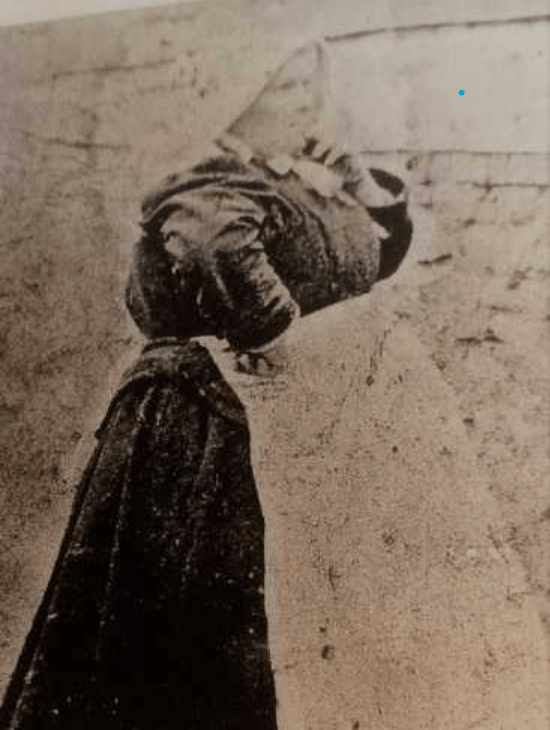
(photograph from a public Ancestry tree, Baker Family Tree, by user Benjamin Baker)
In the 1861 census we find that Joseph had taken on another family member to help him with his smithing work — Isaac Hyde, a ‘cousin’, was only 12 years old, but his occupation was already ‘Blacksmith’. Isaac was in fact the oldest child of Stephen, making him Joseph’s great nephew. Very sadly, Stephen had died just weeks earlier, at the untimely age of 32, before he could inherit the land from his cousins. Burial records show that his baby daughter had died just a month earlier, and that the cause of death for both was ‘Fever’. He left a widow and seven children. Isaac had been born before Stephen’s marriage to his mother Sarah Buckell, so throughout his life he was often known as Isaac Hyde Buckell (or Buckle). He later became a blacksmith in the White Horse village of East Hanney.
Joseph Hyde must have been a trusted member of the parish, as he was appointed one of Drayton’s constables. Parish or ‘petty’ constables’ responsibilities included evicting vagrants, arresting suspects, and keeping the peace. It was common for blacksmiths to take on this role, as they were physically strong enough to restrain and apprehend prisoners. In 1846, a labourer in Drayton was convicted of assaulting Joseph Hyde, constable, ‘in the execution of his duty’. Two years later, Joseph was again assaulted while ‘preventing a pugilistic encounter’. Constables also collected rates, and M. Billing’s Directory and Gazeteer of The Counties of Berks and Oxon, 1854 shows that Joseph was also Drayton’s tax collector. This role may well have made him unpopular; in 1859 a fellow villager ‘willfully broke the glass of a window belonging to Joseph Hyde of Drayton’. Blacksmiths’ strength could also lead them to be pugnacious; Joseph’s brother John, a blacksmith and publican in Abingdon, was charged with assault in 1839, when he collared a man, knocked his head against a window and then knocked him down, knelt on him and theatened to kill him. Then in 1857 he was assaulted by a drunken German bandsman!
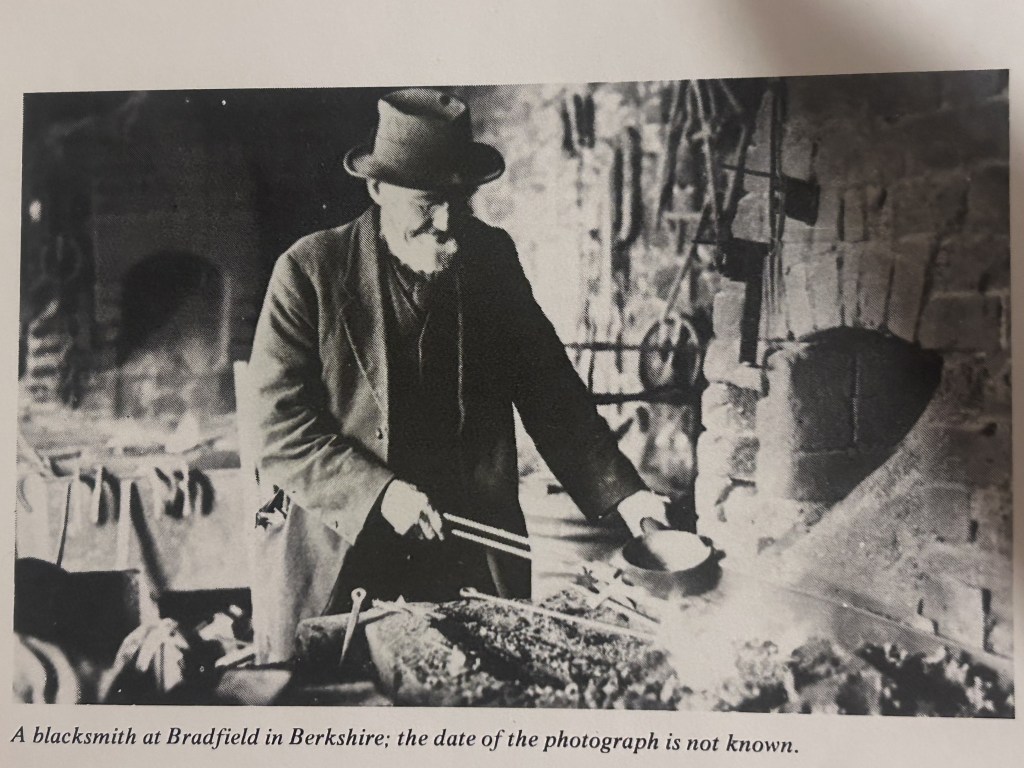
Villages of the White Horse, written, aptly, by Alfred White, in 1913, includes delightful descriptions of local characters — including a blacksmith, and a carpenter who was appointed Constable. Although that’s 50 years later, it helps me picture Joseph at work, and even to hear what he might have sounded like:
John Johnson, a 70-year-old blacksmith nicknamed “Young John“
His shed—which he built himself—is of iron, and stands immediately alongside the school playground, through which he crosses, in dirty weather, to gain the forge, stepping on wooden boxes to assist him over the low fence. At playtime the children come out to watch him at work, to hear the roaring bellows and tinkling anvil, and to see the bright yellow sparks whizzing out, and shooting through the small doorway. The old smith is very fond of the children, and they love him in return; … “Young John” executes all the small repairs to the machinery and implements, and shoes the horses, settling up with his patrons every three months.
The little forge is a curious place, containing all kinds of rough tools, with other odds and ends, and everything is in a muddle, as is usual with the village smithy. … The bellows for the forge are in a tiny box-like place behind where the smith stands; there are several iron “boshes” for the water, and the dust-like coal is kept in a large two-handled pot, which once did service over the kitchen fire. The chimney is a very simple contrivance, being merely a milk-churn, with the bottom knocked out, hung in the iron roof, the broad bottom forming a kind of bonnet, to carry off the smoke and sulphur. This suits the old blacksmith very well, because, as he says, he “can look up the chimmuck at night, an’ see the stars a-shinin’ outside.”
The smith is tall and boney, but none too robust since he had the severe attack of bronchitis last fall, which played havoc with him; he is hard on seventy now. In manner he is extremely gentle and agreeable, a lovable man, with a playful, yet serious mind, full of quaint sayings and sparks of wit, able to converse on matters of the deepest import, and to make rhymes while he beats out the fizzing metal on the anvil. His voice is soft and mellow, and he sings the tenor part in the choir at the tiny church; he has been a chorister all his life, from early childhood. He is ripe for a chat at all times, whenever you care to look in upon him, … He has no mate to help him at the forge, except when he has an extra heavy job in hand; then he gets an old neighbour to come and give him a blow, but be “soon gets out o’ bread” (breath). His hammers are all named: there are “Slogger,” the sledge; “Dragon,” the intermediate one; and “Useful,” the hand hammer. When he wants either of them he cries aloud: “Now, Useful!” “Come yer, Dragon!” “Stop ther, Slogger, till I wants tha agyen!” Where “Useful” is not big enough, and “Slogger” too mighty, he “goes at it, an’ ‘its into ‘t wi’ Dragon, an’ yarns mi bit o’ rooty” (bread).
The village constable
The old carpenter held the post of village constable for twenty years, before the institution of the County Police. This office was one of responsibility in those times, and was not unattended with danger; the old man bears many scars as the result of encounters with roughs in the execution of his duty. The chief offenders
against the law were gipsies, tramps, and travelling navvies; there was seldom any trouble with the villagers. There was no regular salary attached to the post of constable; the only sum he received was 5s. every year when he went to the court to be sworn in. His personal equipment comprised a loaded baton, and hand-cuffs for the prisoners. Several times, on making arrests, when the prisoner would not walk to the town, four miles away, he had clapped the hand-cuffs on him securely, tied his feet and legs together, and hauled him along on his back to the cells. At a neighbouring village the constable was often required to lodge prisoners for the night, on their way to prison. To hold them secure he had two mighty staples driven into the strong woodwork, one each side of the wide fire-place, and the culprits were chained up to these all night, while the constable took his rest. If there were three prisoners, the great, heavy pig-killing bench was brought into requisition, and the third was unceremoniously chained down to that; there was small fear of escaping from such a custody.
Putting my house on the map
Pinning down the location of Joseph’s house in the censuses is challenging. As is typical with rural locations in the earlier censuses, there is no specific address given; simply the name of the village. However, the names of neighbouring families and local landmarks can help to place a household geographically.
In particular, the location of Drayton’s almshouses, which are next door to Forge Cottage, has been a vital clue in my research. In the enclosure map of 1815, the almshouses are marked between John’s garden and William Hyde’s house, in allotment 78.
The almshouses were built in 1806 with funds raised nationally after the ‘Great Fire of Drayton’. The five 18th-century almshouse buildings were knocked down and replaced by six bungalows in 1980, but a plaque on the wall facing the street still records their founding. I am fortunate to be the current custodian of the Almshouse Charity Minute Book, which began in 1818. In the earliest entry — an indenture made in the 59th year of the reign of George III — William and James Hyde (Joseph’s uncles) were named as two of four founding trustees. My neighbour Andrew Bax has written about the history of the almshouses and charities in our village magazine (March 2023 and April 2023).
In 1841, Joseph Hyde’s census entry was not next to any obvious almshouse occupants, but in 1851, the five previous households, excluding one that was uninhabited, were occupied by widows, three of whom were on parish relief. This is strong evidence that by 1851, Joseph was living next door to the almshouses. I think it’s likely that Joseph had hands-on involvement in building his own house. At the very least he would have produced the nails and other metal fittings used in its construction. When I look at the timber beams in the ceilings and the red bricks around the fireplace, made right here in Drayton, I like to imagine his satisfaction with his new home.
Jesse Hyde (1839-1888) & Sons
Joseph Hyde died intestate on 11 January 1865, and on 11 February, probate was granted to his next of kin, his half-brother John Hyde, blacksmith of Abingdon. The next day, a sale of Joseph’s goods to be held at his property was advertised in the Reading Mercury — including furniture, two fat pigs, home cured bacon, and a set of new iron harrows (a farming implement for tilling soil).
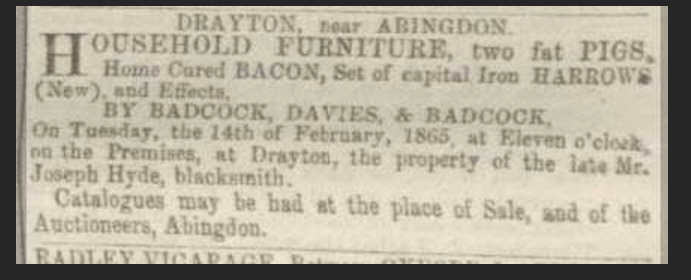
British Newspaper Archive
John had two sons and six daughters, by two wives (his second wife was Mary Parker). His younger son died in childhood, leaving just his son Jesse (b. 1839) to follow him into the blacksmith trade. Jesse was in his late 20s when he took his late uncle Joseph’s place as the new blacksmith of Drayton. In the 1871 census we find Jesse and his family living between the ‘High Street Alms Cottage[s]’ and the ‘Manor House’. (The almshouses next door were occupied by variety of needy villagers: a widow with her two children, an elderly widower, a 62-year-old single woman still working as an Ag Lab, a widowed former seamstress, and an ‘almshouse woman’ stated to be (in the terminology of that time) an ‘imbecile’.) Jesse and his wife Ann (née Woodley) had two young children, John, aged 3 and Henry J.[James], aged 2 (their 5-year-old daughter, Sarah, is absent). The household also included a servant, William Thomas — a 16-year-old ‘shop boy’, and a visitor, Ann Money — a 49-year-old widow who was employed elsewhere as a domestic servant.
In 1881, blacksmith Jesse Hyde’s home was described as a ‘Private House’ on the High Street. His family now also included sons Charles, 7, and Harry, 4. Jesse died in 1888, and by 1891 his sons John (b. 1867) and Charles (b. 1874) had taken over as Drayton’s blacksmiths. In the 1891 census, for the first time, my house had a number. Now, John and Charles Hyde, as well as John’s wife Ellen and infant daughter Florence N.[Nellie], lived at ‘No 35 private house’ on the High Street. Once again, it was adjacent to the Alms Cottages, now numbered 1-5. Meanwhile, Jesse’s widow was still living in Drayton, with her son Harry, an apprentice smith who later joined the Royal Artillery. Their fourth son, Henry, became a blacksmith in Cholsey.
The first OS map of Berkshire was published in 1883 (from a survey in 1878). Drayton’s Smithy is labelled, and the land extends back beyond the churchyard, in an area that has since been used as an extension to the parish burial ground.
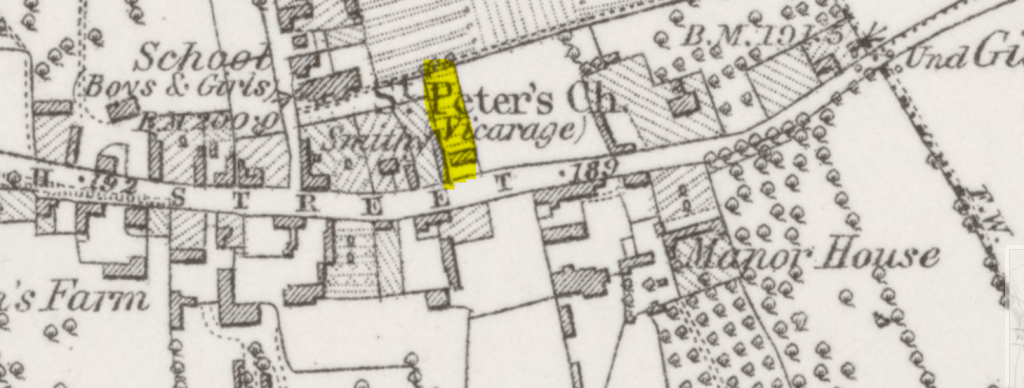
Oxfordshire Sheet XLV Surveyed: 1875, Published: 1883. Re-use: CC-BY (National Library of Scotland)
An OS map of 1897 shows the Smithy and Almshouses all within land parcel 79. A small outbuilding shown behind the Smithy has not survived to the present day. The map also shows that my house was once opposite a Reading Room! These were opened in villages and towns all over Britain in the Victorian period. As well as boosting literacy they provided an alternative, teetotal recreational space to pubs.
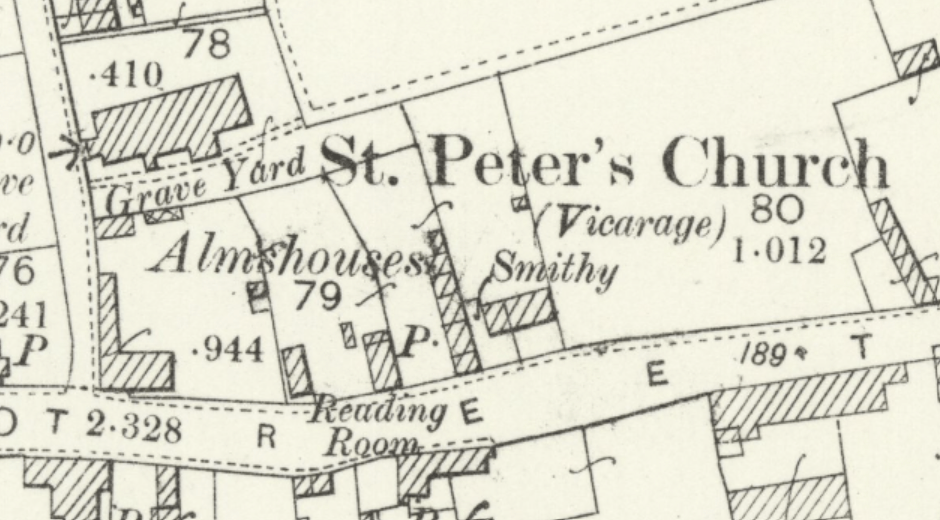
Berkshire X.13, Revised: 1897, Published: 1899. Licensed under CC-BY (National Library of Scotland)
The end of the Hydes’ residence at Forge Cottage?
In 1897, John Hyde died, aged just 30, prompting his widow to leave Drayton and work as a tailoress in a nearby village to support her four young children. And by 1901 John’s younger brother Charles had married, moved to Abingdon and become a gardener. In the 1901 census, 35 High Street, Drayton was still home to the village blacksmith, but for the first time in at least 150 years, this pivotal member of the community wasn’t a Hyde — his name was Charles Fisher. However, deeds reveal that the owner of the property was Charles Parker, who was, in fact, a member of the Hyde family. Let me explain the line of inheritance from John Hyde to Charles Parker …
- John Hyde (blacksmith of Drayton) purchased the land from the Lord of the Manor.
- John passed the land to his son Joseph Hyde (blacksmith of Drayton).
- Joseph died intestate and the property went to his brother John Hyde (blacksmith of Abingdon). John’s son Jesse then took over Drayton Smithy.
- John Hyde died the following year, and the property didn’t go to his sons; it went to his only surviving sibling, Elizabeth (whose son Stephen had been trained as a blacksmith). However, since Elizabeth was married, the property belonged to her husband John Parker.
- But John Parker died the same year, and the property went to his widow, Elizabeth Parker (née Hyde). She was then the sole owner for 14 years. During this time, her nephew Jesse’s sons John and Charles took over as the blacksmiths.
- When Elizabeth died in 1879 the property was inherited by her only surviving son, Charles Parker. His Hyde cousins continued to be the blacksmiths there until the late 1890s. Then, for the first time in 70-80 years, another family moved in: the Fishers.
The Hyde family tree below shows most of the family members who’ve featured in this blog. The owners of the land or cottage are in green, and the blacksmiths who worked here are tagged with an anvil.
This brings my history of Forge Cottage to the turn of the 20th century. Over the next 100 years, the building will be remodelled, renumbered and renamed. It will be home to an iron founder, leather maker, motor engineer, Naval seaman, university lecturer, research chemist, war widow, and of course wives and children. In Part 2, I’ll share their stories, along with the memoir and photograph of one of the last blacksmith’s daughters, who vividly recalled her childhood at Forge Cottage in the early 1900s.
Read Part 2: The war widow, the cadet, the geodesist and the history buff
A few resources for learning about 19th-century blacksmiths
Books:
Jocelyn Bailey, The Village Blacksmith (Shire Publications, 1977)
David L. McDougal, The Country Blacksmith (Shire Publications, 2013)
The Book of Trades or Library of Useful Arts 1811, Vol. 1 (reprinted by Wiltshire Family History Society, 1991); also available online via the Internet Archive
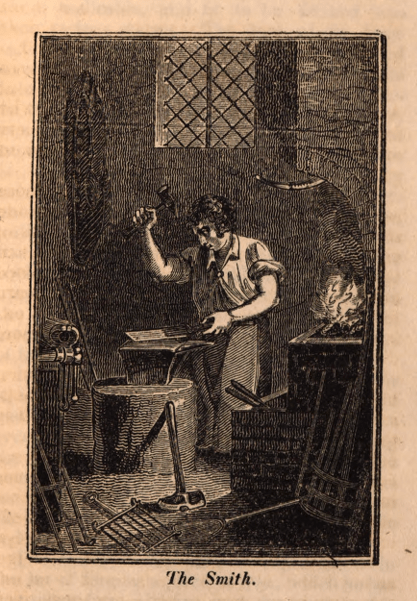
‘The Smith’, in The book of English trades : and library of the useful arts : with seventy engravings (1818, reprinted 1956); also available online via HathiTrust
Websites:
The Blacksmiths Index: a database of blacksmiths by UK county (and abroad) compiled by Ann Spiro (the Hyde family is not in the database)
Blacksmiths: The Essential Rural Craft (The Family History Federation)
Video:
A Victorian forge at Chiltern Open Air Museum
References and footnotes
- I received some helpful insights from the archivists at Royal Berkshire Archives about Drayton’s enclosures. The reference to ‘old inclosures’ suggests that much of the land in Drayton had been enclosed earlier than parliamentary enclosure acts, which began in the mid 18th century. For example, in the map of 1805-1809 we see that the area of land opposite mine comprised several closes, which were held by local landowners. It appears that some of the land was further sub-divided and leased or purchased by 1815, including the land where my house is sited.
- Jackson’s Oxford Journal, 18 Sept 1802
- Slater’s Directory of Berkshire, 1852
Forge Cottage in Censuses (1841-1891):
1841: Household of Joseph Hyde (digitised image of census). ‘1841 Census’. Ancestry [accessed 8 Sep 2026]. Original record: The National Archives (UK), Reference: HO 107/24, Book 3, Folio 7, Page 10.
1851: Household of Joseph Hyde (digitised image of census). ‘1851 England Census’. Ancestry [accessed 8 Sep 2026]. Original record: The National Archives (UK), Reference: HO 107/1688, Folio 675, Page 10.
1861: Household of Joseph Hyde (digitised image of census). ‘1861 England Census’. Ancestry [accessed 8 Sep 2026]. Original record: The National Archives (UK), Reference: RG 9/735, Folio 29, Page 2.
1871: Household of Jesse Hyde (digitised image of census). ‘1871 England Census’. Ancestry [accessed 8 Sep 2026]. Original record: The National Archives (UK), Reference: RG 10/1266, Folio 34, Page 6.
1881: Household of Jesse Hyde (digitised image of census). ‘1881 England Census’. Ancestry [accessed 8 Sep 2026]. Original record: The National Archives (UK), Reference: RG 11/1286, Folio 33, Page 7.
1891: Household of John Hyde (digitised image of census). ‘1891 England Census’. Ancestry [accessed 8 Sep 2026]. Original record: The National Archives (UK), Reference: RG 12/981, Folio 26, Page 6.

