Two weeks ago, Amy Johnson Crow’s 52 Ancestors in 52 Weeks challenge started a four-week theme series of Water, Fire, Air, and Land. Purely coincidentally, I wrote about drownings in the Thames in water week, and in fire week I wrote about an ancestor whose job was the prevention of lightning fires. This week I was determined to participate properly. But what could I write about Air? My grampy was a trainee airman in WW2, but I don’t currently have access to a portrait of him in his uniform, so I’ll save his story for another day. Instead, for Week 16 of #52Ancestors I present the story of an ancestor who vanished into thin air. We all have a few Houdini characters in our family trees, don’t we? – People who left a conventional paper trail of parish records, census returns, and other evidence, up to a point, and then suddenly seem to disappear in a puff of smoke. Charles Edward Saword, my husband’s 2xG grandfather, is one of those unsolved mysteries …
Charles Edward Saword (family photo; the only photo we have, which seems to have been ripped from a larger one)
According to my husband’s late grandpa, Alfred Saword, his grandfather Charles emigrated later in life. He wrote that Charles ‘had income from the ownership of land and property. When the last of his children had grown up and left home, he gave one large plot of land to his son Fred, another plot to my father [James], left his house and other sources of income to his wife and sailed for Australia. Nothing further was heard from him.’
But let’s start at the very beginning:
Charles Edward Saword’s early years weren’t easy. Born in Liverpool in 1841 to Edward, a merchant, and Emma, who came from a family of distinguished potters, Charles was the eldest surviving son. Two baby brothers, including another Charles Edward, had died before he was born, and two baby sisters died in the years immediately after. In 1845 the family home caught on fire, and his father and older sister escaped through the roof of their house. The following year, another baby died. In 1848, Charles gained a second healthy sister, but within a year, their mother Emma died of TB. His father soon married again, and had nine more children, all of whom survived childhood.
In the 1851 census, Charles, age 9 and a ‘scholar’ was living in Birkenhead with his father, step-mother, two sisters and baby half-sister. However, just a couple of weeks later, the rest of his family emigrated to Boston without him! According to their U.S. immigration records, they intended to stay in America. However, the family had a change of heart, and returned to England in 1853. Charles’s whereabouts during their time in America are unknown. When the family returned, Charles, by then about 12, started working in the Audit Department of the London & North Western Railway at Euston Station, where he remained for three years. Next, in 1857 he was indentured into the Merchant Navy for a period of four years, to serve on the Gladiolus at Aberdeen. However, just months later Charles deserted his apprenticeship on pay day! From 1858-1860, Charles’s name appears in the New South Wales Government Gazette, in lists of unclaimed post. Was he living in Australia?
By 1861 Charles was back in England, working as an Insurance Clerk and living with his grandmother. That summer he married Emma Read. The illiterate daughter of a Suffolk labourer, Emma was a surprising choice, and the family apparently didn’t approve! However, Charles and Emma settled in London and started a family, producing eight children in their first decade of marriage, five of which survived infancy, including James, my husband’s great grandfather.
Emma Saword (from family album)
In 1869, Charles’s father Edward was a merchant with the East India Company and travelled to India, where he intended to get rich! As with his American dream, his plans for India were also cut short, and he soon returned to England, probably due to illness. There is no sign of Edward after 1876, when he registered the death of a teenage daughter. He possibly died in India or at sea. In fact, Edward’s father, also a merchant and mariner, had died far from home when Edward was just four. Travel, escape, and disappearance are themes that run through many generations of this family.
When I first heard about Charles giving away his property and emigrating to Australia late in life, while his wife was still alive, it struck me as an odd thing to do, and I was keen to find out more. When my husband’s grandpa did some genealogical research into his family in the 1980s and ’90s, it was extremely difficult to locate people in censuses and especially to trace people internationally. However, thanks to searchable online databases, it only took me a few minutes to discover the truth.
In 1871, 1881, and 1891, Charles and Emma lived together with their children in Hackney. In 1901, Emma was on her own and claimed to be a widow. However, in 1911 she said she was married. There was something fishy going on! A search for Charles in 1901 quickly revealed that he had neither moved to Australia nor died; rather, he had moved south of the Thames to Camberwell, where he was living with another ‘wife’!
Emma Saword, 1901 England Census, Class: RG13; Piece: 1251; Folio: 130; Page: 7, accessed from ancestry.co.uk 15/1/18Charles and Jane Saword, 1901 England Census,Class: RG13; Piece: 497; Folio: 10; Page: 8, accessed from ancestry.co.uk 15/1/18
Charles’s new partner was Jane Stovell. Like Emma, Jane was working class – the daughter of a blacksmith. Also like Emma, she came from a small village; she had come to London to work as a servant. Charles and Jane didn’t marry, so he was not officially a bigamist. However, they had a long-term relationship that started in 1878 by the latest, when they had a daughter together: Florence Louisa Saword. Florence’s birth certificate stated that her father was Charles Edward Saword, and her mother, Jane Saword, formerly Stovell.
Jane had been married before her relationship with Charles, to Thomas Wright, a coachman. Jane & Thomas married in 1865 and had three sons together between 1865 and 1871, the first of which died as an infant. In the 1871 census Jane said she was married, but she was recorded on her own with her toddler and infant sons. There is no sign of her husband Thomas, whose name I only know about from her son’s baptism record. Also, she gave the surname ‘Wright Waterer’ for herself and her sons – the Waterer name is a mystery. In 1881 Jane also claimed to be married, but she and her three children (her sons by Thomas Wright and daughter by Charles Saword) were now using the surname Saword. It is curious that she would choose to apply Charles’s surname to her sons, who had been legitimate children. I have not been able to trace Thomas Wright on any records, due to his common name. Since I have no evidence of his death, it is possible that Jane and Thomas were still married when she claimed to be Charles Saword’s wife. Unfortunately Jane’s sons, whose records may yield some clues, have also proved elusive.
In 1898, Charles was a witness and recorded as the father at his illegitimate daughter’s wedding. Finally, in 1901, Jane and Charles lived together as husband and wife.
Part of the 1898 marriage certificate for Florence Louisa Saword, Charles’s illegitimate daughter with Jane Stovell London Metropolitan Archives; London, England; Reference Number: p73/gis/049, London, England, Church of England Marriages and Banns, 1754-1932, accessed from ancestry.co.uk 15/1/18
Charles and his legitimate wife Emma, though completing the census form together in previous years, had probably been estranged for a long time. After an eight-year gap without children they had a final child in 1882, named (interestingly) Jane, but she died the same day. By then, Emma was 42 years old.
I think that Emma must have known about Jane, and invented the story about Australia for appearances’ sake, possibly keeping the truth from everyone, even her own children. I assume Jane also knew about Charles’s other family, since she claimed to be married in spite of no actual marriage. The mind boggles thinking about how Charles maintained two families and how all of the people involved kept these secrets.
When Charles finally left Emma, he acted to ensure that she would be financially independent. Alf (Charles and Emma’s grandson and my husband’s grandpa) wrote ‘All I can say from my own knowledge is that [Charles] appeared to have left his wife well provided for. When she visited us … she had her own house, was well dressed and quite cheerful. Her husband had not left until all children had grown up and were self supporting.’ He also noted that Emma ‘had a reputation for being “difficult” and even her brother [who was a Detective Inspector] agreed with that.’
However, Charles did not don his slippers, pick up his pipe and live out his final years with Jane in newly found domestic bliss. Instead, between 1901 and 1911 he seems to have disappeared!
In the 1911 census, while Emma Saword claimed to be married, Jane (‘Mrs J Saword’) stated that she was a widow.
There is no sign of Charles in the 1911 census. However, in the summer of 1911, Jane attended her brother’s funeral in Canada, and on arriving back in England, the passenger manifest recorded her occupation as ‘Wife’.
Finally, when Emma passed away in 1920, and Jane in 1928, both claimed to be the ‘Widow of Charles Edward Saword, Shipping Clerk’! Jane had lived as Charles’s lawful wife for several decades, and her daughter, who registered the death, would have wanted to perpetuate this facade, or may have even believed her parents to have been legally married.
Emma and Jane’s death certificates with identical information about their late husband, from GRO
So, what on earth happened to Charles? Did he eventually emigrate to Australia after all? Perhaps he had always wanted to go to sea again, and to return to New South Wales. Did he travel with a false name, and if so, why?
After extensive searches, I have failed to find a death or burial record or a will/probate record for Charles anywhere in the world. Charles Edward Saword simply vanished into thin air.
Updated 19/5/20 to include details of Jane Stovell’s marriage.
On Thursday night at 8 pm my son and husband played ukelele and my daughter and I sang in a family rendition of ‘Over the Rainbow‘ on our front porch, as neighbours all around us clapped for our NHS, healthcare and other essential workers. Throughout our village, and around the world, the rainbow has become a symbol of hope and appreciation for front-line workers in the COVID-19 pandemic. According to an article I saw online, the idea originated in Italy just last month, though I’m sure it will now be associated with brave caregivers for many years to come.
Another symbol long associated with medicine and healing is the Rod, or Staff, of Asclepius. If you don’t know the name, you’ll recognise the symbol of a serpent wrapped around a staff. One famous use is in the logo of the World Health Organisation. The Rod of Asclepius is sometimes used interchangeably with the Caduceus, which features two serpents around a staff. Both symbols come from ancient Greece via the Roman Empire. Asklepios (Asclepius) was the Greek god of medicine and healing, who became Aesculapius to the Romans, and is also associated with the Egyptian God Imhotep. The son of Apollo, Asklepios had many children associated with different aspects of the medical arts, including Hygieia, the goddess of cleanliness (hygiene) and Panacea, the Goddess of universal remedy. Asklepios was associated with snakes and a staff, which over time were intertwined in a single symbol of medicine and healing. The Caduceus was carried by Hermes in Greek mythology, and later by Mercury in Roman mythology, though it possibly had its origins in Mesopotamia 6000 years ago. As a symbol of Hermes/Mercury, the Caduceus originally represented trade and communication, not medicine. If you’re interested in this topic, Dr. Timothy Leigh Rogers has a detailed blog post about the confusion between the two symbols in the ‘Battle of the Snakes‘.
Having worked in the U.S. healthcare industry for 15 years (in marketing, not as a healthcare professional) I can tell you that the Caduceus is the most commonly used medical symbol there. For many years I worked for a company called Epocrates, named after Hippocrates (during the time when all digital companies were adding an ‘e’ to the beginning of words, like ’email’). Hippocrates was a Greek physician who lived 2400 years ago, famous for his ‘Hippocratic Oath’ and often referred to as the father of Western medicine. The Hippocratic oath originally started: ‘I swear by Apollo the Physician and by Asclepius and by Hygieia and Panacea and by all the gods …’.
So, now you know your Rod of Asclepius from your Caduceus, allow me to introduce one of my favourite ancestors: Esculapius Simon Jude Wood.
Admittedly, Esculapius (occasionally spelled Æsculapius, and almost always mistranscribed as something nonsensical) wasn’t a blood relation. His only son, Richard Wood, an aptly but boringly named cabinet maker, married my husband’s 3x Great Aunt Florence Saword, in 1895. However, he has such a great name, and was such a great character, that I proudly claim him as one of my own.
Esculapius Wood was born in 1844 in Bradford to James Wood, an electrician and later ropemaker, and Hannah. His siblings had perfectly ordinary names – Frederick, Francis, Charles, Christopher, and Alice.
Many of us have rare and amusing names in our trees, which stand out in a sea of countless Johns and Marys. I must admit I have a habit of logging unusual and funny names that I come across, and often go down a rabbit warren to learn more about an individual just because of her striking name. It would be understandable to assume that these names are only amusing to us in 2020, and that in Esculapius’s lifetime, his classical name, albeit very unusual, would not have raised much of an eyebrow. However, even in his own era, his name was considered so ‘out there’ that it was lampooned in the news!
In 1868, various newspapers ran an article called ‘Queer Yorkshire Baptismal Names’! Poor Esculapius, already a family man by then, was included in this public name-shaming.
When Esculapius married Sarah Anderson in 1866 at age 21 he was a ‘whitesmith’, a metalworker who does finishing work on iron and steel. Later in life, Esclapius was a manufacturer and fixer of lightning conductors as well as a chimney repairer. The principle of a lightning conductor (US: lightning rod) was developed in the late 1700s. Made of conductive metals such as copper, conductors protected tall structures such as church spires from fires caused by lightning strikes, and and were increasingly in demand as buildings became taller. The term ‘lightning rod’ was also in use, and with my marketing hat on I must say I am disappointed that Esculapius didn’t advertise his business as ‘The Lightning Rods of Esculapius’! In 1864, the Newcastle Chronicle reported on the ‘extraordinary climbing and scaling exploits performed by a man belonging to Bradford, who rejoices in the possession of a string of extraordinary Christian names’. It makes for nail-biting reading!
In 1869 Esculapius, and his name, made the papers again, when he helped subdue a violent drunken thug who had attacked an old man and a policeman:
GROSS ASSAULTS IN WAKEFIELD ROAD. — At the Borough Court, on Monday, a man named Peter O’Connor was charged with having, early on Sunday morning, grossly assaulted an old man named Jonas Walmsley, of Bolton-place, Wakefield- road, and also with having immediately afterwards assaulted Sergeant Rushforth when in the execution of his duty. Walmsley, whose nose was plastered up, and his face partly discoloured, was on his way home, when he reached the place where the prisoner’s wife and another woman were earnestly advising him to go home, but he, having evidently been drinking and irritated at having had water thrown at him by some person, refused, and in struggling to get free from their grasp fell to the ground, upon which Walmsley remarked, “He will be quieter now.” This roused the prisoner, who started to his feet, knocked the old man down with his head against a wall, and cut him to the bone with a blow across the nose, the blow, the fall, and the effusion of blood for the time completely stunning him. Sergeant Rushforth, who was near, came up and endeavoured to take O’Connor into custody, but the irate Milesian* stoutly resisted his efforts, and they rolled twice on the road together before that could be effected, and then only with the help of a man bearing the classico-medical name of Æsculapius Wood. The case being clear, and the prisoner incapable of making any defence, he was fined 20s. and costs, or twenty-one days’ imprisonment for the assault on Walmsley, and 10s. and costs, or fourteen days’ imprisonment for the assault on Sergeant Rushforth.
(Leeds Times, Friday 24 December 1869 p. 8, accessed from BritishNewspaperArchive.co.uk 11/4/20) *Milesian seems to have denoted a native Irishman with a characteristically hot-headed temperament.
So why was Esculapius the bearer of a ‘classico-medical’ name? In 1806, Dr. Abernethy’s household medical book The Pocket Aesculapius was published. The book was advertised in newspapers nationwide throughout the 1800s. This may have made the name more widely known to the masses. As well as the medical association of his first name, he had a middle name ‘Jude’. Jude is the patron saint of lost causes. Did Esculapius Wood have a narrow escape as a baby, rescued from the jaws of death by a skilled doctor, nurse or midwife?
In 2018, I sang in an opera double-bill, which included The Zoo, a comic one-act operetta with music by Arthur Sullivan (later of Gilbert & Sullivan) with libretto by B.C. Stephenson, which premiered in London in 1875. One of the two romantic male lead characters was an apothecary (i.e., pharmacist) called Æsculapius Carboy. He’s a comic rather than heroic character, whose name complements both his profession and melodramatic behaviour. I like to think that Arthur Sullivan read about the bravery and exploits of Esculapius Wood in the papers and was inspired to use the name for his character!
Esculapius Simon Jude Wood died in 1899 and was buried in Undercliffe Cemetery in Bradford. His name may have caused mirth in his lifetime, but he was also admired for his courage, both in his work and for his willingness to put himself into danger for his neighbours’ sake. So, if anyone is looking for a baby name, I think Esculapius would be a very unusual but noble choice!
Photo provided by volunteers at Undercliffe Cemetery, Bradford
I’ve been spending quite a bit of time lately poring over the parish records for St Nicholas’ church in Deptford searching for the burial of an ancestor, shipwright William Saword (b. 1700). His wife Deborah was buried there in 1772 but I can’t find any burial for him. However, the burial records make for truly fascinating reading.
St Nicholas stands very close to what was once a royal dockyard. It was a hub of maritime industry, a major military & naval centre, and a connection point for international travel and trade. In 1730 its parish was split with the new St Paul’s; St Nicholas’ parish was smaller than St Paul’s, but with much higher population density.
St Nicholas, Deptford, c1750 showing the church’s proximity to the river.
This evocative passage from The Republic of Pirates (Colin Woodard, HMS Books, 2008) paints a colourful picture of the chaotic and industrious Thames of the early 1700s:
‘The city’s main artery, the Thames, was even more crowded than the streets. Upriver from London Bridge – under whose narrow arches the tides poured like waterfalls – hundreds of watermen rowed boats ferrying passengers and cargo up, down, and across the river, into which flowed the contents of a half million chamber pots; the blood and guts of thousands of slaughtered livestock; and the bodies of cats, dogs, horses, rats, and just about anything else wanting disposal. Downriver from the bridge, hundreds, sometimes thousands of seagoing vessels waited to load and unload their cargoes, often tying up three or four abreast, a floating forest of masts extending nearly a mile. Coastal trading sloops brought heaps of coal from Newcastle; two and three masted ships disgorged lumber from the Baltic, tobacco from Virginia, sugar from Jamaica and Barbados, and salt cod from New England and Newfoundland. Further downriver, on the outskirts of the metropolis at the naval yards of Deptford and Rotherhithe, the warships of the Royal Navy gathered for orders, repairs, or reinforcements.’
The church’s burial records give us a snapshot of this hectic melting pot. Although baptisms and marriages were primarily of parishioners, burials tell a much broader story. Among local residents, who were predominantly mariners, shipwrights, watermen, and lightermen, were people with ‘exotic’ names that suggest they or their parents had not been born in England. Some were named as palentines – refugees from the lower Rhine region of what is now Germany. Many people of colour are also mentioned. By the middle of the century, burials included scores of the unfortunate poor from the local workhouse, from ‘nurse children’ (infants) to adulthood. However, many of those buried had come from other parts of Britain, and the rest of the world. They included soldiers, mariners, traders and travellers. Some came from Sick Quarters, where men would go after being taken ill at sea. Some came from prison ships, which had been headed to America until prevented by war, and were now stuck in dock on the Thames. Some had presumably died at sea, and been brought to the nearest burial site as soon as the ship came into land. Strangers traveling on land were also found deceased in Deptford, often on the side of roads. For many out-of-towners, Deptford was the end of their journey, and they were to be buried far from home – some without even a name.
Mike Quinn / Skull & crossbones on the gatepost at the entrance to St. Nicholas’ Church, Deptford Green, SE8 / CC BY-SA 2.0Burial of A Man unknown from America, 1776Burial of A Nubian Sailor, name unknown, from on board a Ship, 1777 (one of three buried that year)
The records also show how dangerous and precarious life could also be for people living in the town of Deptford at that time. On the very first page of the records, Robert Ford, a tailor, was buried 14 June 1718, after he had been ‘found dead in a ditch.’ Then on 20 June, we have a burial of four men – John Cosens, Edward Bickerfield, Thomas Bryant, and Richard Harris – who were ‘found killed accidentally in chalk pit in Deptford and all buried in one grave.’ Many other accidental deaths are documented, including falls on ships, men crushed by timber or scalded by fat. There are also suicides, and even a hanging at Tyburn.
With the sheer number of burials, it’s not surprising that a charnel house was built for the church in 1697. This was a repository for bones that had been unearthed when new graves were dug, which must have been a very frequent occurrence. The charnel house at St Nicholas is still standing, a Grade II listed building, though it no longer contains any human remains.
There are so many fascinating entries, but I noticed in particular a macabre trend: on almost every page there seemed to be a burial of someone who had drowned in the Thames.
From 1718 to 1786 (the span of one volume of the parish burial registers), a total of 125 burials were reported as people who had drowned. The highest number in one year was ten in 1785.
Who were these unfortunate people, and why did so many of them lose their lives in this horrible way?
Gender and occupation provide some clues: the vast majority of bodies with an identified gender were male. Only seven of the drownings were noted to be women or girls. This must reflect the fact that many of the drownings were work-related accidents.
20 of those drowned were stated to be mariners (i.e. seamen/sailors). This may be surprising, but in fact, very few people knew how to swim in this period, and this included people who worked near or on the water. Unless they grew up near a safe swimming area and had sufficient leisure time, there simply wasn’t the opportunity to learn. It’s ironic that some of these men, who had travelled hundreds or thousands of miles across the oceans, drowned so near to dry land. Others were employed in work that brought them regularly onto the Thames or to the water’s edge, including two shipwrights, a waterman (transported passengers across or along the river), a joiner (ship’s carpenter), a customs officer, a coal porter and a rigger. The very nature of their work made them more susceptible to a watery death. Leisure time was also hazardous; with so many inns located close to the water, a ‘drunken sailor’ could easily miss his step in the dark, with fatal consequences.
Nine of the victims were described as boys, and two girls, in most cases exact age unknown. Most boys were probably working alongside the men. However, all people who lived near the water were at higher risk of drowning, especially children. In some cases, the children who drowned may have fallen into the water when simply walking or playing nearby. I wonder if this is what happened on 5 June 1774, when James Buckley and John Sergent, both watchmakers, and John Williams, a boy, were all buried after having drowned in the Thames. It reminds me of a story I investigated in California; in 1906, a young cadet was struggling in the water in the San Francisco Bay, and two teachers rushed in to help him. All three died. (That tragic event turned out to have a fascinating back-story and a Hollywood ending – you can read it here). Did Buckley and Sergent attempt to rescue young John? Sadly, no newspapers from Greenwich for this period are available online to tell us what led to the tragedy,
I’ve found several newspaper articles reporting drowning incidents in the Deptford area during this period. Although the victims in these cases are gentlemen and ladies enjoying travel and leisure, and not reflective of most of the drownings that seem to have occurred, they do show how dangerous the Thames could be for passengers in small vessels:
Derby Mercury – Friday 12 September 1755. britishnewspaperarchive.co.ukHampshire Chronicle – Monday 20 September 1790. britishnewspaperarchive.co.ukPolice Gazette – Friday 29 April 1774. britishnewspaperarchive.co.uk
Most chilling and puzzling of all is that the identity of more than half of the burials was unknown; many entries simply say ‘a person unknown drowned in the Thames.’ In a few cases, they were stated to be a man or boy, and in just one case a ‘woman unknown’. How was it possible for so many to drown anonymously? They must have been carried there by the river from further afield, and/or were unrecognisable after being in the water. Presumably, drowned corpses needed to be buried as quickly as possible, making it hard for loved ones or fellow workers to have a chance to identify them. It would also have been very difficult to determine the cause of their drowning. There were no police to make enquiries, and coroner inquests were rare. It is possible that inquests were opened into some of these deaths, both for known and unknown victims, but the burial records only reveal one – a coroner’s warrant had been issued for John Little, a mariner and Deptford resident who drowned in 1729, which allowed him to be buried. It’s shocking to think the discovery of an unidentified body was so commonplace that it probably attracted little attention.
In Peter Ackroyd’s Thames: Sacred River (Vintage, 2008), the chapter River of Death explores the river’s long association with drowning, with specific reference to Deptford:
‘The Thames is in many respects the river of the dead. It has the power to hurt and to kill. … There were steps known as Dead Man’s Stairs at Wapping where, by some accident of tide and current, the corpses of the recently drowned tended to congregate. There is a U-Bend between the Isle of Dogs and Deptford, where the drowned may be delayed in their course towards the sea. It was once known as Deadman’s Dock, the name given because of the number of corpses that were found there when the dock was being constructed. If the body missed these fatal junctions, and drifted down in its decomposing state past Lower Hope Reach, then there was no hope. It would disappear for ever.’
Ackroyd provides examples of drownings recorded in the register of Henley Church, and states: ‘The registry of every church by the banks of the river will have similar testimony to the dangers of the Thames’. Indeed, the pages of the register of St Mary Magdalene in Woolwich (another ancestral church), four miles east of Deptford, are also filled with drownings; between July and October 1787, three ‘drownded’ men and one boy were buried there.
Very poignantly, Ackroyd explains that many people were drawn to the river because they wanted to exit the world anonymously. The treacherous waters made suicide ‘easy’. Afterwards, it was rarely possible to prove a motive of suicide, which was considered a sin. The river also made it easy for criminals to dispose of their murder victims. No wonder Ackroyd says that the Thames is ‘a river of the disappeared’.
In fact, I have seen one record from St Nicholas of a murder victim – on 9 Jan 1798 there was the burial of ‘a drowned man unknown, murdered by a person unknown.’
Presumably, his injuries made it clear that there had been foul play. In July of that year, the Marine Police Force (Thames River Division) began operating, making them the oldest police force in England. However, as I discovered while investigating the career of my ancestor Detective Inspector George Read of the Thames Division, the chief concern of river police was theft and smuggling rather than murders and drownings.
The burial of one unidentified person in 1784 was noted to be paid for by the parish. I assume all of these lost souls were buried as cheaply as possible in unmarked, probably mass graves.
All of these nameless victims (and presumably many more whose bodies were never found) must have had loved ones who never knew their fate. Perhaps one of them is someone whose burial you’ve never been able to find. Perhaps one of them is mine!
The Docks in this part of the Thames are still dangerous. In 2010, a 14-year-old youth tragically drowned in Rainbow Quay, the oldest of London’s riverside wet docks – in Rotherhithe. According to a news report, the water was ‘shockingly cold’, even on what was a hot day, and very murky. It was also an area ‘notorious for submerged objects’. I am sure that this was the same for the unfortunate men, women and children who fell into the black waters of the Thames 300 years ago.
In honour of the people who lost their lives in the Thames and were buried at Deptford, I’ve compiled a list of drowned people buried at St. Nicholas, Deptford, from the register covering the years 1718-1786 (viewed on ancestry.co.uk).
Drowning Burials at St Nicholas, Deptford 1718-1786
Notes:
Between 1735-1762 only six drownings were recorded. I assume this is due to different record-keeping, since from 1763-1786 there were 4.5 drownings per year, on average. About a dozen entries recorded a name or gender next to the term ‘accidental’, including two with a coroner’s warrant – these could possibly be drownings.
After 1786, drownings continued, of course. In the first four years of the next register, five burials of drowned people were recorded.
I have endeavoured to transcribe all relevant entries but it is possible that I have either missed or mistranscribed entries.
1719
20 Aug – John Headman, Smith a Drown’d man from Upper Towne
1721
1 Jan(?) – James Goodey a poor Drowned boy from the Upper Water Gate
1722
7 Jan – Eliza Heath found Dead in the Water by the Tide Mill
1723
3 Aug – a Drowned man from the ship Goyle? Charles Small Commander
14 Aug – Robert Anderson Riger [rigger] who was Drowned from the Green
1724
? Jun – Margt D. of Thomas Phinnis a Drowned Child from the Tidemill
? Jun – a Drowned Man being a Stranger from the Red House [the Red House was the victalling and supply centre]
1727
? Jul – A Boy about 13 or 14 years of age taken out of the River near the red House
1729
17 July – a Drowned Man
18 July – a Drowned Man Grove St
27 Dec – Jno Little Marriner Grove Str Drowned w/ Cor[oner’s] Warrant
1735
? Nov – Charles Cook drowned
1744
24 Jul – John Murray labourer drown’d
1757
8 Oct – a drowned Man unknown
1758
11 Aug – William Ringseed drownd
1760
? Jun – James Hall drowned
1762
3 Nov – a drownd man unknown
1763
28 Apr – John Miller a drowned boy
13 Oct – A drown’d Man unknown taken out of the Thames
1764
? May – A drown’d Man taken out of the Thames unknown
23 Jul – A drown’d man unknown taken out of the Thames
29 Nov – William Wilson Joiner from King Street drown’d
30 Dec – James Olliston? A Dane & Mariner drowned
1765
25 Aug – A drowned Man unknown taken out of the Thames
8 Sep – A drowned Man unknown taken out of the river
1766
30 Jan – William Styles drown’d in the Thames
6 Feb – A Man unknown taken out of the Thames
26 Feb – Two Men unknown taken out of the Thames
6 Mar – John Fagan Mariner drown’d in the Thames
5 Jun – William Docklerly a boy drown’d in the Thames
13 July – A Blackmoor* name unknown drown’d in the Thames
8 Aug – A Man Unknown taken out of the Thames
? Dec – A Person Unknown taken out of the Thames
1767
11 June – William Klaasen a Dutchman drowned in the Thames
20 Dec – Susanna Westley drown’d in the Thames
22 Dec – Thomas Goodall Mariner drown’d in the Thames
1768
1 Jul – John Prince drown’d in the Thames
1769
1 Jul – A Person Unknown drown’d in the Thames
24 Oct – John Limbourgh Mariner drown’d in the River Thames
1770
17 Jul – Anthony Tassania Mariner drown’d in the Thames
5 Oct – A Person unknown taken out of the Thames
1771
9 Apr – A Person unknown, who was drown’d in the Thames
21 Apr – Henry Dykes Mariner drown’d in the Thames
12 May – A Person unknown drown’d in the Thames
1772
16 Feb – A Person Unknown drown’d in the Thames
26 Feb – Walter Archbald Mariner drowned in the Thames
8 Aug – A Boy unknown, drown’d in the Thames
24 Oct – A Man unknown drown’d in the Thames
1773
24 Jan – Peter Goodman Mariner drown’d in the Thames
11 Mar – A Man unknown drown’d in the Thames
21 May – A Man unknown drown’d in the Thames
27 Jul – Two Men unknown drown’d in the Thames
23 Aug – A Person Unknown drown’d in the Thames
1774
27 May – George Richardson, Taylor, drown’d in the Thames
5 Jun – James Buckley, Watch-maker, drown’d in the Thames
5 Jun – John Sergent, Watch-maker, drown’d in the Thames
5 Jun – John Williams, a Boy drown’d in the Thames
1775
16 Mar – Hugh Molton, drown’d in the Thames
24 Apr – A Person Unknown drown’d in the Thames
6 Aug – Philip a Negro* drowned in the Thames
20 Aug – John Drummond drown’d in the Thames
31 Aug – William Bradfield Customs House Officer drown’d in the Thames
1776
24 Mar – A Person unknown drown’d in the Thames
26 Mar – A Person unknown drown’d in the Thames
3 May – A Man unknown drown’d in the Thames
1777
18 Jul – A Man unknown drown’d in the Thames
2 Sep – A Man unknown drown’d in the Thames
? Oct – A Person unknown drown’d in the Thames
18 Nov – A Person unknown drowned in the Thames
2 Dec – A Person unknown drowned in the Thames
1778
16 Feb – A Person unknown drowned in the Thames
16 Apr – William Davis, Coal Porter from the Bone House, drown’d
20 Jul – A Person unknown drowned in the Thames
18 Sep – A Person unknown drown’d in the Thames
1779
1 Jan Arthur Woolcott, drowned in the Thames
9 Apr: – A Man unknown, who was drown’d in the Thames
? Aug – A Person unknown drown’d in the Thames
8 Sep – George Davidson, Mariner, drown’d in the Thames
9 Sep – John Davidson, Mariner drown’d in the Thames
12 Sep – John Towell, Mariner drown’d in the Thames
1780
10 Mar – John Fagan, Mariner, drown’d in the Thames
12 Apr – A Man unknown drown’d in the Thames
26 Apr – Peter Chandler, Shipwright drown’d in the Thames
6 Jun – Two persons unknown drown’d in the Thames
1781
? Mar – Robert Downs, drown’d in the Thames
? Mar – A Person unknown drown’d in the Thames
10 Jun – Edward Jones, Shopman to a Stationer, drown’d in the Thames
3 Nov – Thomas Cullin, Shipwright drown’d in the Thames
1782
19 Mar – George Buxton, Mariner drown’d in the Thames
? – Thomas Elgrin, Mariner drown’d in the Thames
? – John Wilson, Mariner drown’d in the Thames
? Oct – A Person unknown drown’d in the Thames
1783
? Feb – A Person unknown drown’d in the Thames
? Mar – Thomas Cane, Mariner drown’d in the Thames
30 Mar – A Person unknown drown’d in the Thames
9 Apr – A Person unknown drown’d in the Thames
21 Apr – James Barber, drown’d in the Thames
4 Nov – A Person unknown drown’d in the Thames
1784
18 Apr – A Person unknown drown’d in the Thames
May 24 – A Person unknown drown’d in the Thames, by the Parish
29 Jul – John Johnson, Mariner, drown’d in the Thames
30 Jul – Joseph Salisbury, drown’d in the Thames
2 Aug – Ann Jones, drown’d in the Thames
13 Aug – Philip Matthews, Mariner Drown’d in the Thames
17 Aug – John Bruce, a Boy Drown’d in the Thames
1785
? Feb – William Bares Drowned in the thames
4 May – William Butler A Boy Drowned in the Thames
6 May – A Person Unknown Drowned in the Thames
12 May – A Person Unknown Drowned in the Thames
14 Jun – A Person Unknown Drowned in the Thames
22 Jun – Ann Woodward Drowned in the Thames
5 Sep – Francis Roberts A Boy Drowned in the Whet[Wet] Dock King’s Yard
3 Oct – William McCraw A Boy Drowned in the Thames
14 Oct – A Person Unknown Drowned in the Thames
31 Dec – Joseph Smith Mariner Drowned in the Thames
1786
5 Jun – Eliz. Daugr of John Gould Mariner Drowned in the Thames
2 Jul – Patrick Sloan Mariner Drowned in the Thames
5 Jul – A Person Unknown Drowned in the Thames
9 Jul – A Woman Unknown Drowned in the Thames
19 Aug – A Person Unknown Drowned in the Thames
25 Sep – Thomas Williams Drowned in the Thames
10 Oct – James Riley Waterman Drowned in the Thames
12 Oct – Robert Crook Drowned in the Thames
*terms transcribed from original documents; apologies for any offence caused by their inclusion here
All images of burial records taken from the St. Nicholas, Deptford 1717-1786 register, viewed on Ancestry.co.uk
In 1928, my granny (my dad’s mother) broke several records at the tender age of 19 months. This is the story of how she came to be on the front pages of several Canadian newspapers, and what happened next.
The story begins with my great grandmother, Annie Margaret Munday. Annie was born in Aylesbury, Bucks, England, in 1895, to Joseph and Louisa Munday. Joseph, a pub landlord, had a huge family – three children by his first wife and fourteen with Louisa, his second wife. Annie was the fourteenth of seventeen children, and eleven of them were living when she was born (ages 1-26). Sadly, when Annie was between 10-12 years old, three of her siblings died, aged 13, 16 and 19. However, even after that, Annie was still one of twelve. It’s not surprising that in 1911, Annie, with two of her younger siblings and a cousin, lived with her grandmother. At 15 years of age, Annie was working as a Daily Servant.
Perhaps it was because the family was so large that some of Annie’s brothers and sisters moved far away from the area in which the Munday family had lived for centuries. Annie’s older brother Alfred went to Edinburgh before WW1, where he became an orchid specialist at the Royal Botanic Gardens. In 1911, her oldest (full) sister Sarah moved with her husband and two young children to Ontario, Canada. Annie’s oldest brother Will and his wife followed them there in 1913. In 1921, both families lived in Hamilton, Ontario. They must have reported back to family in England that life there was treating them well, because on 14 September 1923, Annie set sail for Canada as well. Her passenger declaration (which has just become available to me) shows that she was a cook, aged 27, and that she intended to remain permanently in Canada. Her objective was ‘to make my home’.
Annie’s sister Sarah Bateman had paid for her passage, and Annie intended to join Sarah’s family at their home: 34 Queensdale Avenue, Hamilton.
The next three years of Annie’s life are shrouded from my view. However, during that time, Annie met a man three years younger than her called Walter Emmanuel Raby. And by 1926, at the age of 30, she became became pregnant with his child — my granny.
In 1921, Walter’s parents, Charles and Mary Ann Raby, and six of his siblings, lived just five doors away from the Batemans, at 24 Queensdale. In 1921 Walter was working as a hired man in Mornington, 115 km away, but he must have met Annie on a visit home with his family. Charles’s parents had emigrated from England, and Mary Ann’s from Germany, but they had grown up together in a German household, and one of the very few things that my grandmother ever knew about her father Walter was that he was ‘German’. The large Canadian-German community in Ontario had faced animosity and suspicion during WW1 (the German-founded city of Berlin, halfway between Mornington and Hamilton, had been renamed Kitchener in 1916), and perhaps they were still pariahs. Could this be one reason that rather than marrying Walter, Annie returned to England? Or, did she leave Canada before she knew she was expecting a baby? Either way, Annie arrived back in Aylesbury in time to register the birth of Delia Raby Munday in February 1927.
However, in September 1927, Annie headed back to Canada on the Cunard ocean liner RMS Antonia, taking 7-month-old Delia with her!
Annie and Delia Munday, outward passenger list, 24 September 1927, Southampton to Quebec. UK and Ireland, Outward Passenger Lists, 1890-1960, Ancestry.co.uk. Original data from The National Archives, London; Board of Trade: Commercial and Statistical Department and Successors: Outwards Passenger Lists; Reference Number: Series BT27/1180.
Delia Raby Munday – was this picture taken to be sent to Delia’s father in Canada?
Did Annie intend to try to get Walter to marry her? It’s pertinent to note that in 1926, the UK enacted a new law, the Legitimacy Act, which gave parents who married after the birth of their child the ability to re-register the child’s birth, making the birth officially legitimate. However, if Annie was on a mission to marry Walter, she must have been unaware that he had in fact got married in November 1926, after he had posted a newspaper ad looking for a wife (!) … and that Walter had also had a baby daughter with his new wife, in May 1927 — only six months after the marriage and just three months after Delia was born! According to family gossip, Walter may not have been the father of this ‘legitimate’ child, since his wife had reputedly answered the newspaper ad out of desperation, finding herself pregnant by her boss! Walter’s actions in marrying a woman, possibly pregnant by another man, rather than Annie, who was carrying his child, are impossible to fathom.
Annie was now a single mother of a baby in a country where she still wasn’t settled, with no possibility of marrying Delia’s father. However, the Mundays in Hamilton weren’t afraid to support an unmarried mother. Annie’s niece, known as Doll, who was only a few years younger than Annie, had had an illegitimate child in 1926, and he seems to have been raised openly within the Munday family.
Nevertheless, for reasons unknown, Annie was not able to keep Delia with her. In September 1928, after less than a year in Ontario, Annie obtained a passport for Delia, and on Friday 14 September, when Delia was one year, seven months, 11 days old, she was put on a ship back to England, on her own!
Delia Munday’s passport, issued in Canada. The signature field states ‘Bearer does not write.’
We have several fragile newspaper clippings about this extraordinary event that must have been cut out by Annie. According to the articles, ‘Little Delia Munday’, ‘a young Hamilton lady’, was going to Aylesbury, Bucks, England to visit her aunt and uncle, Mr. & Mrs. A. Read. However, since her parents weren’t mentioned, and it was unprecedented for such a ‘tiny tot [to] travel alone’ to visit relations, I’m sure many people would have read between the lines, and guessed that she was an illegitimate child going to live with family in England. According to the articles in The Hamilton Spectator and Toronto Daily Star, Delia’s trip, ‘unaccompanied by relations or friends’, would break five records, as she would be ‘the youngest to book through the Heming Bros. [local steamship agent] office, the youngest to travel alone on the Cunard or any other line, the youngest Hamiltonian to cross the ocean unescorted, the youngest Canadian to leave these shores alone, and the youngest person to land in England unaccompanied by parents.’ The previous youngest unaccompanied traveller had been three, and the ‘company steamship people do not encourage voyagers of such tender age as a year and a half.’
Delia’s ticket was for the Cunard ocean liner Ausonia (a sister ship to the Antonia). She was to be ‘taken to Montreal and placed on the boat by her mother’ and would cross the Atlantic in the care of the ship’s nurse. As I picture the scene at the port, I wonder what was going through my great grandmother’s mind as she handed her toddler over to the nurse. Did my granny cry? Did Annie know how long it would be before she would see her little daughter again? I wonder who Delia’s nurse chaperone was, and whether she was kind. There were three women passengers on board with the occupation of Nurse, but no clues as to which of them had my granny in her care.
The son of a WW2-era crew member has created a website packed with history and memorabilia about the RMS Ausonia (and her five sister ships). From his website I’ve learned that she was an ‘A Class’ steamship launched in 1921, which accommodated about 1500 cabin class, third class, and tourist class passengers, plus 270 crew. Amenities on board included a children’s nursery, decorated with murals of Alice in Wonderland. The Children’s Room had miniature furniture and was filled with toys, such as teddy bears, dolls, games, swings and a wigwam. If Delia was able to play in those rooms, I hope that they distracted her from her strange surroundings, and her separation from her mother.
After nine days at sea, Delia arrived at Plymouth on 23 September 1928. Her arrival record shows two number 1s – the first was her age and the second indicated that England was her country of intended future permanent residence. The same record’s ‘Summary of British and Alien Passengers’ shows that she had been one of 20 infants and children (up to 12 years of age) on the journey.
Delia Munday, arrival record on the RMS Ausonia, 3 Sep 1928. UK and Ireland, Incoming Passenger Lists, 1878-1960, Ancestry.co.uk. Original data from The National Archives, London; Board of Trade: Commercial and Statistical Department and Successors: Inwards Passenger Lists; Class: BT26/876; Item: 80.
On her arrival in England, Delia was to be met by her aunt and uncle, Charlotte and Arthur Read, who lived at 51, Chiltern Street in Aylesbury. This was in fact the house in which Delia was born, and it’s likely she spent her first few months there, because when Delia had first travelled to Canada with her mother as a baby, Annie had given the Reads’ home as her last address. Charlotte Louisa Read née Munday was Annie’s older sister by nine years. She and her husband, Arthur Goodgame Read, had been married since 1909 and apparently weren’t able to have their own children. When Delia joined them in 1928 they were in their early forties. This type of informal ‘open adoption’ between relations was not uncommon. Indeed, Annie’s sister Sarah had emigrated to Canada with her own child (Doll) and an adopted baby — her husband’s cousin, whose mother had died in childbirth. Another possible motivation for Arthur Read to take in his niece was that he had been born out of wedlock himself (though of course it’s possible he didn’t know). In Delia’s case, adoption by her relations allowed a childless couple to raise a child, a single mother to avoid stigma and financial crisis, and an illegitimate child to be raised in a more conventional and financially stable two-parent family.
My granny always called Charlotte and Arthur ‘Auntie’ and ‘Uncle’, but they were like parents to her. However, her mother continued to be closely involved in her life as well. In September 1929, a year after Delia’s arrival in England, Annie arrived in Southampton on the Alaunia. In her passenger record (in TNA series BT26) she was recorded as a ‘Domestic’ who would be staying at Chiltern St, Aylesbury (i.e. with Charlotte, Arthur and Delia). However, her intended country of future permanent residence was still Canada, and less than two months later, another passenger record (in TNA series BT27) shows that she boarded the Ausonia at Southampton, bound for Quebec. I believe that it was during this visit of a few weeks that a charming photograph was taken of Delia standing next to Annie. In my opinion, my granny looks shy and uncertain with her mother — understandable for a child who had not seen her mother for a year. Some lovely studio photographs taken with her aunt and uncle, probably about a year later, show her more at ease.
Delia with her uncle and auntie (left and right), Delia with her mother (centre, colourised)
In June 1931, Annie appeared on the Canada census, as a domestic servant for the family of an English-born salesman in Hamilton, Ontario. She had earned $420 in the past 12 months. Her census entry states that her nationality was ‘Canadian’ (although prior to 1947 residents of Canada were still considered subjects of Great Britain). But Annie’s plans to remain in Canada must have gone awry, or perhaps she simply missed her daughter … because just a few weeks later she was back on the Ausonia bound for England. When Annie disembarked at London on 16 August 1931, she stated her intention to stay in England for good.
In 1939, when the National Register was taken in Britain, Charlotte, Arthur, Annie, and Delia were all living together at Chiltern Street. Annie was working outside of the home in Domestic Duties (probably in a hospital canteen). Their cohabitation surprised my dad, who only knew that his mum had grown up with her auntie and uncle. We have no idea how long this arrangement went on for.
Annie never married, and Delia continued to live with Charlotte and Arthur, who gave her everything they could afford. Arthur was a machine mender’s assistant, and they lived in a tiny terrace house with a scullery and outside toilet, yet Delia had piano lessons, and took a piano exam at the Trinity School of Music in London when she was 11. Delia also did well academically and excelled at sports.
When Delia married in 1947, a photograph of the bride and groom’s parents included her mother (centre) and her aunt and uncle (right).
My dad remembers visiting his nan (Annie), but he saw Charlotte and Arthur, who he also called ‘Auntie’ and ‘Uncle’, far more often. Annie and Arthur passed away when he was a boy, but Charlotte was still alive when I was born, and my dad remained very close to his kind and generous (great) auntie until she passed away in 1981.
My granny never spoke of the mysteries surrounding her childhood. Illegitimacy was hugely stigmatised when she was younger, and it was never discussed. Children did not ask their parents personal questions in those days. When we asked her questions, such as why she was sent back to England, she would simply say “I don’t know.” We have been able to uncover many facts, records, and even photographs of Walter Raby and his ancestors in recent years. However, the truth of what transpired between Annie and Walter was a well guarded secret, never intended to be revealed.
It’s very sad that single mothers found it so hard to keep their children, and I can’t help wondering how my great grandmother felt about giving up her daughter. I also wonder how my granny felt about having been sent away from her mum at such a young age. However, it seems that she had a very happy childhood, and had three parent figures who loved her. In her last years, she wrote, poignantly, that ‘I have enjoyed every moment of my life.’
In Part 1 of this post, I shared the story of Ida Gifford – another ancestor who was also raised by an aunt and uncle while her parents were still alive. Although Ida and Delia’s circumstances were different, I see common threads between their stories. Both had opportunities as children that they might not have had living with their parents, especially as girls. I will never know the motivations or emotions experienced by the people involved, but I believe that in both cases, the parents did what they thought was best for their child.
Postscript, February 2026: I recently inherited a wall clock that belonged to Arthur Read — a retirement award from his employers (Hazell Watson & Viney printers and binders). It means a lot to me to have something that belonged to the kind couple who lovingly raised my grandma.
Updated May 2021.
Updated January 2026 with info about the 1926 legitimacy act, an image of the ship’s children’s room, Delia’s 1928 arrival record and the number of nurses on board, Arthur’s illegitimacy, Annie’s 1929 arrival and departure, the 1931 Canada census, and her arrival in England in 1931.
When you find a child missing from a census, the first assumption is probably that the child has died. Sadly, this was far too often the case. Sometimes though, they were living with other family members. You might even find them with a grandparent living right next door, where there was more space!
Of course, we all visit family now and again, and it’s possible that on the night of the census, a child was just visiting that day, or staying there for a short time. However, it was also quite common for children to be raised by other family members, even when their parents were still living.
This blog post is the first of two stories about women in my family who were each raised by an aunt and uncle. It’s also a reflection on the lives they had, compared with the lives they might have had.
The Mysterious Locket
In 2018, my husband’s aunt showed me a locket that had belonged to her grandmother (my husband’s great grandmother), Ida Maud Martin née Gifford. The locket contained striking Victorian photos of a man and woman (which you might recognise from my homepage and social media accounts). She told me that her grandma had been brought up by the couple in the locket, but she had no idea of their names. It was a branch of the family I hadn’t looked into yet and I was thrilled to have a new mystery to solve!
Ida was the daughter of Mark Gifford and Phoebe Morse, who lived in the Forest of Dean. Like many men in the region, Mark Gifford was a coal miner, as was his father, also Mark Gifford. In 1851, when Mark Sr was 61 and Mark Jr was 13, they were both coal miner labourers living in the village of Bream. In 1856, there were 221 pits in the Forest of Dean, and almost every man and boy was a miner. In 1861, both Mark Giffords were still coal miners, even though the older Mark was by then 73. He did eventually leave coal mining … but rather than retiring, he worked as an agricultural labourer into his eighties! Mark Gifford’s brothers also worked as miners of coal and iron ore, except the youngest, who was deaf and dumb.
In 1866, the younger Mark Gifford was in the newspapers, after a woman (in one article called a prostitute) stole a sovereign from him at a ‘low beer-shop’ in Gloucester. Just a few weeks later he married Harriet Ann Jones. Mark and Harriet had two daughters and a son. However, Harriet died in 1874.
The following year, Mark remarried to Phoebe Morse, a miner’s daughter. Two of Phoebe’s brothers had died a few years earlier in mining accidents, which highlights how dangerous this work was. Mark and Phoebe also had two daughters and a son, the first being Ida Maud, born in Yorkley in 1877. In 1881, Mark, then an iron miner, lived with Phoebe and four of his children – the younger two children from his first marriage (the oldest daughter had left home to become a domestic servant) and the younger two from his second marriage. However, four-year old Ida was living 120 miles away with William & Harriet Jones, in Walton on the Hill, just outside Liverpool, where William was the warder of Liverpool Gaol. Ida was described as their niece. And there Ida stayed, until she got married.
Ida M Gifford, William & Harriet Jones at Walton on the Hill, Lancashire. 1881 Census of England, Class: RG11; Piece: 3688; Folio: 47; Page: 21. Via Ancestry.co.uk.
Who were William & Harriet Jones? William Jones was born in Ireland in about 1834. Censuses show that he was working as a warder of Liverpool Gaol in 1871, 1881 and 1891. At first I assumed that William was a brother of Mark Gifford’s first wife Harriet Jones. However, the Jones name was a red herring. Censuses show that William’s wife Harriet was born in Yorkley in the Forest of Dean, like Ida. Harriet was in fact born Harriet Morse, and she was an older sister of Phoebe Morse — Ida’s mother. This did indeed make William & Harriet Jones Ida’s uncle and aunt. Unfortunately, I have not found a marriage certificate for William Jones and Harriet Morse or any sign of Harriet in the 1851 or 1861 censuses of England. It seems plausible that they lived in Ireland during this period, and married there before coming to Lancashire in the 1860s.
Lots of questions come to mind:
How old was Ida when she left home?
Why was she selected or sent away to be raised by her aunt and uncle? Were her parents struggling for money, or unable to cope with caring for all of their children?
How did Phoebe feel about her own first child leaving home while she continued to raise two older step-children?
Why were William & Harriet Jones willing to raise Ida?
How did Ida feel about growing up without her parents and siblings, and did she ever see them or write to them?
How did Ida’s life in the suburbs of Liverpool compare with life in the close-knit Forest of Dean mining community?
I don’t know the answers to any of these questions for certain. What I do know is that William and Harriet do not appear to have had any other children of their own. In 1871 they’d had another niece in their household, Harriet Ansley, aged 12. Young Harriet’s full name was Damaris Harriet Bailey Ansley and she was the daughter of Eliza Morse, another sister of Harriet and Phoebe. Eliza had left the Forest of Dean for Liverpool in the 1850s and married Henry Ansley, a porter, and later coachman, who hailed from Canterbury. In 1871 Eliza and Henry Ansley, living in Liverpool, were well-off enough to afford a servant. But given that Harriet was not said to be a visitor in the Jones’s home, it seems likely that her aunt and uncle were helping to raise her, for an unknown reason. By 1881 Harriet Ansley had become a schoolmistress, married a chemist, and moved in with her parents in Walton on the Hill. At the same time, William and Harriet Jones presumably had the desire as well as the means to offer another girl a home and an education.
As for why Mark and Phoebe gave up a child: Ida’s younger brother seems to have been poorly as an older child, so perhaps he was unwell as a baby too, and demanded extra funds and attention. It is hard to understand why Ida was selected to leave, rather than one of her older half-siblings, whose birth mother had died. However, it would not be long until her half-siblings, aged about 7 and 10, would be old enough to work and help to support the family.
I think Ida must have had a much more comfortable and secure childhood with her aunt and uncle than she would have had with her parents. As a prison warder, I assume her uncle would have been better educated and significantly better paid than her collier father, and that her adoptive family would have had higher social status and greater respect than the one she left behind. Additionally, she was the only child in William and Harriet’s household when they took her in, so had the benefit of her aunt and uncle’s undivided attention and resources.
Ida grew up in a community dominated by the prison (built 1855), with most neighbours also being prison warders and their families. A workhouse had also been built there in the 1860s. I wonder how much contact she had with inmates of the prison or the workhouse. In 1889, when she was about 12, Walton Gaol held a ‘celebrity’ prisoner — Mrs Florence Maybrick, an American woman who had been charged with the murder of her husband, a Liverpool cotton merchant. While awaiting trial she spent several days at Walton, where she was said to be ‘lying prostate’ from weakness, and was visited by her mother. Florence was sentenced to death, but was widely believed to have been wrongly convicted, and her sentence was eventually commuted to life imprisonment. After some years in Woking and then Aylesbury prisons, she was released and returned to the United States, where she wrote a memoir of her ‘fifteen lost years‘. In the first chapter she described her time in Walton Gaol, a ‘tall, gloomy building’, where she had been overseen by a female warder. Initially held in a cell with only a bed and chair, and with only bread and milk to eat, she had paid to upgrade her room to one with a washstand, and received her food from a hotel. Although William Jones probably had no direct contact with this female prisoner, I can imagine the family discussing her case over their supper.
Sheffield Evening Telegraph – Friday 09 August 1889, p2. Via British Newspaper Archive
In the 1891 census, Ida, still living with her aunt and uncle, was 14, and a dressmaker’s apprentice. The photograph below was taken at about that time, suggesting her aunt and uncle’s pride. Ida stayed home until she was in her twenties. Back in the Forest of Dean, Ida’s sister and half-sisters all left home as teenagers to go into domestic service, and her half-brother became a miner like his father and grandfather. At the age of 19 he was convicted of an attempted assault on a woman, but let off due to previous good behaviour and the ‘great temptation [he] was subjected to’! He continued to be in trouble with the law for violent behaviour; even at age 71, an old-age pensioner, he was charged with stabbing his neighbour with a fork! Her full brother seems to have been unwell as a child, and died at the age of 20.
Ida Gifford in 1891, aged 14
In 1891, three children aged five to nine, with the surname ‘Day’, were visitors to the Jones household in Walton on the Hill. They were in fact the children of Harriet Ansley — William and Harriet’s niece (and Ida’s cousin) who’d lived with them in 1871. Harriet and her husband John Robert Day, a chemist, lived in Toxteth Park, and they also had a one-year-old. It’s impossible to know how long the children stayed with them. Their parents were fortunate to have live-in help with the baby, in the form of a 12-year-old ‘nurse girl’ (poor child!), but they also had an assistant chemist in the home as well a domestic servant. It might have been too tight a squeeze for all of the children as well.
The domestic servant was in fact Harriet’s cousin Elizabeth Gifford — Ida’s half-sister! Considering that Ida’s sister was working as a domestic servant for her cousin, while Ida was learning to be a dressmaker, in the home of her aunt and uncle, it does seem that Ida was the luckier one. (though another half-sister, Millicent, was employed by the charismatic musician D’Arcy de Ferrars in Cheltenham — which I suspect was quite an entertaining situation! You can read her story here).
The intimate connections between these relations over multiple generations show that William and Harriet Jones supported many extended family with roots in the Forest of Dean, that children in the family seem to have often spent time in the homes of aunts and uncles, and that Ida had many more family members in the Liverpool area than I had expected.
In 1899, Harriet Jones died, and in 1901, Ida, 24, still lived with her widowed retired uncle, working as a housekeeper (probably for him). For a while, she must have wondered why she had trained to be a dressmaker. However, William Jones died later that year, and after his death, Ida became Second Nanny to a wealthy family, the Stacpooles. According to my husband’s aunt, she fell in love with a footman, but his social status was so much higher than hers, that the match was impossible!
However, James Martin, a man who delivered vegetables to the house, did fit the bill. In 1905, Ida married James (here they are together) and they soon had three daughters. Did Ida’s parents, who still lived in the Forest of Dean more than 120 miles away, come to her wedding, I wonder? And did they ever meet their granddaughters?
Thankfully, there were relations closer at hand, and the wedding guests might have included Ida’s cousin and aunt, Harriet Day and Eliza Ansley. Sadly, Harriet had been widowed in 1900, leaving her to care for seven children and her widowed mother. In 1907, after her mother Eliza’s death, she emigrated to Canada.
Ironically, in 1911, Mark and Phoebe Gifford, now in their sixties and retired, had a 16-year old granddaughter living with them, who was a dressmaker’s apprentice. By then, perhaps they themselves were able to offer better opportunities to their granddaughter than she had at home. However, their support of their granddaughter would be short-lived, as Phoebe died in 1912 and Mark in 1913. Mark died intestate with his estate valued at just £25.
A beautiful picture of Phoebe has been handed down to us. Based on the dress style, circa 1860s, this would have been taken before she was married. It’s surprising to me that a miner’s daughter had such a full and fashionable gown, and that the family had the means to take her picture. However, Phoebe’s family were free miners (independent miners) and they seem to have been considerably better off than the Giffords.
Was the portrait a precious possession of Ida’s, which she took with her to her new home? Perhaps. Nevertheless, it is her aunt and uncle, Harriet & William Jones, whose pictures she kept in her locket. I’m so glad our family now knows their names.
Ida’s two mothers: sisters Phoebe Gifford and Harriet Jones (both née Morse)
Updated 13/9/20 and 8/3/24 with additional family relationships and the story of Mrs Maybrick.
Geagle Badcock (c1724-1802) was the Cook of Pembroke College, Oxford for more than 50 years in the 1700s. I love his name, and imagine that even if he was an excellent chef, some cheeky scholar would have nicknamed him ‘Geagle Badcook‘.
In 1776, when he was about 47, Geagle placed an extraordinary advertisement in Jackson’s Oxford Journal, as follows (don’t miss the surprise ending!):
WHEREAS on Saturday Night last, the 2d of March instant, some evil-disposed Person or Persons stole into the Pantheon Garden, near the New Road (leading from St. Peter’s le Bailey Church to Ensham) belonging to Geagle Badcock; and there did wantonly and lasciviously take away and destroy the Cauliflower and Lettuce Plants from under the Hand-Glasses; and also removed, stole, and wounded, many Fruit Trees; likewise beheaded a large Quantity of Broccoli, and committed many other indecencies: Advice is hereby given, that in order properly to accommodate those Sons of Rapine for the future, the Owner of the aforesaid Garden will engage himself, on the shortest notice, to wait upon these Deadly Night Shades, and give them a warm Reception. But if the Tyler of that Lodge should not give them the Last Word, let them be particularly cautious how they descend the Walls, as Steel Traps and other Engines will be placed as commodiously as can be, for the Protection of Property. And as the said Robbery had been so scandalously perpetrated, any Accomplice, or other Person, who shall give the necessary Information for Conviction, shall receive a Reward of FIVE GUINEAS; and such Person or Accomplice so informing, will also be pardoned the Offence. GEAGLE BADCOCK. N.B. A Book of Songs and Glees, the Property of a young Surgeon, was also stolen; and an enormous Excrement left behind, which smelleth much like one of the Persons suspected. Statim intellexi, quid effet.
Yep! Not only did these vandals destroy the garden, they left a huge poo there as well! Geagle jokes drily that the poo smelled a lot like the person he suspects of making it. The Latin motto at the end was included in a Latin-English phrase book from 1673 (published in ‘Little Britain’ (!) – a London street dominated by book-sellers), and means ‘I quickly smelt it out’.
Glossary:
instant: of this month Pantheon: The Pantheon was a fashionable public entertainment centre which opened on Oxford Street, London in 1772; perhaps naming his vegetable garden the Pantheon was a joke of Geagle’s, since it had been used as a place of entertainment by someone on that night. Hand-Glass: a miniature green-house or cloche used to protect or speed up the growth of plants Sons of Rapine: rapine is violent plunder, and this phrase, presumably of classical poetic origin, pops up in other writing of the era to describe both real and mythical villains, including in an Ode For His Majesty’s Birthday, by poet laureate Henry James Pye, in 1794. Deadly Night Shades: this plant was well-known to be responsible for accidental and deliberate poisonings. Tyler of the Lodge: the office of outer guard of a Masonic Lodge Steel Traps: could have been animal traps or man-traps (snares); it was legal to use man-traps to ensnare poachers and trespassers until 1827. An ‘Engine’ was a mechanical device. Five Guineas: Worth about £460 today
Geagle’s advertisement is brilliantly melodramatic, witty, poetic, and menacing. He was rather like Mr. McGregor, but with lethal man-traps rather than a rake! I really hope he caught the naughty and very anti-social Peter Rabbit who committed this crime.
Featured Image: Geagle Badcock’s ad, Oxford Journal, Saturday 9 March 1776 (britishnewspapers.com)
Have you ever contributed to a crowdfunding campaign to support a startup, community project or someone in need? It might seem like a new idea, but in fact, people had similar ways of fundraising for causes and ideas 250 years ago!
In the 1700s-1800s crowdfunding for a new product or project was commonly called ‘public subscription’ and just like now, financial backers could pre-order products or buy shares in a new venture – anything from a new railway to a book of folk stories. Supporters were given public recognition, for example in the book’s frontispiece or in a newspaper advertisement.
Having worked for numerous startups myself I appreciate that as well as an injection of cash, the public nature of subscriptions would have brought the additional benefit of PR from ‘celebrity endorsement’ – if Lady X and Rev. Z bought a copy, it must be good! (or at least, I’ll look good if I own a copy too!)
Some of the subscribers to The Midland Minstrel, by Thomas Gillet, published 1822 (Google eBooks)
Newspapers also frequently published lists of people who had contributed to a local charitable fund, such as ‘relief to the poor’, as well as national causes, like the ‘voluntary contribution towards the expenses of the War’ in 1798. Some of the supporters were truly philanthropic, but others would have been more concerned about keeping up appearances – with such public displays of generosity, you’d want to make sure your name was on the list, and the larger the donation you could afford to display by your name, the better.
Georgian Britons also launched public campaigns to raise money for individual people in need. Today, friends and families might start a gofundme campaign to help support a family after a tragedy. In Georgian Britain, similar appeals appeared in local newspapers.
Thomas Turner, my ancestor via marriage, was a goldsmith with a business on Oxford’s High Street and also a city council member. In February 1791 he was declared bankrupt. ‘Bankrupts’ were reported in newspapers nationally (presumably to alert anyone who might be owed money by them). Unusually, Thomas seems to have done a runner, as newspaper ads as far away as Kent called for him to ‘surrender himself’. However, less than three weeks later, he was dead. His difficult circumstances, the omission of his death in the papers, and my inability to locate a burial record all point to this being suicide. Quite possibly, rather than try to escape his debts, he had suffered a nervous breakdown.
In March, Jackson’s Oxford Journal reported on the ‘dreadful catastrophe’ that had left Thomas’s wife Ann a ‘widow with four small children, including a newborn, and called on the community to support this family in need through a public subscription or private donation. The first ad appeared on 9 March:
OXFORD, March 9th, 1792
A CASE of Real Distress humbly submitted to the Charitable and Humane.
ANN TURNER, of this City, having by a late dreadful Catastrophe been entirely deprived of every Support, and left a Widow with four small Children, one not more than three Months old, herself in a very indifferent state of Health; in a few Days she must leave her Home, without one Relation who can afford her the least Protection or Assistance, and without on Prospect but what the Hand of public Benevolence will kindly supply: In this melancholy Situation, by the Advice of her Friends, she humbly presumes to address herself to those who are blest with the Means of alleviating Distress the most accumulated and poignant.
The smallest Donations will be most thankfully received … The Friends of this distressed Family have promised to take Care that whatever Sum may be raised shall be applied, as far as possible, to give a permanent Assistance to the rearing of her infant Family, and to render every Information to the Subscribers concerning the Application of it.
Mrs. TURNER returns her grateful Thanks to two Ladies unknown, for Two Guineas received by the Hands of Friends.
Oxford Journal – Saturday 10 March 1792
The tone of the notice was deliberately dramatic. However, the immediate situation for a widow with a young family, whose breadwinner would have died intestate, really was desperate. Without money for rent and food, a parish workhouse would have been one of her only options.
Throughout March, the pleas for support were published weekly with lists of benefactors and the amount they had donated. Amazingly, sums were received from scores of people from both ‘town and gown’, as well as beyond the city of Oxford. Many clergymen contributed, and donations even came from several members of the nobility, including Lord Charles Spencer and the Countess of Guildford.
In April, an older goldsmith, from whom Thomas Turner had learned his trade, announced that he had purchased his former apprentice’s stock. Then, in May, another notice from Ann Turner announced that thanks to the charity of so many people, she had been able to acquire a small house and shop in the Cornmarket:
OXFORD, May 5th, 1792.
ANN TURNER, encouraged by the Indulgence she has hitherto experienced in her great Calamity, presumes once again, in the most humble Manner, to return her most sincere Thanks to all those by whose Generosity she and her Family have not only been rescued from immediate Poverty, but are now enabled to inform the Publick, that she is put into Possession of a small SHOP, opposite the Cross Inn, in the Corn-Market, where she carries on the China, Glass, and Earthen-Ware Business. – As she is supplied with these, and some few other small Articles, from the same Manufacturers as her late Husband, she presumes to solicit the Continuance of the Orders of her former Friends, and a generous Publick, to whom it is known she has no other Support now left for her young Family.
It strikes me that Ann’s own voice is behind this announcement; this is a woman who was confronted with a crisis, but with the help of friends and her own strength of mind, she not only saved herself and family from destitution, but set up a business to safeguard their future.
The amount of support received by the family indicates that the family was liked and respected. Perhaps Thomas’s financial problems had been caused by bad luck rather than recklessness – such as a failed investment or health crisis. In fact, the previous year, Thomas had placed an ad in the paper looking for his lost pocket book containing drafts (cheques) for £266 – could this have contributed to his misfortune?
Thanks to the rallying of the community, Ann was able not just to survive but to thrive. Sales of personal effects and stock in trade after her death in 1809 showed that she had been able to move her business back onto the High Street and lived in comfort. Moreover, her children went on to great things. One had a distinguished career as a Consul in Europe and Latin America. Another matriculated to Christchurch, Oxford at the age of 15, became a private tutor for about a year to William Gladstone, future Prime Minister, and finally became Lord Bishop of Calcutta!
Forty years later another Oxford family was in need of support: Mr Stephen Wentworth, Surgeon to the city and county gaols, died in 1831 at 49 ‘leaving a widow and nine children totally unprovided for’. In early 1832 the Oxford University and City Herald reported on an ‘AFFECTING CASE OF DISTRESS’. Wentworth’s family had been left ‘in a state of utter destitution’ by his decease. ‘After several years’ considerable practice in his profession, he had to struggle for a long period under the pressure of declining health, and the claims of an increasing family, but, having sunk at length, under the combined effects of sickness and adversity, his bereaved Widow and helpless Orphans are left with no resource but an appeal to the generous sympathies of a humane and benevolent Public, through whose prompt and liberal assistance, it is proposed to raise a fund by subscription, sufficient to enable the afflicted Widow to embark in some line of Business, by which she may be enabled to supply the wants of her numerous family.’
Oxford University and City Herald – Saturday 11 February 1832
Once again, the article listed the names of the most recent contributors to the fund, hopefully inspiring many others to follow.
Widows and orphans weren’t the only beneficiaries of charity projects. In 1817, my ancestor James Benwell, who had been a gardener at the Oxford Botanic Gardens for forty years, finally retired at the age of 82. Benwell was ‘although uneducated, a very intelligent man’ and he had many well-to-do supporters and admirers. One of those admirers addressed a long letter to the editor of the Oxford Journal describing Benwell as ‘an individual of acknowledged worth, who is at length, by age and infirmity, rendered incapable of providing for himself.’ After attesting to Benwell’s skills and character (through some fantastic anecdotes that deserve another blog post), he makes his pitch to readers for support:
‘In order to procure some trifling addition to his comfort and support during the remainder of his days, Messrs. Burt and Skelton, two eminent artists now resident in this city, have kindly and gratuitously contributed their assistance, the former by furnishing a most correct and characteristic likeness of the old naturalist, and the latter by executing an engraving from it, with all his well-known taste. … subscriptions will be very thankfully received’.
In other words, local artists had either been commissioned, or had volunteered, to draw James Benwell, and purchases of the engraved portrait would raise money for him. I don’t know how many copies were sold, but one is in the collection of the British Museum and another one hangs in the Sherardian Library of Plant Taxonomy, Oxford, next to grand portraits of much more eminent men.
James Benwell lived two more years, and hopefully, thanks to the ingenious crowdfunding campaign of his friends, he enjoyed a few ‘trifling additions to his comfort’ during his well-earned retirement.
Last week I got my DNA results back from Ancestry.com. I’ve been doing document-based genealogy for 30+ years but I’m unfashionably late to the party with DNA testing. Unlike most of my American friends, whose DNA would be a colourful and exciting melting pot, I was fully expecting mine to be primarily English and quite boring. However, I was hoping to see some evidence of my German ancestry.
My paternal grandmother Delia Munday Raby was born ‘out of wedlock’ between the two wars, and all she knew of her father – Walter Emmanuel Raby – was that he lived in Ontario, Canada and was German. A decade ago, we were able to trace his family. We found that Walter and his parents were actually born in Ontario, and his father Charles Raby’s parents were born in England. However, Walter’s mother Mary Ann Bonn was born to German immigrants Herman & Julian Bonn. The English Rabys shared a house with the Bonns, so Walter’s parents grew up together(!) in a German household in one of the most German areas of Ontario. No doubt Walter, a 2nd generation Canadian, still had a strong German identity.
Herman had come to Ontario in the 1850s as a child with his parents Herman and Anna Bonn, who had a whopping 17 children! Thanks to other descendants’ research I have the details of many lines in several German regions going back to the 1600s. I’ve been able to connect with a historian from one village in Hesse, called Obergleen, where my 5x great grandfather signed an important document in support of an imprisoned hero of the German revolution. Obergleeners are nicknamed ‘dumpling bags’, which my husband says ‘explains a lot’.
Although my granny never knew her father (and never wanted to), I’m proud of my links to Ontario and Germany, and thought that my Germanic roots would show up in my ethnicity results. But in fact, I have ZERO connection to Germanic regions! Instead, I have 95% England, Wales & Northern Europe, and 5% Norway & Iceland. So why is there no German DNA?
Could it be that Walter wasn’t actually my granny’s father? No – I have two strong cousin matches with Walter’s family that make it highly likely he was.
But interestingly, one of those cousins (Walter’s 1st cousin and a grandchild of Mary Ann Bonn) doesn’t have any German DNA in her ethnicity report either! So could it be that Mary Ann Bonn wasn’t in fact a biological child of Hermann & Mary Ann? It’s possible, but another explanation is simply that not enough distinctly German DNA has been passed down to her descendants.
Firstly, German DNA is not that different from English DNA! What we think of as national identities are really quite recent inventions; Germany has only been a unified country since 1848. In fact, the populations of modern England and Germany are very much an ‘ad-mixture’ of numerous tribes, some of whom were ‘Germanic’, some Scandinavian, Celtic, and so on. MyHeritage has a blog post on this topic. Nevertheless, since my German ancestors came from all over today’s Germany, it surprises me that none of them passed on any DNA to me that Ancestry has categorised as being from ‘Germany, the Netherlands, Belgium & Luxembourg’.
Secondly, the absence of German DNA could be explained by the random reality of inheritance. Mary Ann Bonn, my 2x great grandmother is my closest full ‘German’ ancestor (born in Ontario to two German-born parents). She is one of my 16 2x great grandparents, so if we received the same sized portion of DNA from each direct ancestor in one generation, I would have about 6.25% from Mary Ann. However, DNA inheritance does not actually work this way, and it’s actually possible to inherit more or less than the average from each ancestor. Ancestry explains this in ‘Unexpected Ethnicity Results‘ (they also point out that ‘DNA of neighboring regions often looks very similar’ and acknowledge that ‘ethnicity estimation is still a work in progress.’ It’s not unusual to not see ethnicity from 4 generations ago. Still, it’s odd that Mary Ann’s granddaughter didn’t have any German ethnicity either.
Does the lack of German ethnicity in my DNA results mean I didn’t inherit any DNA at all from Mary Ann or her forebears? According to one geneticist, the likelihood that we inherit some DNA from even a 3x great grandparent is ‘close to 100%’, so I probably do have some of Mary Ann’s DNA. Maybe with more markers tested (or my whole genome!) some German DNA would be revealed, though it may simply be too fragmented.
So, probably some DNA from Mary Ann Bonn has come to me. However, I simply can’t prove that Mary Ann was the biological daughter of Herman and Julian Bonn and that she had German ancestors.
So, should I relinquish my (already quite over-stated) claim to be ‘a bit German’?! No, I think I’ll hang on to that interesting story for now! At the very least, I feel I am an honorary Dumpling Bag!
Featured Image: My Ethnicity Estimate – other regions tested – from ancestry.co.uk
Workhouses have a reputation for cruelty and despair. After watching the BBC’s edgy new production of a Christmas Carol yesterday, and the (not at all edgy) Muppet version today, I’ve been reminded of Scrooge’s famous commentary on the workhouses; his appalling lack of empathy for the poor still resonates in 2019:
“At this festive season of the year, Mr Scrooge, … it is more than usually desirable that we should make some slight provision for the Poor and destitute, who suffer greatly at the present time. Many thousands are in want of common necessaries; hundreds of thousands are in want of common comforts, sir.” “Are there no prisons?” “Plenty of prisons…” “And the Union workhouses.” demanded Scrooge. “Are they still in operation?” “Both very busy, sir…” “Those who are badly off must go there.” “Many can’t go there; and many would rather die.” “If they would rather die,” said Scrooge, “they had better do it, and decrease the surplus population.”
So I was surprised to come across this newspaper article from about a Victorian Christmas dinner at Knaresborough Workhouse:
‘Christmas Day was celebrated at the Union Workhouses, Knaresbro’, in the usual manner; the inmates being entertained to a Christmas dinner consisting of roast beef, plum pudding &c. After dinner each person was presented to a small sum of money subscribed for by the ex-officio and elected members of the Board of Guardians. On Christmas Eve the inmates had a “Christmas tea;” after which the children were congregated in the dining hall and gifts, consisting of toys, dolls, bags of marbles, small Santa Slaus stockings, mufflers, mittens and other useful articles … were much appreciated by the delightful children. … The recipients showed their appreciation of these gifts by their hearty cheering.’ Knaresborough Post, 29 December 1888
Was this a one-off? A search for ‘workhouse Christmas’ in the British Newspaper Archive revealed many other similar stories, such as ‘Workhouse Christmas Cheer’ at Ashton-Under-Lyne Workhouse — when a local grocer donated ‘a quantity of figs to the children’ on Christmas Day, and ‘also presented 12lbs. of nuts, 13lbs. of apples, 138 oranges, and a Christmas Tree stocked with a variety of things for the amusement of the little ones.’ (The Ashton Weekly Reporter, 26 December 1868). In London, inmates of the workhouses at St Luke’s, Chelsea, St George Hanover Square, and Kensington all enjoyed a Christmas dinner in 1859, including roast beef, plum pudding, tea and porter. At St George they were also given two days of holiday. At Kensington, a Greek merchant donated a large gift of currants. (West Middlesex Advertiser and Family Journal, 31 December 1859).
The huge amounts of food donated to the poor were news-worthy, and the size of London’s workhouses demanded Guinness-world-record-size quantities of ingredients. On 1 Jan 1876, readers of the Norfolk News could be wowed by reports from London workhouses, such as the 1540lb. of beef distributed in St Pancras, where ‘the male inmates must be terrible smokers, and the women snuff-takers, for tobacco figures at 48lb. and snuff at 20lb’, and the ingredients of Marylebone’s plum pudding: 400 lb. flour, 300 lb. suet, 400 lb. currants and raisins, 150lb. sugar, 700 eggs, 10 gallons of ale, 10 lb. ginger and other spices, and 40 lb. candied peel! Norfolk News readers could also enjoy reports on Christmas dinners at workhouses in their own county, such as at Norwich, Lingwood, St Faith’s, and Swaffham — where the inmates not only enjoyed their ‘usual’ Christmas fare, but were also gifted two dozen rabbits from the Marquis of Townsham. You can read a selection of clippings on these festive meals below.
From the same publication, I learned that poorer residents of Norfolk outside the workhouse also received Christmas meals and gifts. For example, at Burnham, ‘all the poor widows of Westgate had a bountiful supply of roost beef and pudding, through the kindness of Mrs. Clarke of the hall’ while at Bungay, 50 poor families of Ellingham were treated to joints of prime beef, ingredients for a plum pudding and a parcel of tea, by their ‘excellent rector’. Also at Bungay, the annual ‘Christmas dinner for the aged poor’ fed almost 300 elderly people — 200 dined at the Corn Hall, and the rest, who were too infirm or unwell to attend, received their meals at home. A dozen old folks at one table were said to have a combined age of 1040 years! Churches also offered support, such as the Gospel Hall in Norwich, a Pentecostal church, which provided a Christmas meal for more than 300 of the town’s poorest; the repast ended with ‘a bountiful supply of hot plum puddings (weighing 16 pounds each) steaming from portable coppers in the yard at the back of the hall.’
At many of these events, visitors and volunteers were said to be motivated only by the desire to do good. However, no doubt, giving to the poor was also a good PR exercise, and often done as publicly as possible. One anonymous letter-writer to the Shields Daily News on 23 December 1890 had this to say:
‘Sir.- Much has been discussed at various times respecting the “appendages” at the Workhouse Christmas Dinner. There are some “appendages,” however, which I think could well be dispensed with. I refer to those which are usually described in the newspapers as the “Guardians and their friends,” who assemble at the dining hour, to watch the inmates do away with what has been provided for them. Now, it does not follow, because a person wears a pauper’s uniform he is devoid of feeling, and I have no doubt that many of the poor people would feel more comfortable, and enjoy themselves better if “the friends” were only “present in the spirit.” … It seems to be quite the rage now, at all charity dinners, teas, etc., for a large portion of the public to assemble, in order to see (as the menagerie man would put it) the “lions feed.”‘
Whatever the motivation for these acts of charity, it has made me smile to know that for some workhouse inmates at least, Christmas brought a little bit of comfort and joy.
Reports on workhouse Christmas meals in The Norfolk News, 1 Jan 1876 (British Newspaper Archive)
Last year my daughter found an algae-covered claypipe bowl head in the Letcombe Brook in Wantage. We cleaned it up and I realised it was the lovely face of Queen Alexandra (Alexandra of Denmark), who had visited Wantage in 1877 when she was Princess of Wales (a title she held for 38 years until the death of Queen Victoria). With her husband, King Edward VII, she reigned from 1901-1910.
My family has two connections to King Edward VII and Queen Alexandra – via a nephew and niece of my husband’s 2x great grandfather – Alfred George Read and Harriet Knights.
In 1874, Alfred Read Sr., a Constable with the Metropolitan Police, died of TB at just 32 leaving behind his widow Thirsa and little Alfred George, aged about 4. From 1883, when an officer died or was severely disabled, his wife would receive a compassionate allowance to assist in supporting their children. Unfortunately, Constable Read died several years before this fund was available. However, in 1870 the Metropolitan & City Police Orphanage had been established with Queen Victoria as its Patron, and 5-year-old Alfred George entered the orphanage in 1875 fifteen months after his father had died.
A few years ago I was thrilled to receive copies of the orphanage’s annual reports and school reports from the orphanage archives. They make for fascinating reading and really help illustrate what life was like for Alfred in this pioneering institution.
Annual Report from the Metropolitan & City Police Orphanage 1881, with thanks to the Metropolitan & City Police Orphans Fund Could one of these boys be Alfred George Read?
In fact, as the records show, Alfred was not an orphan when he entered the orphanage; his mother was still alive, and this was the case for the majority of ‘orphans’ in the orphanage, many of whom returned home during holidays. I don’t know why Thirsa was unable to continue caring for her son, but it must have been a painful decision for her. I also don’t know if they continued to be in contact with each other; in fact, I have no idea what became of Thirsa (bonus points for anyone who can track her down!). However, I know from the orphanage records that Alfred was raised in a kind and caring and enriching environment.
Far from the awful Victorian orphanages conjured up by Oliver Twist, the Police Orphanage was acknowledged to be one of the best in the country, even in the world. Education started in the infant school and continued in the boys’ and girls’ schools. Both boys and girls were educated in reading, writing, arithmatic, and bible history. Boys’ subjects also included history and geography, while girls also learned needlework, knitting and other aspects of domestic economy. All children had physical education, including military drills and swimming for the boys (a swimming pool was built in the basement in 1878!). During Alfred’s time there, more subjects became available, including the addition of geography and grammar for girls, and drawing and science for boys. Music was also a very strong feature of their education; all children sang regularly and the boys also played instruments. The school band even gave public performances at Alexander Palace!
Older boys took part in the Fire Brigade (training exercises rather than actual firefighting) and received garden plots to work on, while older girls had to take turns with housework or laundry. The division of labour and activities grates on my 2020 sensibilities; however, girls had far greater opportunities here than almost anywhere else in the period, and these activities helped prepare children for realistic work opportunities when they had to leave the orphanage at age 14. The orphanage actively helped procure positions for its young people.
The children also received health and dental care. Infectious diseases sometimes struck, as they did everywhere. However, the spread of infection was low due to ‘isolation and care’. Notably, deaths were rare; in 1880, 182 children received medical treatment but only one died. Nevertheless, many children at the orphanage suffered from chronic health problems, especially respiratory conditions – it was stated that ‘many of the children inherit the weakness of their deceased parents.’ In 1881, the orphanage’s medical officer Dr. Leeson expressed his hope that a new system of warming and proposed schoolroom would produce ‘better statistics’.
Efforts were also made to accommodate individual needs. For example, all children attended church services on Sunday, and in 1880, the 17 Catholic children in the orphanage were able to attend Catholic Mass in Richmond. The orphanage was looking into using an omnibus to make the journey easier for them.
Most heart-warming of all to read, the children enjoyed a play-room, playground, library, and a wide array of sports and entertaining activities throughout the year. In October & November 1882, 12-year-old Alfred could have enjoyed watching or singing in several concerts, free admission to Sanger’s circus (pitched in a field near the Orphanage), Magic Lantern entertainment, attendance at the marriage of the Chairman, a trip to the zoo, and a lecture on bees. Then, in December, a ‘Christmas Tree, ‘presented by Sir John Lubbock, Bart., M.P., to the children remaining at the Orphanage during the holidays, was lighted and hung with toys’.
Excerpt from the 1882 Annual Report of the Metropolitan & City Police Orphanage, with thanks to the Metropolitan & City Police Orphans Fund
In September 1882, the Prince & Princess of Wales, Edward and Alexandra, came to open a new wing, at first named the ‘Prince of Wales Wing.’ The visit was widely reported in newspapers. When the royal carriage arrived at the orphanage, it was greeted by a ‘handsome marquee’ seating 1,200 people. The very front seats were occupied by the orphans – 246 boys and girls wearing blue rosettes and ribbons with silver ornaments and Prince of Wales’s feathers ‘who looked the very picture of health and happiness’. The Royal Party visited an exhibition in the new wing – of crafts and art made by policemen, including watercolours of scenes of notorious crimes (!), as well as woodwork, penmanship, and even knitting! The children sang ‘God bless the Prince of Wales’, and after a speech by the Prince, Princess Alexandra handed out prizes to the children, depicted in the picture below.
The Princess of Wales gifting prizes at the Metropolitan and City Police Orphanage, Twickenham Illustrated London News, 15 July 1882 britishnewspapers.com
Alfred George Read left the orphanage in about 1883-4. In his final school report he was placed 10 in the school in order of merit, and ranked ‘excellent’ in both conduct and industry. He was then apprenticed as a coppersmith in Southampton. Between 1901 and 1910 he settled on Ireland Island, Bermuda! He continued to work as a coppersmith and was a member of the Freemasons. I haven’t yet traced him after that date (I might need to take a trip to Bermuda …)
The orphanage closed in 1930 but the Metropolitan & City Police Orphans Fund has continued its work to the present day, supporting hundreds of children annually. Its current patron is Prince William, Duke of Cambridge. This year marks its 150th year.
Like Diana, Princess of Wales, Princess Alexandra was very popular with the public and was known for acts of kindness towards society’s outsiders. For example, she visited John Merrick AKA The Elephant Man and sent him Christmas cards for many years. Her husband, however, was a notorious womaniser. Which leads to our second connection …
Harriet Knights supposedly worked as a nurse for Sir Frederick Treves, another ally of the Elephant Man. Treves was the royal family’s doctor, and Harriet became, according to family lore, nurse to King Edward VII and Queen Alexandra, and attended to Edward during his famed appendectomy in 1902. Much more juicily, Harriet also reputedly fell pregnant by the King or another royal, who then financed her move to America, where their child became a silent movie actress! Tracing Harriet’s story has been truly tantalising. I do know that she had two illegitimate daughters between about 1895 and 1900 and that they did go to America, where the daughters became a dance teacher and dancer. Harriet returned to England before WW2, in time to watch George V’s coronation parade from her apartment rooftop in central London. She died in 1945 and her ashes were interred in Kensington.

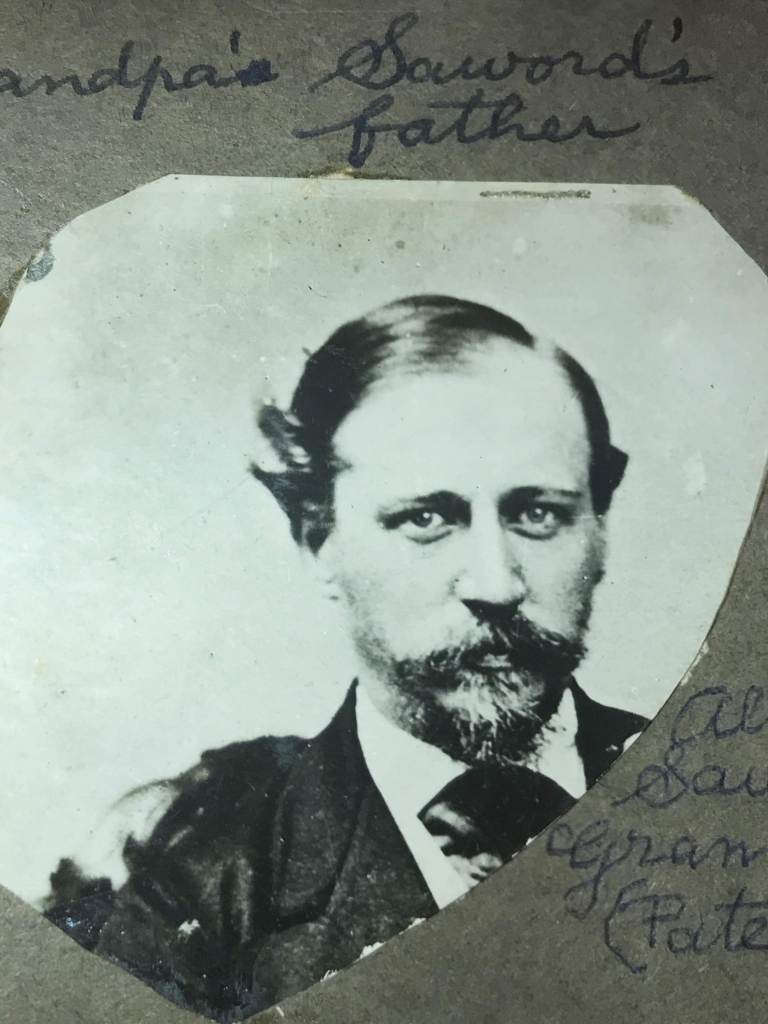





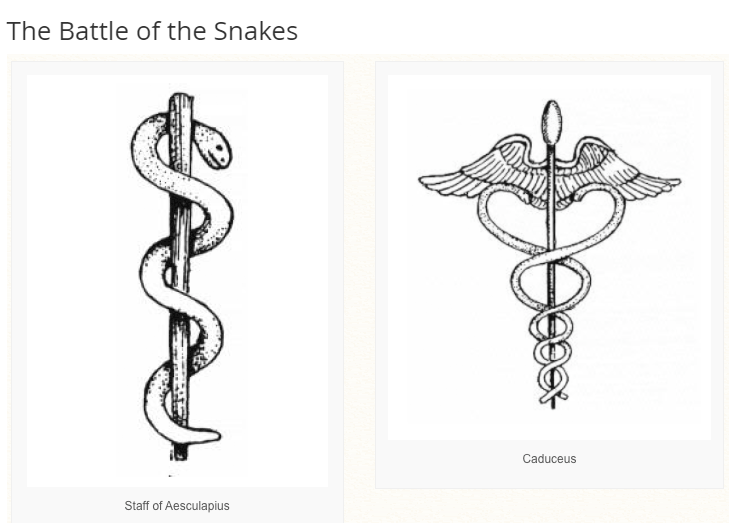
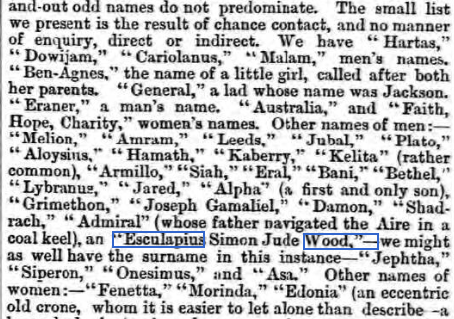


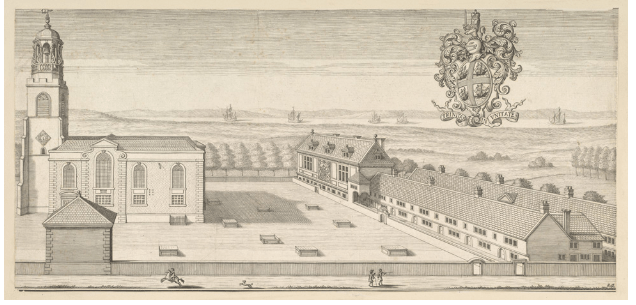
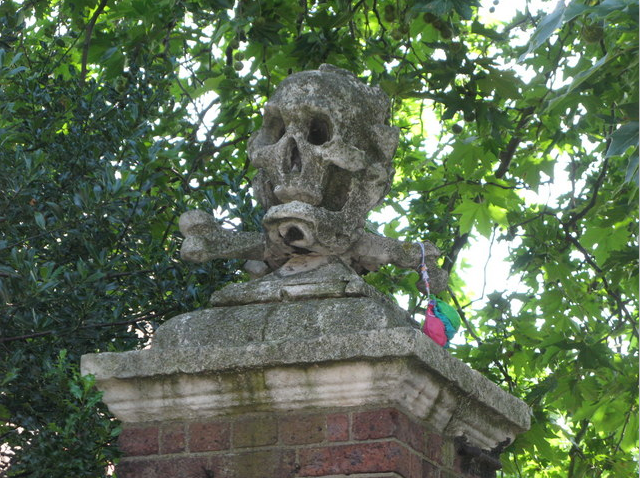


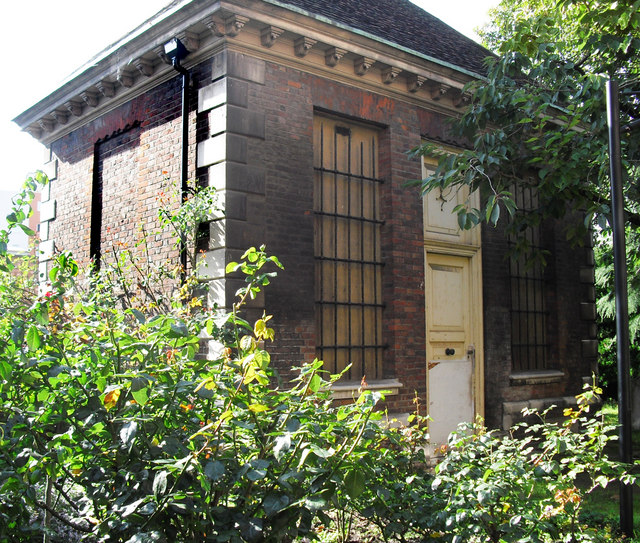
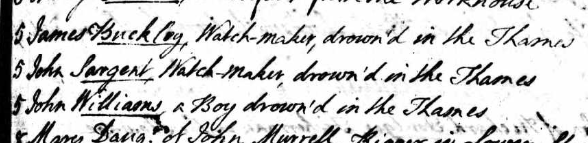
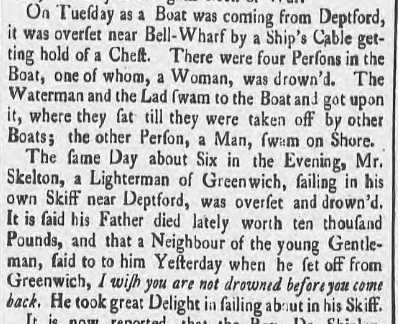
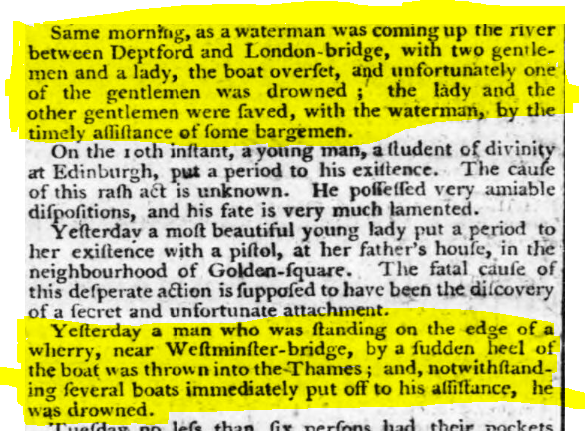
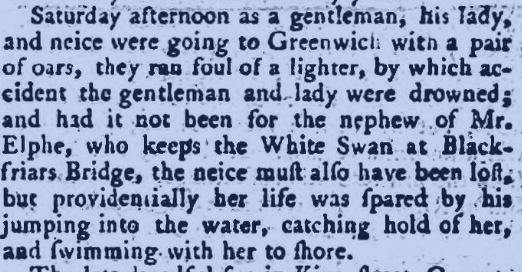


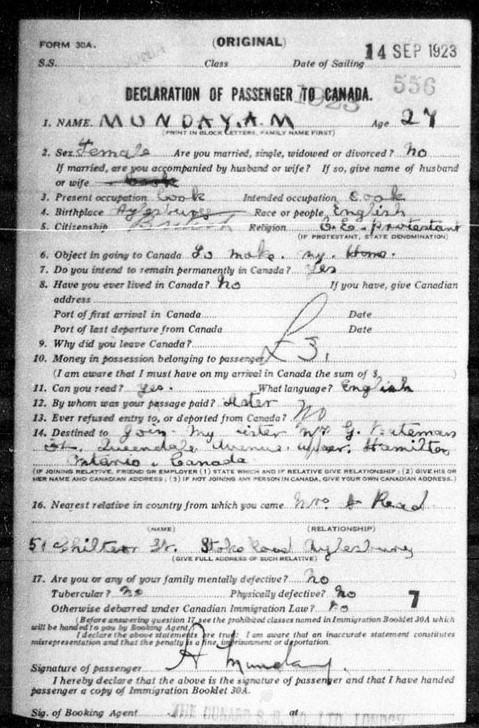
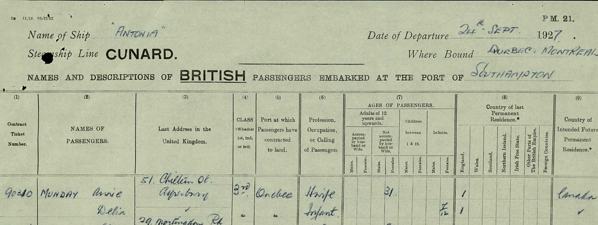
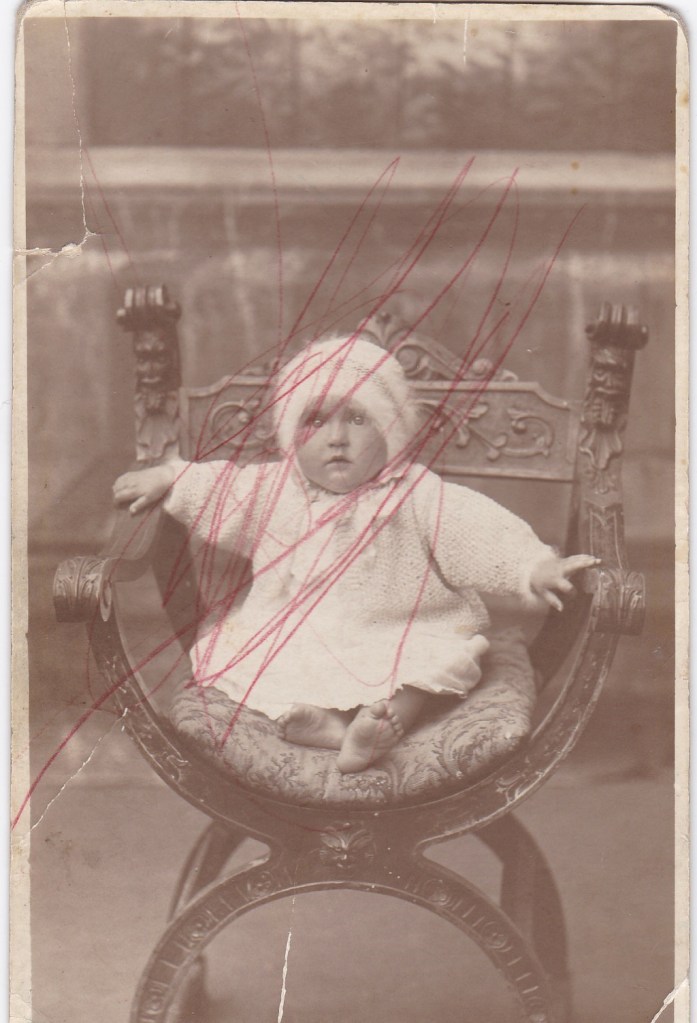

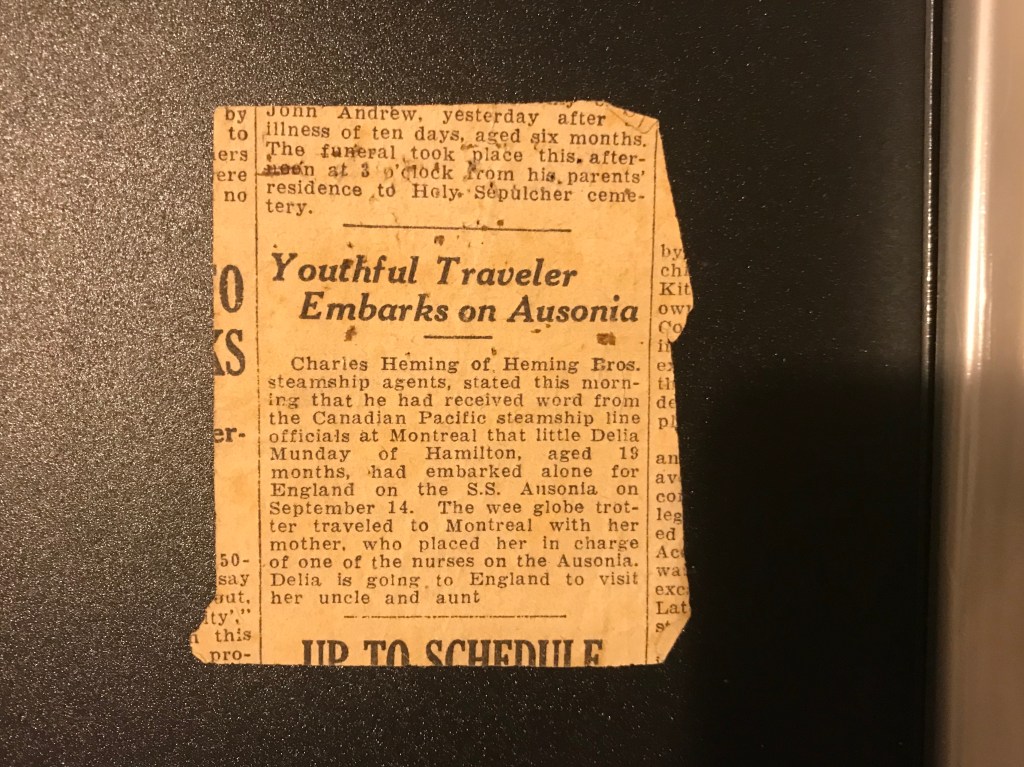

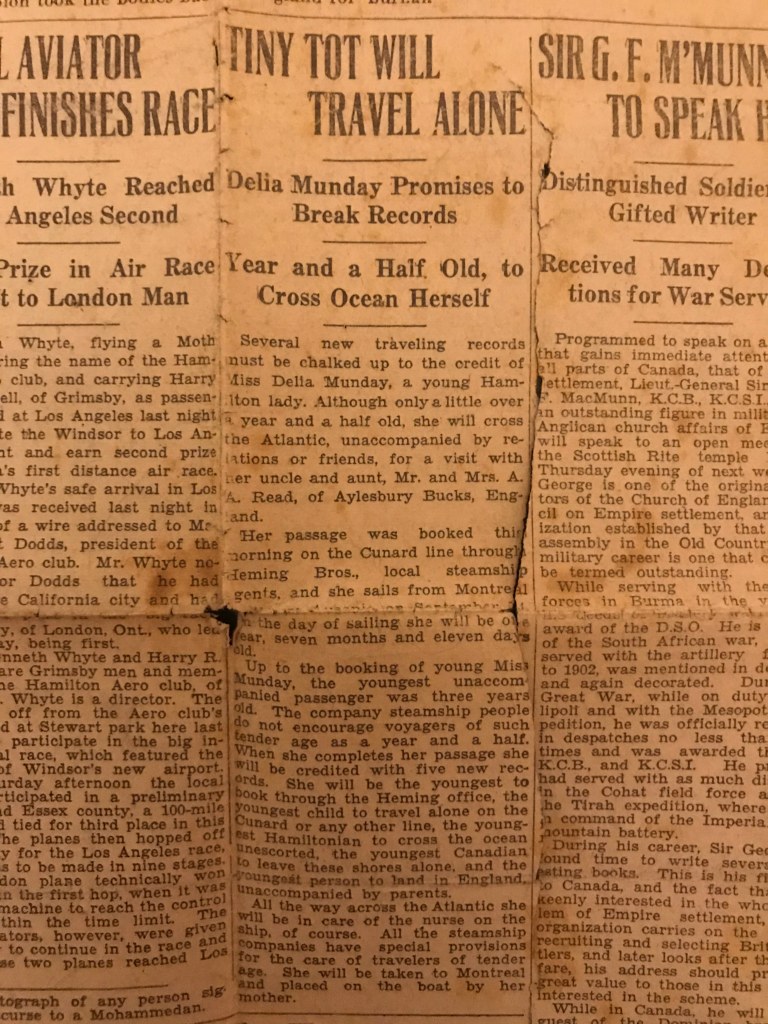

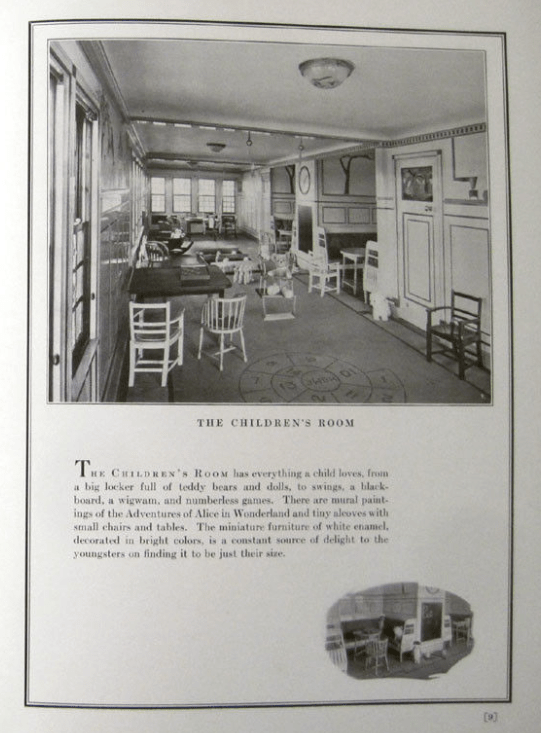

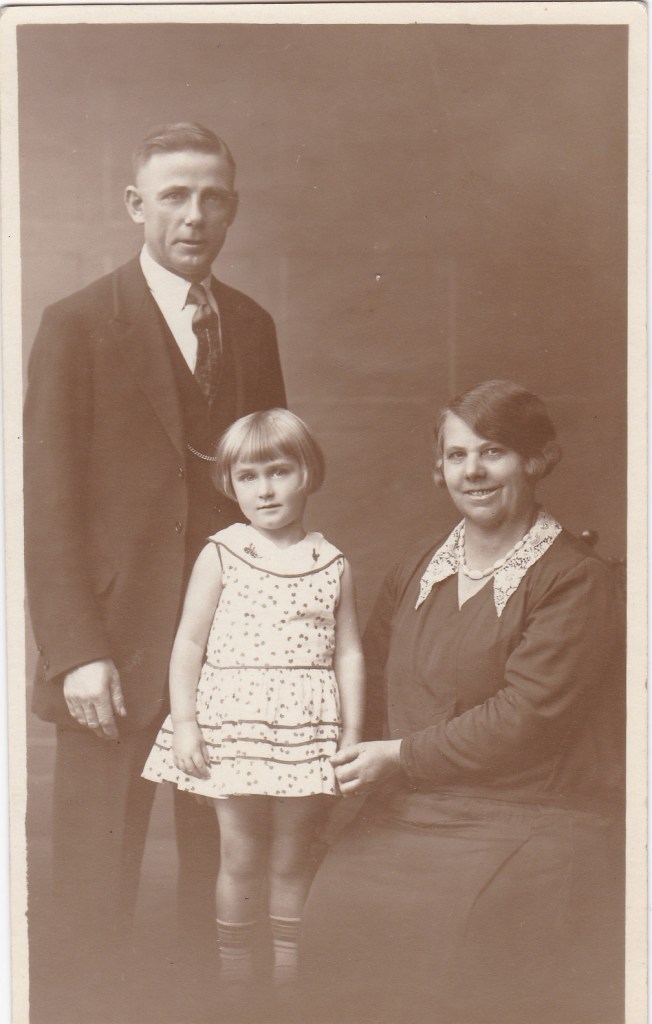


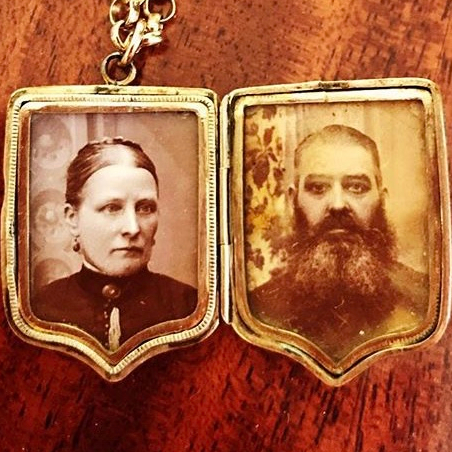


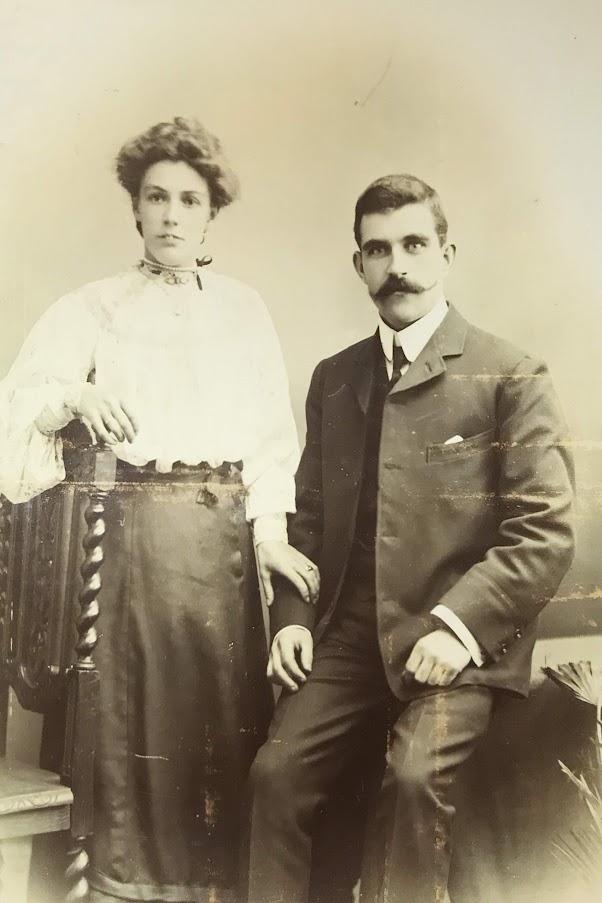


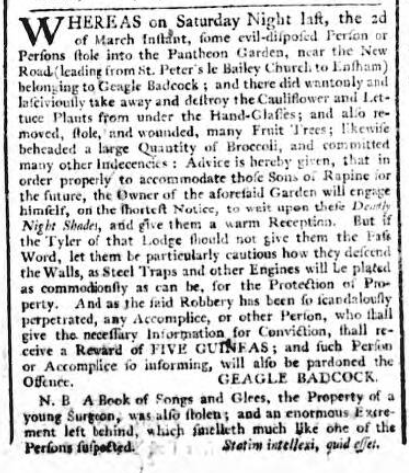


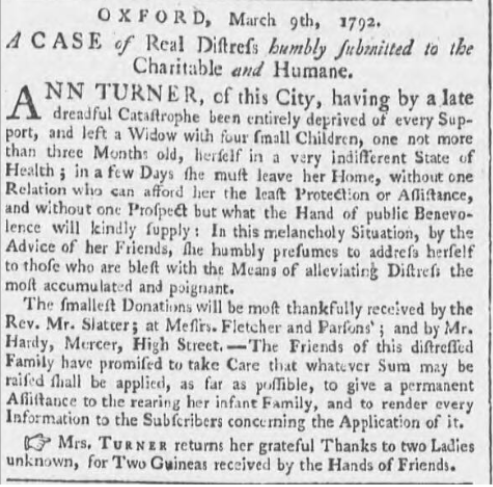

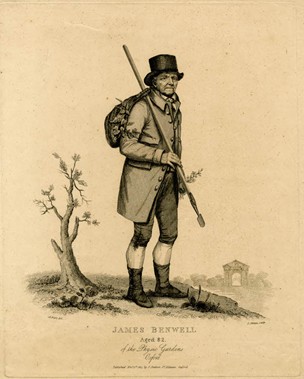



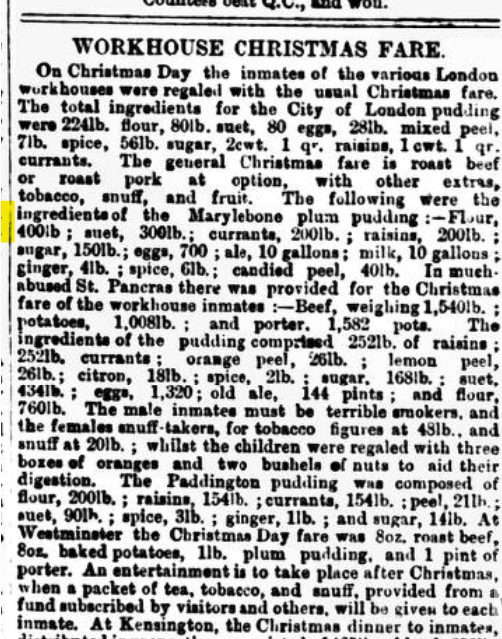
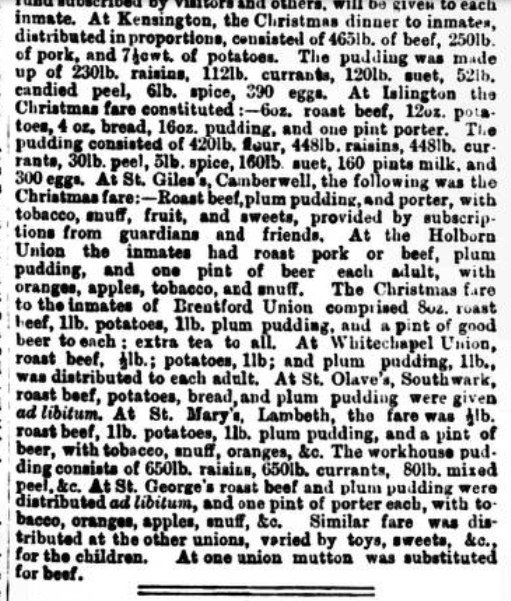


 Dig Up Your Ancestors