A cautionary tale of four Fannies

Made you look! But seriously, this really is a post about four women called Fanny (well, technically, they were all called Frances, but the nickname ‘Fanny’ appears in several records). As for why it’s a cautionary tale, you’ll have to read on to find out…

Two Wives

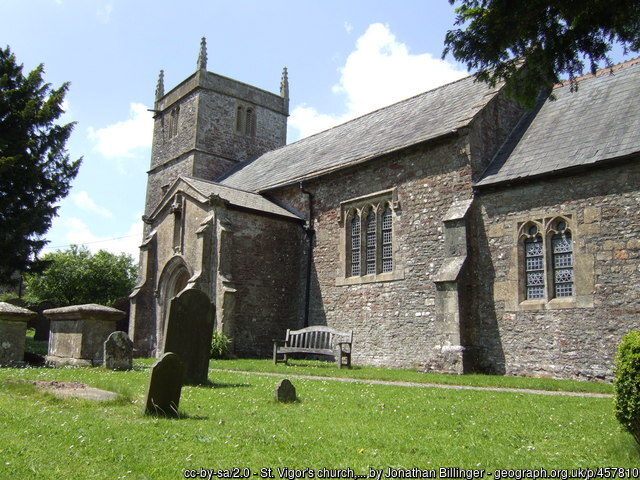
I was recently asked by a client to research the life of Charles Gordon GRAY (c. 1760-1822), whose monument can be seen on the wall of St Vigor’s, Stratton-on-the-Fosse, Somerset. I unearthed a wealth of information about him, but wanted to find out more about his wife, Frances, who is also mentioned briefly on the monument. All that the inscription revealed about Frances Gray was that she died on 6 January 1856, in her 85th year โ€” details that matched the death registration index entry โ€” meaning she must have been born in about 1770.

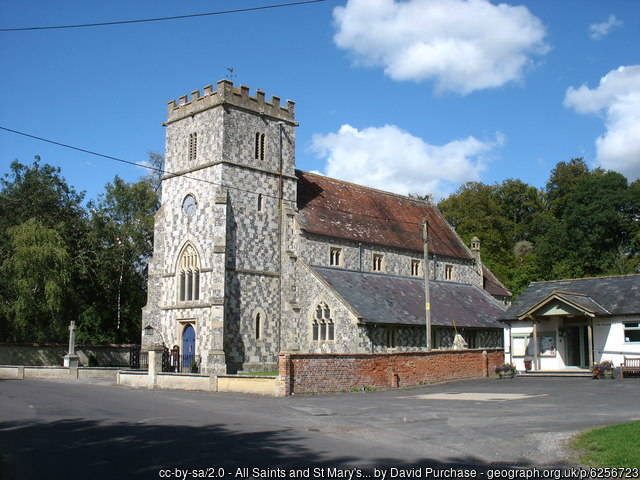
Searches for a marriage record produced, rather puzzlingly, two marriage register entries between Charles Gordon Gray and Frances HUGHES, 11 years apart. Since I was able to view digitised images of the parish registers for both, I confirmed that they were definitely marriage register entries rather than records of banns or bonds for marriages that had never actually taken place. The first marriage was held on 10 October 1782 in the parish church of Chitterne, Wiltshire. The second, on 30 April 1793 in Stratton-on-the-Fosse. Both marriages were solemnised by licence.
I compared the marriage register entries. Neither included any information about marital status. The wife’s name in both was ‘Frances Hughes’, and in both registers, Frances signed her own name. Frances’s signatures are not identical, but neither are Charles’s.
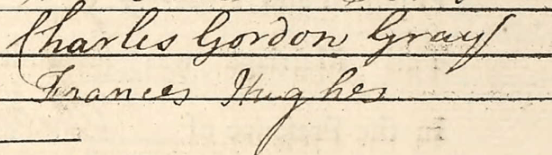
Signatures of bride and groom in marriage register, Chitterne, 1782
‘Wiltshire, England, Church of England Marriages and Banns, 1754-1924’, Ancestry [accessed 4 Oct 2026].
Original record: Wiltshire and Swindon Heritage Centre, Ref: 1109/1b.
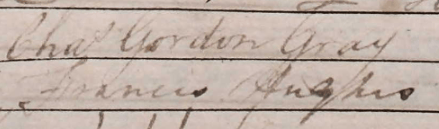
Signatures of bride and groom in marriage register, Stratton, 1793
‘Somerset, England, Marriage Registers, Bonds and Allegations, 1754-1924’, Ancestry [accessed 4 Oct 2026].
Original record: South West Heritage Trust, Ref: D/P/Str.on.F./2/1/4.

In 1782, Charles was a resident of the parish of Chitterne, where the marriage took place, and Frances of Warminster. In 1793, Charles was of Hill Deverill in Wiltshire, and Frances of Stratton-on-the-Fosse, where the marriage took place. There’s no mention of parental consent in either record. The first marriage had four witnesses, including a possible relation, John Hughes, and the second had two witnesses.

Glancing at some other online family trees that included Charles Gordon Gray, I saw that all of them had added both marriage records to his profile, and to the profile of his wife. This wasn’t surprising, since Ancestry Hints were also enticing me to add both of the records to Charles’s and Frances’s profiles. But a couple did not usually marry twice. Something was clearly amiss. Not only that, but if Frances was indeed born in about 1770, she would only have been 12 at the time of the first marriage. 12 was the minimum legal age for a girl to marry, but marriage at such a young age was highly unusual.

I began to ask myself some questions…

  • Could one of the marriages have been to a different Charles Gordon Gray?

No. The only other men with that unusual name I had come across in my research were his son (b. c. 1785) and his grandson (b. 1823). His son was only a young child in 1793, so cannot have been the groom in the second marriage.

  • What could the baptisms of their children tell me?

I had located baptisms of 10 children to Charles Gordon Gray and Frances Gray between 1783 and 1810. In 1783, Frances would have been about 16. There was a noticeable nine-year gap between the second baptism in 1785 and the third in 1794 (a year after the second marriage) but I knew that Charles conducted his business overseas, so could have been absent from home for long periods.

  • What could censuses reveal about Frances’s age?

Since Frances Gray died in 1856, she would have been enumerated in the 1841 and 1851 censuses. Sure enough, I was able to find entries for Frances: In 1841 she was living in Stratton House, Stratton-on-the-Fosse โ€” financially independent, aged 70 (per the age-rounding rules for that census she could have been between 70 and 74), and born in the same county as her residence (Somerset). In 1851, she was still in Stratton, aged 81, a Gentlewoman, b. Abingdon Street, Westminster. These ages matched her reported age at death. Although possible that she was consistently lying about her age, it was unpleasant to consider the alternative possibility that she was telling the truth, and had been just a child when she married an adult man 10 years her senior.

  • What possible reasons could there have been for two marriage ceremonies?

Had Frances eloped without parental consent the first time around and pretended to be of full age? (It would surely have been difficult to convince a clergyman that she was 21, but a bribe might have helped persuade him.) Had the first ceremony later been found to be invalid? Could the gap in baptisms have been due to an enforced separation until she was old enough to marry Charles legally? By 1793, when the second marriage took place, she would have been about 23. It was a reasonable theory, but soon ruled out…

  • Were the marriages reported in newspapers?

Yes. Both were reported in regional newspapers (see below). This makes it highly unlikely that Frances had married without parental consent.

Bath Journal, 14 October 1782
Findmypast [accessed 10 Jun 2026]. Content provided by THE BRITISH LIBRARY BOARD. ALL
RIGHTS RESERVED.

Bath Chronicle and Weekly Gazette, 16 May 1793
Findmypast [accessed 10 Jun 2026]. Image ยฉ Reach PLC. Image created courtesy of THE
BRITISH LIBRARY BOARD.

So far, I hadn’t established a reason for two ceremonies. However, both marriages were performed by licence, so my next step was to see if bonds and allegations (records required to apply for a licence from the diocese) had survived. These records would have been submitted to Salisbury Diocese for the first marriage and Bath and Wells for the second. Fortunately, some of these documents have survived for both marriages. And as luck would have it, they can be found online โ€” a transcription of the bond of 1782 is available in Findmypast, and the allegation and bond of 1793 have been digitised and made available via Ancestry. These records contain some very different details, which I have summarised below.

Year of marriageFrances’s ageCharles’s ageFrances’s marital statusCharles’s marital statusBondsman
178219 – married with father’s consentFullSpinsterBachelorJohn Hughes of Warminster (bride’s father?)
1793Full (21+)FullSpinsterWidowerEdw[ard] BOWEN of St Michael Bath China Dealer

I couldn’t review the original document of 1782 to check the transcribed information, but if Frances was a minor of 19, she would have been born c. 1763 โ€” seven years earlier than other records had inferred. Lying about her age at that time or later in life was still a possibility. However, Frances’s father had consented to her marriage, which confirms that the couple hadn’t eloped. And if Charles and Frances had remarried to legitimise their relationship for any reason, I couldn’t see any advantage to his claming to be a widower.

Considering this evidence, it now seemed more likely that the long childless gap after 1785 was caused by the death of his first wife… which meant that Charles had two wives, both called Frances, and both with the maiden name Hughes. If so, there must be a burial record for the first Frances Gray.

The first marriage and first two baptisms had taken place in Chitterne, but the parish register for Chitterne had no other entries for the family, and a broad search in Ancestry found no other likely records. However, a search for burials in Wiltshire parish registers via Findmypast found a transcribed burial record for Fanny Gray, aged 23, wife of Charles Gordon [Gray], in Warminster, 13 April 1786. Tragically, searching for baptisms in the same database revealed that the day after Fanny’s burial, a daughter of Charles and Fanny, Sarah Maria Gray, was baptised in the same place. I was then able to browse the Warminster registers in Ancestry to find the digitised versions of these records (which for some reason hadn’t surfaced in Ancestry searches or Hints).
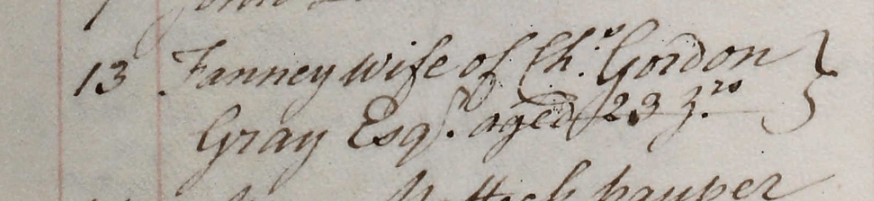
Burial of ‘Fanney wife of Chs. Gordon Gray Esq. aged 23 yrs.’ Warminster, 13 April 1786.
‘Wiltshire, England, Church of England Baptisms, Marriages and Burials, 1538-1812’, Ancestry [accessed 4 Oct 2026].
Original record: Wiltshire and Swindon History Centre, Ref: 2144/24.

Baptism of Sarah Maria Gray, Warminster, 14 April 1786.
‘Wiltshire, England, Church of England Baptisms, Marriages and Burials, 1538-1812’, Ancestry [accessed 4 Oct 2026].
Original record: Wiltshire and Swindon History Centre, Ref: 2144/7.

I now knew for sure that Charles Gordon Gray had married two women called Frances Hughes. The first Frances (Fanny) was born in about 1763 and sadly died after childbirth in 1786. The second Frances was born in about 1770 in Westminster and was buried at Stratton-on-the-Fosse in 1856, aged 85.

Burial of Frances Gray, Stratton-on-the-Fosse, 12 Jan 1856.
‘Somerset, England, Church of England Burials, 1813-1924’, Ancestry [accessed 4 Oct 2026].
Original record: South West Heritage Trust, Ref: D/P/Str.on.F/2/1/8.

It was quite common in wealthy families to marry a relation, so I wondered if Charles might have remarried to his wife’s cousin. The first Frances was the daughter of John Hughes, an attorney of Warminster. I was able to find a baptism of his second wife in Westminster, 1769, to William Hughes and Elizabeth Bentley Hughes (nรฉe CUMBERLAND) and I discovered, through their marriage bond of 1759, that Elizabeth’s parish of residence was Kilmersdon, Somerset (close to Stratton-on-the-Fosse). So, Charles’s second wife had a local Somerset connection. However, William Hughes was living in Middlesex at the time of his marriage. Even if he also came from Kilmersdon originally, that was 15 miles from Warminster.

I hoped that the fathers’ Wills would yield some clues. The Will of John Hughes included a bequest of ยฃ200 to ‘Frances Hughes, wife of Charles Gordon Gray Esq.’ However, she never received the money, because she died two years before her father. No further family names were included. No Will has yet been found for William Hughes.

Hughes is a very common name, so the wives’ identical names could simply be a bizarre coincidence. But evidence from various records leaves no doubt that they were two separate individuals, despite all of the Ancestry Hints to the contrary!


Two Daughters

Before discovering that Charles Gordon Gray had two wives with the same name, I had found that Charles Gordon Gray and Frances Gray baptised a daughter called Frances Gray in 1783 and a daughter called Frances Mary Georgiana Gray in 1794. Since both daughters were baptised with the first name Frances, I assumed that the first child had died. However, the few records I was able to find about Frances Gray as an adult just didn’t add up.

Baptism register entry for Frances Gray, Chitterne, Wiltshire, 15 Aug 1783.
โ€˜Wiltshire, England, Church of England Baptisms, Marriages and Burials, 1538-1812โ€™. Ancestry [accessed 3 Oct 2026].
Original record: Wiltshire and Swindon History Centre, Reference: 1109/1.
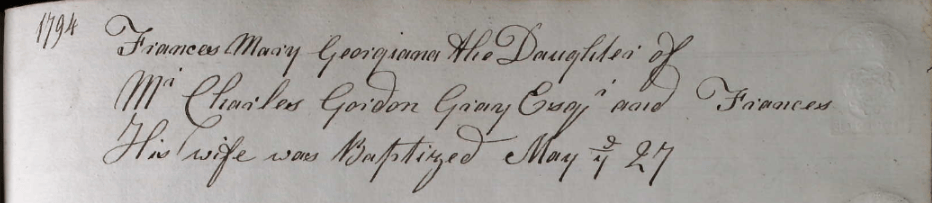
Baptism register entry for Frances Mary Georgiana Gray, Maiden Bradley, Wiltshire, 27 May 1794.
โ€˜Wiltshire, England, Church of England Baptisms, Marriages and Burials, 1538-1812โ€™. Ancestry [accessed 3 Oct 2026].
Original record: Wiltshire and Swindon History Centre, Reference: 18/4.

I had a marriage record for Fanny Gray and William MERCER at Stratton-on-the-Fosse in June 1814. Fanny was a spinster of that parish, and they had married by licence with consent of parents. A marriage in 1814 seemed to fit perfectly with a birth in about 1793. No middle names were included for Frances, but the entry of her name as ‘Fanny’ suggested a rather lax approach to filling out the marriage register! The marriage register stated that William Mercer was a Merchant of St Olave’s Old Jewry. I was able to find two baptisms for children of William and Fanny Mercer: at Olave Jewry, 1817, William Remington Mercer and at Stratton, 1820, Charles Alexander Mercer.
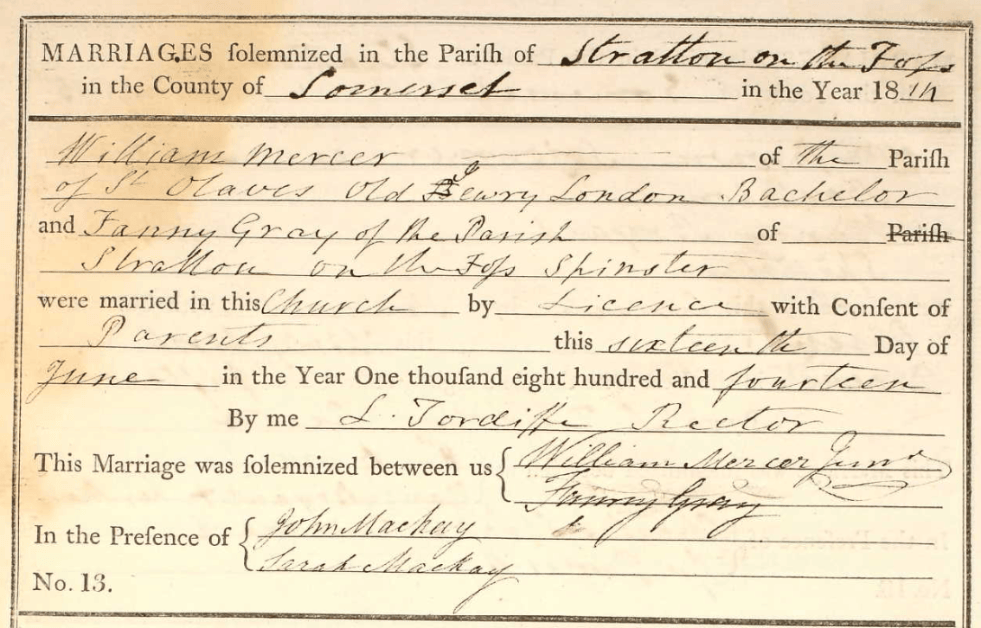
Marriage of Fanny Gray and William Mercer, Stratton-on-the-Fosse, 16 June 1814.
‘Somerset, England, Marriage Registers, Bonds and Allegations, 1754-1924’, Ancestry [accessed 4 Oct 2026].
Original record: South West Heritage Trust. Ref: D/P/Str.on.F./2/1/7.

However, I also had a burial, corresponding death registration index and a newspaper announcement for ‘Frances Mary Georgiana Gray’ in 1850. The first names were exactly right, and the age at death, 56, also fitted. Furthermore, the newspaper announcement’s description of her as the ‘third daughter’ matched the position of Frances Mary Georgiana, following her older sisters Frances and Sarah.

But why was her name at death Frances Gray, and not Frances Mercer? Could this have been a rare case of divorce from the early 19th century? If so, I couldn’t find any evidence of a divorce taking place.
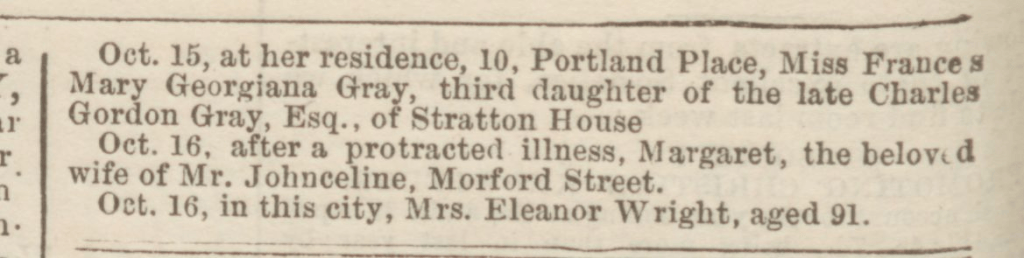
‘Deaths’, Bath Chronicle and Weekly Gazette, Thursday, 17 October 1850.
Via Findmypast [accessed 4 Oct 2026]. Image ยฉ Reach PLC. Image created courtesy of THE BRITISH LIBRARY BOARD.

Just as other Ancestry trees had only shown one wife for Charles, many of them had only included one daughter called Frances (or Frances Mary Georgiana) Gray, and had added the marriage and death to that one profile. Even though I had established that there were two daughters with that name, Ancestry Hints kept encouraging me to add the two events to both of their profiles, despite the records being clearly incompatible.

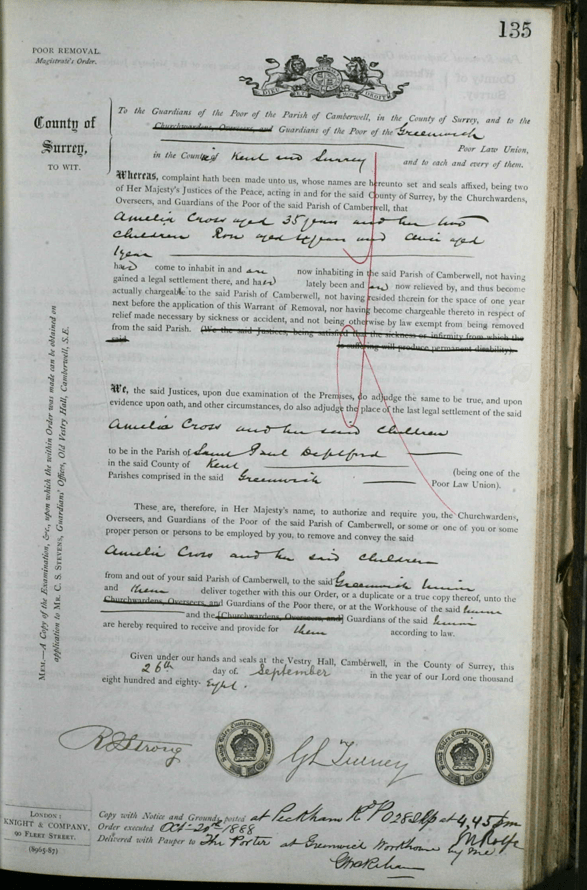
Charles Gordon Gray’s Will, available online, was the key to solving this puzzle. Charles left equal shares of his property to his children, including ‘Frances the Wife of William Mercer Esquire’ and ‘Mary Frances Gray’. So, both of Charles’s daughters named Frances survived to adulthood. The first, Frances Gray, known as Fanny, married William Mercer, and the second, Frances Mary Georgiana Gray, remained a spinster. The younger sister was referred to in the Will as ‘Mary Frances’ rather than ‘Frances Mary’; it could have been the clerk’s error, or perhaps, even though she was baptised ‘Frances Mary’, she used the first name ‘Mary’ to avoid confusion with her older half-sister.

Excerpt from Will of Charles Gordon Gray, proved 13 Jan 1823 (registered copy of original Will).
โ€˜England & Wales, Prerogative Court of Canterbury Wills, 1384-1858โ€™. Ancestry [accessed 15
Jul 2026]. Original record: The National Archives (UK), reference: PROB 11/1665/159.

A set of mortgage documents of 1835 for property inherited by Charles Gordon Gray’s children (held at The National Archives) show the different legal processes that applied to the two Franceses: Frances Mary Georgiana Gray, a single woman, was assumed to have agreed to the terms independently (although it was clear that she and her other unmarried sisters were largely represented by their only surviving brother). In contrast, the married daughters of Charles Gordon Gray, including ‘Frances otherwise Fanny’ Mercer, were each interviewed by a magistrate separately from their husbands to ensure that they had a full understanding of the agreement and gave their consent of their own free will.
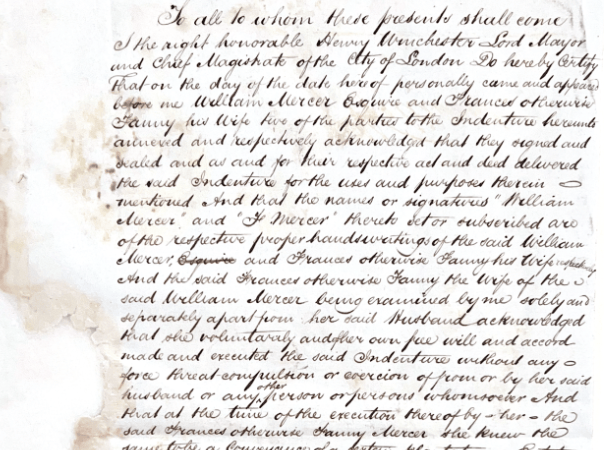
Excerpt of an Affidavit for a mortgage, signed by William and Fanny Mercer and Henry Winchester, Lord Mayor and Chief Magistrate of the City of London, 17 June 1835.
The National Archives (UK). Ref: PWLB 11/85/5.

Once I also knew that Charles had married twice, I realised that Frances ‘Fanny’ Gray/Mercer was the eldest daughter of Charles’s first wife, whereas Frances Mary Georgiana Gray was the eldest daughter of Charles’s second wife.

Hopefully, a family tree will help to clarify these relationships:
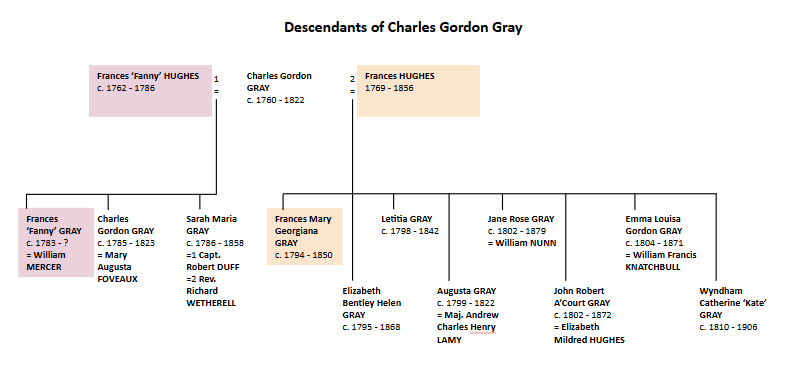

A Tale of Four Frances Grays

My original title was slightly misleading. To begin with I assumed that the use of Frances or Fanny for one woman was interchangeable. But when I looked more closely at the records, I noticed that Charles’s first wife, and the daughter named after her, both used the name ‘Fanny’ in multiple documents; in contrast, all the records I’ve found for his second wife and younger daughter consistently used ‘Frances’. It would be easy to ignore this additional evidence pointing to separate people, who may well have chosen to differentiate themselves from each other by using their formal name or nickname.

Four Individual Lives

Once I had established the existence of four individual women, I hoped to gather more details about their lives. I’ve been able to add more colour to the life of Charles’s second wife, Frances Hughes/Gray (c. 1769-1856). She had some illustrious ancestors and relations on her maternal side, including bishops, academics, writers and philosophers. Sadly, Frances’s mother died the year after she was born, and she was raised, along with six sisters, by her mother’s sister Mary ALCOCK (nรฉe Cumberland). Alcock was a vicar’s wife, but her husband’s mental health problems led to the breakdown of their marriage, and by the time she took in her seven nieces she lived alone in Bath, where she was known as a poet, essayist and philanthropist. When Mary died in 1798 she made a touching bequest to Frances, leaving her ‘as a token of remembrance my brilliant diamond ring set round with small ones also my yellow diamond ring set round with small rubies and my pearl earrings I also give to my said niece my longest framed drawing’. While researching Charles, I had discovered that he subscribed to a posthumous book of Mary Alcock’s poetry in 1799, while Mrs Gray had subscribed to two copies. Only after researching Frances’s own background did I realise that Mary Alcock was essentially Frances’s mother, having raised her since she was a baby.
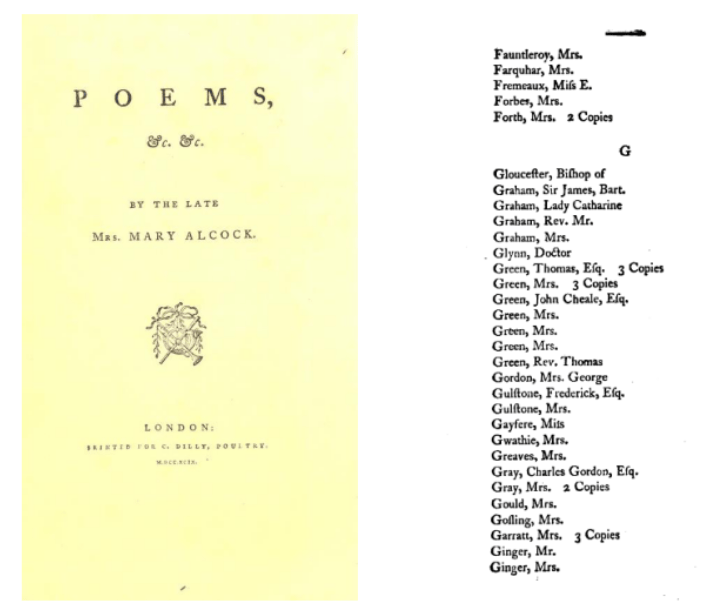
Front cover of Poems, etc. etc. by the Late Mrs. Mary Alcock
and inside, Charles Gordon Gray and Mrs Gray (presumably Frances) in the list of subscribers.
Via Internet Archive. Whole book available online at
https://archive.org/details/poemsetcetc00alcoiala/page/n3/mode/2up [accessed 11 Jun 2026].

Conclusion

Ancestry Hints and many online family trees would lead us to believe that Charles had one wife called Frances Hughes and one daughter called Frances Gray. In fact, he had two of each.

The records of these four women offer excellent examples of how ignoring conflicting evidence can lead to mistakenly merging two individual lives into one. This does of course lead to errors in our family tree, but it also means that we miss out on the pleasure of investigating the mystery! In my opinion, the facts that just don’t seem to fit are some of the puzzles that make researching family history so fun and rewarding. To make sense of them, we need to expand our research into other records, other databases, and sometimes to archives, which is a lot more satisfying than simply accepting a suggested record.

Furthermore, the lives of women who lived centuries ago are already much more difficult to trace than men’s, but can be absolutely fascinating; they deserve the additional effort by family historians to question hints, delve deeper, and tell their individual stories.


Other titles considered for this blog:

  • The Fanny Trap
  • Help! One of my Fannies is missing!
  • The Fanny-tastic Four
  • The Great Fanny Fiasco
  • No Fannies left behind

Some more Fannies who feature in my blogs:


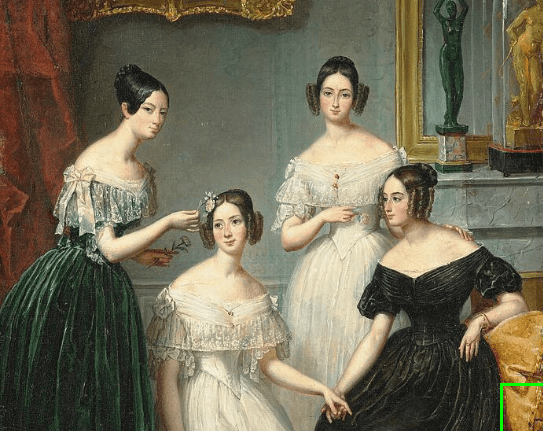
The main image for this blog is taken from a Group portrait of four young ladies in an interior by Francois Quesnel (public domain).
A History of Forge Cottage, Drayton: Part 2

The war widow, the cadet, the geodesist and the history buff

The land and property now known as ‘Forge Cottage’ in Drayton, Oxfordshire (my home) was rented, owned or occupied by one family, the Hydes, for more than a century. The Hyde family โ€” Drayton’s blacksmiths โ€” began renting the plot from the Lord of the Manor before 1815, purchased it freehold for use as a garden by 1829, and built a workshop and house there by 1851. Following the death of the original owner, John Hyde, in 1834, his son, grandsons and great grandsons worked at the village smithy on this site. The last of the Hyde blacksmiths left in the 1890s. In Part 1, I shared the story of the Hydes of Forge Cottage, up to the end of the nineteenth century.

By the turn of the century, the owner was Charles Parker โ€” son of the late Elizabeth Parker (nรฉe Hyde) โ€” and the resident blacksmith was Charles Fisher. In the 126 years since, at least ten more families have made Forge Cottage their home.

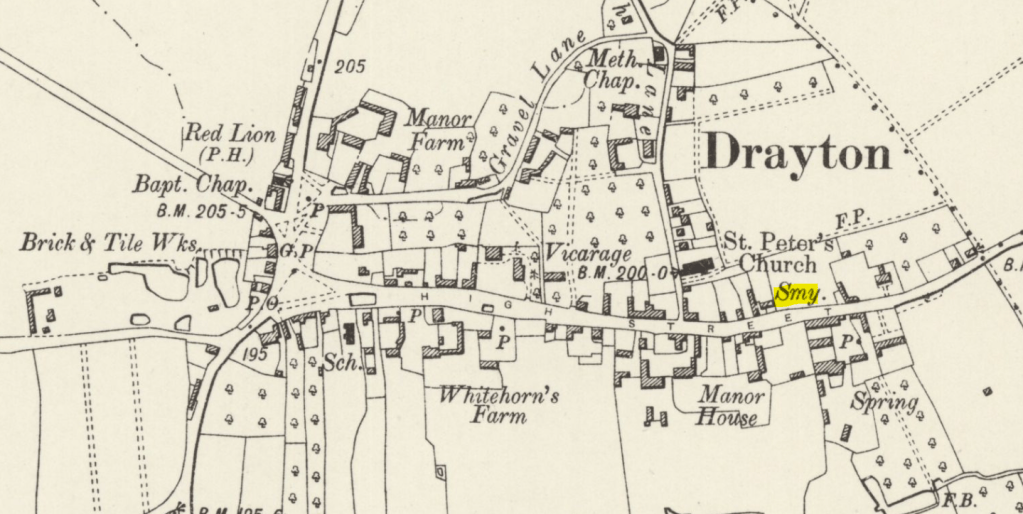
OS Map (six inch), Oxfordshire Sheet XLV.SW. Revised: 1897 to 1898, Published: 1900. National Library of Scotland Map Images. Licensed under CC BY 4.0. Available at: https://maps.nls.uk/view/101458083.

The Fishers (tenants of cottage c. 1898-bef. 1910 & of workshop c. 1898-1920s?)

In the 1901 census, my house โ€” numbered 38 High Street โ€” was occupied by the Fisher family. Blacksmith Charles Fisher was 33, and had been born in Kintbury, between Newbury and Hungerford. His wife, Annie Louisa (nรฉe Dawson), aged 27, was from Didcot. Their children were Ethel Sarah, 4, Mabel Louise, 3, and Dorothy May, 1. Ethel and Mabel were born in Warfield, near Bracknell, but Dorothy was born in Drayton, so the family must have relocated to Drayton between Mabel’s birth in Q4 1897, and Dorothy’s birth on 22 September 1899. Dorothy’s birth certificate shows that Charles was a Master Blacksmith.

Birth certificate of Dorothy Fisher (digital download from GRO).

In 1891, Charles had been lodging in a farm in Warfield, 30 miles from his birthplace of Kintbury, while working as a blacksmith. Charles wasn’t from a smithing family โ€” his father was an Ag Lab โ€” so he might have been apprenticed to a blacksmith there. Charles and Annie married in Wallingford in 1895. In October of the following year, Charles, a smith of Warfield, took part in a horse shoeing competition run by Berkshire Farriery School at a veterinary infirmary in Reading. ‘The competition was open to smiths who had made not less than eight attendances in one of the Farriery Schools since August 3rd’.1 Charles won second prize in the cart horses category, taking home ยฃ2. Not long afterwards, the Fishers moved 28 miles (as the crow flies) to Drayton. Perhaps they heard about the opening at Drayton’s smithy through the Farriery School.

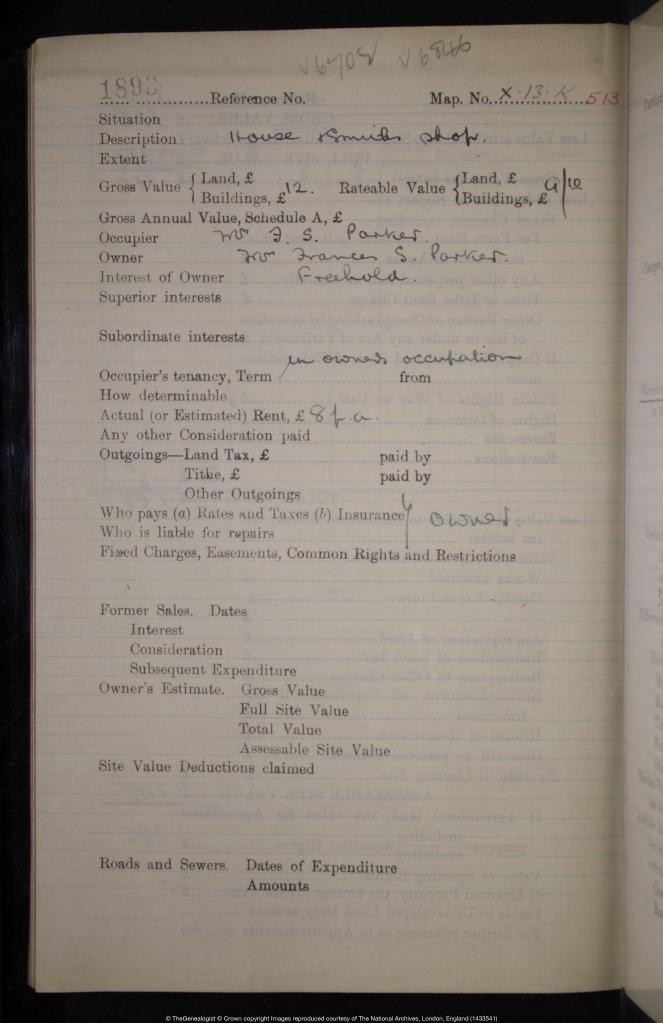
By 1910, the Fishers had moved out of the house; the ‘Domesday’ Valuation Survey of 1910 reveals that the ‘House & Smiths shop’ (valued at ยฃ130) was owned and occupied by Frances Parker. In the 1911 census, Frances was the occupant of ‘The Smithy’ โ€” the name then given to the cottage. (more about Frances below).

Valuation Field Book (p1) for Forge Cottage, Drayton (reference no. 1893), 1910. Image from The Genealogist.
Original record: The National Archives, IR 58.

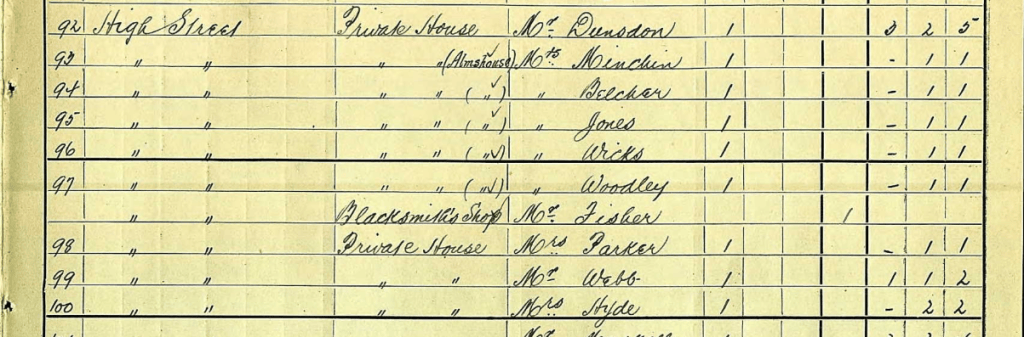
However, the household schedule in the census doesn’t give the full picture. If we also look at the 1911 enumerator’s census summary books (ESBs), we see that there is also an entry for the adjacent blacksmith’s shop, which was in fact still occupied by Mr Fisher. Meanwhile, the Fishers, now a family of nine, lived in a four-room property just around the corner, on Church Lane.

Census Summary, 1911 showing Forge Cottage as a private house and blacksmith’s shop. Ancestry [accessed 16 Sep 2026]. Original record: The National Archives, RG78/319, ED 4.
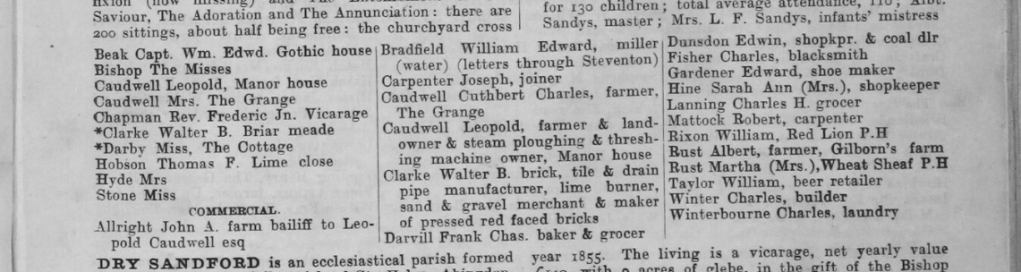
Charles Fisher, blacksmith, listed under Drayton in Kelly’s Directory, 1911

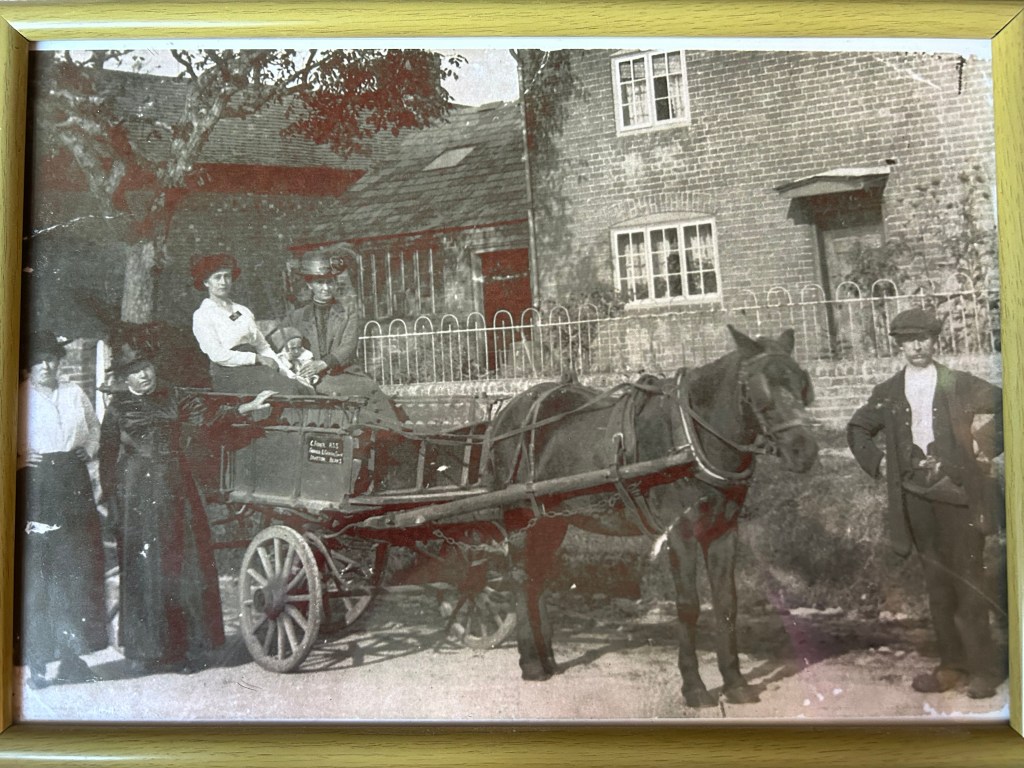
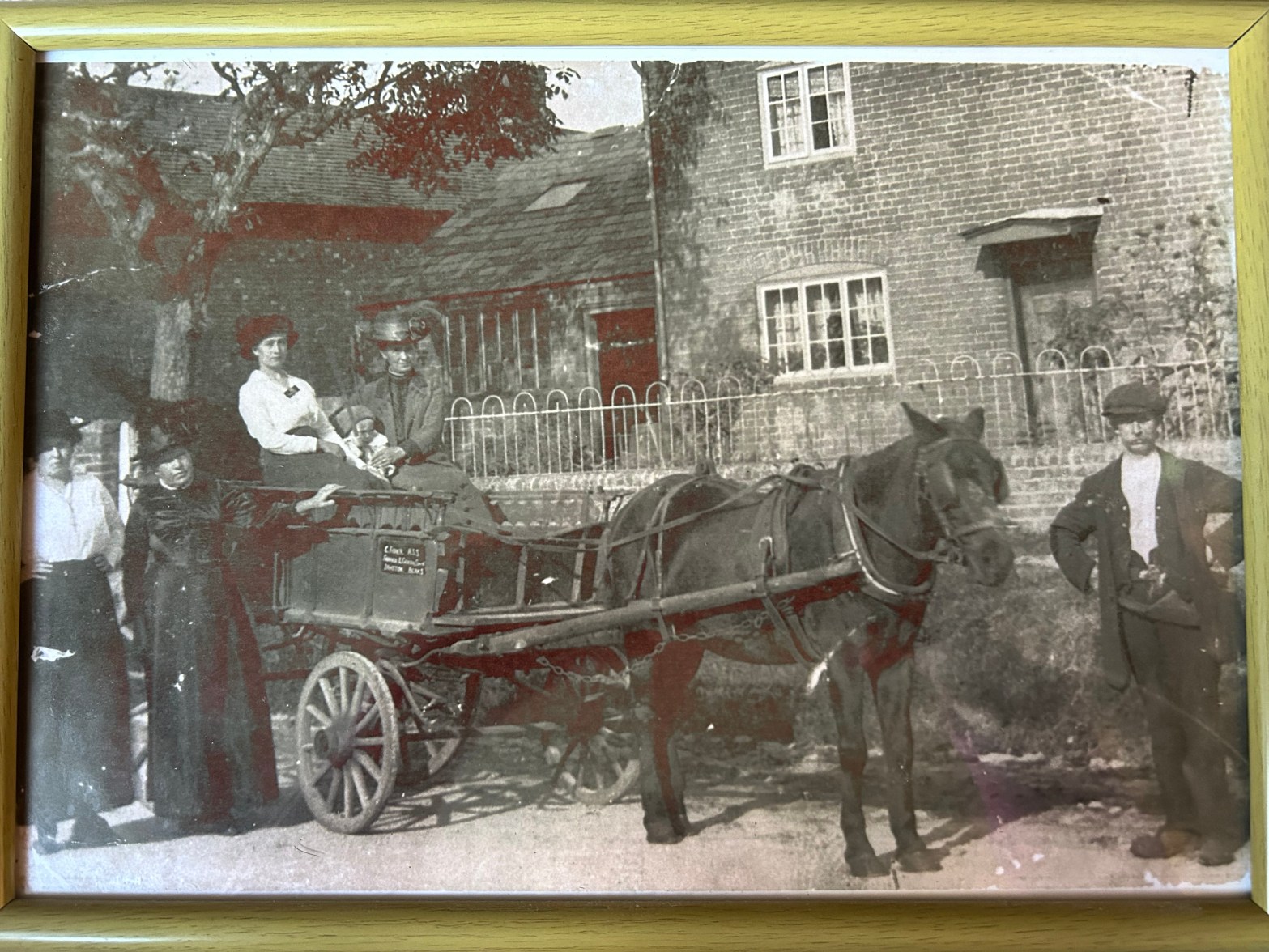
In 1988, two members of Drayton History Group interviewed Charles’s daughter Ethel, who was 92 years old, about her memories of Forge Cottage and the High Street in around 1900. Thanks to her extraordinary memory, I have a lively description of the cottage and blacksmith’s business. I particularly like picturing the thirsty carters having a beer while their horses were shoed (all car washes should offer the same service!) I am also incredibly lucky to have a copy of a photograph of the Fishers at about the same time, in front of Forge Cottage.

‘THE STORY OF HIGH STREET AS TOLD BY MRS ETHEL RUSSELL (nee FISHER)

Then came Forge Cottage where Annie and Charles Fisher lived with their family. He worked as the village blacksmith and Mrs Russell (his daughter) has vivid memories of the blacksmith’s shop. The cottage was on the right with the central doorway leading straight in and up the stairs. The blacksmithโ€™s shop was on the left with large doors opening outwards. On the right of the door was the sitting room, to the left was the kitchen with stone steps to the rear leading down to a cellar. Over the cellar was a kind of platform where sides of bacon and lard were stored. There was also a stone copper and a cask of beer. When the carters brought their horses for shoeing they needed to quench their thirsts! In front of the blacksmithโ€™s shop was a walnut tree to which the horses were tied whilst the shoeing was taking place. Between the tree and the wall of the Almshouses was a stone circle where the wheels of the wagons were laid to have their โ€˜tyresโ€™ fitted. The circle fitted the wheels exactly and there was a centre point for the hubs of the wheels. At the front, leaning against the Almshouse wall, was a penny-farthing bicycle on which the children were allowed to play. To the rear, behind the shop were two stables (again backing onto the Almshouse garden wall) and behind this a hay rick. In the other righthand corner was another huge walnut tree. Mrs Russell’s father Charles came from a strong Wesleyan family and had a lot to do with the Wesleyan chapel.‘

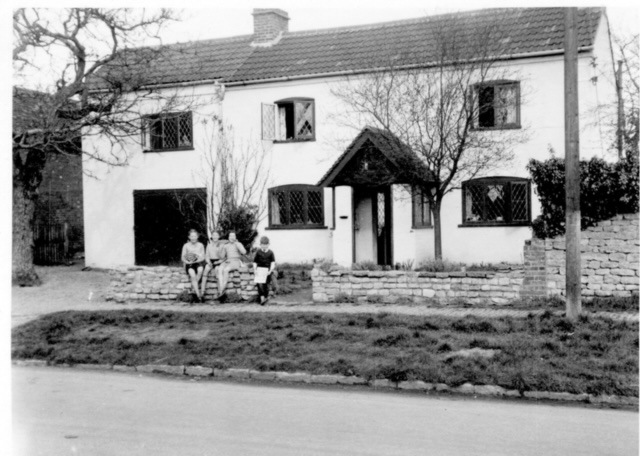
Unidentified members of the Fisher family in front of Forge Cottage. A label on the cart reads ‘C FISHER ASS Farrier & ? Drayton Berks’. The photograph appeared in the Drayton Chronicle, April 2007, but the original source is unknown.

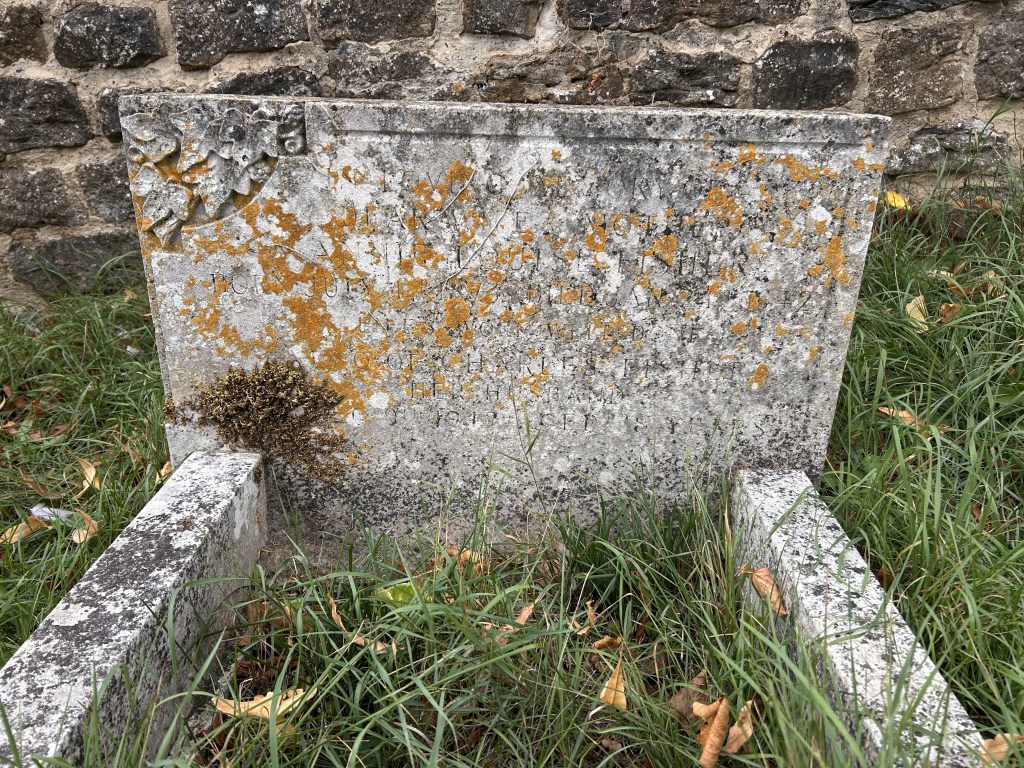
At the outbreak of WW2, Charles Fisher, almost 70 years old, was still a Master Blacksmith living at 12 Church Lane. By then, the smithy on this site was no longer in operation. I don’t know how long Charles continued to work here, but I believe he was the last blacksmith to do so. Charles’s wife Annie died in 1942, and Charles died in 1949. They share a gravestone in Drayton Churchyard, close to their former home and to the Wesleyan Chapel (which is now a private residence).

Gravestone of Annie Louisa and Charles Fisher, Drayton churchyard extension

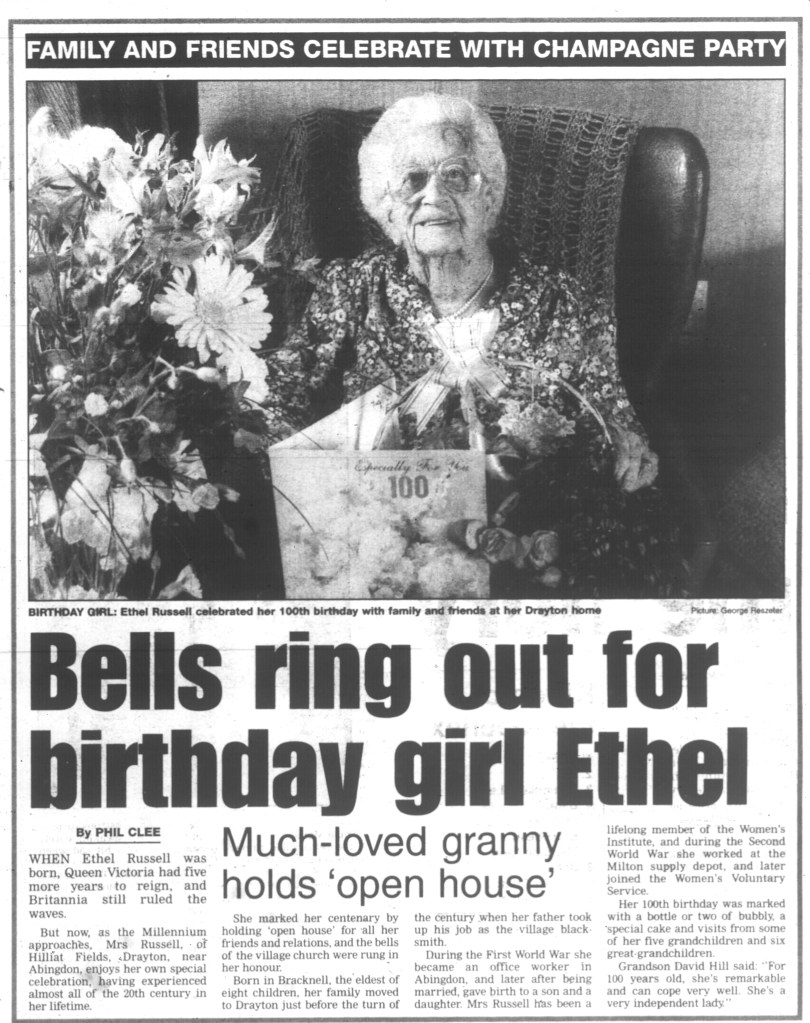
Mrs Ethel Russell lived to the age of 100; Drayton’s church bells were rung to celebrate her centenary on 17 May 1996. An article in the Oxford Mail reveals that she was an office worker during WW1 and in WW2 she worked at Milton Supply Depot and joined the Women’s Voluntary Service. Ethel died in 1997.

Oxford Mail, 18 May 1996 (image downloaded from microfilm at Oxfordshire History Centre)

The Parkers (owners, 1879-1914; residents, c. 1900s-1914)

Frances Sarah Parker (nรฉe Gammon) became the owner of the cottage and shop on the death of her husband, Charles, in 1906. Although they were living in Lambeth in 1901, the probate index record for Charles (below) gives his address as High Street Drayton, suggesting that they moved into the cottage between 1901 and 1906.

Frances, known as ‘Fanny’, was originally from Frant in Sussex, and had worked as a domestic servant in Tunbridge Wells (for Horatio and Thirza Stephens, grocers) before marrying mason Charles Parker in 1866. They had three sons: Arthur, b. 1866, Charles, b. 1872 and Henry, b. 1875. However, Arthur died in 1907.

Frances died at The Smithy on 1 March 1914. In her will she appointed her son Charles, a civil servant living in Balham, Surrey, as her executor. Frances instructed that her ‘freehold property situate in High Street Drayton’ should be sold, and the proceeds divided equally between Charles and Henry Parker.

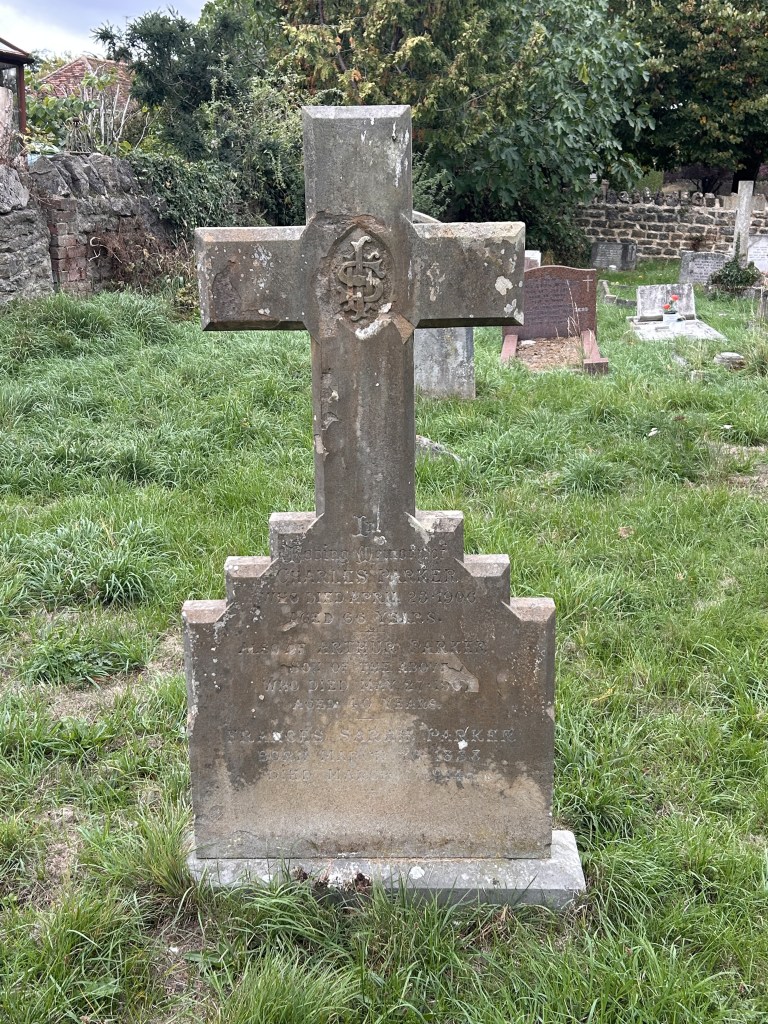
Charles and Frances Parker and their oldest son Arthur are buried in Drayton churchyard.

Gravestone of Charles, Frances and Arthur Parker, Drayton churchyard extension

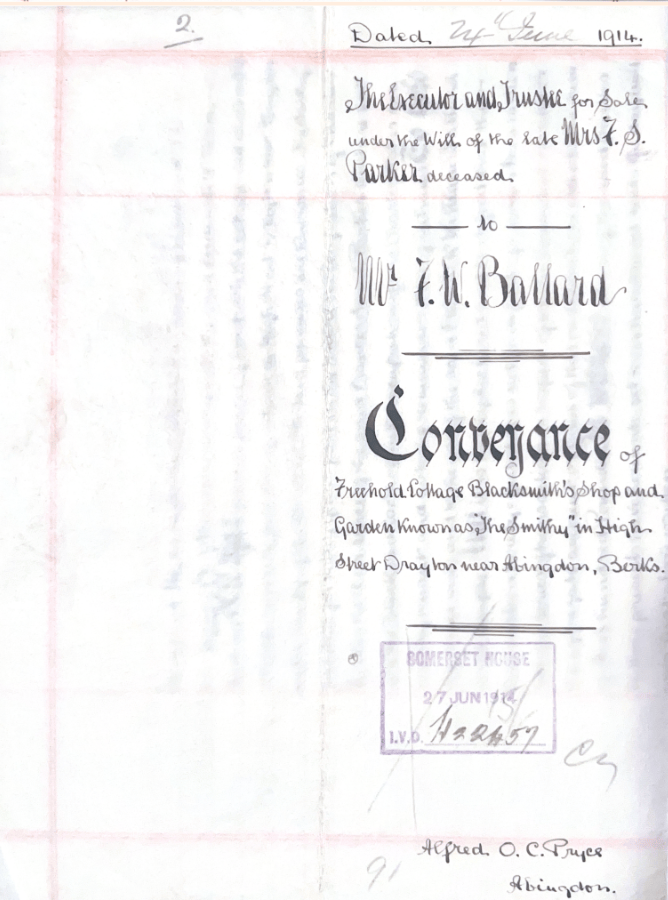
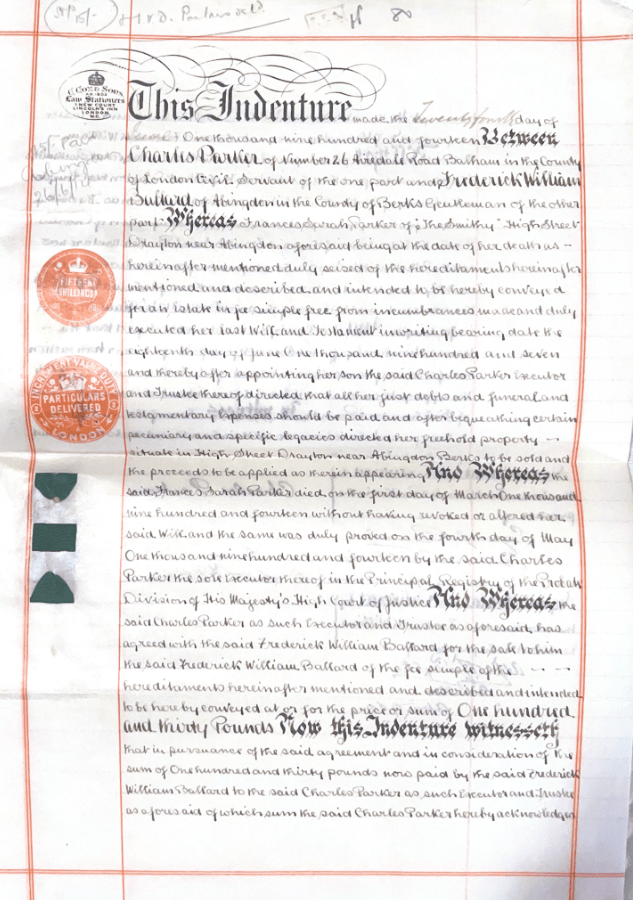
On the brink of WW1, Charles Parker, Jr. sold the โ€˜Freehold Cottage Blacksmithโ€™s Shop and Garden known as ‘The Smithy’ to Frederick William Ballard, an ironfounder.

I’m fortunate to have the original conveyance deed for this purchase, so I know that the cost was just ยฃ130. In today’s money this is not much more than ยฃ13,000. At the time of the transaction, the blacksmithโ€™s shop was in the occupation of Charles Fisher as a weekly tenant, at the rent of ยฃ7.11.8 per annum, and someone called Mrs Cooke was renting the adjoining cottage paying 6/3 per week. I assume that Mrs Cooke began renting the cottage following the death of Mrs Parker, but I haven’t been able to find any other records about her.

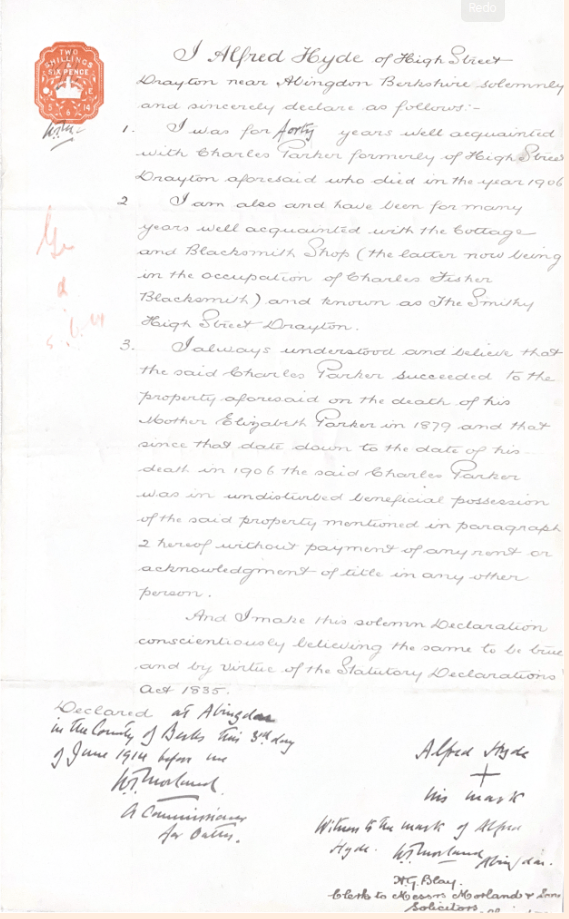
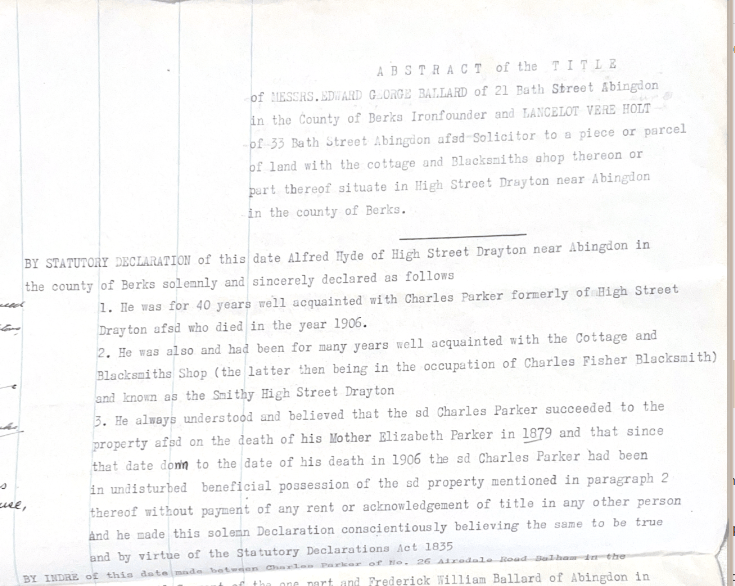
Accompanying the deed was another document, the ‘Declaration of Mr Alfred Hyde’. Neighbour Alfred Hyde, a brickmaker, testified that he had known Charles Parker (Sr), formerly of High St Drayton, for 40 years, and was well acquainted with โ€˜The Smithyโ€™, which Charles had inherited when his mother died in 1879, and held until his death in 1906. Alfred, who signed the document with his mark, was in fact the son of Stephen Hyde, who had once worked at the smithy. Stephen was Charles Parker’s half brother.

The Hydes were deeply rooted in Drayton, but for the first time in Forge Cottage’s history, they were neither its owners nor its tenants.


The Wellses (tenants in 1921; start and end of tenancy unknown)

In the 1921 census, we find a new family living in ‘Forge House’: The head of the family was 22-year-old Charles Wells, an alum leather slaker employed by The Pavlova Leather Company in Abingdon. His wife, Alice, was not yet 20. Both were local, from neighbouring villages. Their son, Kenneth, was just five months old. Charles’s widowed mother, Mary Ann Wells, also lived them.

The Pavlova Leather Syndicate was founded in 1912, and after liquidation in 1918 it was rebranded as the Pavlova Leather Company. According to a BBC article, the business expanded dramatically in WW1, producing belts, straps and harnesses for horses pulling guns and coaches full of equipment, as well as leather boots and helmets for pilots. Most of the work during the war was carried out by women. After the war, production shrank, and some of the factory was taken over by William Morris’s car manufacturing, including his new luxury MG range.2

The relationships of the other family members โ€” Florence Didcock, 37, Reginald Brewer, 15, Beatrice Didcock, 13 and Frederick Didcock, 4 โ€” required some untangling.

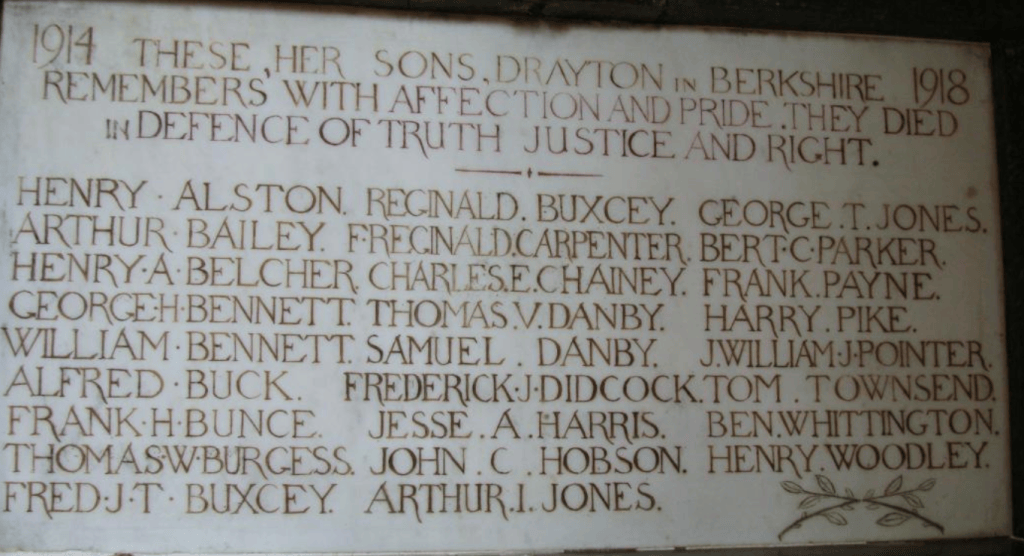
Florence Ethel Didcock was the widow of Frederick J Didcock. Florence and Frederick had been married in 1906, and in 1911 they lived in Abingdon. Frederick was a career soldier from Drayton, who enlisted in the army in 1898. His surviving 22-page service record shows that he served in Egypt and in the Boer War; in the latter conflict he was slightly injured, and also court-martialled. Sergeant Frederick Didcock was killed in action in WW1 while serving with the Royal Berkshire Regiment 1/4th Battalion. He died on 23 July 1916, aged 37, and is commemorated in Thiepval, France.3 His name is included on the WW1 memorial tablet in St Peter’s church, which is located behind Forge Cottage.

WW1 wall plaque, Drayton parish church. Image from IWM War Memorials Database [accessed 15 Sep 2026], copyright Mike Coyle.

In the 1911 census, the family of Frederick and Florence Didcock included Reginald Brewer, Frederick’s ‘love child’. This quaint and rather touching terminology implies that he was the biological son of Frederick and Florence, but had been born before they were married, so used his mother’s maiden surname, Brewer. In 1921, Reginald was a white leather dyer, working at Pavlova alongside Charles. Beatrice and Frederick were legitimate children of Florence and Frederick. It’s poignant to see the note next to all three of Florence’s children: ‘Father dead’. Frederick’s age, four years and 11 months, means that he was born in about July 1916 โ€” the same month in which his father had been killed.

The 1891 and 1901 censuses reveal that Charles Wells and Florence Didcock were half-siblings. Their mother, Mary Ann, had been married to George Brewer (father of Florence) and after George’s death she had married Charles Wells (father of Charles). Charles Wells Sr. had worked as a blacksmith in Drayton in 1901 and in nearby Marcham in 1911. He died in 1919, just two years before the Wells family was recorded in Forge Cottage, and it seems highly likely that he too lived or worked here.

The Wells/Didcock/Brewer family exemplifies the blended families that became more common after the tragic losses and financial strain of the First World War. Three years after the Armistice, the eight rooms of my house were home to seven extended family members AND a lodger, 73-year-old Robert Marshall (no occupation). But wait, there’s more! … Just three weeks after the 1921 census was taken, war widow Florence gave birth to another child; Leslie William Didcock was born at ‘The Forge’, Drayton, on 13 July 1921. The section for father’s name in Leslie’s birth certificate is blank, and his paternity is a mystery. Florence remarried in 1930.

Birth certificate of Leslie William Didcock (digital download from GRO).
The Ballards (owners, 1914-1938)

Abingdon ironfounder Frederick William Ballard, ‘Gentleman’, purchased Forge Cottage in 1914. However, he already had a connection to the property: In 1911, Ethel Fisher, teenage daughter of blacksmith Charles Fisher, was working for the Ballard family as a domestic servant at their home on Bath Street, Abingdon. Ironfounders would have had business connections with blacksmiths in the area, so perhaps Charles Fisher had sourced materials from the Ballards. The Ballards were well established ironfounders, and their trade name can still be seen in several iron items around the town.
Frederick died in September 1922 and was buried in Spring Road Cemetery, Abingdon. A short obituary tells us more about his reputation and personality. As a singer myself, I was delighted to read that he was a devoted choir member.

Early on Saturday Morning last, the death occurred at his residence in Bath Street of Mr Frederick William Ballard, head of the widely known firm of Ballard & Son, iron founders and agricultural implement agents. No townsman could be more highly respected, his gentle and unassuming manner bringing him many friends. He was forty -eight years a valued member of St Helenโ€™s Choir.4

Forge Cottage passed to Frederick’s trustees: his wife Alice Louisa, son Edwin George, and a friend, George Staniland, a Solictor’s Clerk. There’s no evidence that members of the Ballard family ever lived in the house. Rather, they rented the cottage and blacksmith’s shop to tenants. After the death of Staniland in 1927 and Alice in 1938, Edwin George Ballard, an ironfounder like his father, sold the property to Mrs Noรซl Bolton for ยฃ350.


The Boltons (1938-1949)

The sale in 1938 marked the end of an era for Drayton’s smithy. The blacksmith’s shop, cottage and garden became a single, domestic property – ‘Forge Cottage’. From this time onwards, the owners also lived in the property.

Electoral records show that the Bolton family had lived at ‘Vine Cottage’, Abingdon from 1927-1937 and then ‘Chimneys’, Drayton Road, before moving into Forge Cottage. Clearly, they liked houses with quaint names!

Unusually, Forge Cottage was owned by a married woman, and not by her husband. Noรซl Bolton (nรฉe Cullen)’s parents had died in Abingdon in 1934 and 1937, leaving an estate in excess of ยฃ19k (more than ยฃ1m today). The 1939 Register, a civilian census taken at the outbreak of WW2, tells us more about the Bolton family shortly after they moved in. By that time, the house had been renumbered to 55 High Street, which is still the address today.

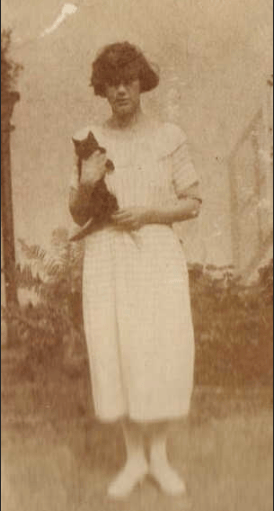
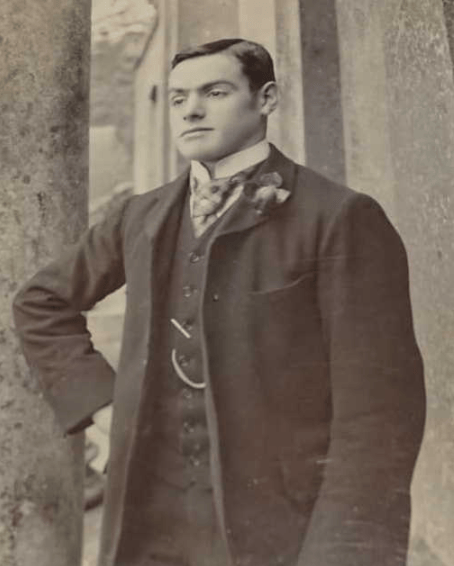
Francis George Bolton, b. 30 March 1890 (in Bangor), was a Motor Engineer, and his wife Noรซl, b. Christmas Day 1900, was occupied with ‘unpaid household duties’. Those duties included caring for their only child, Francis Bryan Noรซl Bolton, who was about 10 years old. (Francis Jr.’s entry is redacted in the register, even though he died almost 80 years ago). Francis and Noรซl had been married for more than a decade, but Francis seems to have been their only child.

A descendant of Noรซl’s brother Sydney kindly allowed me to share photographs of Noรซl and Francis Sr.

Francis Bolton Jr. was too young to be conscripted in the war, but by 1947 he had joined the Merchant Navy and was serving on the F. J. Wolfe, a motor tanker owned by the Anglo-American Oil Company. During the war the ship had been purchased by Britain from Panama, damaged by German torpedoes, and endured a collision with a British steamship.5 In peace time, it was operating between Curacao and Liverpool, transporting oil (presumably) and passengers.

Tragically, Francis Bolton was killed on board in an accident on 2 May 1947.

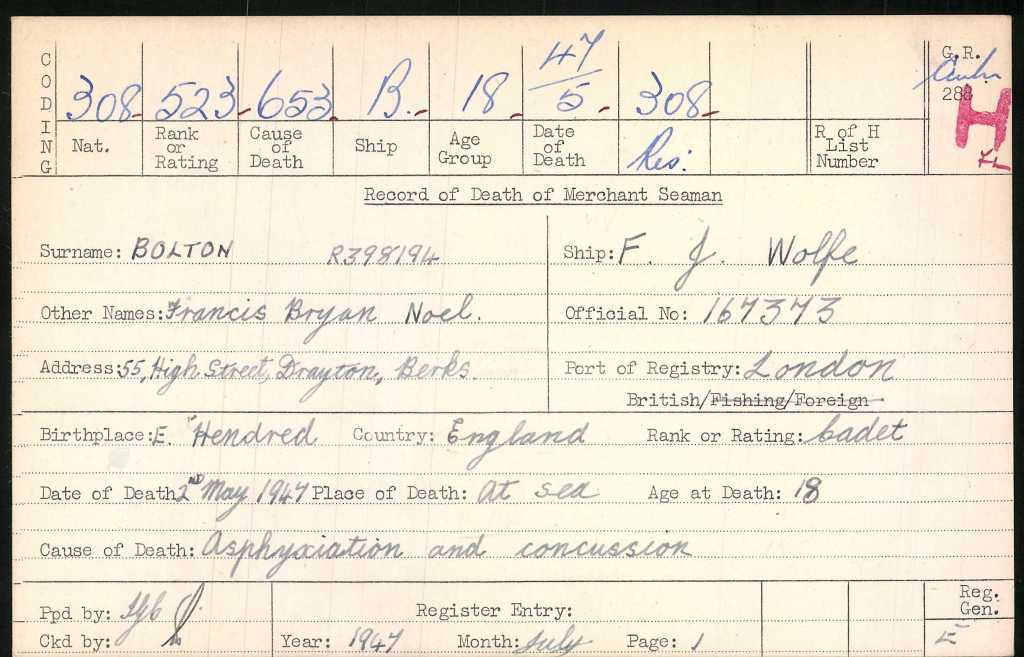
The Register of Deceased Seamen reveals that Cadet Francis Bolton, 18, and Second Mate William John Kennedy, 26, died on the same day, and the cause of death for both was asphyxiation and concussion. The coordinates place their deaths in the middle of the Atlantic ocean, halfway between North Africa and the Southern United States.

Entries for Francis B N Bolton and William J Kennedy (digitised images of register). ‘Register of Deceased Seamen’. Findmypast [accessed 13 Sep 2026]. Original record: The National Archives (UK), BT 334 (‘Deaths At Sea 1891 โ€“ 1972’), Box 0106, Page 1.
Francis B N Bolton (digitised image of index card). ‘UK, Merchant Seamen Deaths, 1939 -1953’. Ancestry [accessed 14 Sep 2026]. Original record: National Maritime Museum; Greenwich, Merchant Seamen Deaths at Sea.

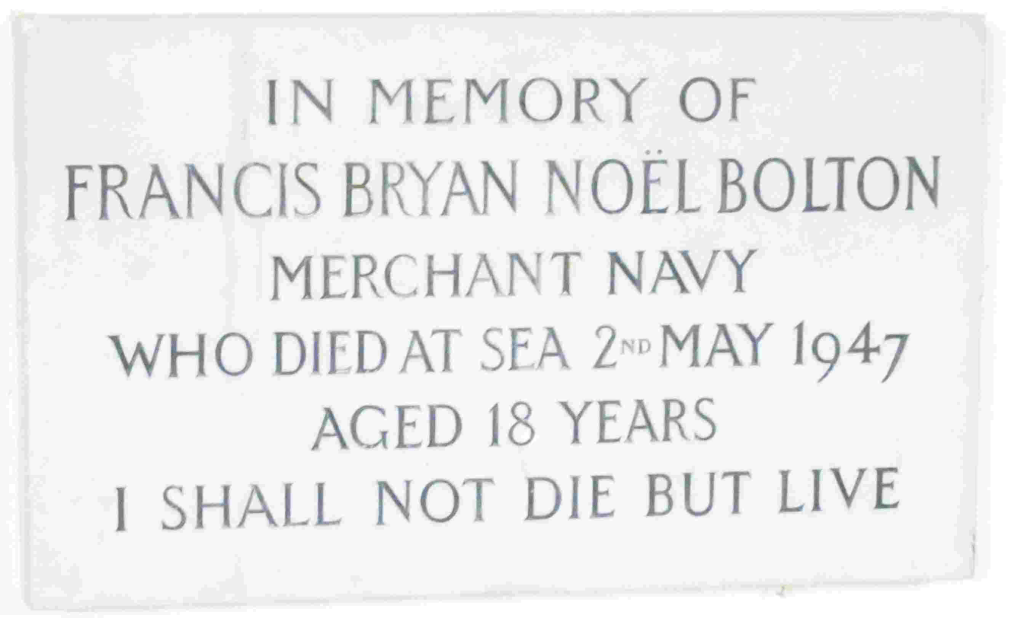
A memorial to Francis Bolton is displayed on the north wall of the nave of St Peter’s church.

Image of the Bolton Memorial via Berkshire War Memorials, http://www.berkswm.org/BWM6019.html [accessed 16 Sep 2026].

Mrs Noรซl Bolton had also lost her oldest brother, Percy, to pneumonia at 22, and her youngest brother, Gordon, had been killed in WW1 aged 20. Two years after the death of her only child, she sold Forge Cottage.


The Robbinses (1949)

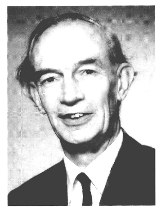
Dr. Alwyn Rudolph Robbins only owned Forge Cottage for six months, from February to July 1949. However, he is the only resident/owner of my house who has a Wikipedia page.

Alwyn Rudolph Robbins, from an obituary in Survey Review, 6(285), pp. 563โ€“564 (July 2002).

Robbins (1920-2002) was a British geodesist, a former chairman of the Royal Society subcommittee on geodesy, and held multiple positions within the International Association of Geodesy. Geodesy is the science of accurately measuring and understanding the Earth’s geometric shape, orientation in space, and gravity field.

Robbins’ research and work took him around the world; he was a surveyor in West Africa during WW2, taught in the United States, Ghana and New Zealand, and carried out work in Pakistan and Canada. In 1947 he was appointed to his first academic post as a Demonstrator in the Department of Surveying at Oxford. When he purchased Forge Cottage he was a University Lecturer.

In 1965 Dr Robbins became a founding fellow of St Cross College at the University of Oxford; he became a Reader Emeritis there on his retirement in 1980. By one of life’s many odd coincidences, my husband Peter studied for his PhD at St Cross College.

Robbins published on geodesy and photogrammetry, with additional contributions to geodetic astronomy and the development of clocks, including the chronochord (printing crystal clock). In 1949, he published ‘A method of finding gradients from air photographs with no control’ in Photogrammetric Engineering.

Obituaries in Survey Review, Geomatica and the St Cross Record (link via Wayback Machine) detail his impressive resume and outstanding contributions to scientific knowledge, but also add provide a window into his personal life.

Alwyn will be remembered by his many friends, colleagues and students not only as an outstanding geodesist and an excellent teacher and advisor, but also as a kind, warm hearted and cheerful person, with a sense of humility and fairness in the best British tradition. He will be greatly missed by his wife Mary, his children Rowena and Mike, and his two grandchildren.6

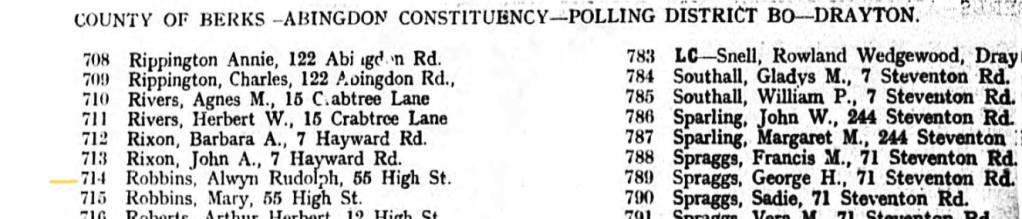
Alwyn Robbins had married Mary Seale at Exeter three years before purchasing Forge Cottage, and they lived here together. Their children were born later, in 1952 and 1957.

The Robbins family possibly left Drayton when Alwyn was offered a post as a Visiting Professor of Geodesy at Ohio State University.

Alwyn and Mary Robbins (digital image of register). 1949 Electoral Register. ‘Berkshire, England, Electoral Registers, 1840-1965’. Ancestry [accessed 14 Sep 2026]. Original record: Berkshire Record Office/Berkshire County Council.

The Hansons (1949-1955) and The Griersons (1955-1966)

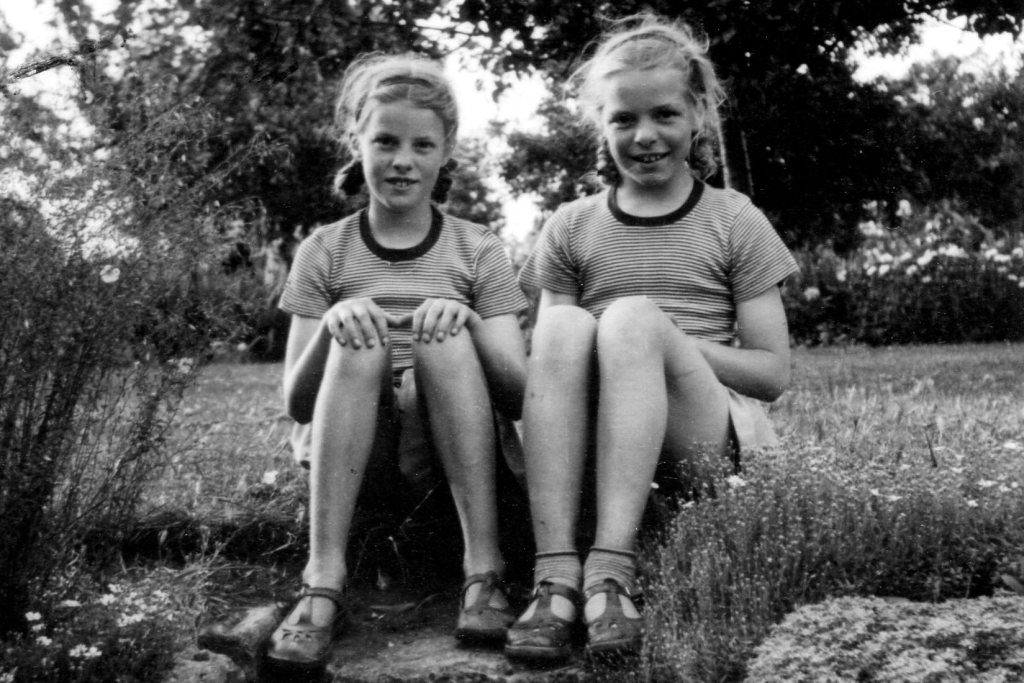
Robbins was followed by another scientist โ€” this time a Research Chemist. Dr Thomas Kenneth Hanson (b. 1913, Halifax, Yorkshire) and his wife Margaret Joceyln (nรฉe Wigg) moved into Forge Cottage in 1949, presumably with their young daughters, Jocelyn S. Hanson, b. 1941 and Gillian M. Hanson, b. 1942. At the time of his marriage in 1939, Thomas was an ‘Oil Technologist’. A passenger list of that year (from New York) reveals that he stood 6’3.5″ tall.

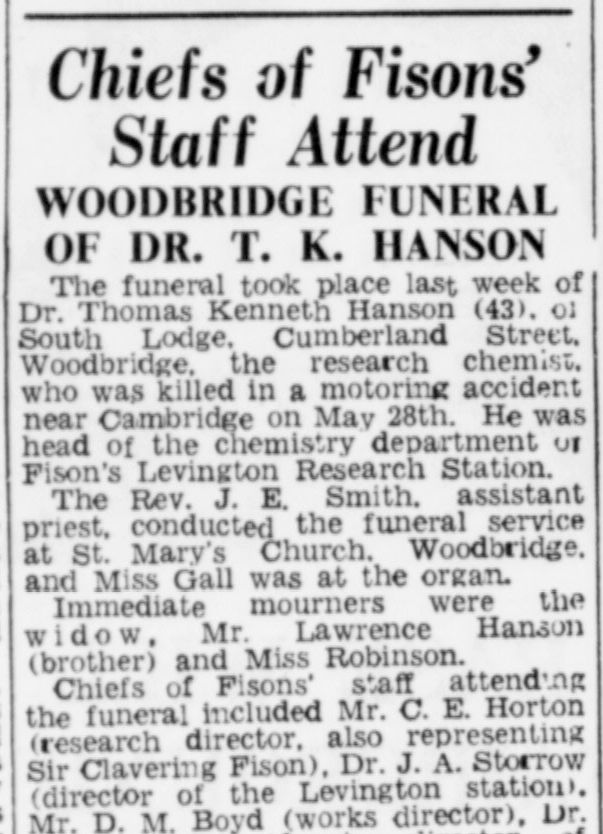
Ancestry family trees (unverified) indicate that the end to their time at Forge Cottage in 1955 coincided with divorce. Thomas remarried in December 1955, but just 18 months later, in summer 1957, he was killed in a car accident near Cambridge.

Suffolk Chronicle, 7 June 1957
Via Findmypast. Successor rightsholder unknown.

The Hansons were followed by another young family, also with connections to oil: the Griersons.

John William Grierson was a Petroleum Sales Instructor. He and his wife Doreen (nรฉe Williams) were newly-weds, having married in Dorset in 1954. They soon had two children: Michael J. Grierson was born in 1955 and Joanna L. Grierson in 1957. Hopefully this was a very happy time for the growing family.

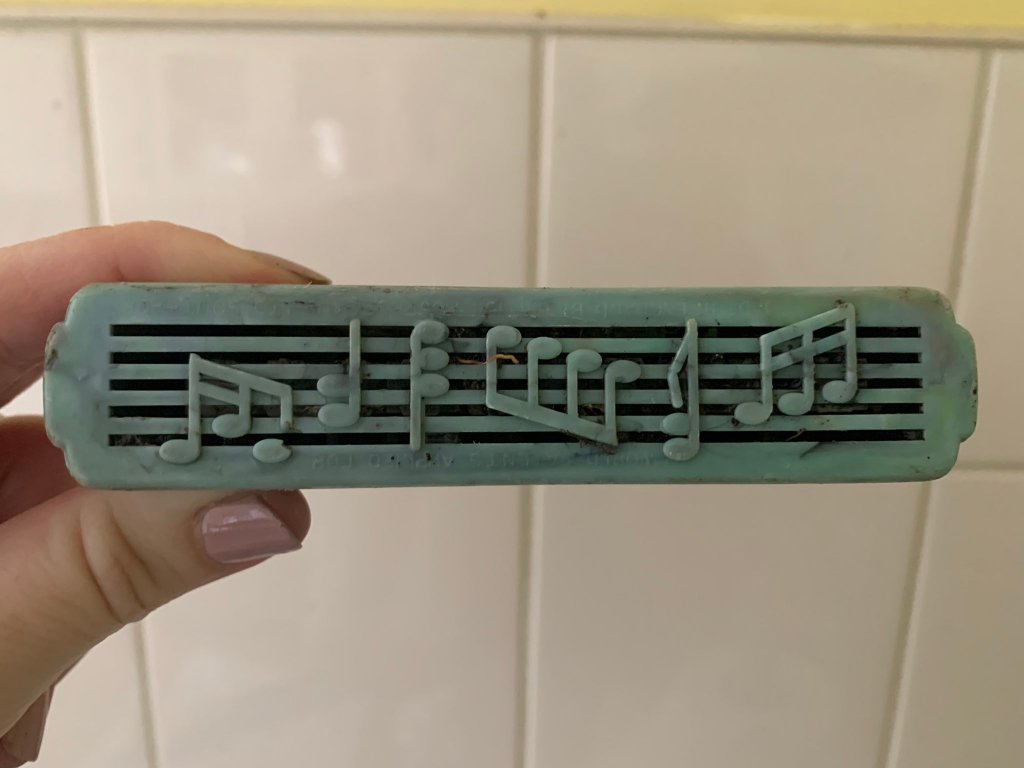
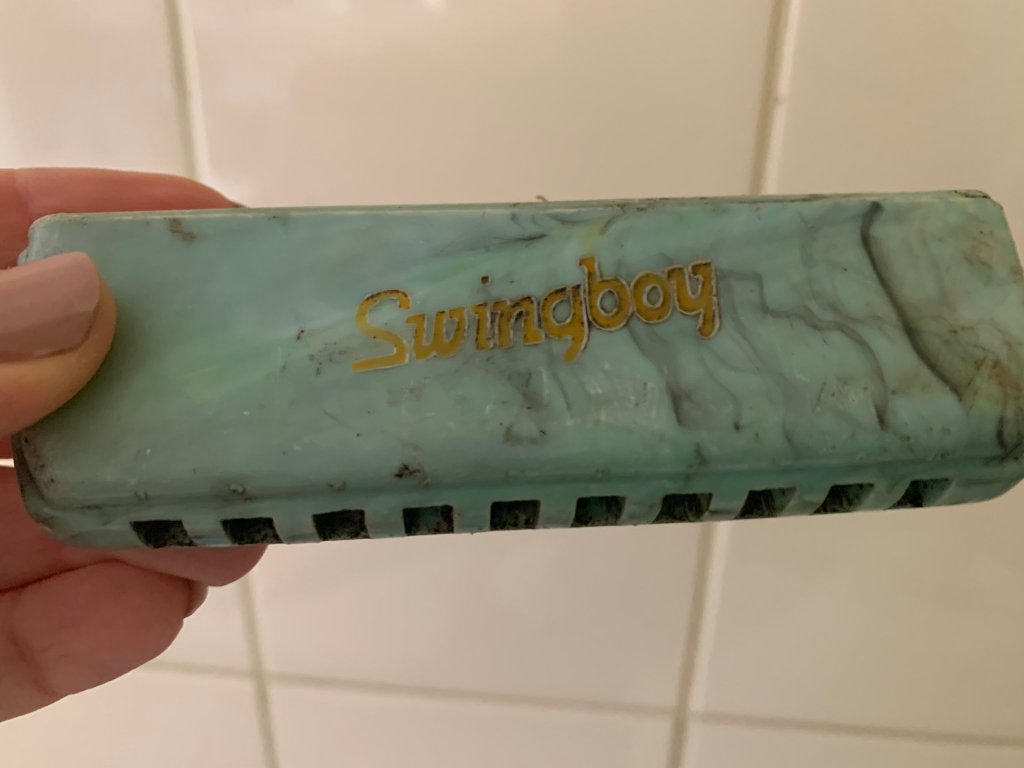
A few years ago I dug up a bakelite (?) harmonica in the back garden which was made by British Mouth Organs Ltd., Southport in about 1956. It could have belonged to the Grierson children. The family lived at Forge Cottage until 1966.


The Davieses (1966-1990)

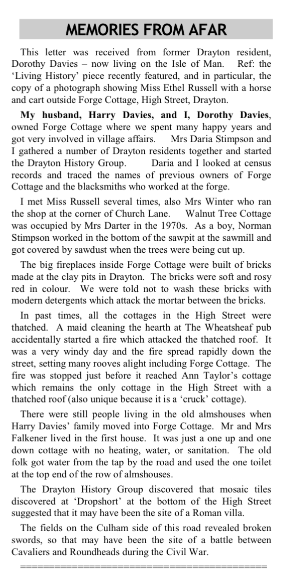
Dorothea Mary Seppings Davies (known as Dorothy) was a founding member of Drayton History Group in the 1980s. She and her husband Harold ‘Harry’ Davies lived at Forge Cottage for nearly a quarter of a century, from 1966-1990. During her time here, Dorothy and a few fellow village history buffs researched the previous occupants of Forge Cottage, but unlike me, Dorothy didn’t have the Internet to help her!

In 2007, Dorothy wrote to the Drayton Chronicle from her new home in the Isle of Man in response to a recent piece in the magazine about Forge Cottage. Some of her letter, as published, is included below:

Drayton Chronicle, August 2007 (Volume 30, No. 7). https://www.draytonvillage.co.uk/drayton-chronicle/chronicle-archive/ [accessed 14 Sep 2026].

During their time at Forge Cottage, the Davieses carried out significant changes, including extensions which received planning permission in 1979 and 1985.

Dorothy passed away the year that I moved into Forge Cottage. She was clearly a kindred spirit, and I wish I could have met her and exchanged stories about our shared home. I hope that I have been able to add even more colour to what she found out before me.


1990 to today

The final two families to live at Forge Cottage before us were Geoff and Judy Bott (1990-2014), who built a red brick shed behind the house; and the Bruce-Reid family (2015-2018), who added a hefty tree trunk mantel above the inglenook fireplace.

We have been lucky to call Forge Cottage our home since 2018. I can’t help but wonder who will follow in our footsteps here in the future.


Select References

  1. Reading Mercury, 31 October 1896. via FindMyPast [accessed 8 Sep 2026].
  2. ‘World War One at Home: Abingdon, Oxfordshire: Pavlova Leather Factory’. https://www.bbc.co.uk/programmes/p02b3490 BBC [accessed 8 Sep 2026].
  3. Entry for Frederick Didcock. CWGC. https://www.cwgc.org/find-records/find-war-dead/casualty-details/756977/frederick-didcock/ [accessed 8 Sep 2026]. Note: This says his parents were William and Florence Ethel but in fact his parents were William and Sarah, and his wife was Florence Ethel.
  4. ‘Abingdon 100 years ago โ€“ September 1922’. Abingdon Blog. https://abingdonblog.co.uk/?p=29679 [accessed 10 Sep 2026].
  5. ‘F. J. Wolfe’. uboat.net. https://uboat.net/allies/merchants/ship/2140.html
  6. Geomatica, Volume 56, Issue 1 (January 2002), pp. 81-83.

Forge Cottage in Censuses (1901-1939):

1901: Household of Charles Fisher (digitised image of census). โ€˜1901 England Censusโ€™. Ancestry [accessed 1 Oct 2026]. Original record: The National Archives (UK), Reference: RG 13/1134, Folio 24, Page 5. 

1911: Household of Frances Sarah Parker (digitised image of census). โ€˜1911 England Censusโ€™. Ancestry [accessed 1 Oct 2026]. Original record: The National Archives (UK), Reference: RG 14/6472, Sch 98.

1921: Household of Charles Wells (digitised image of census). โ€˜1921 England Censusโ€™. Ancestry [accessed 1 Oct 2026]. Original record: The National Archives (UK), Reference: RG 15/5912, ED 4, Sch 10

1939 Register: Household of Francis George Bolton (digitised image of register). โ€˜1939 England and Wales Registerโ€™. Ancestry [accessed 1 Oct 2026]. Original record: The National Archives (UK), Reference: RG 101/2063B, Sch 157.

A History of Forge Cottage, Drayton: Part 1

A blacksmithing dynasty

In 2018 I moved into my new house. Or rather, my old house. After years living in the San Francisco Bay Area, where my oldest home dated from the 1920s, I was delighted to be the owner of ‘Forge Cottage’, especially as the keys to the house came with an envelope of historic property deeds, the personal memoir of a former occupant, and even an old photograph of the house in the downstairs loo! As the house’s name implies, it was once the village blacksmith’s โ€” the village being Drayton near the ancient market town of Abingdon on Thames in the Vale of White Horse (historically in Berkshire but part of Oxfordshire since 1974).

In tracing my house history, I’ve discovered the identities of the people who gardened, lived and worked here from the Georgian era up to my arrival. In this blog I’ll be sharing the story of the extended family of blacksmiths who built the house and lived and worked here for most of the 19th century. And in part 2 I’ll write about the eclectic families that followed them in the 20th century.

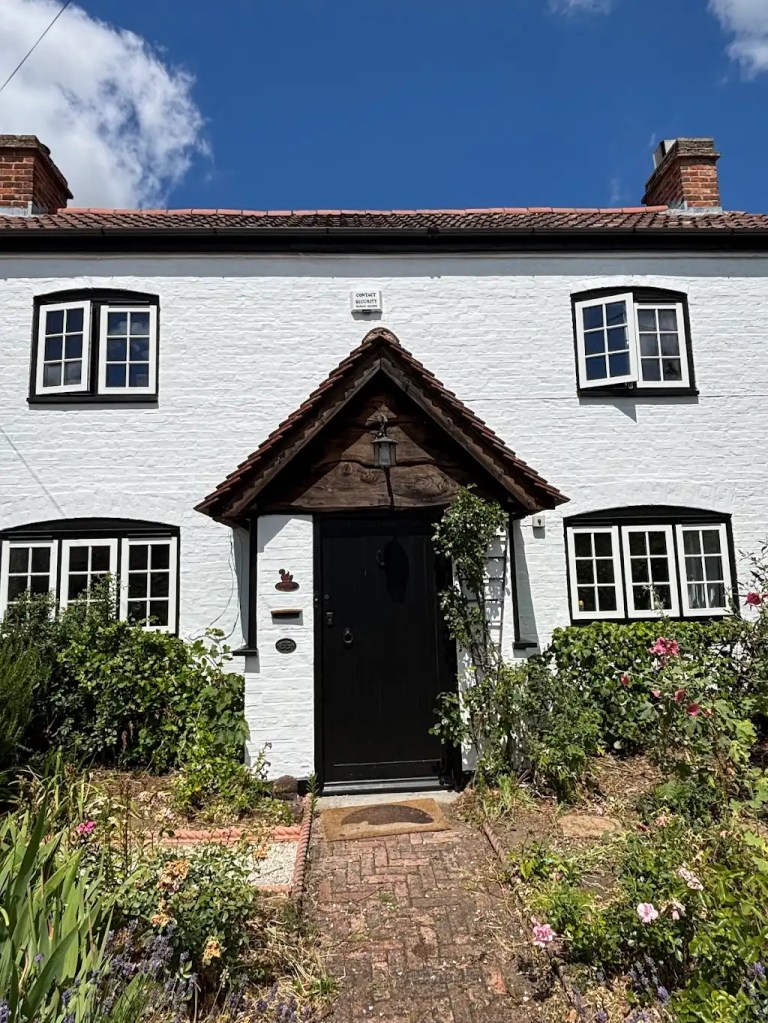
Forge Cottage today

Lord Stafford’s Land

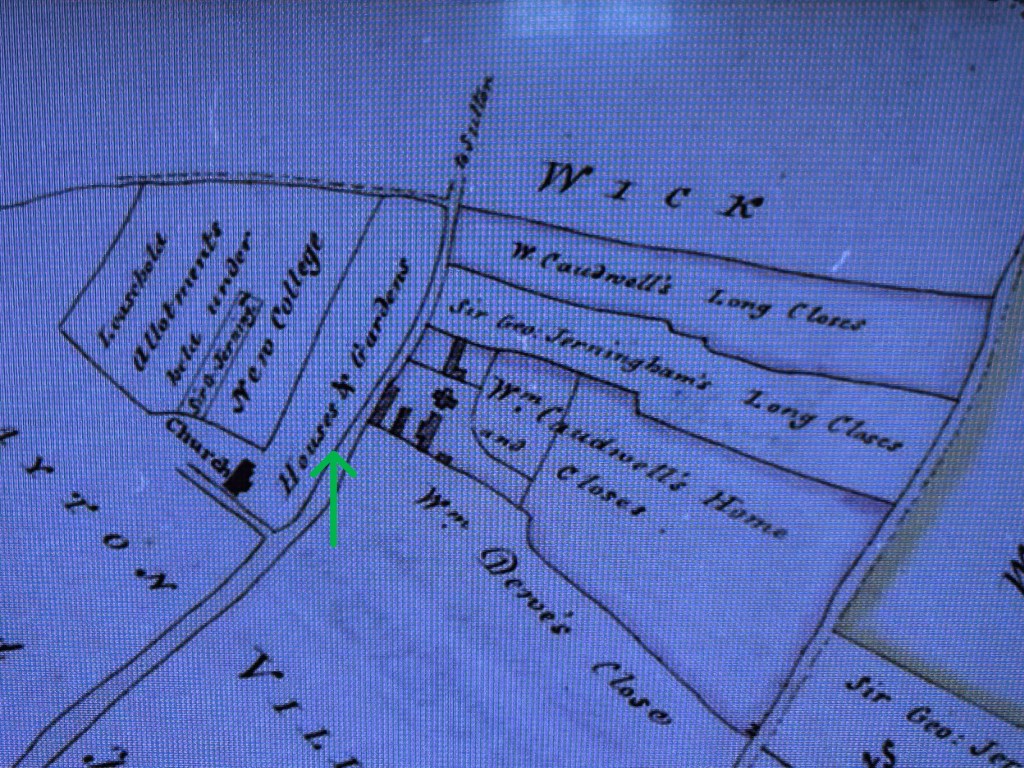
My research into Forge Cottage goes back to the late 18th century. Three maps of Drayton made within 26 years reveal a significant change in ownership and land usage. The earliest, produced in 1789, shows that the land where my house now sits, which had no description, was the property of Sir William Jerningham. Sir William, de jure 7th Baron Stafford, was Lord of the Manor of Drayton from 1758 until his death in 1809. Technically, the Manor of Drayton was the east manor; Drayton was divided into two manors โ€” east and west โ€” before the Norman Conquest. The Jerningham family seat was Costessey Hall in Norfolk, but the family also held estates in Staffordshire, as well as the [east] manor and rectory in Drayton. My house is actually situated very close to the Tudor manor house of the west manor, which was historically held by New College, Oxford. However, the Jerninghams owned a significant amount of land all over Drayton.

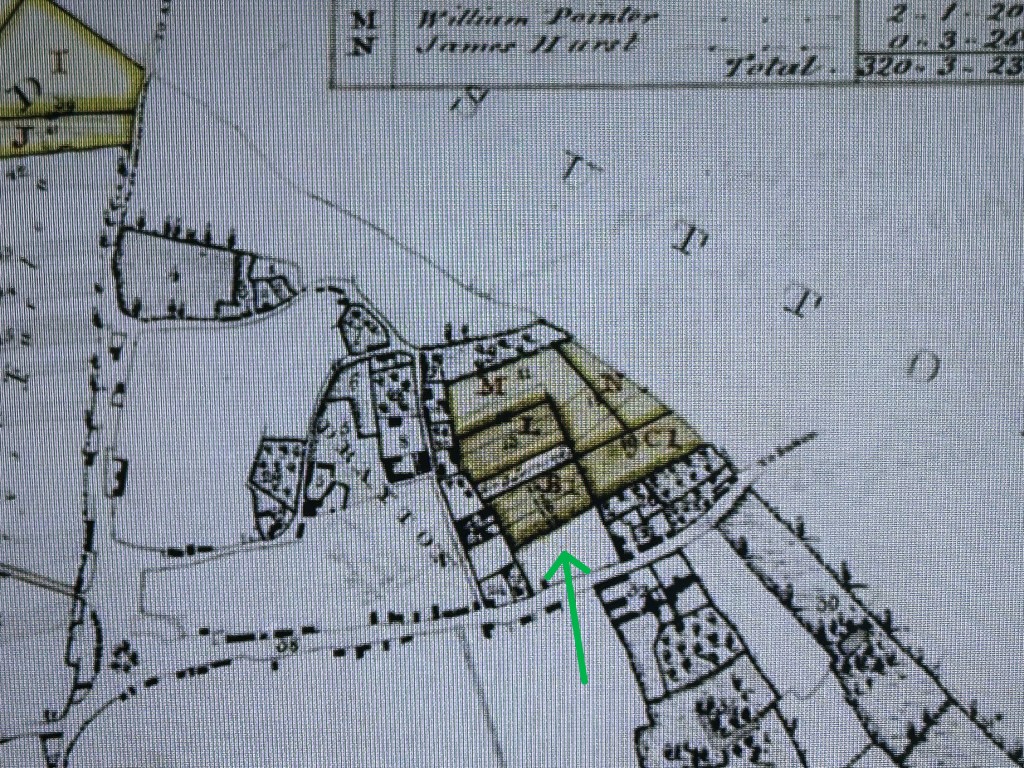
Excerpt of ‘Plan of lands in the parish of Drayton, County of Berks, belonging to the Warden and Fellows of New College in Oxford; drawn in the year 1789 by Saml. Botham’ with green arrow pointing to the location of my house
Photo of digitised map, viewed at Oxford History Centre (POX0082749)

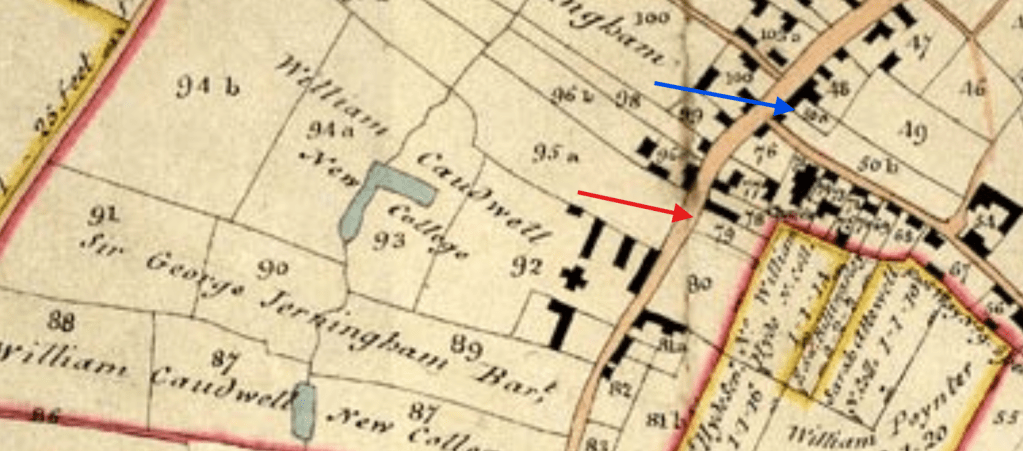
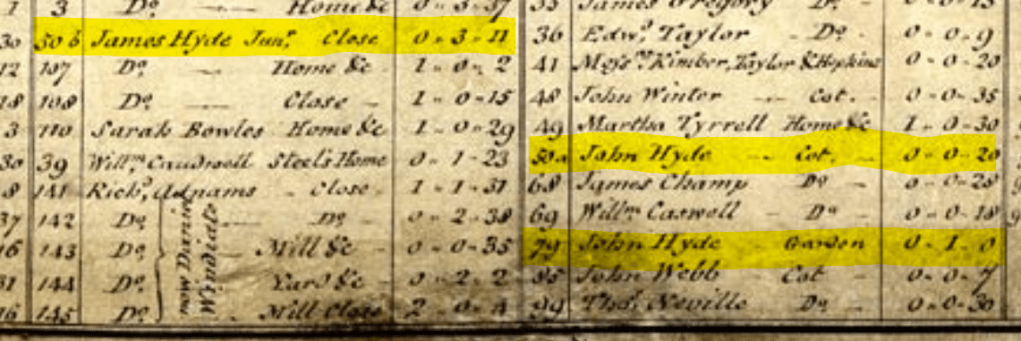
By the first decade of the 19th century, an area of land that included our plot was labelled as ‘Houses & Gardens’. Then in 1815, the land in Drayton was enclosed, and a map of the ‘Parish of Drayton … as divided allotted and enclosed’ recorded the ‘old inclosures’ (indicating land that had already been enclosed prior to parliamentary acts)1. A list of enclosed parcels of land beneath the map shows that my plot of land (no. 79) was a garden, one rood (1/4 acre) in size, held by John Hyde. John also had a cottage a short distance away (50a). Both were ‘lifeholds under Sir G. [George] Jerningham’. Sir George was William’s son and heir, who inherited his father’s land in Drayton in 1809, and officially became 8th Baron Stafford in 1824.

TIP: Berkshire enclosure maps and awards can be viewed online at a high resolution for free at berkshireenclosure.org.uk.

Excerpt of ‘New College estate map of allotments in Drayton, held under New College; also showing neighbouring allotments held under Sir George Jerningham. 1800-1809’, with green arrow pointing to the location of my house
Digitised map viewed at Oxford History Centre (POX0082718).
Excerpt of Drayton’s enclosure map (1815) showing the garden plot (red arrow) and John Hyde’s cottage (blue arrow)
An original copy is held by the Oxfordshire History Centre (PC335/1/H1/1). Berkshire enclosure maps can also be searched and viewed online for free at https://www.berkshireenclosure.org.uk/find_via_map.asp, courtesy of the Royal Berkshire Archives.
Extract of enclosure awards for Drayton (as above)
The listing includes John Hyde’s garden (79) and his cottage (50a) within James Hyde’s close (50b) – highlighted

From John Hyde’s Will of 1829 (proved 1834) I know that this piece of land was a ‘freehold piece of garden ground’ that he had ‘lately purchased of Lord Stafford’. So, between 1815 and 1829, John had purchased the land that he’d previously rented. By the time John wrote his Will, Sir George had sold the manor; from 1826 the owner of the east and west manors was Lewis Loyd, a Nonconformist-minister-turned-London-banker. It seems likely that Sir George sold this parcel of land to John at the same time. Unfortunately, I was unable to find any details of the sale among Jerningham family papers in the Royal Berkshire Archives, and manorial recordsโ€” which are held at the Staffordshire Record Office โ€” only go up to 1793.

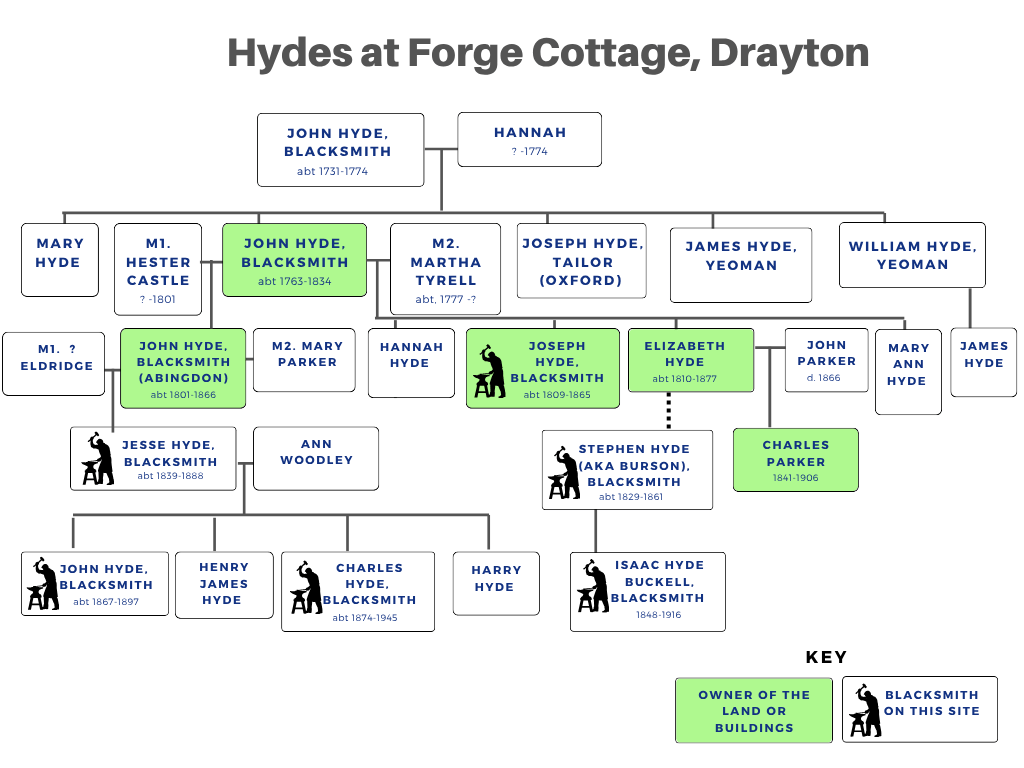
When John Hyde purchased the garden plot in about 1826, he began 100 years of ownership by the Hyde family, including many of the blacksmiths who plied their trade here. There are lots of names, so to help readers make sense of this Drayton dynasty, you can find a family tree towards the end of this blog. You’ll also find a list of resources there for learning more about 19th-century blacksmiths.

John Hyde, Blacksmith (c1763-1834)

John Hyde was baptised in Drayton in 1763, and was the eldest son of John Hyde (b. c1731, Drayton), and Hannah (nรฉe Cheer). I believe John Sr. was the first of the Hydes in Drayton to become a blacksmith, as he was apprenticed to Joseph Hunt, blackmith of Drayton, in 1748.

John Hyde (Senior)’s apprenticeship to Joseph Hunt (Register of Duties paid for Apprentices’ Indentures)
Board of Stamps: Apprenticeship Books: Series IR 1; ancestry.co.uk. Original record: The National Archives (UK); 1R 1/18.

Tragically, John and Hannah died within a few weeks of each other in 1774 โ€” their gravestone can still be seen in the churchyard behind our house. They left five orphans (a girl and four boys) under 13 years of age. The two eldest sons, John and Joseph, soon learned trades: John followed his father into blacksmithing, and I believe that he learned the trade from a woman blacksmith! An entry in the Register of Duties paid for Apprentices’ Indentures shows that a John Hyde was apprenticed to Martha Hanns, a blacksmith of East Hendred, in 1776. East Hendred is just four miles from Drayton. As a female ‘master’ of a male apprentice, Martha must have been the widow of a blacksmith. She may well be the same Martha Anns [sic] who died in 1802 in East Hendred at the age of 100!2 In 1777, Joseph (b. c1766), was apprenticed to an Oxford tailor called William Davenport (coincidentally, the previous year, Davenport had been elected to Oxford’s City Council along with one other man, who was also a tailor; his name was Thomas Benwell and he was my husband’s 6x great grandfather!).

John Hyde (Junior)’s apprenticeship to Martha Hanns (Register of Duties paid for Apprentices’ Indentures)
Board of Stamps: Apprenticeship Books: Series IR 1; ancestry.co.uk. Original record: The National Archives (UK); 1R 1/28.

In 1780, Drayton was ‘nearly exterminated by a terrible fire’2. The ‘Great Fire of Drayton’ detroyed more than 30 homes in the village within half an hour, as flames swept down the High Street from one thatched roof to the next. Among the afflicted residents was John Hyde, whose damages were valued at ยฃ109 10s 4d (about ยฃ17k today) โ€” possibly John’s grandfather. The home of Rev. Wright also burned down, along with all of Drayton’s parish registers.

In 1796, blacksmith John was living in St Thomas’s, Oxford, when he married Esther (or Hester) Castle in that parish. Sadly, Esther died in Drayton in 1801, when their son John was just one month old. In 1804 John married again, to Martha Tyrrell. With Martha, he had four children in Drayton, including a son, Joseph, born in about 1809, and three daughters: Hannah, Elizabeth and Mary Ann.

As John’s family grew, it makes sense that he leased a garden plot where he and Martha could cultivate fruits and vegetables and perhaps keep some livestock, and as the enclosure map shows, this was not far from his cottage. In his Will, John also mentions his shop (i.e. workshop) in Drayton; there are no clues to its location in the Will or enclosure map, but in 1838, his son’s smithy shop and cottage were both in plot 50a – where John’s cottage had been located in 1815.

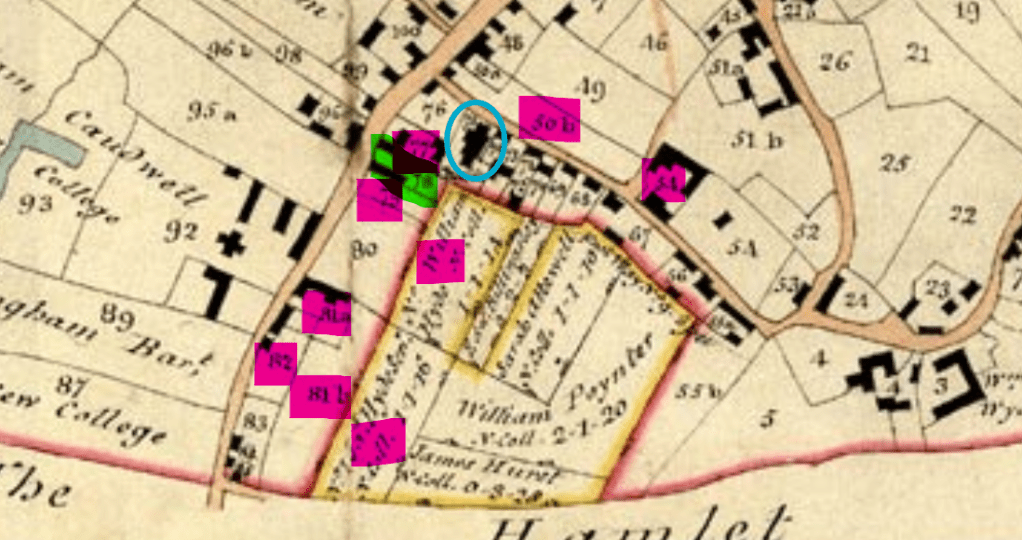
John’s property was close to land and buildings in the heart of the village that were owned by three other Hydes. The land behind the garden was rented by William Hyde, John’s younger brother, who lived in allotment 77. John’s cottage was within a close held by his nephew James Hyde Jnr, son of William, whose home was at 82. Both William and James farmed large areas of land throughout Drayton (most of it owned by New College). James Hyde Snr, another of John’s younger brothers, had allotments 81a and 81b and also a modest area of farmland.

Pink highlights show parcels of land close to my home owned or rented by the Hyde family in 1815.
The green highlight shows the village’s almshouses and the blue circle shows the location of Drayton’s medieval church and churchyard.

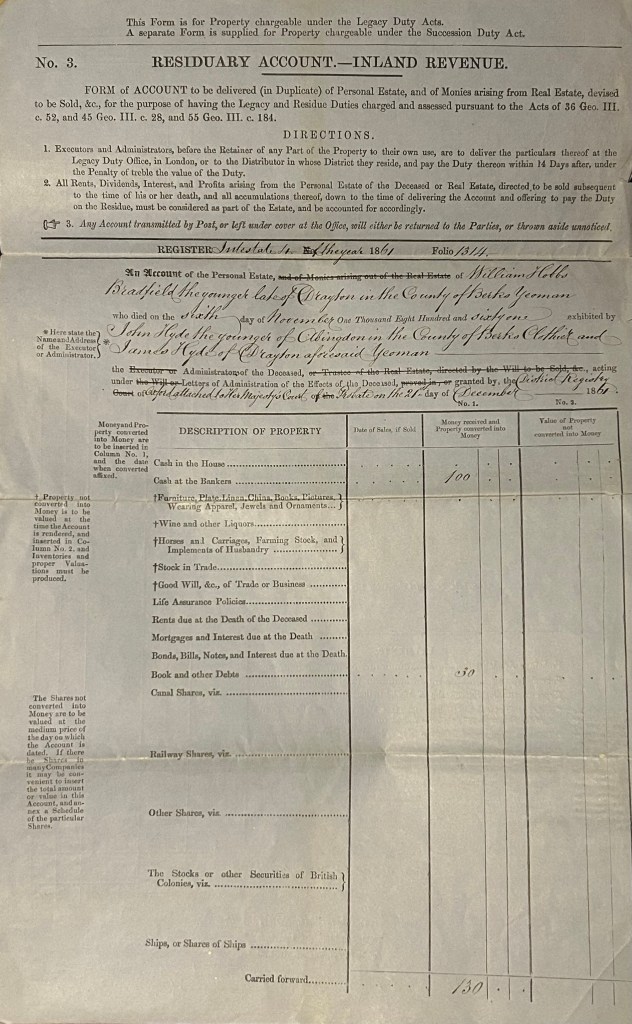
For a long while, I couldn’t connect the Hydes of Forge Cottage to these other, wealthier Drayton Hydes. But a few years ago I had an amazing stroke of luck: At a small antiques fair in our village hall I met a stall owner who traded in old documents. He had made the trip from Dorset to Drayton because he had a large stash of 19th-century documents from one family: the Hydes of Drayton! Thanks to this collection, which included manorial records of property transfer, and legacy receipts, I was able to connect the Hyde families in Drayton. But a significant mystery remains: Given that John and his brother Joseph were apprenticed into trades, how did their two younger brothers James and William became prosperous yeoman farmers whose sons were listed as Gentry in local directories? I can only theorise that they were taken in as young children by well-to-do relations, possibly grandparents. Another researcher into the Hyde family has found that an earlier generation included several wealthy tradespeople and farmers, and indeed John’s oldest sibling, Mary, benefited from being the sole legatee of a grocer uncle (and later married a grocer as well). Joseph also did very well for himself, progressing from the trade of tailor to being an Oxford innkeeper and ‘Gentleman’. Of the five Hydes who were orphaned in 1774, John the blacksmith, though able to afford my parcel of land, seems to have been the least prosperous.

When John died in 1834 aged 69, he divided his money equally between his three surviving children, John, Joseph and Elizabeth (two had died in childhood). His household goods were divided between Joseph and Elizabeth. Joseph also received the garden ‘with the appurtenances theretoโ€™ and โ€˜all the smithing tools stock of iron and everything else belonging to my business in and about the shop where I carry on the said businessโ€™. Surprisingly, his wife Martha wasn’t mentioned at all, but she lived comfortably with her niece and nephew (farmers, and children of her brother-in-law William Hyde) until her death in 1844.

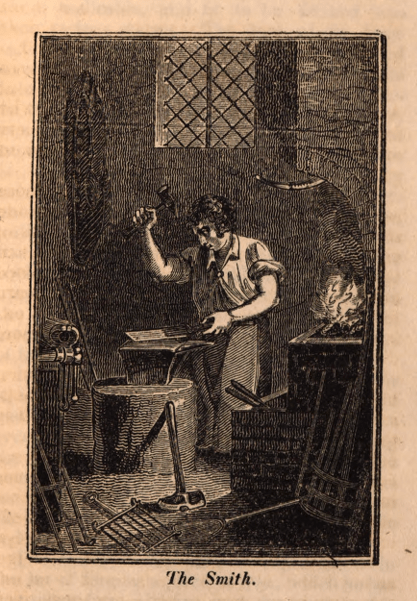
Engraving in The book of English trades (see book list below)

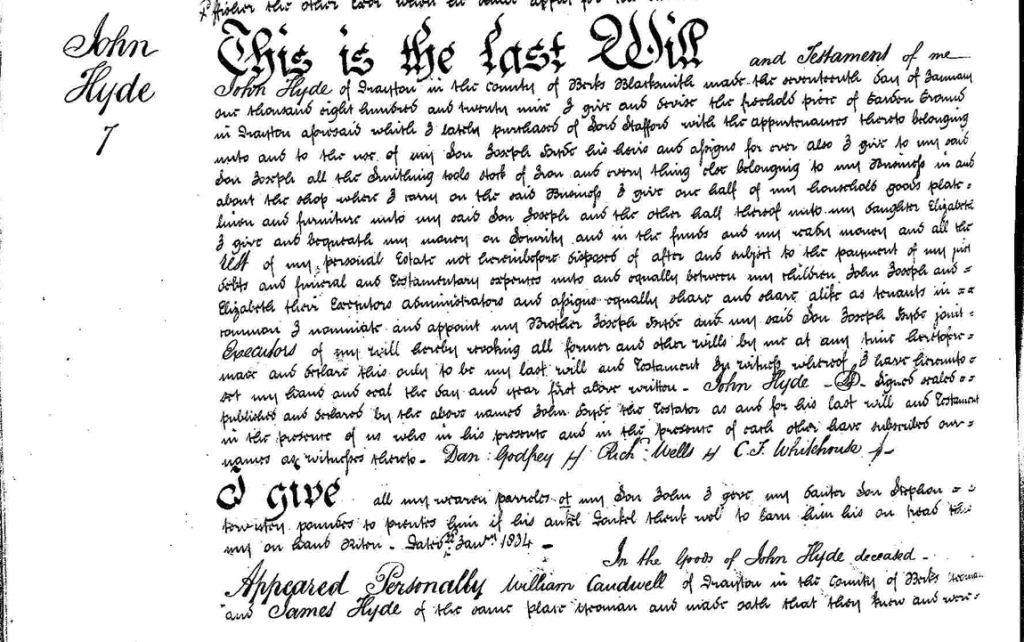
John Sr. also added a codicil just before his death. To his son John, he left his ‘wearer parroles’ (clothing). John Jr. was also a blacksmith, whose smithy was in Abingdon. Presumably he already had the tools of the trade so had no need for his father’s equipment. John Sr. also added a bequest of ยฃ20 to Elizabeth’s illegitimate son, Stephen Hyde, to ‘prentis him if his ankel Darkel thenk wel to larn him his on tread this my own hand riten’. (apprentice him if his Uncle [?Darkwell] think[s] well to learn him his own trade this [in] my own hand written’). William Caudwell and James Hyde, yeomen, vouched for the codicil being in John’s own handwriting, as they had ‘frequently seen him write’. John had clearly received some elementary education, but he used mostly phonetic spellings. In contrast, his brother James, who hadn’t been apprenticed in his youth, was more literate. This is a registered copy of John’s Will and it would be lovely to see his handwriting in the original.

First page of the Will of John Hyde, blacksmith of Drayton, Berkshire
(registered copy Will from the Prerogative Court of Canterbury (PCC); The National Archives (UK); PROB 11 Piece: 1840 )

Joseph Hyde, Blacksmith and Constable (c1809-1865)

Joseph was about 25 years old when he inherited the garden land along with his father’s tools. Although I have no records of exactly when our house was constructed, I believe that Joseph had it built, and perhaps even built it himself.

In 1838, poor rates for Drayton recorded the property and land held by Joseph Hyde. Very conveniently, they used the same numbering system as the enclosure map, so I know that Joseph had three holdings: a) the garden of one rood (allotment 79) with no mention of buildings, b) land in Culham Close, measuring 3 roods and 11 perches, and c) a house, shop (workshop), offices and another garden at 50a, in 20 perches of land (only 1/10 of an acre). The garden had a gross estimated rental of ยฃ2 7s 6d and ratable value ยฃ1 10s.

Given that the parcel of land with the cottage, workshop and offices was very small, I believe that Joseph chose to move his home and workshop to the larger garden plot, probably in the 1840s. Unfortunately, I’ve not been able to pin down an exact year. Two potential sources of information from the 1840s are tithe maps and the 1841 census, but frustratingly, there is no tithe map for Drayton (as tithes there were extinguished by enclosure), and the 1841 census for Drayton is vague on household locations.

In 1841, Joseph was a blacksmith in Drayton, living with his 11-year-old nephew Stephen Hyde, and a domestic servant, Martha Howse. Stephen’s baptism record named his father as Josiah Burson (there are several candidates for his father in the local area). His mother Elizabeth had married a stone mason called John Parker when Stephen was little, and moved to the nearby village of Marcham. (John Parker was the brother of Elizabeth’s sister-in-law, Mary Parker โ€” the wife of Abingdon blacksmith John Hyde. The Parker family will be important later in this story.)

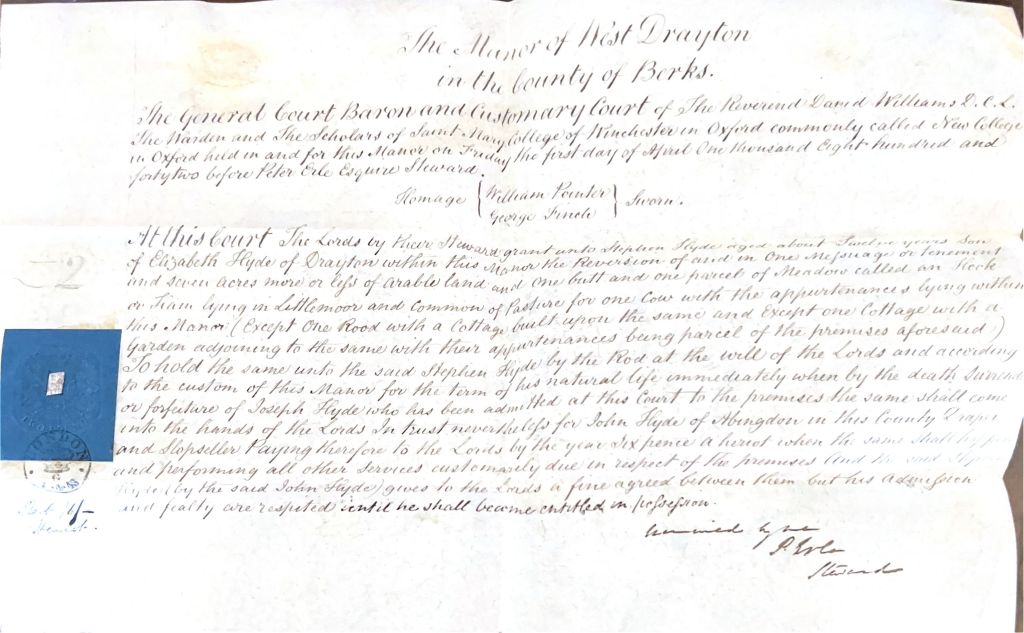
Although Joseph’s father John had left money for Stephen to be apprenticed to an ‘Uncle ?Darkwell’, he seems to have learned the blacksmith trade from his uncle Joseph. My collection of Hyde papers reveals that Stephen was also set to inherit a lifehold in Drayton from father and son John and Joseph Hyde โ€” wealthy drapers in Abingdon (John’s son John, also a draper, became Mayor of Abingdon). John was probably a first cousin of John, the father of blacksmith Joseph โ€” another example of more affluent Hydes helping their poorer cousins. On draper Joseph’s death Stephen would acquire ‘One Messuage or tenement and seven acres more or less of arable land and one butt and one parcel of Meadow called an Hock or Ham lying in Littlemoor and Common of Pasture for one Cow with the appurtenances lying within this Manor’ (except for two cottages).
Reversion of Stephen Hyde
(my own document)

In Kelly’s Berkshire Directory, 1848, Joseph was the only blacksmith listed in Drayton, but there was another blacksmith in the village in the 1840s. William Hopkins, alias William Lambourn, was mentioned in a newspaper in 1840 (when a fatal accident befell a pear picker in his garden) and in 1850 (by which time he had died). He also appeared in the 1841 census.

The 1851 census shows that Stephen had left Joseph’s home to start his own family, leaving Joseph alone with his servant Martha (by then 70 years old). The Post Office Directory of Berks …, 1854 shows that both Joseph and Stephen were blacksmiths in Drayton, possibly working independently โ€” though typically, a small village like Drayton could only sustain one smithy.

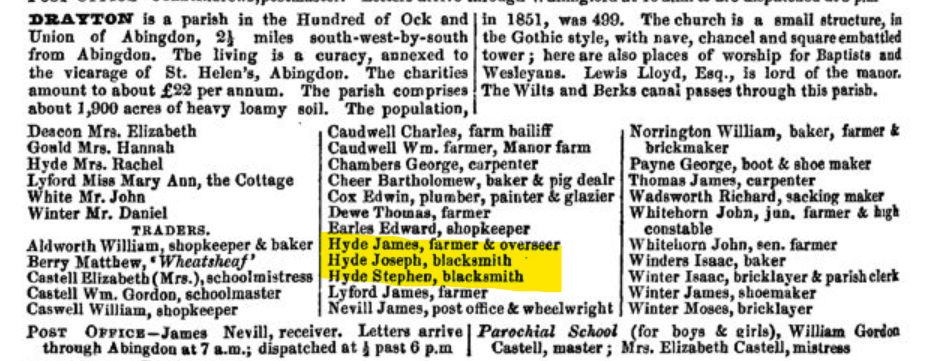
Entry for Drayton in the Post Office Directory of Berks, Northants … , 1854 showing the two Hyde blacksmiths (Joseph and Stephen) and Joseph’s cousin, James Hyde (who was serving as the parish overseer)
via University of Leicester Special Collections Online

Joseph’s elderly servant Martha died in 1854 and by 1860 Joseph had a new servant called Thirza Giles. Unfortunately, the only reason I know about Thirza is that she stole half an ounce of tea and six ounces of sugar from her master and was sentenced to two months’ imprisonment. Thirza was only about 16 when she lived in my house. I was delighted to find a photograph of an older Thirza in an Ancestry family tree. According to that tree, she married Levi Smith in 1866 and they had 12 children.

Thirza Smith
(photograph from a public Ancestry tree, Baker Family Tree, by user Benjamin Baker)

In the 1861 census we find that Joseph had taken on another family member to help him with his smithing work โ€” Isaac Hyde, a ‘cousin’, was only 12 years old, but his occupation was already ‘Blacksmith’. Isaac was in fact the oldest child of Stephen, making him Joseph’s great nephew. Very sadly, Stephen had died just weeks earlier, at the untimely age of 32, before he could inherit the land from his cousins. Burial records show that his baby daughter had died just a month earlier, and that the cause of death for both was ‘Fever’. He left a widow and seven children. Isaac had been born before Stephen’s marriage to his mother Sarah Buckell, so throughout his life he was often known as Isaac Hyde Buckell (or Buckle). He later became a blacksmith in the White Horse village of East Hanney.

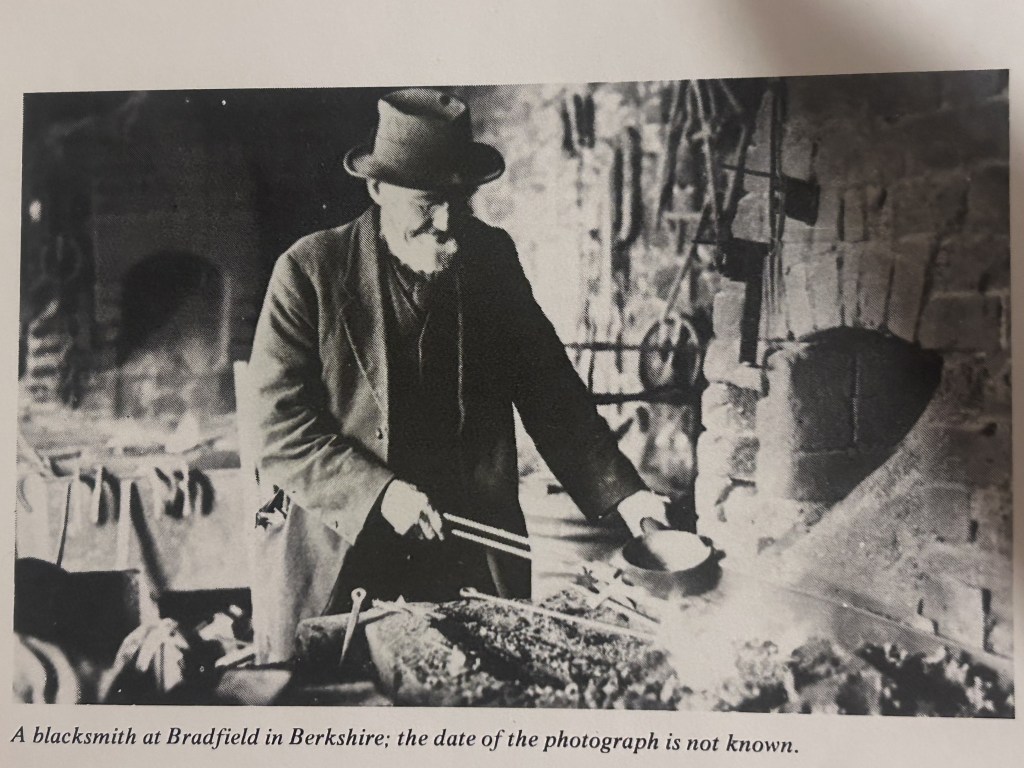
Joseph Hyde must have been a trusted member of the parish, as he was appointed one of Drayton’s constables. Parish or ‘petty’ constables’ responsibilities included evicting vagrants, arresting suspects, and keeping the peace. It was common for blacksmiths to take on this role, as they were physically strong enough to restrain and apprehend prisoners. In 1846, a labourer in Drayton was convicted of assaulting Joseph Hyde, constable, ‘in the execution of his duty’. Two years later, Joseph was again assaulted while ‘preventing a pugilistic encounter’. Constables also collected rates, and M. Billing’s Directory and Gazeteer of The Counties of Berks and Oxon, 1854 shows that Joseph was also Drayton’s tax collector. This role may well have made him unpopular; in 1859 a fellow villager ‘willfully broke the glass of a window belonging to Joseph Hyde of Drayton’. Blacksmiths’ strength could also lead them to be pugnacious; Joseph’s brother John, a blacksmith and publican in Abingdon, was charged with assault in 1839, when he collared a man, knocked his head against a window and then knocked him down, knelt on him and theatened to kill him. Then in 1857 he was assaulted by a drunken German bandsman!

Villages of the White Horse, written, aptly, by Alfred White, in 1913, includes delightful descriptions of local characters โ€” including a blacksmith, and a carpenter who was appointed Constable. Although that’s 50 years later, it helps me picture Joseph at work, and even to hear what he might have sounded like:

John Johnson, a 70-year-old blacksmith nicknamed “Young John“
His shedโ€”which he built himselfโ€”is of iron, and stands immediately alongside the school playground, through which he crosses, in dirty weather, to gain the forge, stepping on wooden boxes to assist him over the low fence. At playtime the children come out to watch him at work, to hear the roaring bellows and tinkling anvil, and to see the bright yellow sparks whizzing out, and shooting through the small doorway. The old smith is very fond of the children, and they love him in return; … “Young John” executes all the small repairs to the machinery and implements, and shoes the horses, settling up with his patrons every three months.
The little forge is a curious place, containing all kinds of rough tools, with other odds and ends, and everything is in a muddle, as is usual with the village smithy. … The bellows for the forge are in a tiny box-like place behind where the smith stands; there are several iron “boshes” for the water, and the dust-like coal is kept in a large two-handled pot, which once did service over the kitchen fire. The chimney is a very simple contrivance, being merely a milk-churn, with the bottom knocked out, hung in the iron roof, the broad bottom forming a kind of bonnet, to carry off the smoke and sulphur. This suits the old blacksmith very well, because, as he says, he “can look up the chimmuck at night, an’ see the stars a-shinin’ outside.”
The smith is tall and boney, but none too robust since he had the severe attack of bronchitis last fall, which played havoc with him; he is hard on seventy now. In manner he is extremely gentle and agreeable, a lovable man, with a playful, yet serious mind, full of quaint sayings and sparks of wit, able to converse on matters of the deepest import, and to make rhymes while he beats out the fizzing metal on the anvil. His voice is soft and mellow, and he sings the tenor part in the choir at the tiny church; he has been a chorister all his life, from early childhood. He is ripe for a chat at all times, whenever you care to look in upon him, … He has no mate to help him at the forge, except when he has an extra heavy job in hand; then he gets an old neighbour to come and give him a blow, but be “soon gets out o’ bread” (breath). His hammers are all named: there are “Slogger,” the sledge; “Dragon,” the intermediate one; and “Useful,” the hand hammer. When he wants either of them he cries aloud: “Now, Useful!” “Come yer, Dragon!” “Stop ther, Slogger, till I wants tha agyen!” Where “Useful” is not big enough, and “Slogger” too mighty, he “goes at it, an’ ‘its into ‘t wi’ Dragon, an’ yarns mi bit o’ rooty” (bread).

The village constable
The old carpenter held the post of village constable for twenty years, before the institution of the County Police. This office was one of responsibility in those times, and was not unattended with danger; the old man bears many scars as the result of encounters with roughs in the execution of his duty. The chief offenders
against the law were gipsies, tramps, and travelling navvies; there was seldom any trouble with the villagers. There was no regular salary attached to the post of constable; the only sum he received was 5s. every year when he went to the court to be sworn in. His personal equipment comprised a loaded baton, and hand-cuffs for the prisoners. Several times, on making arrests, when the prisoner would not walk to the town, four miles away, he had clapped the hand-cuffs on him securely, tied his feet and legs together, and
hauled him along on his back to the cells. At a neighbouring village the constable was often required to lodge prisoners for the night, on their way to prison. To hold them secure he had two mighty staples driven into the strong woodwork, one each side of the wide fire-place, and the culprits were chained up to these all night, while the constable took his rest. If there were three prisoners, the great, heavy pig-killing bench was brought into requisition, and the third was unceremoniously chained down to that; there was small fear of escaping from such a custody.

from J. Bailey, The Village Blacksmith (see booklist below)

Putting my house on the map

Pinning down the location of Joseph’s house in the censuses is challenging. As is typical with rural locations in the earlier censuses, there is no specific address given; simply the name of the village. However, the names of neighbouring families and local landmarks can help to place a household geographically.

In particular, the location of Drayton’s almshouses, which are next door to Forge Cottage, has been a vital clue in my research. In the enclosure map of 1815, the almshouses are marked between John’s garden and William Hyde’s house, in allotment 78.

The almshouses were built in 1806 with funds raised nationally after the ‘Great Fire of Drayton’. The five 18th-century almshouse buildings were knocked down and replaced by six bungalows in 1980, but a plaque on the wall facing the street still records their founding. I am fortunate to be the current custodian of the Almshouse Charity Minute Book, which began in 1818. In the earliest entry โ€” an indenture made in the 59th year of the reign of George III โ€” William and James Hyde (Joseph’s uncles) were named as two of four founding trustees. My neighbour Andrew Bax has written about the history of the almshouses and charities in our village magazine (March 2023 and April 2023).

In 1841, Joseph Hyde’s census entry was not next to any obvious almshouse occupants, but in 1851, the five previous households, excluding one that was uninhabited, were occupied by widows, three of whom were on parish relief. This is strong evidence that by 1851, Joseph was living next door to the almshouses. I think it’s likely that Joseph had hands-on involvement in building his own house. At the very least he would have produced the nails and other metal fittings used in its construction. When I look at the timber beams in the ceilings and the red bricks around the fireplace, made right here in Drayton, I like to imagine his satisfaction with his new home.

Jesse Hyde (1839-1888) & Sons

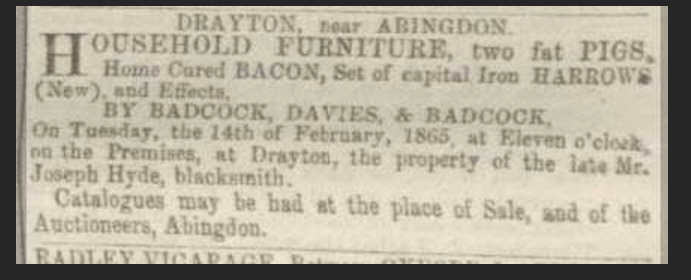
Joseph Hyde died intestate on 11 January 1865, and on 11 February, probate was granted to his next of kin, his half-brother John Hyde, blacksmith of Abingdon. The next day, a sale of Joseph’s goods to be held at his property was advertised in the Reading Mercury โ€” including furniture, two fat pigs, home cured bacon, and a set of new iron harrows (a farming implement for tilling soil).

Advertisement for the sale of Joseph Hyde’s possessions, Reading Mercury, 12 February 1865
British Newspaper Archive

John had two sons and six daughters, by two wives (his second wife was Mary Parker). His younger son died in childhood, leaving just his son Jesse (b. 1839) to follow him into the blacksmith trade. Jesse was in his late 20s when he took his late uncle Joseph’s place as the new blacksmith of Drayton. In the 1871 census we find Jesse and his family living between the ‘High Street Alms Cottage[s]’ and the ‘Manor House’. (The almshouses next door were occupied by variety of needy villagers: a widow with her two children, an elderly widower, a 62-year-old single woman still working as an Ag Lab, a widowed former seamstress, and an ‘almshouse woman’ stated to be (in the terminology of that time) an ‘imbecile’.) Jesse and his wife Ann (nรฉe Woodley) had two young children, John, aged 3 and Henry J.[James], aged 2 (their 5-year-old daughter, Sarah, is absent). The household also included a servant, William Thomas โ€” a 16-year-old ‘shop boy’, and a visitor, Ann Money โ€” a 49-year-old widow who was employed elsewhere as a domestic servant.

In 1881, blacksmith Jesse Hyde’s home was described as a ‘Private House’ on the High Street. His family now also included sons Charles, 7, and Harry, 4. Jesse died in 1888, and by 1891 his sons John (b. 1867) and Charles (b. 1874) had taken over as Drayton’s blacksmiths. In the 1891 census, for the first time, my house had a number. Now, John and Charles Hyde, as well as John’s wife Ellen and infant daughter Florence N.[Nellie], lived at ‘No 35 private house’ on the High Street. Once again, it was adjacent to the Alms Cottages, now numbered 1-5. Meanwhile, Jesse’s widow was still living in Drayton, with her son Harry, an apprentice smith who later joined the Royal Artillery. Their fourth son, Henry, became a blacksmith in Cholsey.

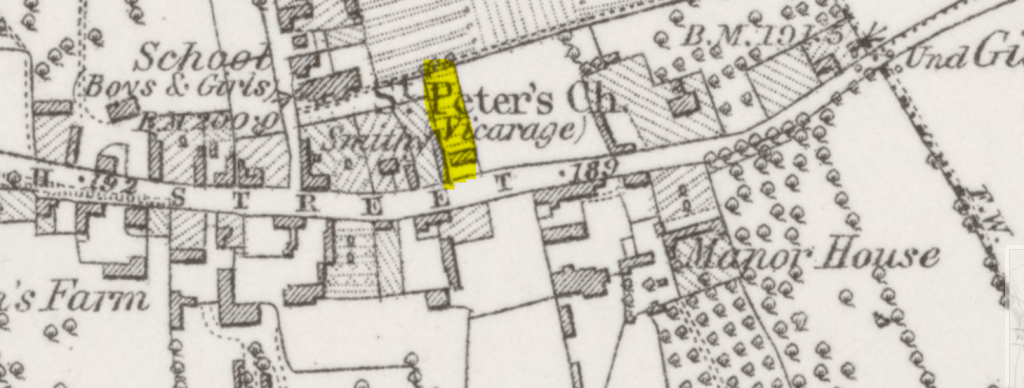
The first OS map of Berkshire was published in 1883 (from a survey in 1878). Drayton’s Smithy is labelled, and the land extends back beyond the churchyard, in an area that has since been used as an extension to the parish burial ground.

Excerpt from OS Map of Drayton, 1883
Oxfordshire Sheet XLV Surveyed: 1875, Published: 1883. Re-use: CC-BY (National Library of Scotland)

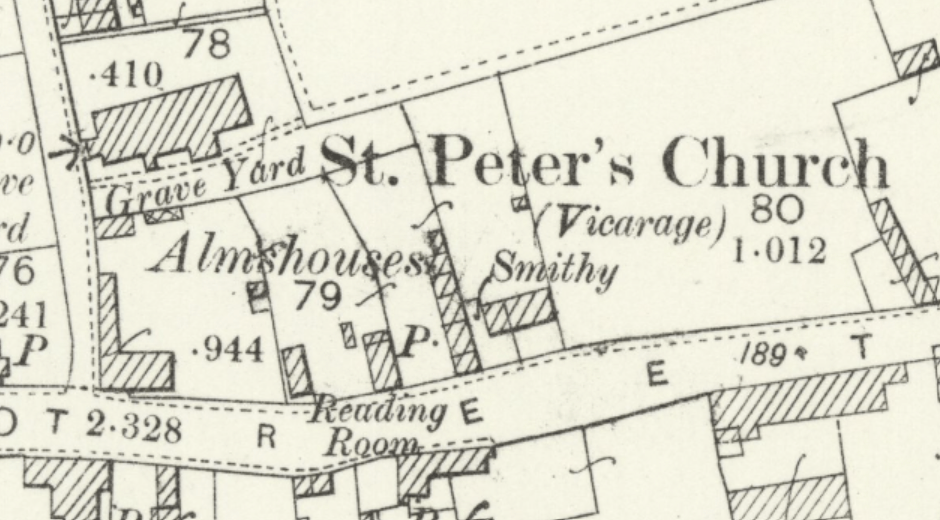
An OS map of 1897 shows the Smithy and Almshouses all within land parcel 79. A small outbuilding shown behind the Smithy has not survived to the present day. The map also shows that my house was once opposite a Reading Room! These were opened in villages and towns all over Britain in the Victorian period. As well as boosting literacy they provided an alternative, teetotal recreational space to pubs.

Excerpt from OS map of Drayton, 1899
Berkshire X.13, Revised: 1897, Published: 1899. Licensed under CC-BY (National Library of Scotland)
    

The end of the Hydes’ residence at Forge Cottage?

In 1897, John Hyde died, aged just 30, prompting his widow to leave Drayton and work as a tailoress in a nearby village to support her four young children. And by 1901 John’s younger brother Charles had married, moved to Abingdon and become a gardener. In the 1901 census, 35 High Street, Drayton was still home to the village blacksmith, but for the first time in at least 150 years, this pivotal member of the community wasn’t a Hyde โ€” his name was Charles Fisher. However, deeds reveal that the owner of the property was Charles Parker, who was, in fact, a member of the Hyde family. Let me explain the line of inheritance from John Hyde to Charles Parker …

  1. John Hyde (blacksmith of Drayton) purchased the land from the Lord of the Manor.
  2. John passed the land to his son Joseph Hyde (blacksmith of Drayton).
  3. Joseph died intestate and the property went to his brother John Hyde (blacksmith of Abingdon). John’s son Jesse then took over Drayton Smithy.
  4. John Hyde died the following year, and the property didn’t go to his sons; it went to his only surviving sibling, Elizabeth (whose son Stephen had been trained as a blacksmith). However, since Elizabeth was married, the property belonged to her husband John Parker.
  5. But John Parker died the same year, and the property went to his widow, Elizabeth Parker (nรฉe Hyde). She was then the sole owner for 14 years. During this time, her nephew Jesse’s sons John and Charles took over as the blacksmiths.
  6. When Elizabeth died in 1879 the property was inherited by her only surviving son, Charles Parker. His Hyde cousins continued to be the blacksmiths there until the late 1890s. Then, for the first time in 70-80 years, another family moved in: the Fishers.

The Hyde family tree below shows most of the family members who’ve featured in this blog. The owners of the land or cottage are in green, and the blacksmiths who worked here are tagged with an anvil.

This brings my history of Forge Cottage to the turn of the 20th century. Over the next 100 years, the building will be remodelled, renumbered and renamed. It will be home to an iron founder, leather maker, motor engineer, Naval seaman, university lecturer, research chemist, war widow, and of course wives and children. In Part 2, I’ll share their stories, along with the memoir and photograph of one of the last blacksmith’s daughters, who vividly recalled her childhood at Forge Cottage in the early 1900s.

Read Part 2: The war widow, the cadet, the geodesist and the history buff


A few resources for learning about 19th-century blacksmiths

Books:

Jocelyn Bailey, The Village Blacksmith (Shire Publications, 1977)

David L. McDougal, The Country Blacksmith (Shire Publications, 2013)

The Book of Trades or Library of Useful Arts 1811, Vol. 1 (reprinted by Wiltshire Family History Society, 1991); also available online via the Internet Archive

‘The Smith’, in The book of English trades : and library of the useful arts : with seventy engravings (1818, reprinted 1956); also available online via HathiTrust

Websites:

The Blacksmiths Index: a database of blacksmiths by UK county (and abroad) compiled by Ann Spiro (the Hyde family is not in the database)

Blacksmiths: The Essential Rural Craft (The Family History Federation)

Video:

A Victorian forge at Chiltern Open Air Museum


References and footnotes

  1. I received some helpful insights from the archivists at Royal Berkshire Archives about Drayton’s enclosures. The reference to ‘old inclosures’ suggests that much of the land in Drayton had been enclosed earlier than parliamentary enclosure acts, which began in the mid 18th century. For example, in the map of 1805-1809 we see that the area of land opposite mine comprised several closes, which were held by local landowners. It appears that some of the land was further sub-divided and leased or purchased by 1815, including the land where my house is sited.
  2. Jacksonโ€™s Oxford Journal, 18 Sept 1802
  3. Slater’s Directory of Berkshire, 1852

Forge Cottage in Censuses (1841-1891):

1841: Household of Joseph Hyde (digitised image of census). โ€˜1841 Censusโ€™. Ancestry [accessed 8 Sep 2026]. Original record: The National Archives (UK), Reference: HO 107/24, Book 3, Folio 7, Page 10.

1851: Household of Joseph Hyde (digitised image of census). โ€˜1851 England Censusโ€™. Ancestry [accessed 8 Sep 2026]. Original record: The National Archives (UK), Reference: HO 107/1688, Folio 675, Page 10. 

1861: Household of Joseph Hyde (digitised image of census). โ€˜1861 England Censusโ€™. Ancestry [accessed 8 Sep 2026]. Original record: The National Archives (UK), Reference: RG 9/735, Folio 29, Page 2. 

1871: Household of Jesse Hyde (digitised image of census). โ€˜1871 England Censusโ€™. Ancestry [accessed 8 Sep 2026]. Original record: The National Archives (UK), Reference: RG 10/1266, Folio 34, Page 6. 

1881: Household of Jesse Hyde (digitised image of census). โ€˜1881 England Censusโ€™. Ancestry [accessed 8 Sep 2026]. Original record: The National Archives (UK), Reference: RG 11/1286, Folio 33, Page 7.

1891: Household of John Hyde (digitised image of census). โ€˜1891 England Censusโ€™. Ancestry [accessed 8 Sep 2026]. Original record: The National Archives (UK), Reference: RG 12/981, Folio 26, Page 6. 

A Hull fish-worker fights fascism

As the sky outside his bedroom window began to lighten, Dick Mortimer quickly and quietly slid out of his bed. His heart was pounding, but his mind was made up. Dick dressed in a hurry โ€” it was a particularly warm April, and it wouldn’t be cold where he was going. (Would it?) Crouching to the floor, he pulled out a canvas rucksack from under his bed. What to pack? He didn’t dare take his territorial uniform. So, just a few essentials: a change of clothes, a nearly-new can of brill cream, toothbrush … and his filleting knife might come in handy. Dick padded softly downstairs, but he hadn’t been stealthy enough. From his parents’ room his mam called out croakily: “Dick? Are you going out to work?” Dick froze for a moment, and then answered lightly, “Yes, Mam. I’ll see you at tea.” He opened the front door and stepped outside onto Alexandra Terrace. The sun was beginning to rise, and it wasn’t too long until the workday would begin. But the fish would have to cure themselves for a while, because Dick Mortimer was leaving Hull and going where his comrades needed him. He was on his way to Spain.


The summer of 2026 will mark 90 years since the start of the Spanish Civil War. In February 1936, a broad left-wing coalition, the Popular Front, was elected to Spain’s government, but on 17 July, a group of military generals launched an attempted coup. The military rebellion led to a bloody civil war between the right-wing Nationalists (led by General Franco and backed by fascist Germany and Italy) and centre/left-wing Republicans (supported by communist USSR). Although the British government decided not to intervene in the conflict, a few thousand Britons went to Spain voluntarily (and illegally) to support the Republicans. Among them was my husband’s great uncle, Dick Mortimer. When he arrived in Spain in 1937 he was just 18 years old.

A very dapper Dick Mortimer

Dick was one of ten Hull volunteers (nine men and one woman) who joined the International Brigades, which were organised by The Communist International (Comintern). More than 30,000 men and women joined the brigades from 50+ countries. These volunteers, known in English as ‘brigaders’ or Spanish ‘brigadistas’, arrived in Spain with many different languages and cultures, but united in their determination to defeat fascism and uphold Spain’s democratically-elected government. More broadly, they hoped to hold back the tide of fascism that was sweeping across Europe โ€” British volunteers had also seen this far-right, ultra-nationalist ideology rearing its ugly head in the UK.

The chaotic and brutal war lasted more than three years and resulted in an estimated half a million deaths. The Spanish people โ€” soldiers and civilians alike โ€” suffered an appalling number of fatalities, as well as mass destruction, horrific attrocities and collective trauma. Additionally, about one in five International Brigaders were killed, including more than 500 from Britain and Ireland. However, their service and sacrifice is not very well remembered today.

By telling Dick’s story I hope that I can honour his bravery and integrity. I’ll also share some resources that you could use to research a British International Brigader in your own family tree.


Richard John ‘Dick’ Mortimer was born in Hull on 17 September 1918, just a few weeks before the Armistice. His parents, John (known as ‘Jack’) and Alice, were Londoners (although Jack had Lancashire roots), but by the time of their marriage in 1916, they were based in Hull โ€” where Jack was serving in the Merchant Navy as a steward and cook on board fishing trawlers that had been requisitioned for mine sweeping. After the war, Jack continued to work as a trawler fisherman and cook, and the family became embedded in Hull’s fishing industry. Dick’s younger brother was a trawlerman, and his brother-in-law Harry Kirk (my husband’s grandpa) was a trawlerman. Before and after Dick’s volunteer service in Spain, he worked as a fish curer.

Deep-sea fishing was extremely difficult and dangerous, so trawlermen had copious reasons to be aggrieved with their working conditions. And in the economic ‘great slump’ of the 1930s, which caused high unemployment, workers and out-of-workers in many sectors were drawn to political organisations that championed working-class issues. In Hull, those included local branches of the Communist Party of Great Britain (CPGB), Socialist Party of Great Britain (SPGB) and the Friends of the Soviet Union, as well as numerous trade unions. Dick’s father was a passionate member of the Communist Party, which as well as focusing on workers’ rights, promoted anti-fascism and anti-colonialism.

The left-wing political movements and trade unions also attracted younger people like Dick through groups such as Hull’s Socialist Youth Club and Young Communist League (YCL). Thanks to two rich online sources of records for British International Brigaders I have insights into Dick’s affiliations. The International Brigade Memorial Trust (IBMT) hosts a free database of biographical profiles for 2400 British and Irish volunteers in the International Brigade. The profiles were created 10-30 years ago and draw on records in the International Brigade Archive (IBA) in the Marx Memorial Library, London and the Russian State Archive of Socio-Political History in Moscow (RGASPI). They also typically include photographs, details from newspapers and information about the later lives of those who survived the war. See Dick’s IBMT profile.

From this excellent resource I know that Dick was a member of the CPGB and the Transport and General Workers’ Union (TGWU), probably because the National Union of British Fishermen had merged with the TGWU in 1922. I also learned that Dick had been a member of the Territorial Army. If he joined the TA prior to volunteering in Spain it cannot have been more than six months earlier, when he’d turned 18, but unlike most Brigaders, he might have at least received some basic military training.

The University of Warwick also holds a large collection of primary sources for the Spanish Civil War, most of it from the archive of the British Trades Union Congress (TUC). Much has been digitised and is available online fo free via Warwick Digital Collections. By searching the collection, I found Richard Mortimer in two lists of IB members who had belonged to a trade union. The first list was sent in November 1938 to the Secretary of the Trades Union Congress by the Secretary of the International Brigade Dependents and Wounded Aid Committee, which had been awarded a TUC grant. The second (below) was produced in 1939. Both lists show that Dick was also a member of the MGWU – the Municipal and General Workers’ Union.

International Brigade members who had belonged to a trade union (list), created January 1939, Archives of the Trades Union Congress, Copyright: International Brigade Memorial Trust. Document reference: 292/946/34/3. Via Warwick Digital Collections. Accessed 24 January 2026.

According to Harry Gammon of Hull Socialist Party (writing about Hull’s International Brigaders in 2019), ‘Before they left [for Spain] every one of them was involved in strikes and disputes across the UK and as far away as Australia.’ The experiences of another Hull volunteer, trawlerman Joe Latus, illustrate the types of events that would have shaped Dick’s beliefs and spurred on his activism: In 1934 Joe was fined half a guinea and imprisoned for a week for refusing to fish in severe weather conditions. In July 1936, he was arrested again at ‘The Battle of Corporation Field’ โ€” a violent clash in the centre of Hull between the ‘Blackshirts’ of the British Union of Fascists (BUF), led by Sir Oswald Mosley, and anti-fascist protestors, including Joe.

Like East London’s famous ‘Battle of Cable Street’, which took place three months later, thousands of local anti-fascists showed up at Corporation Field to scupper the BUF’s attempt to hold a paramilitary rally. Among them were trade unionists, dockworkers, railway workers, communists, socialists, Jews (Hull had a large Eastern European Jewish community), and many others. There was violence on both sides โ€” bricks and stones were hurled at the blackshirts, who fought the “reds” off by lashing out with their belts. Far more protestors than fascists were injured, but in the end, the BUF was forced to abandon the rally.

Gammon states that ‘Most of [the Hull International Brigaders] were at Corporation Fields where they fought against and smashed Oswald Mosleyโ€™s fascists when they came to our city.’ I think it very likely that Dick and his father Jack were both at Corporation Field that day. However, despite the father and son’s shared politics, Dick kept his decision to volunteer in Spain to himself: whether because his actions were against the law, or simply that he knew that his parents or employer would try to stop him, he left home without telling his parents, and presumably without taking leave from work. At the start of this blog I tried to imagine how Dick felt as he left home at dawn, but that is only speculation. What I do know is that like the vast majority of volunteers, he would have had no combat experience, very little money, and was probably leaving Yorkshire for the first time, and going to a country where he had no local knowledge or language. That was a daunting prospect for a young man who was just 18 years old.


The IBMT database shows the briefest details of Dick’s deployment: He arrived in Spain on 29 April 1937, served with the ’15th Army M.G. [Machine Guns]’. Dick was ‘in hospital sick’ on 7 September 1938, and departed Spain on 7 December 1938.

The XVth International Brigade was made up of volunteers from Britain and Ireland, United States and Canada, the Balkans, France and Belgium, and Cuba. Internal commands and communications were in English. Most British soldiers served in the 16th ‘Saklatvala’ battalion (known as the ‘British battalion’), though a few served alongside North Americans in the 17th ‘Lincoln’ battalion (known as the ‘Lincoln Brigade’). (For those of you researching volunteers from the United States, the Abraham Lincoln Brigade Archives (ALBA) website is an excellent resource and has a database of more than 2800 volunteers from U.S. territories).

According to the website ย XV International Brigade in Spain, Dick was in the British battalion. The section about the British battalion features biographies of the brigaders, some of which have details not found in the IBMT database, and is chock-ful of photographs showing groups of volunteers, for example at rest, marching, or standing for inspection.

The Wikipedia page for the British battalion includes a list of notable members; the best-known to me is Laurie Lee, author of a semi-autobiographical trilogy that began with his beloved memoir of childhood in the Cotswolds, Cider with Rosie. The third instalment, A Moment of War, draws on his experiences in the International Brigade (it’s on my reading list!)

Dick’s journey to Southern Spain, most likely with at least one other Hull volunteer (at least to begin with), probably took him first to London, then Paris, where ComIntern was headquartered. There, he might have been given some money and support for the rest of the journey. The final leg was an arduous walk over the Pyrenees, probably at night, and on to the IB HQ at Albacete, where he would have been assigned to a battalion and unit, largely based on language. IBMT’s archivist, Alan Loyd, tells me that most of the men who arrived on the same day as Dick were Welsh.

Once in Spain he became the responsibility of the Spanish Republic, who paid International Brigaders a small daily amount that barely covered expenses. I learned from the superb podcast Journey Through Time, which recently produced a 6-part series on the Spanish Civil War, that despite the brigaders being volunteers, once they had signed up they were effectively trapped in Spain and in military service. There was no defined period of engagement, and leaving the front without permission was viewed as desertion, which was punishable by death. It’s unlikely that Dick travelled with a passport, but some volunteers had their passports confiscated. Some brigaders also received special service passports.

I am grateful that Dick arrived too late to take part in the devastating Battle of Jarama. However, even if he had left Hull an adventure-seeking and naive idealist, by the time he got to Spain he must have had few doubts that his life was at risk. The volunteers were poorly trained, often unarmed (or armed with old weapons) and were woefully unprepared to face a professional army, with the result that casualties among the brigades at Jarama were shockingly high. During Dick’s service, the British battalion was involved in three key battles, none of which were Republican victories: Brunete (July ’37), Teruel (December ’37 – February ’38), and the Battle of the Ebro (July – November ’38). The Battle of the Ebro was the longest and biggest battle of the war, and was truly harrowing for the combatants. Fighting took place over bare mountains (the Pandols Range) on rocky soil in stifling heat, and the volunteers found themselves without food and water, constantly shot at, and relentlessly bitten by flies. Recollections of the battle on the IBMT website include that of First Aider Alun Menai Williams: โ€˜It was the worst time in the war. Not for terror, Iโ€™d got over that. The agony of the Pandols was that I couldnโ€™t do much for the wounded. Day and night we were being bombarded by aircraft, mortars, shelling and there was no cover. The casualties were horrendous. It was a big, open-air abattoir.’

As the war progressed, more and more Spaniards joined the battalions. But the International Brigades were withdrawn from action in September and October 1938, and the British battalion left Ebro on 5 October, leaving their Spanish comrades to continue the fight alone. For most volunteers, their time in Spain ended with an emotional farewell parade in Barcelona, at which Republican leaders and supporters thanked them for their service, and thousands of local people showed their appreciation. Finally, British brigaders left Spain en masse on 7 December, travelling to England by train. They were greeted at London’s Victoria Station by Clement Attlee (leader of the Labour Party) and other prominent left-wing and union leaders, as well as thousands of well-wishers, before returning to their home towns and villages across Britain.

Most of what I know about Dick’s experiences in Spain comes from an ebullient newspaper article published the morning after his joyous return to Hull on 9 December 1938. Beneath the headline about ‘Hull’s “Spanish Soldier”‘ is a photograph of Dick wearing a Basque-style wool beret and a hand-knitted scarf ‘in Republican colours’ (red, yellow and purple) and arm in arm with his proud sisters Lily (my husband’s grandma) and Alice. I love this article so much that I have transcribed it below in full.

Front page of Hull Daily Mail, 10 December 1938
(British Newspaper Archive)

Hull’s “Spanish Soldier” Home from the Wars

BACK FROM THE LINEโ€”Wearing brown beret and scarf in Spanish Republican colours, Corporal Richard Mortimer comes home to Hull from Spain.

He Celebrated His 20th Birthday Fighting

CROWDS flled Paragon Station hall last night to welcome a 20 years old corporal home from the wars. He is Richard Mortimer, a fish-worker before he made himself into a soldier. But a general couldn’t have had a better welcome. With other young Hull men he has been fighting in Spain with the International Brigade, now disbanded under the withdrawal of volunteers.

STILL WEARING HIS BERET
There were cheers when he walked through the barriers from the London train, still wearing the brown beret of the Brigade, and a scarf in Spanish Republican colours knitted for him by a senorita. Preceded by the Spanish flag, and under a banner inscribed “Welcome Home to Our International Brigadier,” he marched at the head of aprocession through the streets. His mother and sister welcomed him with delight. But there was another mother in the crowd who wept from disappointment. Joe Latus, another Hull man, was to have been on the same train. But, after surviving the front line, he caught fever on the way to the French border, and has been left behind in a Spanish hospital.

WENT AT DAWNโ€”TOLD NOBODY
“I ran across London to catch the first train I could home to Hull,” Mortimer told the “Mail.” “It’s grand to see a city again with lights burning at night and buses running.
“One of the things I want to do first is to go to the pictures. I saw Bing Crosby in Spain, but there the film flickers so much you laugh even when it isn’t funny …”

With interjections from his mother, Mortimer described how, at the beginning of this year, he suddenly decided to go and fight, got up at dawn, and went without telling anyone.
“Yes,” said his mother, “there was me shouting ‘Dick, are you getting up for work?’โ€”and him on his way to Spain! I’ve been that worried โ€ฆ” His father, at sea in a Hull trawler, does not know his son is safely home.
Mortimer is browned by the Spanish sunโ€”talked of the grapes he picked in great bunches on the Ebro frontโ€”and only the constant trembling of his hands reminds you of what he has been through.
“I had to walk over the Pyrenees to join the Brigade,” he said.
“I was through the great four-day battle on the Ebro. The air seemed full of Fascist aeroplanesโ€”just the sight of them was enough to drive you crackers. Our ‘planes weren’t many, but they were good. In the first day we brought down 33 Fascist Avions, and only lost six of ours.” Mortimer had his 20th birthday in the lineโ€””They gave me a good bombing for a present,” he said.
Promoted for good service in the fleld, young Mortimer became a corporal and had his own machine-gun section. He was slightly woundedโ€”two small pleces of shrapnel in his armโ€”and had a dose of the fever which has kept Joe Latus in Spain. But he says he would go to the front again if he had the chance.

“SMOTHERED IN KISSES”
“They were sorry to see the International Brigade leave Spain.” he said. “I should think about a million people turned out to say good-bye to us in Barcelona.

“As we marched through the streets, factory girls in blue overalls rushed out and smothered us in kisses and flowers. My face was covered in lipstick, and I had a bunch of flowers in each hand!”
And Corporal Mortimer thinks the Spanish people will win.

A SILENT TRIBUTE
At the meeting held at Y.C.L. headquarters to welcome him home, both he and Sam Walters (who got back from Spain some time ago) spoke of the desperate need for food in Spain, particularly for the children.

Corporal Mortimer used his brigade beret to take up a collection for the Humber food ship and there were Treasury notes in it.
The meeting stood in silence to remember the Hull menโ€”Jack Atkinson, Bob Wardle and Jim Bentleyโ€”who were killed fighting with the brigade.


‘Friday 28/10/1938 around 5.00pm: Farewell parade. Flowers for this Brigadista.’ From XV International Brigade in Spain, https://internationalbrigadesinspain.weebly.com/british-battalion-in-spain.html (accessed 14 February 2026).

Dick was welcomed home to Hull as a hero, and was excited to share tales of his Spanish adventures. Despite the battering that the International Brigade had suffered, he expressed a willingness to return to the front, and a belief that the Republicans would prevail. But the description of his shaking hands โ€” perhaps caused by the shrapnel in his arm or the vibrations of the machine guns โ€” shows the physical and mental toll that combat must have taken on him. So I find it truly moving that within hours of arriving back in Hull, Dick was fund-raising for hungry Spanish children.

Dick’s family must have been incredibly relieved to have him home. Three Hull brigaders were already known to already lost their lives, but by the end of the war, Hull mourned four men:
‘Jack Atkinson died on 21 February 1937 in Jarama. Robert Wardle, aged 28, left his wife and two children to go to Spain and both he and Jim Bentley, 24, died near Calaceite on 31 March 1938 less than a month after they had arrived. Morris Miller, 22, who had written articles for the International Brigade newspaper, was the last of the four to be killed during a battle on Hill 666, near Gandesa in the Ebro offensive of 1938.’1

The IBMT database shows that despite Dick’s promotion and position of responsibility, his service was assessed late in the war as simply ‘Ordinary’. Historian Richard Baxell points out that the assessments were made by political superiors, who were frequently critical or even derogatory โ€” with many volunteers, even those with outstanding military records, unfairly accused of being drunk or disorderly. In that context, ‘ordinary’ seems rather positive! It is clear that the people who had encouraged the volunteers to join the movement did not ultimately show much appreciation for their service and sacrifice.

Furthermore, although returning International Brigaders were not penalised by the British government, some were held under suspicion and might have been subject to continued surveillance. Dick might have been surprised to learn that the MI5 had files on thousands of Britons who fought in the Spanish Civil War, or were supporters of the International Brigades. These files are held at The National Archives in London (series KV 5/112) and were opened to the public in 2010. Each card in the index ‘generally gives name, date / place of birth, address and occupation as well as dates of departure to Spain and return’. In my next visit to TNA I will take a look at the cards for people with surnames beginning with M, to see if Dick Mortimer is among them. Additional MI5 Spanish Civil War records can be found in Series KV 5/113-131.

The Spanish Civil War came to an end on 1 April 1939 with the surrender of the Republican armies. General Franco would rule over Spain for the next 36 years, until his death in 1975. See a simple illustrated timeline of the war.

Just nine months after Dick returned home, Britain was facing imminent war with Nazi Germany, and the ‘1939 Register’ was taken to help with wartime planning. Dick was recorded with his family in Hull, once again working as a fish curer. However, his civilian life was shortlived. In WW2, Dick served with the British Army as a Gunner Sergeant โ€”using the skills he had acquired in Spain โ€” and was deployed to Burma. Thankfully, he made it through that horrific campaign as well. I’m hopeful that by 2028 I’ll be able to view his service record at The National Archives (9.3m service records are currently being relocated there from the MOD).

In early 1945 Dick married his sweetheart, Georgina ‘Jean’ Newman. He met Jean in Portsmouth, where she was serving in the ‘Wrens‘ (Women’s Royal Navy Service). Her service in the wrens also earned her the nickname ‘Jenny’. At the end of the war, Dick and Jean settled in Portsmouth, where Dick worked as a Guard for British Rail. The couple had two sons, Richard and Clifford, and several grandchildren.

In 1990, Dick attended the unveiling of a plaque in Hull’s City Guildhall to remember eight Hull men who volunteered with the International Brigade (until very recently, only those eight were known to have taken part). At the time of the event, Dick was the last surviving of them. The ceremony was also attended by a woman who had come to Hull as one of 4000 child refugees from the Spanish Civil War, and made it her home.

“These young men showed that they were prepared to give their all,
if necessary, for the sake of their ideals of peace and democracy.”

Dick Mortimer died in 1995. In an obituary printed in the Hull Daily Mail, his son, Richard Jr., said that his father was very modest and didn’t speak about the war but that he “believed in the National Health and things that he had fought for in the war. He was very committed to social justice.” Dick’s granddaughter Paula also wrote to me that ‘Grandad was a very proudย man and didn’t talk about the war or his part in it.’

caption

In recent years, Dick and his fellow Hull volunteers have been recognised in several creative ways. In 2017, a play, Ocho, by Jane Thornton, told the stories of the eight then-known volunteers from Hull and also the wives they left at home. Featuring songs by Dave Rotheray, lead guitarist for The Beautiful South, it was performed in Yorkshire and Barcelona. Then, in 2019, after three years of fundraising and campaigning by the Hull International Brigade Memorial Group (HIBMG), a memorial sculpture made of Basque marble and Catalonian steel, inscribed with the names of the volunteers, was installed outside the Guildhall. Its unveiling was attended by the brigaders’ families. An exhibition was also held at Hull History Centre, and a documentary produced by Hull College.

Hull International Brigade Memorial in Hanover Square

George Green was a musician from Stockport and a member of the Communist Party who was killed in action in Spain. Before his death, a letter to his mother reveals the stirring motivation of many British volunteers: โ€œMother dear, weโ€™re not militarists, nor adventurers nor professional soldiers. But a few days ago on the hills on the other side of the Ebro, Iโ€™ve seen a few unemployed lads from the Clyde, and frightened clerks from Willesden stand up (without fortified positions) against an artillery barrage that professional soldiers could not stand up to. And they did it because to hold the line here and now means that we can prevent this battle being fought again on Hampstead Heath or the hills of Derbyshire.โ€2

I hope that this anniversary year, 2026, the courage and moral convictions of the thousands of young British people who volunteered to join a global fight against fascism in Spain will once again be remembered and celebrated. But this isn’t just history; in the world today, the incendiary political climate of the 1930s feels alarmingly relevant. So, I also hope that the examples of ‘ordinary’ people like Dick Mortimer will inspire us to stand up and speak out against fascism and authoritarianism now, and in the days, months, and years to come.


Some key resources for researching British International Brigade volunteers:


References (all others are embedded as links in the article):

(1) ‘Play remembers eight Hull men who fought in Spanish Civil War‘, BBC News, 24 June 2017 (accessed 15 February 2026).

(2) ‘Remembering the International Brigade’s Fight Against Fascism‘, Challenge Magazine, 20 October 2025 (accessed 15 February 2026).


My thanks to Paula Mortimer, Dick’s granddaughter, for telling me more about her grandfather and sharing the lovely WW2 photograph of Dick and Jean walking arm and arm.

Updated 30 April 2026 to reflect new information provided by the Archivist of the IBMT, Alan Loyd. Alan also recommends two books about the British battalions, both by Richard Baxell: Unlikely Warriors and British Volunteers in the Spanish Civil War.ย 

William Hobbs Bradfield the younger

I truly believe that every family history is filled with stories waiting to be discovered. And even the driest of documents can open a door to uncovering those stories. Case in point: I recently researched a name on an old document in my possession, and soon discovered some deaths with unusual circumstances.

In a collection of old papers from the family who built my house, there’s a large blue document from 1861. It is a residuary account form, which was used to record any property of a deceased person that was chargeable under the Succession Duty Act. At first glance it didn’t look very exciting, and the family I’m researching are only named as executors. But on inspecting the sparse details, my interest was piqued …

The deceased was William Hobbs Bradfield the younger, a yeoman of Drayton, Berkshire, who died intestate on 6 November 1861. From this brief information, I knew that there was also a William Hobbs Bradfield the elder, and that the younger of these namesakes had died first. Were they father and son, and what had happened to the younger man?

Since he had a distinctive name, I did a search of historic newspapers online and quickly found a death notice in the Berkshire Chronicle, 16 November 1861. Despite its typical format, it gave me quite a surprise:


DIED
…

Nov. 6, at Drayton, after a fortnight’s illness, Mr. William Hobbs Bradfield, to the great grief of his friends, aged 24.
Nov. 8, Mr. William Hobbs Bradfield, father of the above, aged 74.


The older William Hobbs Bradfield, who was indeed the father, had died just two days after his son! It must have been a terrible shock for their family. I wondered if they had both died of the same infectious disease, and my curiosity prompted me to download their death certificates.

I learned that the younger William had died of typhoid fever after 14 days with the illness. Typhoid was a scourge in many parts of the world that year. It killed thousands of soldiers in the American Civil War, and just five weeks after William’s death it claimed the life of Queen Victoria’s beloved Prince Albert. Learn about typhoid in the Victorian era from Oxford’s History of Science Museum.

Death certificate of William Hobbs Bradfield the Younger

But typhoid was not given as the cause of death of the older William. Rather, he’d been paralysed for five days, and the condition had begun three days before the death of his son. It is difficult to know if the paralysis was caused by typhoid, or perhaps a stroke. In recent years the INTERSTROKE study showed that strong negative emotions (such as being very upset because your son is gravely ill) increase the risk of a stroke.

Death certificaye of William Bradfield the Elder

William Hobbs Bradfield Sr. had written a will before his death. I don’t know when he wrote it, or its contents, and as the cost to order a will has recently increased from ยฃ1.50 to ยฃ16, for now this will have to remain unknown. What I do know is that probate was granted on 17 December to his executors John and James Hyde. And that the same men were granted letters of administration on 21 November for the estate of William Hobbs Bradfield the Younger. Father and son both had effects worth less than ยฃ200.

Only eight months before their deaths, the two William Hobbs Bradfields appeared together in the 1861 census.1 William Sr. was a farmer of 15 acres in Drayton, and was a widower. The household also included William Sr.’s 26-year-old unmarried adult daughter, Esther. I later learned she was named after her mother.

After the deaths of both Williams, Esther continued to run the farm herself. In 1871 she farmed 13 acres, living only with her widowed elderly aunt2, and in 1881, she was living with her sister in law, an annuitant, and farming 15 acres3. Then in 1887, at the age of 51, she got married!

Her husband was Robert Langford, a 63-year-old, recently widowed coal merchant from Somerset, who had the main contract to supply coal to the train station at Steventon, immediately south of Drayton. Robert had started life as a labourer but had become a ‘gentleman’ and had built several houses in Steventon village, including Timsbury Villa and an adjacent row of cottages, Timsbury Terrace. Thanks to Steventon History Society I know that Timsbury was the name of the village at the centre of the Somerset coalfield that had made Robert rich.

Tragically, just a few weeks after the wedding, Robert died ‘rather suddenly’ after becoming breathless. An inquest was held on his body in Steventon’s Wesleyan school room, and evidence was heard that he’d had diabetes for many years, and had suffered with a bad cold for 13 weeks. In fact, he had ‘never enjoyed the best of health’. Given Robert’s known medical problems, the coroner ruled it a death by natural causes. ‘His death however was altogether unexpected, and much sympathy is felt for Mrs Langford, who has been forced into widowhood after but a few weeks of married life.’4 I can’t help wondering if anyone harboured suspicions, rather than sympathy.

Timsbury Villa (undated postcard), Steventon History Society
https://www.steventonhistory.co.uk/people-langfords-webb [accessed 6 December 2025]

After Robert’s death, Esther Langford lived comfortably in Timsbury Villa, ‘on her own means’.5 She died in 1905 aged 70, leaving effects valued at ยฃ2647 (ยฃ281k today). Her will instructed the sale at auction of several properties, brewery shares and furnishings. However, there were no heirs to her estate, and in 1907, a national newspaper ad sought her Bradfield kin:


NEXT OF KIN
And Others Wanted to their Advantage.
…
Langford, Esther, widow, late of Steventon, Berks, deceased. Heir-at-law wanted.

Bradfield, Thomas, Jonathan, and William Hobbs, all of whom went to America some years ago, or their descendants are believed to be interested in the estate of the said Esther Langford.

(Midland Mail, 23 November 1907)


Thomas and Jonathan were Esther’s uncles. But who was this William Hobbs Bradfield who had emigrated? And did any of Esther’s relations in the United States claim the inheritance?

The wonderful thing about family history is that there is always more to find out!


  1. 1861 Census of England, The National Archives, RG 9/735, Folio 31, Page 6.
  2. 1871 Census of England, The National Archives, RG 10/1266, Folio: 32, Page 1.
  3. 1881 Census of England, The National Archives, RG 11/1286, Folio 30, Page 1.
  4. Witney Gazette and West Oxfordshire Advertiser, 2 April 1887.
  5. 1891 Census of England, The National Archives, RG 12/981, Folio 60, Page 5 and the 1901 Census of England, The National Archives, RG 13/1134, Folio 52, Page 18.

William and Frederick: Case 2

Who was Alice’s father?

In William and Frederick: Case 1 I went on the trail of my elusive 2x great grandfather. By piecing together a variety of sources I was able to show that he used multiple names throughout his entire life โ€” including ‘Fred/Frederick Homan’, ‘William Homan’ and ‘William Taylor’. And after exploring his upbringing in a blended family and his adult relationships, I was able to suggest reasons for these aliases. I was also able to use DNA to substantiate my research.

By a strange coincidence, my husband also has a 2x great grandfather for whom there are records of multiple first and last names, including William and Frederick! I’ve attempted to make sense of the confusing paper trail to try to establish if this was another case of one man using several aliases, or multiple men. And if it was more than one, who was my husband’s biological ancestor? I’m still working on this conundrum, but I invite you to come along with me on my research journey so far. In this blog, I’ll be presenting the documentary and DNA evidence I’ve gathered to date, and sharing a theory of what might have happened โ€” and I would love to hear your thoughts!

Although this blog sets out to solve the puzzle of a father’s identity, I also want to tell the story of the people at the heart of this complicated situation โ€” my husband’s 2x great grandmother, Amelia, and her children. At their lowest point, Amelia and her two little daughters were admitted to the Workhouse. The youngest, just 18 months old, was my husband’s great grandmother, Alice.


The search for Alice’s origins

My husbandโ€™s great grandparents, John James ‘Jack’ MORTIMER and Alice Ada CARTER, married in Hull during the First World War. The marriage certificate stated that Aliceโ€™s father was Frederick Carter, a Coachman.

Marriage certificate of Alice Ada Carter and John James Mortimer

I knew that Alice was born in 1887 in Bermondsey. I was able to find an Alice Ada Carter in the 1901 census in Camberwell (next door to Peckham), who fitted the bill. She was 13, born in Bermondsey, and her father was Frederick William Carter. Other family members were Frederick’s wife Amelia, and his daughters Rose Minnie, 17, and Florence Ethel, 9. 

I was fairly confident this was the right family, but Frederickโ€™s occupation was Night Watchman rather than coachman, and he had a middle name that wasn’t included on the marriage certificate. Since Carter is a common name, I wanted to be sure. I hoped that a birth certificate for this Alice Ada Carter would match the birth date of my husband’s great grandmother Alice Ada Mortimer in the 1939 Register (22 June 1887). Frustratingly, I was unable to find a birth registration for Alice, or for her older sister Rose. But their younger sister Florenceโ€™s birth record showed that their mother Ameliaโ€™s maiden name was HATTON.

Using the FreeBMD site I found two births for an Alice Ada born in St Olave Southwark district (which included Bermondsey) in Q2 and Q3 1887: Alice Ada CROSS and Alice Ada SNELLGROVE. I was then able to use the GRO database to look at the mother’s maiden name for these two births, and found that Alice Ada Cross had the MMN of Hatton. The birth certificate showed that her birthdate matched that of my husband’s great grandmother. So I had found the right Alice, but she had been born with the surname Cross, not Carter, and her father was William Cross, an Engineer. Had her mother, Amelia, been married before?

Birth certificate of Alice Ada Carter

I discovered that 12 years before Alice’s birth, Amelia Hatton had indeed married a Mr Cross, but rather than an engineer called William Cross, as per Alice’s birth certificate, Amelia’s husband was Frederick James Cross, a painter.

Marriage register entry of Frederick James Cross and Amelia Hatton
London Metropolitan Archives; London, England, UK; London Church of England Parish Registers; Reference Number: P83/DAV/010; via Ancestry.co.uk.

In 1891, 4-year-old Alice was was recorded in the census as ‘Alice A Carter’, living with her parents Frederick and Amelia Carter in Peckham. I therefore assumed that Amelia had been widowed and remarried between Alice’s birth in June 1887 and the census in April 1891. However, I was unable to find a marriage for Amelia Cross (or Hatton) and Frederick Carter then, or at any other date.

And the more I delved into the family, the more perplexing it got. I could find no evidence for an engineer called William Cross, and had little to go on to find out more about Frederick Carter and Frederick Cross. It didn’t help that Frederick Carter had numerous completely different occupations and gave inconsistent ages and places of birth.

To tackle this type of family history puzzle, I find it really helpful to be very methodical โ€“ to pull together as much evidence from records as possible and organise it chronologically. Below, I’ve shared information about this complex family, through three phases of the family’s development. In each phase, I have summarised key events. For those of you who enjoy the nitty gritty I’ve also included a chronological list of records, and in each record, the name, age, occupation and place of birth of the father is highlighted in red.


1875-1882: Amelia and Frederick James Cross

A few months after marrying in Islington in early 1875, Amelia and Frederick Cross had a son, Edwin, in Ware, Hertfordshire. I believe Frederick had connections in that town. Two more children were then born in London (Ernest in 1877 and Stephen in 1880) but by the spring of 1881, Frederick and Amelia seem to have been living separately (though possibly only 2 miles apart). Meanwhile, their first two sons, Edwin and Ernest, were alone in Ware Union Workhouse โ€” at just 3 and 5 years old. Had they been taken into care for their safety? Or did their parents take them there out of desperation?

Amelia may have spent time in Fulham Road Workhouse before the death of their third child, Stephen, in 1882, just before his second birthday.

Records:

  • 3 Feb 1875, St David’s, Barnbury (Islington): marriage of Amelia HATTON, 20 and Frederick James CROSS, 21, a painter. Frederickโ€™s father was William CROSS, a coachman.
  • 25 May 1875, Ware, Hertfordshire: birth of Edwin George Fred CROSS.
  • 25 July 1875, Christchurch, Ware, Hertfordshire: baptism of Edwin George Fred CROSS to Frederick James CROSS, painter and Amelia CROSS.
  • Q1 1877, Islington district: birth registration of Ernest Arthur CROSS.
  • 15 July 1880, West Ham registration district: birth of Stephen John CROSS.
  • 15 August 1880, St Saviour’s, Walthamstow: baptism of Stephen John CROSS to Frederick James CROSS and Amelia CROSS.
  • 3 Apr 1881 (1881 census), 15 Watson St, South Hornsey: Amelia CROSS, dressmaker, 26, married, b. Essex; [Stephen] John CROSS, ? months. No husband present. Two miles away, at 27 Wynford Rd, Islington, a Frederick CROSS, carman, 28, b. London, was enumerated as a married lodger, with no wife present. Although not a painter, could this be Ameliaโ€™s husband? In the same census, Edwin CROSS and Ernest CROSS were in the Ware Union Workhouse, aged 5 and 3.
  • 23 August 1881, Fulham Road Workhouse: Discharge from workhouse of Emily CROSS, 25; Could this be Amelia? If so, she wasn’t with her infant son Stephen.

1884-1889: Amelia and Frederick James/William Cross

In about 1884 Amelia relocated to south London, and that year she registered the birth of a child in Greenwich: Rose Minnie Cross, daughter of Frederick James Cross, a Builder. But the following year she registered the birth of her daughter Alice with the father William Cross, an engineer, and that same father’s name and occupation were recorded in the baptism register. The occupation of engineer is specific, and different from any occupations recorded for Frederick Cross or Frederick Carter, suggesting a real and distinct person, but I have been unable to find anyone called William Cross in the 1881 or 1891 census with that occupation.

Birth certificate of Rose Minnie Cross

Amelia and her daughters spent time in more than one workhouse in 1888 and 1889, and the reason given by Amelia for their predicament was desertion by her husband, which had left them destitute.

Admission to and Discharge from Woolwich Road workhouse, 1889
London Metropolitan Archives; London, England, UK; London, England, Workhouse Admission and Discharge Records, 1764-1921; Reference Number: GBG/250/19; via Ancestry

Within the Poor Law collections held by The London Archives that have been digitised in Ancestry, a few have been indexed (primarily admission and discharge registers), but many have not, and these unindexed collections can be a treasure trove of information. In the collections London, England, Selected Poor Law Removal and Settlement Records, 1698-1922 and London, England, Poor Law and Board of Guardian Records, 1738-1926 I was able to find more records about Amelia and her daughters. A settlement examination of several pages from 1888 revealed that although Amelia had been residing in Camberwell since the prior year, it was not long enough to have secured settlement there. She had previously lived in the parish of Deptford in Greenwich Union for ‘upwards of three years’, at more than one address, and she was still the responsibility of that Union. An order was then issued for Amelia, Alice and Rose’s ‘removal’ to Greenwich โ€” a reminder of how little control Amelia had over her own life, even when she was without a partner.

Amelia’s predicament reminds me of the story behind one of the pictures of the ‘Spitalfields Nippers’ โ€” very poor East-End children who were photographed in the early 1900s. It shows two young girls of similar ages to Rose and Alice when they were admitted to the workhouse, and is the featured image I’ve chosen for this blog. Their mother, Annie, had been in a relationship that had produced 8 children, half of whom had died, and she had been abandoned by her partner. One of her boys had been taken away and placed in a workhouse. You can learn more about the image at the end of this blog.

It has been very challenging tracing Frederick Cross before or after his relationship with Amelia. However, a possible candidate is the Frederick Cross who was living in Ware in 1871, aged 17, an Ag Lab. He was baptised in Stanford, Norfolk in 1853 (now one of the deserted ‘battle churches‘), the son of William Barton Cross (a labourer, not a coachman) and Eliza (nรฉe BOWERS). His mother remarried to Edward BOUTLE in 1867. As well as the Ware connection, Frederick’s step-father was a house and barge painter, so Frederick could have learned that trade from him. Eliza and Edward were living just outside Ware in 1881, so if this is the right family, why did they not take in her grandchildren, Ernest and Edwin?

Records:

  • 10 March 1884, 73 Napier Street, Greenwich district: birth of Rose Minnie CROSS; father is Frederick James CROSS, builder.
  • 22 June 1887, 189 Drummond Road, Bermondsey: birth of Alice Ada CROSS, my husbandโ€™s great grandmother; her father was William CROSS, engineer.
  • 31 July 1887, Clare College Mission church, Bermondsey: baptism of Alice Ada CROSS to William CROSS, engineer, and Amelia CROSS, of 189 Drummond Road, Bermondsey. 
  • 20 March 1888, Brighton Road School, London: school admission of Rose M CROSS; sent from Camberwell Union; nearest relation is her mother, in Gordon Road [Camberwell] Workhouse.
  • 20 October 1888, Greenwich Union: admission to Woolwich Road Workhouse of Amelia CROSS, 35, Rose CROSS, 4, and Alice CROSS, 1. Amelia and her children had been removed from Camberwell, since they were not settled there. She was the โ€˜wife of Frederick a decoratorโ€™ and they had been โ€˜desertedโ€™.
  • 28 May 1889, Greenwich Union: discharge from Woolwich Road Workhouse of Amelia CROSS, 34 and Alice CROSS, 18 months; they came from Norwood and were โ€˜destituteโ€™. On 7 November Rose was re-admitted and sent to the Infirmary.

1890-1916: Amelia and Frederick William Carter

By the time Rose Minnie started school in 1890, the school register recorded her as Minnie Carter, daughter of Frederick Carter. She was also baptised as Frederick Carter’s daughter the following year at the age of 7. In the 1891 census in Peckham, Frederick Carter was the head of the family, and Amelia was shown to be his wife. Two weeks later, Alice also started school, and her father was ‘Alfred Carter’.

Amelia and Frederick had three more children between 1892 and 1898, but only one, Florence Carter, survived. When Florence started school in 1897 her father’s name was given as ‘Fred Carter’. In 1901 the family was living in Camberwell.

I have not been able to find any definite records of Frederick William Carter before he came on the scene in 1890, as the personal information he gave varied significantly. He was said to be 35 in 1891 but only 38 in 1901. And he was born in either Ipswich, or Burnt Fen โ€” both places are in Suffolk but 50 miles apart. He might have been the Frederick Carter who was a 21-year-old railway porter from Ipswich, lodging in Lewisham in 1881. Coincidentally, Amelia Hatton had three siblings who married Carters. Two of those Carters were the children of William Carter, a farmer in Comberton, Cambridgeshire. The other came from Aston in Hertfordshire. But neither of these Carter families seems to be a fit for Frederick.

Frederick had many different occupations over the years (seedsman, merchants clerk, clerk to seedsman, carman, night watchman, window cleaner, coachman). The change from a clerk to more manual occupations could be put down to a change in fortunes, although being a coachman was a skilled position and not something you could dabble in! I find the wide range of jobs rather implausible and more than a little fishy! It’s also worth noting that Frederick Cross was possibly a carman in 1881, and was the son of a coachman, and Frederick Carter also worked as a carman and coachman. Coincidence?

Amelia’s first-born sons, Edwin and Ernest, do not seem to have ever returned to live with their mother. They were were boarders together in Hoddesdon, Herts, in 1891. Ernest’s great granddaughter has told me that they had been told their mother had died of alcoholism. Ernest emigrated to Ontario in 1893 at the age of 16, as part of Britain’s ‘Home Child’ programme, while Edwin stayed in England.

Frederick Carter lived with his youngest daughter Florence in 1911 and was stated to be a widower, though I have not yet found Amelia’s death. After 1911, Frederick disappears from my view, although his daughter Alice seemed to think he was still alive when she married in 1916.

Records:

  • 27 May 1890, Colls Rd School, Peckham: school admission of Minnie CARTER, b. 10 March 1884; father Frederick CARTER of 30 Loden Street.
  • 25 March 1891, St Jude’s, Peckham: baptism of Rose Minnie CARTER to Frederick William CARTER, seedsman and Amelia CARTER of 50 Clifton Crescent, Peckham; Rose was 7 years old.
  • 5 April 1891 (1891 census), 50 Clifton Crescent, Peckham: Frederick CARTER, merchants clerk, 35, b. Ipswich; Amelia CARTER, 34, b. ?, Essex; Rose M CARTER, 7, b. London New Cross, Alice A CARTER, 4, b. Bermondsey. In the same census, ‘Frederick’ [Edwin] CROSS, aged 16 and Ernest CROSS, 14, were boarders in Hoddesdon, near Ware.
  • 27 April 1891, Colls Rd School, Peckham: school admission of Ada Alice CARTER, b. 22 June 1887; father Alfred CARTER of 50 Clifton Crescent, Peckham. [perhaps if he went by ‘Fred’, the clerk assumed he was an Alfred rather than a Frederick].
  • Q1 1892, Camberwell district: birth registration of Florence Ethel CARTER.
  • 10 January 1892, St Jude’s, Packham: baptism of Florence Ethel CARTER, b. 25 November 1891, to Frederick William CARTER, clerk to seedsman, and Amelia CARTER, of 50 Clifton Crescent.
  • Q1 1893, Camberwell registration district: birth registration of Leonard CARTER.
  • Q2 1894, Camberwell registration district: death registration of Leonard CARTER.
  • 9 April 1895, Camberwell registration district: birth of Martha Eleanor CARTER.
  • 18 April 1894, Camberwell Old Cemetery: burial of Leonard CARTER, aged 14 months.
  • 11 November 1895, St Jude’s, Peckham: baptism of Martha Eleanor CARTER to Frederick William CARTER, carman, and Amelia CARTER, of 21 Honiton Street.
  • 2 November 1897, Waller Rd School, New Cross: school admission of Florence Ethel CARTER, b. 25 November 1891; father Fred CARTER of 30 Loden Street.
  • Q3 1898, Camberwell registration district: death registration of Martha Eleanor CARTER, aged 3.
  • 7 July 1898, Southwark: burial of Martha Eleanor CARTER.
  • 31 March 1901 (1901 census), 57 Evelina Rd, Camberwell: Frederick William CARTER, 38, Night Watchman, b. Burnt Fen, Suffolk [50 miles from Ipswich]; Amelia CARTER, 41, b. Romford, Essex, Rose Minnie CARTER, 17, b. Deptford, London; Ada Alice CARTER, 13, b. Bermondsey, Florence Ethel CARTER, 9, b. Camberwell.
  • 26 December 1908, St Katherine’s, Rotherhithe: marriage of Rose Minnie CARTER to William Henry TAYLOR; Rose’s father was Frederick William Carter, window cleaner.
  • 2 April 1911 (1911 census), 87 B Ewart Road, Forest Hill: Frederick William CARTER, 54, widower, window cleaner, b. Ipswich; Florence Carter and a lodger.
  • 24 January 1916, Hull Registry Office: marriage of Alice Ada CARTER to John James MORTIMER; Alice’s father was Frederick William Carter, coachman.

After 1911

I have been able to follow the next steps of three of Alice’s siblings:

  • Ernest Cross settled in Ontario, Canada and I was delighted to find that my husband is a DNA match with his granddaughter, Cindy. She told me that sadly, Ernest lost touch with his older brother Edwin when he emigrated, and despite family members travelling to England to search for him, the brothers never saw each other again.
  • Rose Minnie Cross/Carter married in 1908 but separated from her husband after 1911. In the 1921 census she was a musician, and the wife of a Bohemian musician (he was actually from Bohemia!) though they did not really marry until 1930.
  • Florence Carter emigrated to Vancouver, Canada, where she married.

Ernest, Rose and Florence all had children, and this has resulted in valuable DNA data …

Ernest Arthur Cross (front centre) with his wife and 5 surviving children, Ontario, 1930s (photograph kindly shared by my husband’s third cousin, Cindy)

DNA evidence

Ancestry DNA’s Thrulines feature has helped me to find matches between my husband and father-in-law and descendants of two of Alice’s siblings, Ernest and Rose. Descendants of Ernest Cross are all ‘half’ cousins; they include two predicted half 3rd cousins of my husband (sharing 30-54 cM) and a half 2nd cousin of my father-in-law (sharing 15 cM). I have only one match to a descendants of Rose Carter, which is a predicted [full] 2nd cousin of my father-in-law (sharing 60 cM).

Based on these estimated relationships, it appears that Alice and Rose had the same father (i.e. they were full siblings) but Ernest had a different father (i.e. he was Alice and Rose’s half brother).

If this is correct, I assume that Frederick James Cross was the father of Ernest, but who was the father of Alice and Rose? Was it the mysterious William Cross, or Frederick William Carter?


A theory

My research suggests that a) Frederick Cross and Frederick Carter were two distinct individuals, despite having similar names, similar places and dates of birth, and some of the same occupations and b) that William Cross was a fictional character. However, I still don’t know the identity of my husband’s biological 2x great grandfather.

It’s clear that Amelia and Frederick Cross were unhappily married, and separated. Their separation and financial hardship presumably led to them giving up their two firstborn children. Amelia then had a relationship with another man, and Alice and Rose were born from that affair. Although Amelia initially passed Rose off as her husband’s daughter (at least in the official paperwork), she was unable to do so for Alice, so to give the illusion of legitimacy without the risk of stating the real father’s name, she fabricated a fatherโ€™s name for Aliceโ€™s birth certificate and baptism. The name ‘William Cross’ could have been a combination of her married surname Cross and the given name of the biological father, or Amelia could have given the name of her father in law (though hopefully he was not the father!). I think it’s very possible that Frederick William Carter was Rose and Alice’s biological father, especially as William was his middle name.

After this ‘infidelity’, Frederick Cross deserted his wife (though they may in fact have been separated for several years already) and they ended up in the workhouse. Even if Frederick Carter was the father of Rose and Alice, he might not yet have been in a position to live with them or support them financially.

Amelia then met or moved in with a new partner, Frederick William Carter. They lived as husband and wife, although she remained legally married to Frederick Cross. Even if Frederick Carter was not Alice and Rose’s biological father, he became their de facto father, even being named as such at Rose’s baptism.

This narrative seems plausible but I am still far from getting to the bottom of this case. Searching for common names in London is always a challenge, but the two Fredericks seem especially slippery. Was there something more murky going on than an affair and illegitimate births? Perhaps the numerous unrelated occupations and inconsistent names, ages and places of birth were designed to evade detection, not of an unmarried couple, but of criminal activities?

My DNA analysis suggesting there were two separate fathers is certainly not conclusive, and at least one other researcher on Ancestry believes that Frederick James Cross and Frederick William Carter were one and the same person โ€” just like my example in Case 1. But what do YOU think?

There are quite a few avenues of research I would like to pursue when time and finances allow, including looking at more workhouse records, ordering more birth, marriage and death certificates, and reaching out to more DNA matches. Meanwhile, if you have any ideas, do drop me a line at ckirkancestors@gmail.com or post a comment below. Thank you!


Bonus mystery

I have no photographs of the mysterious Fredericks and no known photo of Amelia. However, in two family group photos that include a middle-aged Alice Mortimer in the 1920s/30s, she is with an older unidentified woman (as well as some other mystery women). Her mother-in-law had died in 1912, so could this be her mother, Amelia? Amelia would have been about 70 in 1924, so this probably doesn’t fit. But I am still searching for Amelia’s death …

Alice stands at the back on the right next to an unknown older woman (though the woman in the front left is also unidentified), circa mid 1920s.
Alice sits on the left and the same unknown older woman sits in a deckchair (though the other women are also unidentified), circa early 1930s.

Spitalfields Nippers: Annie and Nellie Lyons

An amateur photographer, Horace Warner, captured haunting photographs of some of London’s poorest children in the early 1900s for use in fundraising by a Quaker mission. The images highlighted their extreme hardships but also their character and resilience. Some of these images have become iconic, including the photograph of Annie and Nellie Lyons that I have chosen to be this blog’s featured image. It comes from my own copy of Spitalfields Nippers (Spitalfields Life Books, 2014).

The excellent Spitalfields Life blog has posted an account given by Annie and Nellie’s mother of her situation:

โ€œMy name is Annie Daniels, I am thirty-five years old. My occupation is a street seller. I was born in Thrawl St to Samuel Daniels and Bridget Corfield. Around fifteen or sixteen years ago, I met William Lyons who is thirty-eight years old, at this time he was living at 4 Winfield St. He is a street hawker. The last known address for William is Margaretโ€™s Place. I have had eight children: Margaret born 1888 in Beauvoir Sq. William born 1889 in Tyssen Place. Joseph born 1891 in Whiston St. William born in Tyssen Place died. James died in Haggerston Infirmary. Annie born in 1895 at Hoxton Infirmary. Lily born April, one year and four months ago at Bakerโ€™s Row. Ellen born April, one month ago at Bakerโ€™s Row. About ten or eleven years ago, I had a son called John. He was sent away around seven years ago to the Hackney Union House. My eldest daughter Margaret is living with my sister Sarah and her husband Cornelius Haggerty. My son Joseph is living with my other sister Caroline and her husband Charles Johnson. I have moved from various addresses over the last ten years and have been lodging with my sister Mary for three years in Dorset St previous to Lilyโ€™s birth.โ€

See some more of the Spitalfields Nippers photographs in The Guardian

William and Frederick: Case 1

Tracing an ancestor with an alias

Several recent episodes of The Family Histories Podcast have featured stories of men who had an alias, i.e., an alternative name or identity. In ‘The Marine‘ (series 8 episode 5), Richard Holt told the story of his naval ancestor, who was baptised Matthew Buyrn but later used the name John Dunmore. And in ‘The Secretive‘ (series 9 episode 1), Ron Williams introduced the tantalising tale of his grandfather, Alfred Victor Williams, who also went by Roy Hammond (a story so full of twists and turns that it inspired him to research and write a book in 2024). Genealogist Judith Batchelor (‘Genealogy Jude’) has an excellent 2-part blog about ‘chameleon ancestors‘, looking at some of the reasons why people changed their names or used multiple names, including illegitimacy, nicknames and adoption, or deliberate identity changes, whether for legitimate or nefarious purposes! Whatever the reasons our ancestors had for these choices, it can make it much harder to trace them.

My 2x great grandfather, William Taylor, was a bricklayer, and also a family history ‘brick wall’! A few years ago I finally broke down the wall, when I discovered that he had used more than one name. In this blog I share my research into his origins and alternative identities and uncover the real life story behind a puzzling paper trail. This is also the first of two case studies that look at remarkably similar family history mysteries, but with very different truths behind them …


My maternal grandfatherโ€™s mother had an surprisingly grand name for the daughter of a bricklayer: Dorothy Georgina Alexandria Taylor (known as ‘Georgina’). Born in 1905, Georgina’s birth certificate names her parents as William TAYLOR and Edith Matilda Taylor (nรฉe LANKFORD). (Edith’s maiden name was occasionally written ‘Langford’). 

Despite the information in the birth certificate, William and Edith weren’t actually married. If my great grandmother didn’t know as a child that she was illegitimate, she would certainly have found out when she got married in 1925. Although she signed her name in the register with the surname ‘Taylor’, the vicar who completed the register entered her name as ‘Dorothy Georgina Alexandria Langford (known as Taylor)’. Furthermore, in the space where her father’s name and occupation should have been entered, he wrote ‘Edith Matilda Langford (mother) known as Taylor’. Georgina’s father William Taylor had died the previous year; perhaps his death had brought his unmarried status to light, and the vicar disapproved!

Marriage certificate of Dorothy G A Lankford/Taylor

In 1911, aged 6, Georgina (recorded as ‘Dorothy’) appeared on her first census, in Aylesbury, Buckinghamshire, with her parents William Taylor (b. c 1867, Waddesdon), a bricklayer, and Edith Taylor (b. c1878, Hatfield). Georgina was one of five Taylor children, all born in Aylesbury. However, the family also included John, Ada and Elsie Clara HOMAN โ€” aged between 16-21 and all born in Waddesdon โ€” who were also stated to be William Taylorโ€™s children.

William and Edith appeared to be married but the marriage was stated to have lasted 23 years, and as Edith was reported to be 33 years old, this would have meant sheโ€™d got married at about the age of 10. She was also reported to have had 8 children, all still living, which matched the number of children in the household, though clearly, the ages of the older children meant they could not have been hers.

Partial transcription of data for the family of William Taylor in the 1911 Census of England and Wales;
The National Archives RG 14/ 7932, Sch 205

It’s not uncommon for the marriage and children columns to have been completed incorrectly, as many people found them confusing, so I thought it likely that the 23 years of marriage and 8 children applied to William, not Edith, and that she was probably only the mother of the Taylor children โ€” starting with Gladys, born in about 1898. But my interest in the Homan children was immediately piqued!

I located the family a decade earlier, in Aylesbury. This time, the family had six children, all with the surname Taylor. However, John, Ada and Clara (2nd, 4th and 5th children โ€” shaded in the transcription below) matched the three children who’d been enumerated with the surname Homan in 1911. Another discrepency was Edith’s age. She had been 33 in 1911 but was said to be 27 in 1901. As I had observed in 1911, the older children’s ages meant it was unlikely that she was the mother of all of them.

The possibility of William having a previous wife who’d died, sadly, wasn’t uncommon. And if she had been a widow who’d already had children with a Mr Homan, it wouldn’t have been unusual for them to adopt their step-father’s surname. But why would they have used ‘Taylor’ in 1901 and ‘Homan’ in 1911?

Partial transcription of data for the family of William Taylor in the 1901 Census of England and Wales;
The National Archives RG 13/1355, Folio 183, Page 32
(Note that their boarder, Victor Lankford, will pop up again later in this blog!)

Going back in time again to 1891, things started to get rather strange. I was unable to find William Taylor but I was able to locate two of his older children: John Homan (who had been John Taylor in 1901 and John Homan in 1911) and Pollie Homan (who had been Polly Taylor in 1901) โ€” shaded in the transcription below. They were living in Waddesdon but their parentsโ€™ names were Frederick (an agricultural labourer) and Sarah Homan. They also had an older sister, Lizzie Homan.

Partial transcription of data for the family of family of Frederick Homan in the 1891 Census of England and Wales;
The National Archives, RG 12/1147, Folio 76, Page 17

At this stage, before searching for the children’s birth records, my theory was that William and Edith Taylor had adopted the children from Frederick and Sarah Homan, perhaps relations. I found a death for Sarah Ann Homan in Waddesdon, 1896, aged 29, so the idea that some or all of her children were then taken in by another couple seemed plausible.

However, when I researched the Homan children’s births, I found that it wasn’t possible to draw a clear line between them and the Taylors. There were five children who had been given the name Homan in at least one census โ€” Annie Elizabeth (‘Lizzie’), John, Mary (‘Polly’), Ada, and Elsie Clara. All of their births were registered with the mother’s maiden name of ‘Haines’. However, whereas the three oldest were registered at birth with the surname ‘Homan’, Ada (the fourth) was registered with the surname ‘Taylor’ and the fifth child, Clara, was registered with the surname ‘Homan’.

Researching their parents uncovered yet more inconsistencies. I obtained a marriage certificate for Frederick Homan and โ€˜Ann Hainsโ€™ in Aylesbury reg. district in 1887. However, a newspaper announcement of the marriage gave the groomโ€™s name as โ€˜William Homanโ€™. I also found newspaper articles about the inquest into Sarah Ann’s sudden and untimely death. Although in the 1891 census her husband was Frederick Homan, an Ag Lab, the newspapers in 1896 named her as the wife of โ€˜William Homan, a bricklayerโ€™.

Bucks Herald, 2 April 1887;
Digitised image from the British Newspaper Archive
A sad account of Sarah Homan’s death in the Bucks Herald, 4 July 1896;
Digitised image from the British Newspaper Archive

The mystery deepened when a search for later evidence of Frederick Homan (e.g. censuses or a death) drew a blank. Likewise, I had been unable to locate a birth record for William Taylor, and searching for him in earlier censuses was also proving a challenge. His ages in later censuses varied, putting his birth between 1865 and 1870.

I was unable to find him in 1891 but in 1881 I found a close match in Waddesdon โ€” William Taylor, age 17 (born about 1863). He was living with parents Francis and Sarah Taylor and five younger siblings. Was this my William?

Partial transcription of data for the family of Francis Taylor in the 1881 Census of England and Wales;
The National Archives, RG 11/1475, Folio 106, Page 18

I was able to find a marriage registration in 1865 for Francis TAYLOR and Sarah HOMAN. Sarah’s maiden name pointed to this being my family. But Francis and Sarah had married two years after William was born, so was he an illegitimate child whose birth was registered with the surname of his mother? I searched birth indexes and found no records for William Homan, but I did find a record for Fred Clark Homan, and his birth certificate showed he had born on 12 June 1863 at Aylesbury Workhouse โ€” the son of Sarah Homan. Bingo. Although censuses from 1891 onwards gave William’s birthplace as Waddesdon, rather than Aylesbury, William grew up in Waddesdon, and may simply have believed that is where he had been born as well.

The middle name, โ€˜Clarkโ€™, suggests that Francis Taylor was not his biological father, and this is supported by DNA evidence that I’ll get to a little later in this blog. I wrote about some potential candidates for his father (with surname Clark) in my blog, ‘Five reasons why ancestors used surnames as middle names‘, but I have also considered the possibility that ‘Fred Clark’ was a mistranscription of ‘Frederick’. ‘Fred’ was usually a nickname rather than a birth name, and there are no examples of him using that shortened form later in life. Furthermore, I have not come across any examples of him using the middle name Clark. It would be interesting to examine the original birth certificate from Buckinghamshire Archives in the future.

GRO birth certificate of Fred Clark Homan

By now I was convinced that William Taylor, Frederick Homan, William Homan and Fred Clark Homan were all the same person. It wasnโ€™t at all uncommon for someone born outside of wedlock to use more than one surname, including their motherโ€™s surname, biological fatherโ€™s surname, and step-fatherโ€™s surname. So it made sense to me that he used both his birth surname (Homan) and the surname of the man who raised him (Taylor).

But what about the first name? If he had been born with the name Fred (or Frederick) why did he also use the name William? And when did he start to use that name?

The likely answer came from the first census to document William โ€” 1871.

When the 1871 census was taken, Francis and Sarah Taylor lived in Quarrendon, between Waddesdon and Aylesbury. William Taylor’s age (7) and birthplace (Aylesbury) matched the birth for Fred Clark Homan, but confusingly they also had a 9-year-old son called Frederick Taylor, b. Waddesdon. William also had an older sister, Annie Taylor, aged 10. All three of these children were born prior to Francis and Sarah’s marriage in 1865.

Partial transcription of data for the family of Francis Taylor in the 1871 Census of England and Wales;
The National Archives, RG 10/1414, Folio 77, Page 3

It turned out that Annie (Ann Homan) was another illegitimate child of Sarah Homan. However, Frederick John Taylor was the legitimate son of Francis Taylor, through a previous marriage; Francis had previously been married to Louisa BECK, and she had died just two months before his marriage to Sarah. Francis and Louisa had three children, but two had sadly died earlier that year, and only Frederick had survived.

Therefore, when Francis married Sarah, he was a widower with a child, Frederick Taylor (aged about 3), and Sarah was a single woman with a son, Fred Homan (aged 2), and a daughter, Annie. The 1871 census shows that Annie and Fred took on the Taylor family name*, but Francis already had a son called Frederick (another indicator that Fred Homan was probably not his biological son), and I believe that is why Fred Homan was given a different first name: William. Nevertheless, although he was only a small boy at that time, he didn’t forget his birth name, and continued to use both names at different times in his life.

*It is possible that the census enumerator simply assumed that all children in the household were Taylors, just as they assumed they were all ‘son’ or daughter’ rather than ‘step-son’ or ‘step-daughter’, but since Annie and William continued to use the name Taylor into adulthood, it suggests that they were in effect adopted by their step-father and used his surname from an early age.

DNA Evidence

Despite the many pieces of evidence from birth and marriage records, censuses and newspapers, which together make a strong case, I have not found a single record that definitively states that Frederick Homan and William Taylor were the same man. However, as well as traditional research, DNA offers the potential to provide unequivocal evidence that links me to the Homan family. Sarah Homan was born nearly 200 years ago, five generations before me, and the amount of shared DNA between myself and another descendant of Sarah, or of her siblings, would have to be small. Nevertheless, there are genetic matches to myself and my mother that support my theoretical paper trail!

Most significantly, my mum shares 36 cM with a grandson of Sarah Ellen Taylor โ€” a daughter of Sarah Homan and Frederick Taylor (she is listed as Ellen in the 1881 census transcription above). Sarah Taylor would have been Fred Homan/William Taylor’s half sister, so Ancestry’s prediction that the relationship of this match to my mum is ‘half second cousin 1x removed’ is spot on. My mum is also related to a descendant of a Homan born in Waddesdon the 1700s. And I match a descendant of the wonderfully named Herodias Homan, born in Waddesdon in 1813.


Now that I’ve worked backwards in time, and put the pieces of the jigsaw back into place, I’d like to briefly tell my 2x great grandfather’s life story from beginning to end, this time going beyond mere names and dates.

Fred Homan/William Taylor โ€” a Biography

Fred Clark Homan, born in 1863, was the second child of single mother Sarah Homan, who also had a daughter called Annie. Sarah was the daughter of John Homan, a labourer and a pauper. As a child she lived with her grandparents and worked as a lace maker. Sarah had two sisters, both of whom also had illegitimate children.

Sarah married widower Francis Taylor on Christmas Day 1865, becoming step-mother to his son Frederick Taylor, and by 1871, her son Fred Homan was using the name ‘William Taylor’. (Annie also took on the surname Taylor, but in 1890 she married her cousin, Tom Homan, an illegitimate son of Sarahโ€™s sister, so she became Annie Homan again!)

Fred/William married Sarah Ann Haines in 1887 using the name ‘Frederick Homan’, which suggests that he still considered that his legal name. Their marriage certificate is very unusual, because both of them were illegitimate, so rather than the names and occupations of their two fathers, we have the details of two mothers who were both ‘single women’ when their children were born! If I had ordered a copy of the certificate sooner I would have spotted that Frederick Homan’s mother’s name was ‘Sarah Taylor’ (her married name) but there was no clue to that in the index.

Detail from the marriage certificate of Frederick Homan and Sarah Ann Hains

At some point between 1891 and 1896 Fred/William changed occupation from agricultural labourer to bricklayer. I have wondered if this change of career was prompted by the construction of magnificent Waddesdon Manor, which was built on a bare hillside by Baron Ferdinand de Rothschild between 1874 and 1889. In the 1890s Queen Victoria paid a visit and in the following years several new buildings were erected in the town. The church tower was also rebuilt in 1891/2.

Waddesdon Manor

In 1895 Fred/William’s mother Sarah died, and the following year, his wife Sarah Ann died suddenly, collapsing on the floor of her home. She had suffered a uterine hemorrhage and had a weak heart. My 2x great grandfather was left a widower with five young children, from 18 months to five years old. From about this time he began to use the name ‘William Taylor’ much more than ‘Frederick Homan’. Perhaps it reflects an increased closeness to his step-father Francis Taylor and his step- and half-siblings at that difficult time.

In the aftermath of this family tragedy, Edith Lankford first came into the household to help look after the children. She would have been just 16-17 years old. Edith came from Hatfield, more than 30 miles away. Her grandfather had been an auctioneer but the family’s fortunes had declined and her father, the youngest of nine, was a pheasant breeder-turned-beerhouse keeper. At some point, she began a relationship with William, and became his commonlore wife. She gave birth to their first child in 1899, ten days after her 20th birthday. By 1901 the family had moved to the nearby, much larger town of Aylesbury, so it might have been easier there for William to let go of the Homan name and also to convince everyone that they were a lawfully married couple. I don’t know why William didn’t marry Edith, but perhaps she was unable to obtain her parents’ consent to marry him (which she would have needed due to her young age), and as time went on, it was far easier to act as if they had always been married. They went on to have nine of their own children (two died in childhood).

The Taylor family was large, and it can’t have been easy for William and Edith to support so many children. Newspapers reveal that they were often in trouble with the authorities. Throughout the Great War William was repeatedly called to Aylesbury Petty Sessions due to his children’s non-attendance at school. It was unfortunate for William that a school attendance officer, Victor Kerr, lived just a few doors away! In 1918, the court heard that one of his children had only attended school on 22 out of 104 days, and that he had been summoned for the same offence on seven previous occasions. He was fined ยฃ1. I haven’t found any further charges for non-attendance after 1918, but perhaps that is because the school attendance officer sadly died of war wounds in 1919. In March 1922 Edith was one of several children and adults in trouble for stealing wood. In fact, they had simply found some branches lopped from trees along the canal path. The pompous Chairman said that ‘grown up people should certainly have known that people did not have trees cut down for the purpose of giving the wood away, especially such large pieces.’ Edith was fined 10s for this ‘theft’.

The 1921 census shows that William Taylor was still working as a bricklayer in his late 50s, and living with 7 of his children (in total, he had 14). He died at his home, 9 Grecian Street, Aylesbury, on New Year’s Day 1924, from cardiac disease, asthma and bronchitis. His lung problems were probably caused by his work, which had exposed him to brick dust and other chemicals for about 25 years. William’s ages were rarely consistent in official records (whether due to genuine confusion or evasion), and in typical style, his age at death was given as 56, though he was actually 60. The death certificate names him William Taylor.

Death certificate of William Taylor

Edith was present at his death, and was described on the certificate as his widow. 15 years later, in the 1939 register, she was still ‘Edith Taylor’ but was a ‘single woman’. According to family stories, in the ‘Thirties she had a ‘fancy man’.

Grecian Street circa 1920

For the last 20+ years of his life my great great grandfather had favoured the name William Taylor, but he was clearly comfortable using the name Homan when appropriate. His children with Sarah Ann continued to use the name Homan into adult life, and this led to the unusual 1911 census return, with William having both Homan and Taylor children in the same household. When his Homan children married, they named their father as ‘William Homan, Bricklayer’. The first was Lizzie, who in 1909, rather unconventionally, married her step-mother’s younger brother, Victor Lankford (he’d been boarding with them in the 1901 census), and the last was Elsie, who in 1923 married … a Taylor! (not a relation as far as I can tell, but certainly confusing).

Marriage certificate of Elsie Clara Homan

John Homan was the only one of William’s sons with that surname. After marrying in 1916, he had a son, Charles Arthur Homan, born the following year. Tragically, John died of Influenza in 1918, just four days before the end of the War, and the Homan name ended with Charles, who was childless by his death in 1991. My mum, William’s great granddaughter, knew many of her Taylor relatives in her youth, but had never heard the name Homan in connection with her family.

In 2020, I was able to connect with another of William’s descendants (my mum’s second cousin), Jane, who generously shared her excellent research report with me (it was very reassuring to find we had found the same key evidence and come to the same conclusions). Jane also kindly provided me with a photograph of our elusive ancestor, William Taylor aka Frederick Homan; he was a rather solid man wearing a bowler hat and sporting a thick mustache. Presumably he’s surrounded by some of his children. I also have one picture of Edith in my own collection. She lived until 1968, and reached the age of 88.


My sincere thanks to Jane, my second cousin once removed and a great granddaughter of William and Edith, for her research, stories and photograph.

Thank you also to genealogist and civil registration expert Antony Marr for his insights into my great grandmother’s marriage certificate.


CASE 2 Preview

In Case 2 I’ll be sharing the search for my husband’s 2x great grandfather, born around the same time as William Taylor/Frederick Homan. In a bizarre coincidence, the records for this mysterious ancestor also feature the names Frederick and William and two different surnames. Was his name Frederick William CARTER, William CROSS or Frederick Cross? And was this another case of an ancestor with an alias?

Find out more in William and Frederick: Case 2, coming soon …

A Herculaneum Potter

The journey of the jolly potters

My story begins with a journey from Burslem in Staffordshire to Toxteth in Liverpool in November 1796. A group of 40 to 60 potters and their wives and children left behind the life they knew in Staffordshire and travelled more than 50 miles along the Mersey-Trent Canal to the bustling port town of Liverpool (which was more than 10x the size of Burslem). It was the same route that the goods made at the renowned Staffordshire Potteries took before being exported throughout the world. The waterway, which opened in 1777, had been championed by Josiah Wedgwood and engineered by James Brindley (I learned about Brindley just a few weeks ago, after spotting a memorial fountain to him in a field in his birth parish of Wormhill, Derbyshire).

Route of the Trent & Mersey Canal in its current context, from UK Waterways Guide

The ease at which pottery wares could be brought from Staffordshire on barges led to such a boom in Liverpool that many Staffordshire potteries had offices and agents at the Liverpool docks. The result was that by the 1790s Liverpoolโ€™s own potteries were in โ€˜severe declineโ€™. But in stepped Samuel Worthington, a savvy businessman who began his career in the silk-weaving trade and then made his fortune in slate mining in North Wales. He saw an opportunity to revitalise Liverpoolโ€™s pottery industry by the creation of a pottery factory far bigger than the small potteries currently in operation. Samuel had recruited skilled potters from Staffordshire to get his venture off to a flying start. He also coordinated the materials needed for the pottery from across Britain โ€” including coal from Lancashire, clays from the southwest, colours and moulds from Staffordshire, flint from North Wales and stone from Cornwall. To set his new business apart from the small-scale potteries that were named after their street or owner, he also gave it what we would now recognise as an aspirational brand โ€” inspired by the contemporary passion for Classical antiquity, it would be called Herculaneum.

Dingle Point view of the Mersey showing the pottery kilns of Herculaneum Pottery, 1825, Joseph Mayer; Liverpool Record Office via The Priory and the Cast Iron Shore

The journey of Herculaneumโ€™s founding potters was recounted more than 50 years later in charming (and rose-tinted) fashion by the Victorian antiquary Joseph Mayer FSA* in his essay โ€˜On Liverpool Potteryโ€™. I think itโ€™s really lovely so Iโ€™m going to share it in full here:

โ€ฆ the little group of emigrants, who were chiefly from Staffordshire, being ready to start, their employers gave them a dinner at the Legs of Man public house, at Burslem, to which a few of their friends were invited. There they spent the parting night in jollity and mirth; and at a late hour, in conformity with an old Mercian custom, still prevalent in some parts of Staffordshire, the parting cup, was called for, and each pledged the other to a loving remembrance when absent, and a safe journey, with a hearty goodwill.

Next morning, at an early hour, they started on their journey, headed by a band of music and flags bearing appropriate inscriptions, amongst which was one, “Success to the Jolly Potters,” a motto still met with on the signs of the public houses in the Staffordshire pot-districts. When reaching the Grand Trunk canal, which runs near to the town of Burslem, after bidding farewell to all their relatives and friends, they got into the boats prepared for them, and were towed away amid the shouts of hundreds of spectators. Now, however, came the time for thought: they had left their old homes, the hearths of their forefathers, the joys of acquainted neighbours, and were going to a strange place.

Still the hopes of bettering themselves were uppermost in their thoughts, and they arrived at Runcorn in good spirits, having amused themselves in various ways during their canal passage, by singing their peculiar local songs, which, as “craft” songs, perhaps stand unrivalled in any employment; for richness of material, elegance of thought, and expression of passion and sentiment, and it is to be regretted that many of them are daily becoming lost. Amongst other amusements was one that created much merriment โ€” drawing cuts for the houses they were to live in, which had been built for them by their emplovers; and as they had not seen them nor knew anything about them, the only preference to be striven for, was whether it should be No. 1, 2, 3, &c.

At Runcorn they stayed all night, as the weather was bad and the river very rough, after one of those storm-days frequent in the Mersey, when the waters are lashed by the wind into such fury that few boats dare venture out, and many who had never seen salt water before, were afraid to trust themselves upon it in a flat. Next morning, November 11, 1796, the wind had subsided. They embarked on board the flat, and at once, with a fair wind, got into the middle of the Mersey where it becomes more like an inland sea surrounded with lofty mountain ranges. This much surprised the voyagers, alike by its highly picturesque beauty and the vast extent of water. They had a pleasant voyage down the river, and arriving at their destination were met on their landing by a band of music, and marched into the works amidst the cheers of a large crowd of people who had assembled to greet them. Thus commenced the peopling of the little colony called Herculaneum, where, a few years ago, on visiting the old nurse of my father, who had accompanied her son there, I heard the same peculiar dialect of language as is spoken in their mother district, in Staffordshire, which to those not brought up in that locality is nearly unintelligible.

*Joseph Mayer was a Staffordshire man himself, born in Newcastle-under-Lyme in 1803. In his twenties he also made the journey to Liverpool, where he became a goldsmith by trade, and a collector, museum owner, philanthropist and pottery historian for pleasure. In 1857 a photographic portrait of him was the first ever to be โ€˜made the size of lifeโ€™. Heโ€™ll pop up again a couple more times in this blog โ€ฆ

The Herculaneum Pottery opened on 10 December 1796 at the site of a former copper works on the shore of the Mersey. Worthington was clearly a canny marketeer because the opening was marked by a military band, who paraded from the Works along the docks and streets bearing two colours (flags with pictures), one showing a view of the new โ€˜manufactoryโ€™. The Works launched with about 60 employees. The first production was earthenware, including creamware. According to Mayer, the very first piece made was a blue-printed chamberpot! Another very early piece, now in a private collection in the USA, is a jug of 1796 which features portraits of George Washington along with Chinese-style decoration and a humorous inscription at the centre of the bowl, celebrating ‘A Wonder! An honest Lawyer!!’ As Herculaneum was founded only 20 years after the birth of the United States, exporting patriotic American pieces was good business.

John Edwards of Madeley

One of the most prominent migrant families at the Herculaneum Pottery was the family of John Edwards โ€” my husbandโ€™s 4x great grandfather. John was not one of the original โ€˜little group of emigrantsโ€™ but he followed the same path (well, probably a canal) about six years later. Peter Hylandโ€™s informative book, The Herculaneum Pottery: Liverpoolโ€™s Forgotten Glory (which draws on an earlier book by Alan Smith), gives some context for the decision of Staffordshire potters like John to migrate to Liverpool and suggests how they would have heard about employment opportunities:

To produce the volume and quality of wares which would make the venture worthwhile, a fairly large and experienced workforce would be needed. There would undoubtedly have been some active or retired pottery workers in Liverpool, but these would not have been numerous and they would not have had the up-to-date knowledge and specialist experience of the potters centred in Staffordshire. Samuel Worthington therefore recruited in Staffordshire, and must have presented an attractive option of working in a new factory on a river-bank amid rolling green fields, and perhaps living in a new cottage. The wages offered must also have been competitive. โ€ฆ For Samuel Worthington to have drawn on Staffordshire sources for his skilled labour force was โ€ฆ not a new idea, though the scale on which he did it was probably unprecedented. The method of recruitment in Staffordshire is not known, and there are no records of advertisements by Worthington in local newspapers. It is likely that an agent was used.

So, itโ€™s likely that John was already a skilled potter before he left Staffordshire, but where did he come from exactly?

John Edwards was baptised in Madeley, Staffordshire on 16 May 1773, the son of a single woman, Sarah Edwards. Sarah had already had another illegitimate child five years earlier. Shortly before John’s birth, Sarah was subjected to a ‘bastardy examination’, where she reported to two Justices of the Peace that the father of her unborn child was Matthew Bedson Junior, a husbandman. Thankfully, Matthew agreed to provide financial support, and a few months after Johnโ€™s baptism, Sarah and Matthew (then a labourer) were married. Despite being raised by his biological father, John used the name Edwards throughout his life. I don’t know anything concrete about Johnโ€™s early life but he may have had an elementary education; there was a day school in the Methodist meeting house and a Sunday School at Madeley Wood. Madeley was also being reshaped by the Industrial Revolution. The year that John was born, the first proposal was made to construct an iron bridge which would link Madeley with Brosley and Coalbrookdale. The eponymous Ironbridge was opened in 1780. Despite this boom in local industry, John’s family was not well off; when his grandfather Matthew Bedson Senior died in 1788, he was a pauper.

Ironbridge in 2023 (my own picture)

At the age of about 23, John married Mary Griffith(s) (bp. 1773, Madeley); they tied the knot at St Gilesโ€™s, Newcastle-under-Lyme on 23 May 1796. John’s residence at the time was ‘Stoke’ [on Trent]. Less than seven months after John and Maryโ€™s wedding, the first wave of potters embarked on the trip to Herculaneum.ย 

The first record of Johnโ€™s employment at Herculaneum is in 1807 โ€” by then 150 people worked there and the factory was producing porcelain and bone china. However, he is thought to have come to Liverpool in around 1802, aged about 29. This tallies with the baptisms of his children. There are some possible children baptised to John and Mary in Madeley โ€” Ann in 1796 and Mary in 1799 โ€” but the first child I can attribute to them with confidence is Margaret, baptised in Stoke on Trent in 1798. John, baptised in Stoke in 1799, was also probably their child, but the first son I can be sure of is James Hardy Edwards, baptised in Stoke in 1800. The next known child, Ann, was born in 1802 (place unknown) but wasnโ€™t baptised until 1806, at St Nicholasโ€™s, Liverpool โ€” suggesting a major upheaval for the family between those dates. The baptism register entry for Ann shows that the family of John Edwards, Potter, lived at North Shore. Later baptisms give the family’s residence as Toxteth Park and ‘Pottery’. Since the pottery was in Toxteth Park and on the north shore it’s probable that they lived in pottery housing throughout all of these events. However, Hyland notes a listing in an 1816 directory of Liverpool for a John Edwards, โ€˜China manufacturerโ€™ with a specific address at 103 Dale Street, though he cannot be sure this is the same man. Dale Street was about 2-3 miles north of the pottery, within the Borough of Liverpool.

Baptism of Ann Edwards, 26 Jan 1806, St Nicholas, Liverpool; Liverpool Record Office; Liverpool, England; Liverpool Church of England Parish Registers; Reference Number: 283 NIC/1/8; Ancestry.co.uk.

A Herculaneum enameller

Although John was recorded generically as a ‘potter’ and possibly ‘china manufacturer’, physical evidence of his work shows that John worked at Herculaneum specifically as an enameller. Enamel could be applied as a single colour over a whole piece or part of a piece, or colours could be combined into highly sophisticated works of decorative art. According to Hyland and Smith, there is only one documented piece that has been attributed to John Edwards; an enamelled porcelain plaque depicting Telemachus and Calypso in the collection of the Museum of Liverpool. John produced the piece in about 1815-20 and it was donated to the museum by Joseph Mayer. I contacted the museum to ask if they would be willing to send me a colour photograph, and when the Curator of Decorative Art responded I got a lovely surprise โ€ฆ They actually have TWO of Johnโ€™s plaques in the collection: one depicts Telemachus being conducted by Mentor to the Isle of Calypso and its companion piece illustrates Telemachus relating his adventures to Calypso, the Goddess of Silence โ€” both events recounted in Homer’s Odyssey. Hyland calls them โ€˜the work of a highly schooled artist in the classical tradition.โ€™ 

Given that John was born into a working-class family I find the quality of his painting quite remarkable. Itโ€™s even more impressive when you consider that to make the images, John had to apply powdered glass to the unfired ceramic surface. Only when fired would it melt and transform into a painting that bonded to the ceramic to produce the finished piece.

The chemical recipes for several colours were written into a notebook in a collection of papers from Herculaneum (and I assume John would also have had the skills to mix them himself):

Recipes for enamels in the Tomkinson papers; reproduced from Liverpool Herculaneum Pottery

Only the finest and most expensive ceramics were hand-enamelled โ€” with purely decorative items such as John’s plaques at the most luxurious end โ€” whereas more humble wares would have been transfer-printed. Shawโ€™s History of the Staffordshire Potteries, published in 1829, tells us that the art of enamelling initially developed separately from the potteries, particularly in tile production. At first it was simply an application of a white glaze, but over time the demand grew for ‘ornamented productions’ and consequently ‘a few of the more opulent [pottery] manufacturers’ brought the skills in house.

Where did John Edwards learn such an intricate and refined craft? Another item in the collection of the Museum of Liverpool is connected with an intriguing testimonial about his training. Itโ€™s a creamware jug made in about 1800, decorated with a scene of sailors making merry on Saturday night while toasting their ‘sweethearts and wives’ (it’s not clear if some sailors had both!). This lovely piece, which was last exhibited in 2015, belonged to John Edwards (and is therefore believed to have been made at Herculaneum) and was passed down in his family, eventually being gifted to the museum by Miss Diane Edwards of Widnes, Lancashire. According to Diane, John had been apprenticed to Flaxman at Etruria before leaving Staffordshire for Toxteth. 

The Etruria Works in Hanley was the ceramics factory of Josiah Wedgwood, in Stoke on Trent (the location also tallies with his residence when he married in 1796, and the baptism of his children Margaret and James Hardy in 1798/1800). It opened in 1769, and produced Wedgwoodโ€™s fancier wares (the previous factories in Burslem continued to make more useful objects). John Flaxman was Etruriaโ€™s most famous designer, as well as being a celebrated sculptor (mainly of funerary monuments), draftsman and book illustrator โ€” all despite fragile health due to a curved spine. John would likely have been apprenticed to Flaxman from about 1787-1794*, mastering his trade before marrying Mary in 1796. He perhaps then worked at Etruria until moving to Liverpool.

The Etruria factory from the canal bridge at Etruria Road in 1794 (thepotteries.org), showing the potters’ mill, used for grinding flint and bone; today, Etruria Industrial Museum has the last steam-powered potters’ mill in Britain. Herculaneum once also had a mill.

*Unfortunately thereโ€™s no record of John Edwardsโ€™ apprenticeship in the apprenticeship books that record stamp duty paid from 1710-1811 (The National Archives series IR 1) or in Staffordshireโ€™s apprenticeship names index (which is mainly pauper apprentices). Perhaps there are some answers in the V&A Wedgwood Collection Archives in Stoke on Trent, which include some articles of apprenticeship, or in Newcastle-under-Lymeโ€™s Guild apprentice records. I think it’s likely that his apprenticeship was funded by charity. More research is needed!

John Edwards may have technically been an enameller but he was also considered one of Herculaneum’s small number of ‘painters’. A factory minute book shows that in 1822, a gilder called Jesse Taylor was appointed as the ‘foreman of the painters’, with a salary of ยฃ2 10s. per week. John Edwards is one of four painters at Herculaneum that have been identified, and I assume that he would have been among the most well paid and respected potters.

In about 1820, a list was made of ‘persons to be engaged’ at the pottery, suggesting that the potters were contracted year by year. According to this list, John Edwards was to be assigned to Coffee Pots! If this was my John, it is hard to know if this was a desirable role or a demotion. Although only in his forties, it’s possible that he was in poor health at that time.

Life at Herculaneum

What was it like to live and work at Herculaneum? As Hyland points out โ€˜the joyous events which marked the opening โ€ฆ should not disguise the fact that work in a busy pottery around 1800 was both dirty and dangerousโ€™ and that due to the risks from machinery and toxic materials, โ€˜potters everywhere were not long livedโ€™. Chronic silicosis, dubbed ‘potter’s rot’, was the results of prolongued exposure to flint dust; it caused serious breathing problems and even blue skin, and it also made potters more susceptible to tuberculosis.

Nevertheless, Worthington seems to have been a considerate owner for the period. Many of the workers could rent cottages with scenic views across the water, and the management provided rewards and incentives for good work, a financial safety net for poor employees, a Sunday school and monetary support for a local free school. The Pottery also had a Benefit Society, established in 1804, which put on monthly social events and helped pay for burials. In 1813 the town was illuminated to celebrate the defeat of Napoleon, and the men at the Herculaneum works were all treated to bread, cheese and ale. Herculaneumโ€™s proprietors also built a small Methodist chapel for the workers, since many of the families from Staffordshire were Wesleyans. A chapel account book from 1815 includes expected expenses such as bibles and sacramental wine, as well as haircutting, boat hire, leeches, and a โ€˜lovefeastโ€™ (the mind boggles!!)

In 1815 the area also gained a new Anglican church, St Michael in the Hamlet in Aigburth (originally built as a chapel-of-ease to the church at Walton on the Hill). In keeping with the industrial innovation of the time and place, it was one of the first buildings in the world to be constructed using cast iron. The first service held there was one of Thanksgiving for the victory at Waterloo. The community at Herculaneum was extremely tight-knit, and the parish registers of St Michaelโ€™s are full of the same names; โ€˜there was evidently much intermarriage between the families forming the Pottery community.โ€™ The Liverpool historian J A Picton wrote that the Herculaneum potters โ€˜long continued a separate and isolated people, preserving their own manners and customs and still retaining their Mercian dialectโ€™. The location of the pottery, in an extra-parochial and sparse area outside of the town, would have contributed to this strong sense of community. A newspaper announcement of a ‘match of the athletic game of prison-bars’ (a bit after John’s time) shows that the ‘potters of the Herculaneum Pottery’ had a distinct identity, but they weren’t cut off from the town, and they were able to have some fun!

Liverpool Saturday’s Advertiser – Saturday 21 June 1828; British Newspaper Archive.

The Edwards family: potting connections

Following the birth of Ann Edwards in 1802, John and Mary had four more children in Liverpool: Isaac (1805), Aaron (1807), Elisha (a boy, 1812), and lastly Emma (1815) โ€” my husbandโ€™s 3x great grandmother. The baptism registers consistently record John’s occupation as simply ‘Potter’. Unsurprisingly, John and Maryโ€™s children, and grandchildren, maintained strong connections with Herculaneum and the pottery trade:

  • Margaret Edwards married George Ibbs, a potter, and they lived in the Herculaneum Pottery. The Ibbses were an important Herculaneum Staffordshire family. In fact, 14 members of the family were early potters at the factory and one of them later ran the biscuit factory (as in biscuit ware). Tragically, Margaret buried her husband less than a month after they baptised their first and only child, George, and then young George died at the age of 3. More than a decade later Margaret remarried to Henry Byram, a shipwright (not a surprising occupation for Liverpool, but an outlier in this family!). But despite being 16 years her junior, and safe from the hazards of the pottery, he died after just three years of marriage. He was buried in the Wesleyan cemetery.
  • James Hardy Edwards married Rachel Roberts, the daughter of Edward, in 1822. Edward Roberts must have one of those first โ€˜migrantsโ€™, because he is the potter who produced that pioneering chamberpot! When James married, he was a potter, but in the 1841 census, he was an โ€˜Accountantโ€™, and thereโ€™s evidence to suggest that he was the Manager of Herculaneum in the mid 1820s! This was noted by Peter Entwhistle, Curator of the Mayer Collection in the Liverpool Museum in the early 1900s. Unfortunately, few Herculaneum records survive from the 1820s as many were destroyed in the Blitz, so this canโ€™t be verified. James must have been a prominent member of society as he served as Secretary of the Liverpool Dispensaries. In 1834, James was elected as Governor of the Workhouse, with Rachel becoming its Matron. He died in 1845.
  • Isaac Edwards married Ann Roberts, another daughter of Edward, in 1835, and they immediately moved to Burslem, where Isaac worked as a potter. After a few years in Bovey Tracey in Devon, they returned to Staffordshire. By 1861 Isaac was a Commissioners Agent and by 1871 a Pottery Manager. Some of their 14 children were also potters, including Lawrence, a pottery figure maker.
  • Ann married Edward Roberts, a potter, in 1823 at Walton on the Hill. I think itโ€™s very likely he was the son of Edward โ€˜chamberpotโ€™ Roberts. Edward Jr. died in 1844, and in 1851, Ann was a widow living in Hanley, Staffordshire. Her daughter Ann, aged 20, was a potter. Ann Srโ€™s twice-widowed sister Margaret Byram was also living there, and also worked as a potter. Itโ€™s important to remember that many women worked in the potteries. As Michael Sharpe writes in Tracing Your Potteries Ancestors, ‘The pottery industry was unusual for the period in that men and women worked alongside each other. Women generally had the lighter but less agreeable work.’ In one Staffordshire pottery in the early 1840s, 45% of the 348 employees were women and girls (the industry also employed large numbers of children).
  • Sadly, Aaron Edwards died at the age of 20 in 1827 and Elisha aged 16 in 1828. Their burial records at St Michaelโ€™s state that their abode was โ€˜Potteryโ€™. Whether they worked there as well isnโ€™t recorded, but it’s highly likely.
  • Finally, Emma Edwards, my husbandโ€™s direct ancestor, married Edward William Turner Saword in Winwick, her parish of residence, in 1836. Edward was a Greenwich-born merchant based in Liverpool. Winwick is nearly 20 miles from Liverpool, and as far as I’m aware Emma wasn’t a potter. None of Emma’s children or descendants were potters either, but thanks to James Hardy Edwardsโ€™ signature as a witness in the marriage register, I can be certain that she was the daughter of John and Mary Edwards of Herculaneum. Since confirming her parentage I’ve also identified the person who registered her death in 1849 as her sister, Margaret Byram of Hanley, who I now know worked as a potter. Very sadly, no beautiful (or even plain) potterywares have been handed down in the family!
Marriage of Emma Edwards and Edward Saword; Bishops Transcripts for Winwick; ‘Lancashire, England, Church of England Marriages and Banns, 1754-1936’; Ancestry.co.uk

Potters turned to clay

In 1824, the Herculaneum Benefit Society purchased a small parcel of the churchyard of St Michael in the Hamlet, enough space for seven burials. The โ€˜pottersโ€™ graveโ€™ is marked by a stone tablet on the ground near the vestry door, inscribed with the following touching verse:

Here peaceful rest the POTTERS turn’d to Clay

Tirโ€™d with their labโ€™ring lifeโ€™s long tedious day

Surviving friends their Clay to earth consign

To be remoulded by a Hand Divine.

John Edwards was laid to rest at St Michaelโ€™s on 1 April 1825. He was 51. His wife Mary was buried there on 10 April 1840 and their eminent son James Hardy in 1845. Mary, James Hardy, Aaron and Elisha share a ledger stone. A free burial index for the church shows that 16 burials of an Edwards took place between 1821 and 1865. At 68, Mary Edwards was the longest-lived. There were also numerous marriages, and 23 baptisms all the way up until 1908. The later generations of the Edwards family may well have attended a major historical exhibition that was held to celebrate Liverpoolโ€™s Sept-Centenary Anniversary in 1907. Both of Johnโ€™s plaques were displayed alongside some โ€˜papers by John Edwards, relative to the establishment of the Herculaneum Potteryโ€™. These papers were owned by Jaggard & Co, a Liverpudlian bookseller and printer. I would love to know if the papers have survived somewhere! However, knowing that they existed is confirmation enough that John was a key member of the Herculaneum pottery from its earliest days. It must have made his descendants very proud.

The Herculaneum Pottery continued in production until 1840. Unlike the sudden destruction of the ancient city of Herculaneum, there was no cataclysmic event that brought production to an end. Rather, the business changed hands a couple of times, and finally wound down. The land was later used as Herculaneum Dock (until 1970), and the site is now occupied by small industrial units and a business park. The last pottersโ€™ houses were pulled down in the 1960s. Only a local pub, the Herculaneum Bridge Hotel, hints at the behemoth of a pottery works that was once an almost self-contained community of hundreds of people, and sent its wares all over the world.

The Potters’ Grave, St Michael in the Hamlet; part of a photograph by Phil Nash from Wikimedia Commons CC BY-SA 4.0

Acknowledgements

My sincere thanks to Nicola Scott, Curator of Decorative Art at National Museums Liverpool for providing images of John Edwards’ ceramics and additional insights into his work.

Select sources/Further reading

Peter Hyland, The Herculaneum Pottery: Liverpoolโ€™s Forgotten Glory (National Museums Liverpool and Liverpool University Press, 2005) (a digital version is available to ‘borrow’ at archive.org)

Alan Smith, The Illustrated Guide to Liverpool Herculaneum Pottery (Barrie & Jenkins Ltd, 1970)

Michael Sharpe, Tracing Your Potteries Ancestors (Pen & Sword, 2019) (this book is focused on the Staffordshire potteries)

Joseph Mayer, On Liverpool’s Pottery [available to read online] (1855)

Useful resources

Staffordshire Name Indexes: free access to 26 indexes to the holdings in Staffordshire Archives, including illegitimacy, apprenticeships and asylum patients

Liverpool as a Trading Port Project: free database of 1.3M individual life records and 33k voyages to and from Liverpool

OnLine Parish Clerks for the County of Lancashire: free index to baptism, marriage and burial registers by parish

thepotteries.org: website about the Staffordshire potteries, with an A to Z index index of pottery works, guides to ‘how it was made’, pottery terms, pottery occupations and much more

The lost boys … and girls โ€” tips on searching for missing children in your family tree

In this blog post I’ll be investigating a story about a man who was reported to have had 30 children, and sharing some methods for finding children who were born in England in the 1800s to early 1900s. If you are looking for a ‘missing’ child or simply to add another generation of offspring to your tree, I hope that you’ll find this helpful.


While researching for a client recently, I discovered a remarkable story about their ancestor, William Wilson (b. 1808). I’d already established that William had married twice, and censuses included the names of 15 children. So, this was already a large family. However, I was taken aback to find a newspaper article from 1866 that announced the birth of William’s 30th child! He’d reportedly had 22 with his first wife and eight with his second. And since I knew of three more children who were born to William after the date of this article, it meant that he might have had 33 children (or more)! I was delighted that my client encouraged me to spend some time searching for his other children in online sources. Could I track down the ‘missing’ boys and girls?

Westmorland Gazette and Kendle Advertiser, 27 October 1866; digitised image from the British Newspaper Archive

Evidence from the censuses

Many of us start to build a new generation of our family tree using census records. And this was my starting point for recording the children of William Wilson with his first wife, Hannah, and second wife, Dinah.

William was born in Whitehaven, Cumberland on 21 April 1808 and he was the second in what would become a four-generation printing/book-selling/stationer’s business in that town. He married Hannah CARR (b. c1807, Hull) in Liverpool on 3 January 1828.

In the 1841 census, we find William living in Whitehaven with Thomas Wilson, age 8 and William Wilson, age 3. Hannah’s whereabouts are unknown. In 1851 William and Hannah were in Whitehaven with Thomas and William (now stated to be William’s sons) and three more children: Luisa [sic] Wilson, Isabella Wilson and Goodfrid Wilson. I noted that Hannah was not only a mother of five but also a straw bonnet maker (she actually had her own shop!)

TIP:

The 1841 census does not record relationships within a household. So additional evidence is needed to be confirm a parent-child relationship. From the 1851 to the 1921 censuses, relationships were recorded between each household member and the head of the household โ€” typically a working, married man. Although his wife was usually the biological mother of any children in the household, this might not be the case; for example, they might be the children of a previous wife. A family historian still needs confirmation from another source.

Hannah died on 2 March 1856, and within a few weeks William had remarried to Dinah MOORE (b. c1833, Distington, Cumberland).

In the 1861 census, we find William and Dinah in Distington (next to Whitehaven) with four children. The oldest child, John Moore, is described as ‘wife’s son’ and the rest, Martha Wilson, Harold Wilson and Harriet Wilson, are William’s son and daughters. In 1871, the family, still in Distington, had six children, including a girl called Bertha Wilson, aged 15, and three born since 1861 โ€” Herbert Wilson, Ernest Wilson and the unusually named Gulielimus Wilson. Gulielimus is a Latin form of William, so it seems that William Sr. was already running out of names for his children!

William died on 21 January 1878, and in the 1881 census, Dinah was living with four children, two of whom had been born between the 1871 census and William’s death (Loo Wilson and Horace Wilson).

Getting my ducks in a row

It was tempting to get stuck in right away chasing after the missing children. But I knew that I would be able to do this more efficiently and accurately if I first spent some time gathering more evidence about the 15 children I already knew about, starting with the censuses, and then civil registration (births/deaths) and parish registers (baptisms/burials).

TIP:

Summarising ages and places of birth across the censuses will help to locate birth and baptism records (or, sadly, death/burial records), and makes it easier to spot any discrepencies. For example, if there’s a John aged 1 in 1851, and a John aged 8 in 1861, that might mean that the first John died in about 1852, and another baby was born and given the same name soon afterwards. I only compiled information on William’s children while they were living in his household (or with Dinah after his death) but to be more thorough I could have also inputted census data from his children when they lived elsewhere.

Children of William Wilson living with him in the 1841-1871 censuses, or with his widow in the 1881 census

Observations and questions:

  • I noticed that Martha and Bertha appeared in subsequent censuses (Martha only in 1861 and Bertha only in 1871) but they were both estimated to have been born in 1855-56, in Whitehaven. It was probable that they were one and the same child. (and if so, my count of children would decrease, not increase!)
  • John Moore had a different surname than William and was said to be his ‘wife’s son’. However, it was possible that he could have been an illegitimate child of William and Dinah.
  • Martha/Bertha and Harold could have been born to either mother. Since the newspaper article stated how many children were born to each of William’s wives, I would need to establish who the mother of these children was.
  • Loo was said to be 11 in 1881, so she should have been a baby in the 1871 census. It’s possible that she was staying elsewhere when the census was taken, though it would have been unusual for an infant not to be at home with her mother.
  • None of these children match the details of William’s 30th child โ€” a daughter whose birth on 11 October 1866 was celebrated in the local news. So, who was she?
  • I noted that there were gaps between many of these children long enough for other children to have been born in between.

Tracing birth registrations

Thomas, the oldest child in census records, was born about five years before Civil Registration began in 1837. The next oldest, William, was born just as Civil Registration came into law (b. 1837-8), and his birth might have been registered. Their younger siblings should all have birth registrations. So, I set out to locate birth registrations for as many of them as possible.

TIP:

Two of the best online databases to help with finding birth registrations are the GRO Online Index (gro.gov.uk) and FreeBMD (freebmd.org.uk). Each has its pros and cons. GRO enables you to directly search the official government index to birth registrations. One major advantage is the ability to view and search by maiden name (this is only available in FreeBMD for records from 1911 onwards). However, each search is limited to a time period of just five years and you must select male or female for each search, so it can be time-consuming. In contrast, FreeBMD enables a search of a much broader time period (for an uncommon name, a single search can cover 1837 to the present day) and does not require a sex to be entered. FreeBMD also has better functionality for non-exact and wildcard name searches.

By using the GRO and FreeBMD databases I was able to find birth registrations for 12 of the children listed in censuses:

Observations:

  • Loo Wilson’s birth year was later than expected. However, given that she was not listed in the 1871 census, and the lack of any other registrations with her unusual name, I believe that her reported age in the 1881 census was wrong, and have confidence that this is the correct birth registation.
  • I found that John Moore was illegitimate, and ordered a digital download of the certificate. Although he was indeed the son of Dinah Moore, no father was named.
  • I was able to confirm that Harold was Dinah’s son, but I couldn’t find a birth for Martha or Bertha Wilson. However, I found a registration for an illegitimate child, Bertha Moore, in Cockermouth (not far from Whitehaven) in Q4 1855 and downloaded the certificate. The mother’s name was Dinah Moore, so I knew that Bertha had been born illegitimately to Dinah Moore prior to her marriage to William Wilson. With no records for a Martha Wilson (or Moore), I also felt confident that her name was Bertha, and that the name ‘Martha’ had been a one-time entry error.
Birth registration for Bertha Moore

The first additional child is found!

Using the GRO search, I was able to identify William’s 30th child (whose birth was announced in the newspaper). Her name was Amy Wilson, and her birth was registered in Q4 1866. Sadly, Amy died in Q4 1867, which is why she didn’t appear in any censuses.


The search for more children

After building on the details from censuses and the newspaper clipping, I could attribute 13 children to William with confidence. There were still question marks over the paternity of Bertha Moore and John Moore, and about half of William’s children were still unaccounted for. It was time to don my detective’s hat and use a variety of sources to track down as many more of them as possible …

  1. Birth indexes

As well as using birth indexes to help find the births of known children, we can use them to look for other children born to a particular set of parents. As mentioned above, for children born after 1911, FreeBMD is an excellent resource for a single search for children based on the surname and mother’s maiden name. However, since William Wilson’s children were born in the 1800s, I needed to use the GRO database to search by maiden name, and this meant performing multiple searches for both female and male children over the relevant period of time: from 1837, when civil registration began, until 1879, a year after his death. Since William and Hannah were married nine years before civil registration there was no way to do this search for that first phase of their marriage.

TIP:

The GRO search form requires you to enter a single year between 1837 and 2022 (excluding 1935-1983) and you can choose to include matches for up to two years before and two years after that year. So, each search covers five years. That means that if you’re searching over a longer period, you can skip forward or back five years in each search. For example, a search of 1885 +/- 2 years covers 1883-1887. The next search of 1890 +/- 2 covers the years 1888-1892.
For a common combination of surname and mother’s maiden name, narrow the search by selecting the county or registration district. To allow for spelling variations, especially with names that were likely to be mispelled, try searching with phonetically similar or similar sounding names, or searching with the surname and registration district but no mother’s maiden name.

A thorough search of the GRO birth index added six more Wilson children to my list. A search of the death index found that all had died as infants before the 1841 census or between later censuses:

  • Goodfred Wilson b. Q2 1839 d. Q1 1840 (MMN CARR)
  • Bertha Wilson b. Q2 1842 d. Q1 1846 (MMN CARR)
  • Emma Wilson b. Q3 1845 d. Q4 1845 (MMN CARR)
  • Ruben Carr Wilson b. Q4 1846 d. Q4 1846 (MMN CARR)
  • Herbert Wilson b. Q1 1859 d. Q4 1859 (MMN MOORE)
  • Amy Wilson b. Q2 1862 d. Q1 1863 (MMN MOORE)

(all births and deaths registered in Whitehaven)

Unfortunately, extremely high child mortality in the 1800s mean that many of us researching our family history in this period will find evidence for children who lived for just a short time between censuses. The child mortality rate dropped by a half from 1800 to 1900, but it was still all too common into the 20th century.

TIP:

For those of us researching into the Edwardian era, the 1911 census provides a unique source of information on families; it asks married women how many children had been born alive to that marriage, and how many of those children were still living, or had died. If the mother was an older woman, she may have had adult children who had died, but in a younger family, this can provide a vital clue to look for missing children from your tree.

2. Baptism and burial registers

Unfortunately, there are no digitised or indexed parish registers for Whitehaven available online. The registers are held at Whitehaven Archive and Local Studies Centre, and I was unable to travel to see them. However, thanks to an Ancestry user researching the Wilsons, who is local to Whitehaven, I know of another child baptised there to William and Hannah prior to civil registration and the censuses: William Wilson, bp. 1 Feb 1835; the National Burial Index showed that he was buried as in infant in Whitehaven on 25 Feb 1835.

Nearly three years after baby William’s death, William and Hannah baptised another William at Whitehaven: William Carr Wilson, on 10 December 1837. This is the William who appeared on the 1841 and 1851 censuses (and thanks to his middle name I know that he died in Bendigo, Australia in 1860, possibly while pursuing the gold rush that began there in 1851).

โ€˜DEATHSโ€™, Whitehaven News, 21 February 1861; digitised image from British Newspaper Archive

If I was able to extend my research, I would have gone to the Whitehaven Archives to peruse the baptism and burial registers for other potential children.

3. Other databases

If you’re like me, you have a preferred primary commercial database that you usually turn to first for basic searches. However, it’s always a good idea to search in multiple free and subscription-based databases, since many contain unique data. FreeReg and FamilySearch are both free databases that include a wealth of English parish register entries. In this case, FreeReg didn’t produce any more children, but in FamilySearch, I found a baptism record for Alexander Wilson, son of William and Hannah, at Brampton, Cumberland, 14 September 1830. Brampton is nearly 50 miles from Whitehaven. However, other evidence confirmed that this was the same family. Alexander was living in Whitehaven with his Wilson grandparents in 1841 and 1851. In his teens he joined the family bookselling business, but he died from consumption at the age of 20 in 1853. His death was announced in newspapers, where he was stated to be the ‘son of Mr Wilson of King Street, Whitehaven’.

I was also surprised that my search results included indexed records of two baptisms that took place on same day in Newcastle. Hannah Wilson and Thomas Wilson were christened on 9 April 1827 to William Wilson and Hannah Carr. Perhaps they were twins. Newcastle may sound too far, but I knew that William and Hannah had married in Liverpool and that Hannah came from Hull, so this family certainly moved around considerably. Moreover, from looking at a map I could see that Brampton, where they had baptised Alexander, was almost exactly halfway between Whitehaven and Newcastle. It also made sense that William would name his first child Thomas, since that was his father’s name.

So, it is perfectly plausible that William and Hannah baptised two children in Newcastle prior to their marriage in January 1828. It might be that they lived in Brampton but chose to baptise their children at a distance due to being unmarried. Or they may have been living in Newcastle in the late 1820s; if so, what took William there? William’s father Thomas was a bookseller, and later in life William followed in his footsteps. But he started out as a printer, and by the time of his marriage, when he was about 21, he was a printer residing in Liverpool. Perhaps prior to working in Liverpool, he had served an apprenticeship in Newcastle. It would be interesting to look at some trade directories or at Newcastle’s freeman or guild records..

OpenStreetMap, via maps.nls.uk

I noted that one of the Newcastle baptism records was catalogued as non-conformist; since the two children were baptised on the same day it is very likely that both were baptised in the same non-conformist chapel. Frustratingly, the transcribed records did not state the name of the place of worship where the baptisms took place. In 1827, Newcastle had a great many chapels of many denominations, including Presbyterian, Baptist, Methodist, Unitarian, Swedenborgian, Congregational and Independent, as well as a Quaker meeting house. Since some non-conformist baptism registers provide rich family history information, a trawl through surviving baptism registers, as well as other records, such as minutes, would be worthwhile (but was not possible in this project).

TIP:

Although it’s a commonly held trope that people in the past rarely left their village, it’s also well-known that the industrial revolution triggered mass migration across the British Isles, especially to larger towns and cities. Building comprehensive timelines, creating visual maps of our ancestors’ known whereabouts, and studying trades in different towns and regions can help us to understand the journeys they might have taken. And in turn, this can help verify possible children born in unexpected places.

4. Newspapers

Newspapers are a great source for simple announcements of births, marriages and deaths, but they can also lead to some fascinating discoveries, just like the article about William’s 30th child that set me off on this research project. Earlier in this blog we looked at whether Bertha Moore, who was described in censuses as Dinah’s daughter, was also William’s daughter. I had found a birth registration in Cockermouth and was able to confirm that this was the right child. Bertha had been baptised in Workington on 11 November 1855. But both her birth and baptism records only named her mother, Dinah Moore. I considered ordering her marriage certificate, but since she had grown up in William’s home, it was likely she would name him as her father even if she wasn’t his biological daughter. I wasn’t expecting to be able to confirm her paternity, so I was surprised when the truth about Bertha was uncovered as a result of a family scandal that made it into the local news.

After Hannah’s death from tuberculosis in March 1856, William had rapidly remarried to Dinah Moore, a miner’s daughter and agricultural labourer, who was 25 years his junior. They married at Gretna Green in May, and a week later their marriage was announced in the Whitehaven Advertiser.

Cumberland Pacquet, and Ware’s Whitehaven Advertiser, 3 June 1856; digitised image from British Newspaper Archive

Their decision to go to Gretna Green points to disapproval from their family or community, and three weeks later, the same newspaper that had announced the marriage reported on ‘A Family Fracas’. Two of William’s oldest children, Thomas and Louisa, by then older than their new step-mother, had strongly objected to the marriage, and the disagreement had led to a violent physical altercation between the adult children and their father. Crucially, the report stated that ‘his present wife had one child by him before his first wife died.’ Given that Bertha had been born in late 1855, a few months before Hannah’s death, everything fitted. And then finally, William’s will (see below) removed the last element of doubt; I could add one Moore child (๐Ÿ˜‰), Bertha Moore/Wilson, to our list.

I had also hoped to find an obituary to William printed in newspapers, as surely, I thought, that would have provided some details of his life and a final count of his children. However, the British Newspaper Archives was missing the relevant issues of the Cumberland Pacquet for 1878, so I contacted Cumbria Archives. They consulted the papers on my behalf and let me know that a notice of William’s death did appear in that paper and in the Whitehaven News, but unfortunately, it only included his name, age and abode.

5. Wills

A will made after civil registration began in 1837 is unlikely to reveal previously unknown legitimate children. However, William’s will of 1876 did confirm that he was the father of Bertha. An equal share of his estate, split 11 ways, was to go to his ‘”natural daughter” [i.e., illegitimate daughter] Bertha Taylor, the wife of James Taylor of Distington’. Furthermore, although Bertha was not a beneficiary of his mother’s will, he directed that the other children arrange for her to receive an equal share.

Excerpt from William Wilson’s will

William’s will also provided useful information about nine of his surviving children who were his legatees, as well as two glaring omissions: Thomas and Louisa, who had fought with him after his re-marriage (though Louisa’s daughter was a beneficiary). It was poignant to note that a codicil mentioning his son Goodfrid was written without the knowledge that Goodfrid, a Private in the 40th Regiment, had actually drowned in India just nine days earlier.

Carlisle Patriot, 14 September 1877; digitised image from the British Newspaper Archive

6. Other family trees

We should always carry out as much of our own independent research as possible, finding and recording evidence from primary sources. However, occasionally, another researcher might have some knowledge or records that can be illuminating.

I’ve mentioned above that I was grateful to another researcher for the work he had done searching for William’s children in the parish registers of St Nicholas’s, Whitehaven. This same Ancestry user also had evidence of another child, Mary Wilson, who died in Whitehaven on 20 June 1836. Although he could not recall the source of this information, a search for the name in the British Newspaper Archive led me to a notice of her death in the Cumberland Pacquet, and Ware’s Whitehaven Advertiser. She was the ‘eldest daughter of Mr William Wilson, printer’ and sadly died at the age of 7. I had not found this in previous newspaper searches (based on the father’s name, surname and place), and without browsing the trees of other researchers interested in the same family, I would not have known about Mary’s existence.


After hunting for children in birth indexes, baptism registers, newspapers and wills, I had been able to identify 13 further children โ€” 10 more born to Hannah (including the two illegitimate children baptised in Newcastle that were very likely to be hers) and three to Dinah (including her illegitimate daughter Bertha). Of the 22 children that Hannah was said to have had, I had found 14. And I had found all of Dinah’s eight, in addition to the three she had after the newspaper report. In total, I have been able to find 25 children born to William Wilson, spanning nearly 50 years.


Where were the other children?

My search was not comprehensive โ€” there are other sources I could have looked at, many of which are mentioned above โ€” so it’s certainly possible that there is evidence of other children of William Wilson and his two wives that I have not been able to find.

It’s also possible that the news story that started this project is wrong. Perhaps William was simply exaggerating his virility!

However, it is most likely that the missing children were not recorded in official records because they didn’t live long enough, or at all.

The newspaper article about William’s 30 children stated that they had ‘been born’ or that his wife ‘bore’ them. However, it does not say that all of the children were born alive, or at full term. The average total fertility rate for a woman in the UK between 1825 and 1875 ranged from 4.76 to 5.52. But that underrepresents the actual figures for pregnancy/birth. As Dr Sophie Kay says in her excellent and very personal blog, The pitter patter of ghostly feet, ‘officially speaking, stillbirths generally represent a partial blind spot in the official record until we reach 1927 in England and Wales, when the civil registration of stillborn children was legally enacted.’ Sophie shares testimonies of mothers of large families in the early 20th century who had also experienced pregnancy loss; it is a reminder that even in large families, or perhaps especially in large families, official records only tell us part of the story.

We family historians can attest that many women of child-bearing age in the 19th century were giving birth about every other year. Dinah managed to have 11 children in 19 years; that’s one birth about every 20 months. There were no obvious gaps between her children before William’s 30th child was announced. Only in her later years did the frequency of births go down slightly. In the early years of Hannah’s marriage there was perhaps space for one more child to have been born (c1833). But between 1835 and 1848, Hannah produced nine children โ€” about one every 15 months! It left little room for additional pregnancies, although given that her first children might have been twins, multiple births in which only one baby survived are a possibility. Hannah’s last known child was born in 1850, when she was about 42, and for the last six years of her life after that, no births were registered. If she did get pregnant during that time, it’s pertinent to note that in addition to the increased risk from her age, she was in poor health, and tuberculosis has been linked to increased rates of miscarriage.

If some of the children that William was including in his count had been stillborn, it means, poignantly, that those children had not been forgotten. They counted. Sadly, a great many of his documented children also died as infants, children or young adults. It’s quite shocking that only two of Hannah’s 14 known children lived past the age of 30.

Although I’ve used the story of William’s 30+ children to illustrate some techniques for finding them in records, and have focused on him as the prolific father, I’d like to end by acknowledging the strength of the two women who brought all of these babies into the world. Pregnant for most of their adult lives, they raised houses-full of children while supplementing the household income, battling disease, appeasing aggrieved family members and enduring substantial loss.
So, here’s to Hannah and Dinah, two extraordinary mothers.

Hannah and Percy: a WW1 Story

Over the past several years, around the time of Remembrance Day, Iโ€™ve shared the stories of six men in my family who served in WW1. This year I would like to tell you about another brave soldier, Percy Kirk, but this is also a story about his resilient and devoted wife, Hannah, and the impact that the Great War had on both of them. I’ll also be looking at Pals battalions, zeppelin air raids in Hull, and the close bonds that formed between siblings in two ‘blended’ families.

Percy Kirk, my husbandโ€™s great grandfather, was born in Hull on 3 May 1887. His father Henry had steady work for many years as a railway guard, but once Percy had completed his education at 12, he began contributing to the household income, working as an errand boy. At the age of about 21, Percy had attempted to join the Military, but was rejected for unknown reasons. However, two years later, the 1911 census shows us that Percy, aged 23, was the manager of a fruit shop.

Percy Kirk and family, 1911 Census of England, RG14/487

The 1911 census also gives us a snapshot of a โ€˜blendedโ€™ family. Percy had two sisters and five brothers. However, his mother, Mary Ann, had died when he was 15, and three years later, his father had remarried to Hannah. Percy’s step-mother had been married and widowed twice before โ€” she had a daughter by her first husband and three sons by her second husband. In 1911, Percy lived with three of his Kirk siblings as well as his three step-brothers, who had the surname Jackson.

When war broke out in August 1914, Percy, 27, was a ‘Colour Works Labourer’ at Blundell Spence and Co, a Hull paint manufacturer. On 7 September, just a month and three days after Britain declared war on Germany, Percy was one of thousands of Hull men who rushed to volunteer for the new Hull ‘Pals’ battalions. Percy enlisted as a Private in the East Yorkshire Regiment (service number 11/30). He was to serve in the 11th (Service) Battalion (2nd Hull), commonly known as the ‘Hull Tradesmenโ€™s battalion’.’

Pals battalions were conceived by General Sir Henry Rawlinson, who suggested that men were more likely to enlist if they knew they would be fighting alongside their friends and brothers. At the outbreak of war, Percyโ€™s family included six young men โ€” three Kirks and three Jacksons. All but one, 17-year-old Dick Jackson, were of eligible age to sign up. By 1917 four of his brothers/step-brothers were serving, and at least one was in the same battalion, so itโ€™s probable that several volunteered together.

Despite enlisting early, Percy wasn’t deployed overseas until late 1915. And by the time he left England, he was married.

Percy Kirk and Hannah Thacker were probably sweethearts before war broke out in August 1914. Like Percy, Hannah was born and raised in Hull, though her parents John (a brassfinisher and later, hotel porter) and Elizabeth came from Birmingham. It is a marvel that Hannah survived infancy โ€” within three weeks before she was born, on 5 May 1891, four of her siblings died of infectious diseases. But survive she did, and in 1911, aged 19, she was a domestic servant just around the corner from Percyโ€™s home. Hannahโ€™s employer was a fruit broker, and itโ€™s likely that he sold fruit to Percy.

This elegant picture of Hannah possibly dates to her engagement, although the style of her hair and clothing points to around 1910, perhaps when she first entered domestic service.

Percy and Hannah were married at St Lukeโ€™s, Hull on 29 August 1915. A few weeks earlier, at midnight on 5 June, a German zeppelin carried out the first air raid over Hull. Today we are all too familiar with the idea of air attacks and ‘The Blitz’ but in 1915 the sheer sight of a massive zeppelin in the sky must have been truly terrifying. As the zeppelin approached the city, it became silent and motionless, before dropping 2,762 lbs of high explosives and incendiaries.1 25 civilians were killed. Many of the Hull Pals were home on leave at the time, so perhaps Hannah and Percy experienced the attack together. One Private from the 12th Bn. who was on leave in Hull that night was so traumatised by the air raid that he was discharged from service and admitted to an asylum, where he died in 1918.2

Four pages of Percyโ€™s service record have survived but they are in poor condition, providing only some scant details of his service, his eye colour (grey) and hair colour (brown). Thankfully, David Biltonโ€™s book, Hull Pals (Pen & Sword, 1999), provides a fantastically detailed account of the entire war for the Hull Brigade โ€” 10th (‘Commercial’), 11th (‘Tradesmen’), 12th (‘Sportsmen’) and 13th (‘T’others’!).

After many months of training, in August of 1915 the Hull Pals were assigned to the 31st Division: 92 Infantry Brigade. On 3 December, Percy was appointed a Lance Corporal, which meant that he would oversee some other Privates. The 2nd Hulls set sail on 10 December and arrived at Malta nine days later. Conditions on board were cramped, especially as the men were sharing space with horses and mules. Food was poor and the menโ€™s seasickness was compounded by the side effects from cholera vaccinations. At Valletta, Malta, they learned that their destination was Egypt, and their task to defend the Suez Canal. They arrived at Port Said on Christmas Eve. Their time in Egypt was monotonous and often unpleasant โ€” with sandstorms, dysentery and water shortages โ€” but they saw very little action. However, the posting to Egypt was short-lived; just three months later, in March 1916, the Hull Pals were transferred to France. 

Meanwhile, back home, Hannah was starting married life without her husband. The address Percy gave for his wife in his service records was just a few doors away from where Hannahโ€™s parents had lived in 1911, so she may have been living with them as a newlywed. She would have needed practical and financial support, because by the time that Percy arrived in France, she was six months pregnant. And the day before he disembarked at Marseilles and boarded a train north to the Western Front, Hull was hit by a second air raid, with at least ten high explosive bombs and up to 50 incendiary bombs falling on the city. Lighting restrictions imposed for safety made Hull ‘the darkest city in England’.3 Many streets in Hull had ‘street shrines’ with a roll of honour and lists of those who had died.4, which must have provided a constant reminder to Hannah of the dangers Percy faced, especially after 28 March, when, having been issued an uncomfortably heavy helmet and a gas mask, Percy descended into the trenches for the first time, at Auchonvillers in the Somme.

Air raid damage to Campbell Street, 1915; half a mile from Hannah’s address (https://ww1hull.com/air-raids-on-hull1/)

On 6 June Hannah gave birth to a son, Henry, who would be known throughout his life as Harry โ€” my husbandโ€™s grandfather. Less than a month later, Percy found himself in one of the most lethal offensives of the Great War โ€” the Battle of the Somme. However, all of the Hulls Pals battalions were kept in reserve on the first day of the Battle of Albert, on which 57,470 British servicemen lost their lives. Air raids continued in Hull. On 8-9 August, when Harry was two months old, the ‘Selby Street Raid’ killed a dozen people including two mothers and their daughters and a three-year-old boy. Many people from Hull spent the night in fields and parks.

Birth certificate of Henry ‘Harry’ Kirk

Over the following months, I am sure that Hannah would have written to Percy to tell him about their baby son and about life back home, including the air raids. In return, he sent a postcard portrait home from ‘Somewhere in France’ (left below). Percy is the soldier on the right, and I suspect that the seated soldier is his younger brother Fred Kirk. I am sure that Percy would have been proud to tell Hannah that on 13 November he was made a Corporal, commanding a section of soldiers. However, he may not have mentioned that on the same day, the 11th Bn. commenced fighting in the Battle of the Ancre. It’s possible that Percy was injured during his service; the Kirk family photo album contains a mysterious image of a military hospital as well as another photograph of a soldier with a rifle, who may or may not be Percy.

In early April, the division moved to Arras. In the early hours of 3 May 1917, after leaving German trenches they had been living in, they participated in the โ€˜Third Battle of the Scarpe’, specifically in the Battle of Oppy Wood. The attempt to capture this one-acre piece of woodland was primarily a diversionary tactic. The wood was elaborately fortified and defended by experienced German troops. Worse still, a full moon and ‘very lights’ (extremely bright search lights) made the men extremely vulnerable as they advanced up a slope towards the wood. Once in the wood, they became entangled with barbed wire and found themselves under constant machine gun fire.

The 11th battalion diaries (National Archives WO/95/2357) paint a vivid and chilling picture of the events:
To get to the assembly line positions Coys had to go over the top of a rise within 100 yds of the Bosch with a moon low in the sky behind them. Also while they were assembling German VERY LIGHTS were falling on the W. side of them. Therefore it was not to be surprised at that at 1-40 AM the Germans started an intense barrage on the Battalion which never really stopped all day. โ€ฆ Zero hour was at 3-45 AM. At this hour the Battalion had been lying out in the open under a very heavy hostile barrage for 2 hours 5 minutes. โ€ฆ Our own barrage started at 3-45 AM advancing at the rate of 100 yds in four minutes and the Battalion followed 50 yds in rear of the Barrage. It was dark, the smoke and dust caused by our barrage, and the hostile barrage, also the fact that we were advancing on a dark wood made it impossible to see when our barrage lifted off the German trench. Consequently the Hun had time to get his Machine Guns up. Machine Guns were firing from within the wood from trees, as well as from the front trench, nevertheless the men went forward, attacked and were repulsed. Officers and NCOโ€™s reformed their men in โ€œNO MANโ€™S LANDโ€ under terrific fire and attacked again, and again were repulsed. Some even attacked a third time, some isolated parties got through the wood to OPPY VILLAGE and were reported there by aeroplanes at 6 AM. These men must have been cut off and surrounded later. The Battalion was now so scattered and casualties had been so heavy that it was decided to consolidate the only assembly trench we had when the Battle started. The casualties were as follows:-

[list of 12 Captains/Lieutenants missing/wounded/killed] 
9 O.R. killed 
150 O.R. wounded
98 O.R. missing

The Oppy Wood battle was the deadliest for the 11th Bn. in the entire war, with 56 men killed at Oppy Wood that day (200 from the combined Pals battalions). One of them was Hull FC rugby league player Jack Harrison, who was posthumously awarded the Victoria Cross.

Another was Percy Kirk. He had been killed in action on his 30th birthday.

A newspaper article in the Hull Daily Mail reported Percyโ€™s death, and provided an account of his final courageous actions provided by his step-brother Albert Jackson, who was perhaps serving with him. Percy was making his way to safety when he had heard a pal shouting for help, and had gone to his assistance, ‘and then it was that he met his death’.

Hull Daily Mail – Friday 25 May 1917; The British Newspaper Archive

The report also states that Percy was โ€˜buried on the birthday of the widowโ€™ โ€” Hannah turned 25 two days after Percyโ€™s death. However, I am not convinced that Percy had a burial, as he has no individual grave marker; he is commemorated at the Arras Memorial, Bays 4&5. Percy is also remembered in Hull on the city’s war memorial and on a brass plaque for employees of Blundell Spence and Co Ltd. Other memorials include one at the site of the battle, and The Battle of Oppy Wood, a living war memorial of 18,000 trees at Cottingham, just outside Hull.

I took some comfort in reading that Percy had ‘recently been home on leave’; it meant that he must have met his baby son Harry, who was just 11 months old when Percy was killed. I hope this gave Hannah some comfort too.

In the same issue of the Hull Daily Mail, in the Roll of Honour, Percy’s ‘sorrowing wife and baby’ and many of his siblings shared their tributes to this ‘hero brave loving and kind’. He was clearly much loved by his extended family, and although he had been 18 when his father remarried โ€” almost an adult โ€” I noted that there was no distinction in these tributes between his biological and step-siblings. All of the young men, most of whom had a shared bond of fighting for their country, were his brothers.

Hull Daily Mail – Friday 25 May 1917; The British Newspaper Archive

On 12 April 1918, one of those brothers, Private John William ‘Jack’ Jackson, was killed in the Battle of Estaire or Hazebrouck. Jack also served in the Hull Tradesmenโ€™s battalion (service number 11/419). His death was especially tragic as he had got married just a few weeks before. Jack Jackson is remembered at Ploegsteert Memorial, Belgium.

Widow Annie Jackson’s tribute in the ‘Roll of Honour’, Hull Daily Mail – Monday 13 January 1919; British Newspaper Archive

As far as I know, all of Percy and Jack’s other brothers came home. However, about half of the Hulls Pals (2000 men) never returned. Many families, villages and neighbourhoods across Britain suffered catastrophic losses due to Pals battalions, as so many that enlisted and fought together also died together (and many of those who survived had life-changing injuries). After the Battle of the Somme, no more Pals battalions were raised.

The last air raid in Hull took place in March 1918. There had been more than 50 warnings and at least eight attacks on the city, with 160 casualties, and extensive damage. But as the war finally came to an end, Hull came under attack from yet another enemy: ‘Spanish flu’, which had reached the city in about June 1918. Within a year, 1,261 died, nearly half of them in October and November.5 Health officials carried out door-to-door visits to young mothers in the poorest areas of the city. Was Hannah Kirk among them?

It is difficult to know how Hannah managed financially. Between November 1917 and December 1919, the Register of Soldier’s Effects for Percy shows that she received three payments, including the widows’ War Gratuity, totalling about ยฃ19 โ€” ยฃ1100 today. It was a meagre amount for the loss of her husband and the father of her child. The 1921 census shows Hannah and five-year-old Harry at Mayo Terrace, Stanley Street in Hull. Harry is described as an orphan. Hannah had no paid employment, so perhaps she was being supported by family.

Hannah and Henry Kirk, 1921 England Census, RG 15/23790 Sch 46

For ten years after Percyโ€™s death, on the anniversary of his death (and his birthday), Hannah placed memorials in the Hull Daily Mail. When I discovered that she had honoured him in that way for so long, I was very moved. The notices even continued for a year after she remarried in 1926. As she wrote in the 1921 memorial, ‘Love and remembrance last forever.’


One of many annual messages ‘In Memoriam’: Hull Daily Mail, 3 May 1920; British Newspaper Archive
Hull Daily Mail, 3 May 1923; British Newspaper Archive
The final newspaper memorial to Percy, on 3 May 1927; British Newspaper Archive

Hannahโ€™s second husband, Jesse Callis, was a widower with three children. He was a deep sea fisherman who’d served with the Royal Navy in the war (Hull’s fishing fleets were commandeered by the navy to become mine sweepers). Hannah and Jesse went on to have two children of their own. So, just like Percy, Harry Kirk grew up in a mixed family, with half-siblings and step-siblings (a fact that was unknown to his own son until he met some of the brothers at Harryโ€™s funeral in 1998). We tend to think of blended families as modern phenomena, but Percy and Harry’s families show that families in the past could also be complex, often after the loss of a parent, and especially after the upheaval of war.

It is very sad that at some point before 1939, Hannahโ€™s husband Jesse was committed to Hull City Mental Hospital, where he remained until his death in 1967. Iโ€™ve wondered if his wartime experiences were the cause of his problems, and I hope one day to examine his records. So, Hannah spent another war living apart from her husband. However, in 1939 she was living in Filey; if she stayed there throughout the war, she at least wouldnโ€™t have been subjected to the intense air raids that bombarded Hull yet again, from 1940-45 (with far more casualties and damage than in WW1). Despite all of the hardships that Hannah endured, she lived until 1974, the year before my husband, her great grandson, was born. 

We should never forget the millions of young men who lost their lives in the First World War โ€” they experienced hell on earth and were denied the chance to grow old. The fact that Percy died on his 30th birthday has always been particularly poignant to me. But there is an idea that the families back home were getting along with their daily lives as normal, while servicemen suffered overseas. In many parts of the UK, this was simply not true. It is also important to acknowledge the strength and endurance of the families that had to carry on after the war without their loved one, and more practically, without their breadwinner. This included upwards of 200,000 women in Britain who became war widows6 and 350,000 children who lost their father7. Unfortunately I know much less about Hannah’s long life than I do about Percy’s tragically short one, but I have found it meaningful to contemplate the devastating impact that war had on this young family.

Hannah Callis, circa 1930s

  1. ‘Why JRR Tolkien’s time in East Yorkshire was no picnic – amid airship and submarine attacks‘, 26 Sep 2021, Hull Daily Mail (online)
  2. ‘Air Raids on Hull‘, 21 Nov 2013, Kingston Upon Hull War Memorial 1914-1918 (ww1hull.com)
  3. Same as 2.
  4. ‘Pals, street shrines and Zeppelin raids: Hull in the First World War‘, 3 Sep 2024, thehullstory.com; and ‘Hullโ€™s WW1 Memorials‘ (ww1hull.com)
  5. ‘The devastating impact of Spanish Flu in Hull as epidemic killed hundreds‘, 20 Mar 2020, Hull Daily Mail
  6. https://www.westernfrontassociation.com/world-war-i-book-reviews/british-widows-of-the-first-world-war-the-forgotten-legion/
  7. ‘Children’s Lives in the Great War‘, Voices of War and Peace

Also suggested reading: ‘It’ll all be over by Christmas โ€” Hull in the First World War‘, Paul Gibsonโ€™s Hull and East Yorkshire History