
This is a true California story of heroism, murder, and tragedy — with a Hollywood ending. It was first published on Medium in February 2017 and then in the St Paul’s Episcopal Church magazine, Epistle, December 2017.
For four years, I sang at St. Paul’s Episcopal Church in Burlingame, California. Outside the choir room, there is a plaque that I always found very moving:

In a brave but vain attempt to save the life of Clarence Marshall Dell a cadet of this school George William Smith and John Thomson Brooke both instructors were drowned in the bay of San Francisco on the Fifteenth of August 1907
To the dear memory of the boy and his heroic friends this tablet is placed by the alumni of St. Matthews School
How did a boy and his teachers come to drown in the Bay? Who were they? What was a cadet? Why is the plaque at St. Paul’s, rather than at St. Matthew’s Episcopal School or church, just 1.5 miles south?
As I explored the details of this triple drowning, I discovered incredible heroism, a family beset with tragedies, a connection to New York’s finest architecture, and a link to the Golden Age of Hollywood.
St. Matthew’s Cadets

In 1865, St. Matthew’s church was built in San Mateo, which then had a population of about 150 (now >100K). The following year, Rev. Alfred Lee Brewer established a military boarding school for boys, St. Matthew’s Hall (also known as the St. Matthew Military Academy, or Brewer Academy), which offered a classical English education with military discipline. An 1873 marketing piece called it a “family boarding school” where the principal “exercises a fatherly care and discipline … seeking to influence and kindly lead, rather than drive”. However, one former student from the 1880s recalled punishments including whippings, solitary confinement, reduced rations, and weekends of marching.
Most students were boarders from around the West and the Pacific, and even included three Hawaiian princes — nephews of Queen Kapiolani — and the first surfers in California! In 1882, the school moved to an 80-acre site “on the first rise of the foothill”. In 1891, Rev. Brewer’s son, The Rev. William Augustus Brewer, took over as headmaster, and by 1902 the school was called “the best known private educational institution upon the west coast.” When President Roosevelt visited Burlingame en route to San Francisco in 1903, the school’s cadets acted as Guard of Honor.

Tragedy Comes to St. Matthew’s
I was able to find seven news articles about the “deplorable tragedy” that occurred at San Mateo Beach on 15th August, 1907. Every report contained some unique information, and there are some inconsistencies (and in one case, what I would deem “alternative facts”!). I have pieced together the events as best I can …

It was the first day of term, a Thursday, at about 5 in the afternoon. A large number of students were “in swimming attended by two instructors”, “where the cadets are accustomed to go swimming” after each day’s session. The teachers were warned by the manager of the beachside swimming baths “to be careful of the rush tide and to keep a close watch over their charges.” The 5-foot waves were “unusually high”.
Clarence Dell, 19, was the first in the water, and “struck out for a raft some distance away”, followed by fellow cadet Earl L. R. Askam, 17. Dell was an “excellent swimmer” and Askam had received one of the school’s military honors in Easter term. However, “shortly after the lads had plunged into the surf piercing screams came from Dell and Askam.” Dell “became exhausted in his struggle against the high waves that persistently tugged him seaward” and called for help. At that time they were 30 feet from the safety of the pier.
Teachers Mr. Smith and Mr. Brooke hastily removed their coats, vests, and trousers, jumped from the pier, and flung themselves into the surf. They “made frantic efforts to reach the boys, both of whom had been carried under by this time.” Smith was unable to reach the boys, but Brooke “snatched [Askam] from the waves as he was on the point of sinking”, removing him from Dell’s grasp. He swam beside Askam, encouraging him to swim to the pier, and eventually managed to push Askam up the pier steps to safety. He then “returned to render further help to Mr. Smith and Cadet Dell.”
“Smith and Brooke were both expert swimmers but they were overwhelmed by the currents” and “the fight against the angry breakers.” “The high tide that was running made further help impossible, and before assistance could be brought all three had lost their lives.
”The description of the drowning in the San Mateo Times is quite horrific.

Rev. Brewer (who had retired as headmaster in 1905 but remained the school’s Rector/Chaplain) hurried to the beach and searched with others for their bodies. They soon found Dell’s, and three physicians were summoned; they attempted resuscitation without success. Search parties sent out several launches, finally recovering the teachers’ bodies at about 10 pm, 8 feet apart and 100 feet from where they had disappeared. “It was 2 in the morning before Mr. Brewer reached home, crushed with the weight of the calamity and worn out with the fatigue from his strenuous labors.”
The following day, the San Francisco Call reported that Rev. Brewer had “telegraphed Smith’s mother and Brooke’s father regarding the catastrophe, but … does not expect to hear from them for a few days.” However, a funeral for Dell was held on the 17th, and he was buried in the Masonic cemetery at Colma.
San Mateo Beach?
The location of the incident was a beach within the Howard Estate — referred to as “San Mateo Beach” or “Burlingame Beach” — located “some two miles from the school”. A late 19th century map (below), shows the “Brewer School”, and “San Mateo Pt.” — now Coyote Point.

Coyote Point was an island in 1850, when it was purchased by the shipping firm of Mellus & Howard. The Howard family connected it to the mainland in 1850, and built a pier there to ship out lumber. In 1880, a swimming pool and large bathhouse were added, and the beach attracted large numbers of San Franciscans at the weekend.
Today, Coyote Point Beach is still open for swimming, and there are plans to expand it. However, the informal “Coyote Point Swimming Club” posted this warning about water conditions:
Currents are usually pretty mellow to nonexistent, but can occasionally pull hard, particularly past the rock as you head toward the breakwater/jetty guarding the marina. Note: on a flood tide, the current will be flowing east, out of the Coyote Point cove, which is the opposite of what you might expect. Pay attention — it might be a lot harder to swim back than it was to swim out!
Life Saving Appliances
Both newspapers made a point of stating that in the school’s 40-year history, this was the first fatal accident. I wouldn’t be reassured by that defensive statement coming from my kids’ school today, but perhaps, for a military school that gave regular swimming lessons in the Bay, and considering that the Great 1906 Earthquake had shaken the peninsula just 16 months prior, this was in fact a striking achievement.
Nevertheless, an inquest was held the following week. The coroner’s jury concluded that the drowning was accidental. However, the Howard Estate “was censured for not having a telephone installed at the bathhouse, for calling doctors in case of accident, and also for failure to provide lifelines along the bathing wharf.” By Sept 2, the Howard Estate “installed life saving appliances. They have placed life buoys along the pier and a seaworthy boat is hanging from davits on the wharf.”
Clarence Dell’s Famous Uncle
According to the San Francisco Call “Young Dell came from a prominent family in San Francisco. He was a bright student and had spent several terms at St. Matthews.” Dell’s parents’ names were not reported, but The Churchman highlighted that he was a nephew of “Mrs John M. Carrère, of New York City”, while the San Mateo Times also noted that he was “a nephew of the famous New York architect, John M. Carère.[sic]” Western Architect and Engineer even reported the drowning, in conjunction with the famed architect:

John Merven Carrère (1858–1911) and Thomas Hastings headed Carrère and Hastings, “one of the outstanding Beaux-Arts architecture firms in the United States”, which rose to national prominence by winning the competition for the New York Public Library in 1897. Other notable civic projects included the House and Senate office buildings on Capitol Hill, and the Manhattan Bridge.

Carrère was involved in city planning throughout the nation, helped establish the Art Commission of New York City, and worked with other leaders of the American Institute of Architects to persuade the US Treasury Department to implement the Tarnsey Act, which allowed the federal government to award architectural commissions for its buildings through open design competitions. John Carrère married Marion Sedonia Dell of Jacksonville, FL, in 1886, and they had 2 surviving daughters. Sadly, he also died in a tragic accident, just 4 years after his nephew, when a streetcar collided with his taxi.
Dell Family Secrets
I wondered why, since Dell was from a prominent SF family, his parents weren’t named. A dig into genealogical records revealed several tragedies and scandals in the Dell family’s past.
Clarence’s father, Charles Love Dell, was born in Texas, the son of Colonel Charles Love Dell, a “famous slave owner and rancher”. When Charles Jr. was about 3, his father died, and his mother Amanda married Lewis Birdsall Harris. In 1860, Charles and his younger sister, Marion (the future Mrs. Carrère) were living in Sacramento, CA, with their mother and stepfather, and stepbrother, Lewis. L.B. Harris, a trader from NYC and a VP of the State Agricultural Society, had real estate worth $300K and a personal estate of $50K — about $10M today.
(As an interesting side note, the Harris household also included Hagar Harris, a black woman who was unable to read/write, and her daughter Ina (recorded as “Ind” — denoting a native American), who both came from Georgia (as did Amanda), where it would be 5 more years until the abolition of slavery.)
When Charles was 12, he broke his arm very badly, and was left permanently disabled. Nevertheless, in 1870, his stepfather was the Deputy Secretary of State for California, and Charles, known as “Charley”, was studying medicine. He seemed to have a bright future, but later that year, at the age of 21, he made the front pages of national newspapers — when he was charged with MURDER!

This was a famous case in its time, and absolutely deserves its own post. But here’s a concise account: Charles was in love with Miss Sallie Fisher, a “fine looking” girl of 18, and the daughter of the Business Manager of the Daily Reporter, Charles E. Fisher. Mr. Fisher did not want Charles Dell to see his daughter, and warned him that if he found them together, he would beat Dell. On December 14, Dell went to visit Miss Fisher, along with another male friend. Mr Fisher came home, discovering Dell with his daughter, and hit him on the head with a heavy cane, seriously injuring him. Dell warned Fisher that he would shoot if Fisher hit him again. Fisher continued to strike Dell, and Dell shot him. Fisher still continued to attack Dell, and Dell shot him two more times, killing him. Dell then returned to his home, covered in blood. A doctor found that Fisher’s attack had severed an artery in Dell’s head and fractured his disabled arm. At an inquest two days later, four witnesses gave statements, including Dell’s stepfather. Dell was found responsible for Fisher’s death, but due to his physical injuries at Fisher’s hands, he was acquitted on December 29th.
After this disturbing event, Charles Dell abandoned medicine (perhaps due to injuries to his body or reputation) and moved to San Francisco. He seems to have married twice, to Sara and then Alice A. Aylett. Charles and Alice had two sons, William Aylett Dell and Clarence Marshall Dell. In 1874 he formed a business partnership with William Van Buren Wardwell, a wealthy civil war veteran. However, the business must have failed, because by 1880 Charles had become a clerk with the California Pacific Railroad. Wardwell also became a clerk. Within 10 years, both men’s lives were ruined; Wardwell embezzled his employer, was arrested in 1884, and poisoned himself; and by 1890, when Clarence Dell was just a baby, Charles Love Dell became a patient in the Napa State Hospital for the Insane.
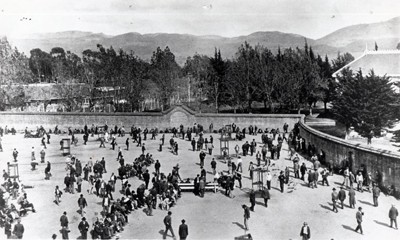
Worse was to come … In 1900, Charles was still in the Napa asylum. Alice was renting a home in Oakland with a daughter, Marguerite (b. 1895 — so presumably Charles was not her father), and poor Clarence and his brother were living in the Ladies Relief Society Children’s Home in the same city. In 1902, Charles Love Dell passed away, and then in 1904, Alice was herself committed to Stockton Insane Asylum! Newspaper articles state that Charles had also died at Stockton Asylum, where his widow was now a patient. Bizarrely, her father, Dr. W.D. Aylett, had been the superintendent of the asylum decades earlier (and I can’t resist mentioning that the resident physician he replaced had been dismissed after shooting his assistant physician in a duel!)
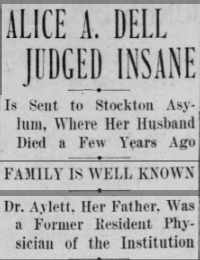
Newspapers explained that Alice had inherited $20,000 on the death of her father, and her husband had inherited $50,000 from his, but they had lost all of the money on the stock market.
According to the San Francisco Call: “Mrs. Dell is afflicted with the hallucination that she is being pursued by people who wish to do her bodily injury. At night she imagines that they search for her with policemen’s pocket lamps and in order to keep from being awakened by their flashing she sleeps with a light in her room. She has three children. William, the eldest, who is 16 years of age, is away and it is not known where he is; Clarence, a year younger, is at Dr. Brewer’s school in San Mateo, and Marguerite, the girl, is attending the Sacred Heart Convent in this city. Three years ago Mrs. Dell attempted suicide by jumping from a ferry-boat into the bay, but was rescued.”
The Oakland Tribune reported that the children are “now under the care of L. M. Hoefler in San Francisco”, and that Alice had gone to Sacred Heart to try to remove her daughter from the school; she wouldn’t leave, and instead was “placed in charge of an officer and taken to the Receiving Hospital.” Clarence and his siblings were effectively orphans.
However, by 1904, Clarence’s luck had changed, and he was enrolled at St. Matthew’s. School prospectuses from 1904–5 list his guardian as L. M. Hoefler, and in 1907, Dell’s guardian was his uncle John M. Carrère.
Hoefler was a prominent San Francisco attorney and vice president of the San Francisco Club, under Alma Spreckels. As well as acting as Clarence’s guardian, he represented Clarence and his siblings in their claim to a share of their grandfather’s Texas estate. They were awarded $30,000 in 1908 — too late for Clarence to receive his share.
The San Mateo County History Museum Archives hold hundreds of photographs of St Matthew’s students and teachers from 1900–15. Sadly none of the pictures are named (it was a spooky feeling knowing that I must have seen Dell among them), but they show that school life, though strict, was a privileged and healthy one, full of outdoor sports, military exercises, and even theater. St. Matthew’s cadets went on to study at America’s best colleges. After years of hardship, Clarence, on the brink of adulthood, finally had an opportunity to improve his life — but it wasn’t to be.
The HEROES — Mr. Smith & Professor Brooke
Mr. Brewer “said that he had never known an instance of greater fidelity to simple duty than was shown by these two teachers.” He continues with touching testimonies to their character:
“Mr. Brooke had been with me but two days” “but he had already won my heart.” “Mr. Smith was one of the most lovable characters I ever knew. He had been with me two years and as his character unfolded I daily discovered new traits to admire. I am sure they went to their death with a smile and a sense of duty performed.”
(The idea of them dying with a smile, at performing their duty, seems rather macabre to us now, but fits perfectly with the rhetoric of the “Great War” that lay only 7 years ahead).
Mr. Smith, Assistant in Mathematics and Director of Athletic Sports, was 25. Professor Brooke, an English teacher, was just 22. These brave teachers were just three and six years older than the student they tried so hard to save.
George William Smith hailed from a “noted family” in Colorado Springs, and was a Stanford electrical engineering graduate (1905). Known in college circles as “Denver” Smith, he was a “famous football player” and “college athlete” who had played end on the Stanford Varsity 11 in 1903–05. In a winning Thanksgiving game against The Indians, “Smith kicked goal each time.” Writing this as I watch the 2017 Superbowl, I’m struck by this summary: “Besides the good quality of football that Stanford men displayed, their work was remarkable for its extreme fairness and absence of all unsportsmanlike actions.”
Learning about Denver Smith revealed how common drowning was in that era. A player who played the same position as Smith a year later — “Brick” West — also drowned (in a storm on Eel River) a few months afterwards. Additionally, The Stanford Daily, 27 Aug, 1907, reported that as well as the recent death of George W. Smith, the “famous varsity end”, three undergraduates had also met their deaths that summer — all by drowning! Two were drowned in Lake Washington, when their boat overturned, since neither was able to swim. Like Smith, they were members of the university’s Encina Club. Another was drowned in Lake Young, near Astoria; he was sailing when wind caused him to hit his head, which rendered him unconscious, and he was thrown into the lake. “A Brief History of Drowning” on Medium sheds some light on the past and present dangers of water recreation — with swimming lessons only becoming formalized in the early 20th C.
“Denver” Smith was engaged to Miss Lois Mayhew of Stockton. They had met in San Francisco, where she had resided with her mother “who at that time, kept a private boarding house, catering only to the patronage of college students.” The couple were expected to marry in San Francisco “before the close of the holidays”. Friends of Smith broke the news of his death to her “as softly as possible.” Miss Mayhew was described as “very beautiful”, a “prominent society girl” with “a large circle of friends.” She was “heart broken over the sad and untimely death of her heroic lover”. Poor Lois did not marry until 1912.
John Thomson Brooke II was born April 22, 1885, the only son of the Right Rev. Francis Key Brooke (named for Francis Scott Key, a relation, and the lyricist of “The Star-Spangled Banner”!). Rev. Brooke’s church became the Episcopal Cathedral for OK that same year, which made him Episcopal Bishop of Oklahoma. His son’s drowning was reported in The Churchman, an Anglican journal, and the Bishop of California “read brief services over the body of Mr. Brooke before it was sent on to [Ohio].”
John Thomson Brooke had heart trouble, which makes his bravery even more poignant. As a youth, he had attended Kenyon Military Academy in Gambier, OH. He then attended Kenyon College, where he was a member of Alpha Delta Phi, and he had just graduated before moving to California. After his death, he was remembered fondly and with great pride in the Kenyon Collegian.
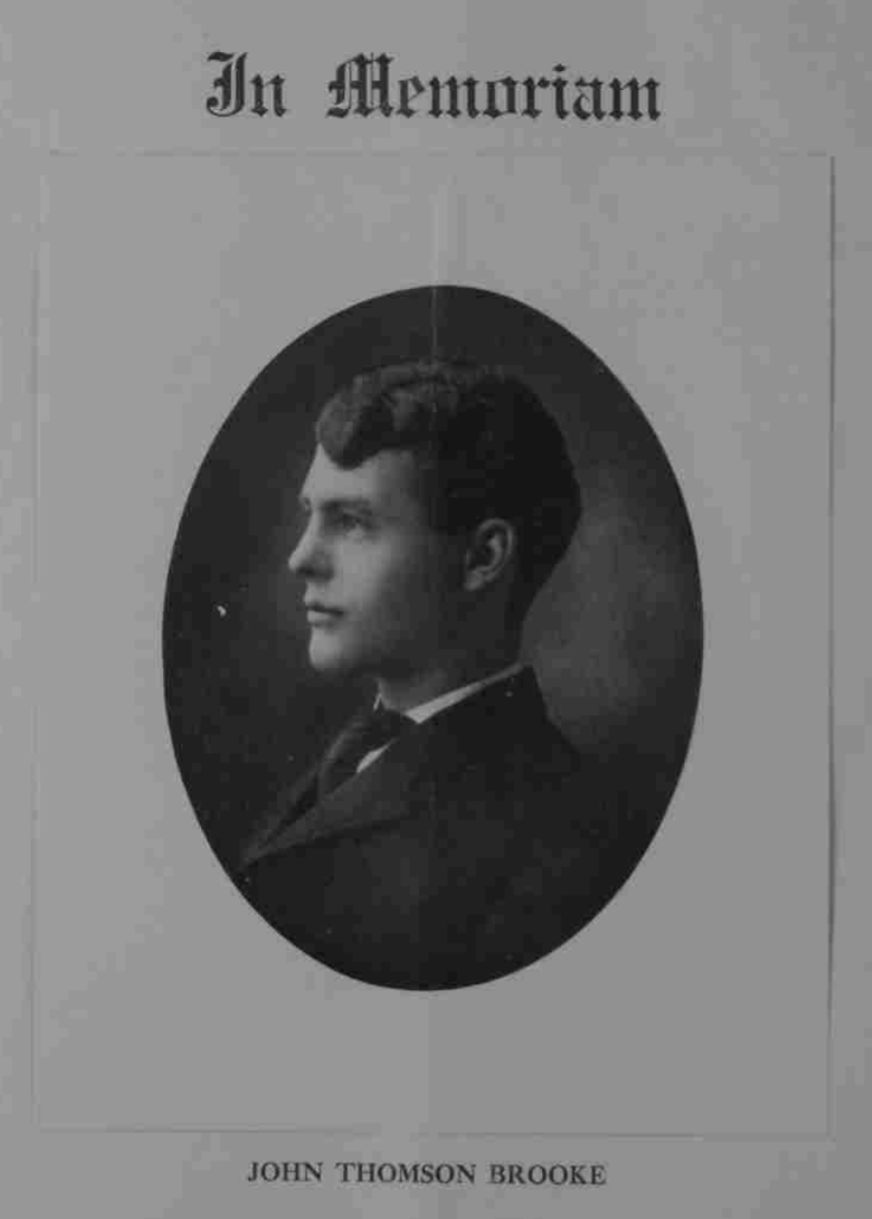
The Editor opens by asking: “will not his heroic and God-inspired example always serve as an inspiration to all true Kenyon men to give even as if they have been given to? We feel for Bishop Brooke and his family the sincerest sympathy and assure them of the secure place that their noble son has in the hearts of Kenyon men.”
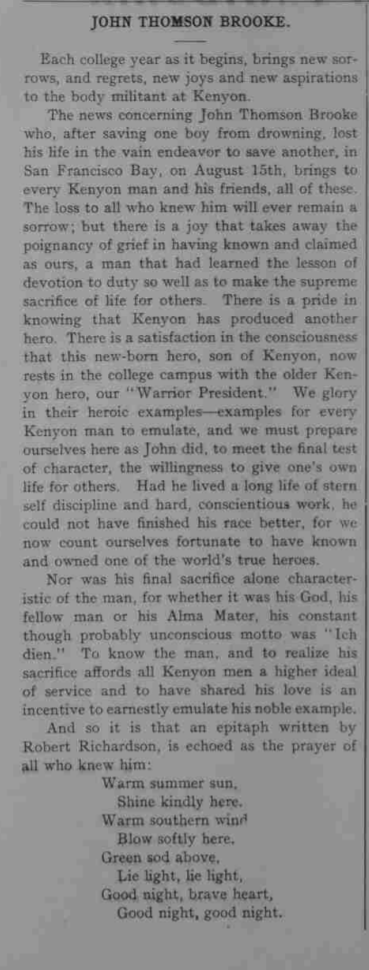
Brooke’s stirring epitaph eulogized him as a man who lived to serve others, and who made the ultimate sacrifice — an example for all Kenyon men to follow. Here it is in full:
Memorials in Glass and Stone
George Smith is buried at the historic St. John’s Cemetery in San Mateo, close to what is now known as the “Brewer Subdivision”. He has a small, simple headstone in the “Brewer Plot.”

At the Episcopal Cathedral of Oklahoma, John Brooke’s parents gave a window on the gospel side of the altar in his memory.
Kenyon College also remembers the Brooke family.

John’s grandfather, John Thomson Brooke I, was a professor at Kenyon, and his father Francis also attended the school. The three generations of Kenyon men are honored in the Brooke Memorial Windows in the Church of the Holy Spirit there, commissioned by John Thomson’s sister, Louisa Brooke Jones, and unveiled in 1931. John is remembered in a rose window, which “depicts a youth running along a rocky beach toward the setting sun.”
Brooke is buried at Kenyon College Cemetery with his parents. A cross over his grave states simply and powerfully “HE GAVE HIS LIFE”.
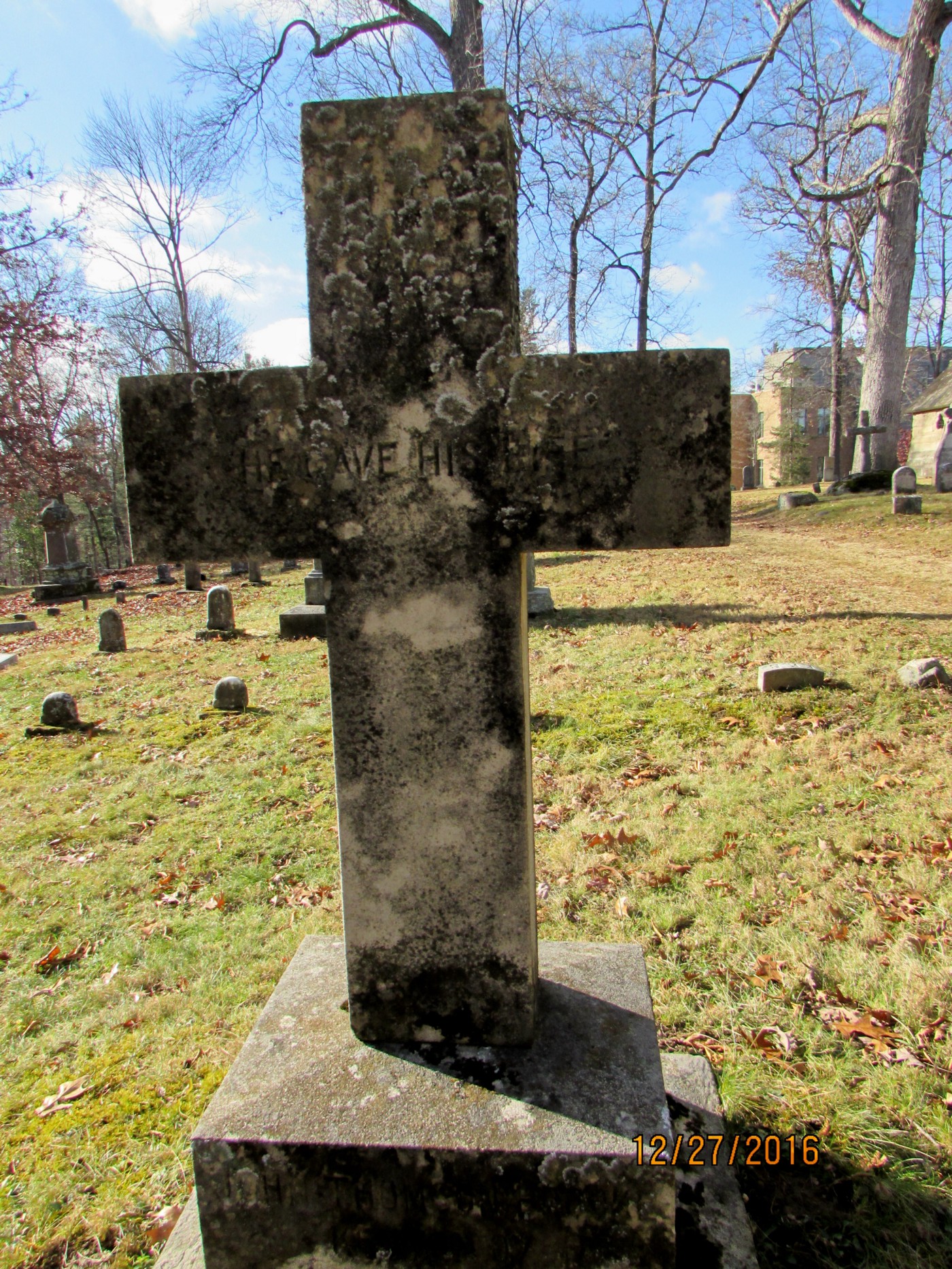
Let’s return to the plaque at St. Paul’s, Burlingame:
Three weeks after the tragedy, The Churchman reported that “the citizens of California have recognized the splendid heroism of these two men, and steps are already being taken to provide at the school a suitable memorial.”
I wondered how that memorial from St. Matthew’s Hall came to be at St. Paul’s, rather than St. Matthew’s church. In fact, the school and both churches are very closely tied.
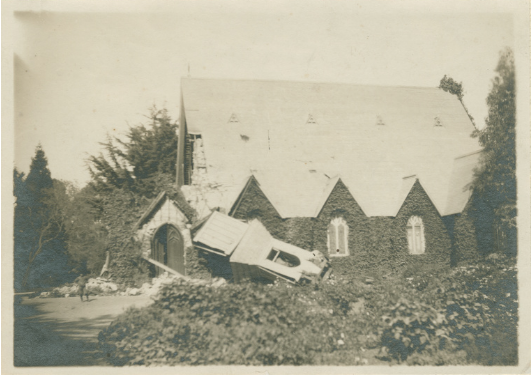
The year before the drowning, the infamous 1906 earthquake seriously damaged St. Matthew’s Church, and the Vestry chose to raze the church rather than attempt to repair it.
By 1908, St. Matthew’s rector, the fabulously named Rev. Neptune Blood William Gallwey, raised funds to build a new church. They salvaged many parts of the original building and fixtures.
While St. Matthew’s was rebuilding, Rev. Gallwey founded 3 missions, including St. Paul’s, to minister to the large number of people who moved to the Peninsula from San Francisco after the great earthquake. He passed away in 1910, just 11 days after new St. Matthew’s church was consecrated.
In 1915, the City of Hillsborough had plans for a major thoroughfare that would pass through St Matthew Hall’s land. Rev. Brewer decided to close the school (which was presumably razed). He then became the first rector of St. Paul’s, still a simple wooden structure. He also became mayor of Hillsborough. The present St. Paul’s church was built in 1926, with Rev. Brewer still at its helm.
Perhaps the plaque was placed in St. Matthew’s Hall, and when the school was closed, Rev. Brewer brought it with him to St. Paul’s, where it was kept safely until it could be finally placed into the new St. Paul’s church in 1926. I like to think that Brewer wanted to have it close by, to remember the selfless sacrifice of his teachers and tragic loss of his student.
Carnegie Awards
In 1913, Brooke and Smith were posthumously awarded medals by the Carnegie Heroes Fund, which had been established by Andrew Carnegie in 1904. Brooke’s father received a silver medal and Smith’s mother a bronze medal. Each was also awarded $1000.
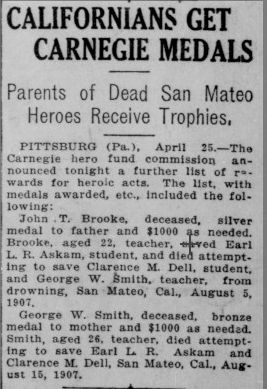
The Carnegie Hero Fund website maintains a page about the heroic acts of every recipient. This account of the tragedy helped clarify other sources.
John Brooke’s Carnegie medal page
George Smith’s Carnegie medal page
Earl Askam
Finally, you may be wondering what became of Earl Askam — the boy who was rescued by John Brooke. (Or perhaps it’s just me?!)
Earl Leslie Rengstorff Askam was born May 10, 1891 in Seattle, WA to Dr. Oliver & Helena Askam. They lived in Fremont, CA, by 1900, and then settled in Mountain View. However, his mother died in 1902 and father in 1906. Like Clarence, Earl was an orphan.
But this cadet’s story has a remarkable and happy ending, because, believe it or not, he went on to become an opera singer and Hollywood actor!!
Askam attended Santa Clara University, where he trained as a singer (and was also an athlete). He and his younger brother Perry both became members of the New York Metropolitan Opera. In 1939, Earl was even a principal in a stage version of Verdi’s Aida at the Hollywood Bowl!
Earl often performed in concerts and shows with Perry, who was the bigger star of the two. He also took time out from the stage to act in many Hollywood movies, and was best known for Flash Gordon, Trail Dust and Empty Saddles (all 1936).

Here he is in Red River Range, 1938, standing behind a young John Wayne, who was born just two months before Askam’s teenage brush with death, and would become a big star in Stagecoach the following year.

Askam also served in the US Army as a lieutenant in World War I, and married a German woman called Wally Ella.
In total, Askam clocked up 42 acting credits, continuing to work until his death at the age of 48 on April 3rd, 1940, of a heart attack — while playing golf in Los Angeles with fellow actor Kermit Maynard. His funeral was held in Mountain View, CA, and he is buried in Oakland.
_____________________________________
Updated on 2/27/17 to include additional information provided by Kenyon College Archives. Re-published on digupyourancestors.com on 17 April 2022.
Special thanks to:
Carol Peterson, Archivist at San Mateo County History Museum
Kathy Wade, Superintendent at St. John’s Cemetery, San Mateo
Liam Horsman, Student Manager, Kenyon College
Sources in addition to links embedded in the article:
St. Matthew’s Episcopal Church website
St. Paul’s Episcopal Church website
St. Matthew’s Episcopal Day School website
St. Matthew’s Episcopal School Wikipedia entry
Military-style academies on the march in 1800s (The Mercury News)
Carrère and Hastings on Wikipedia
Stockton State Hospital: A Century and a Quarter of Service
Stanford University Annual Register 1903–4
Kenyon College Alumni Bulletin
Earl Askam bio on b-westerns.com
Newspapers & Periodicals accessed on microfiche, via Google, or the California Digital Newspaper Collection:
San Mateo Times, The Churchman, Western Architect & Engineer, Chicago Tribune, Daily Alta California, Sacramento Union, San Francisco Call, Press Democrat, Oakland Tribune
























































 Dig Up Your Ancestors