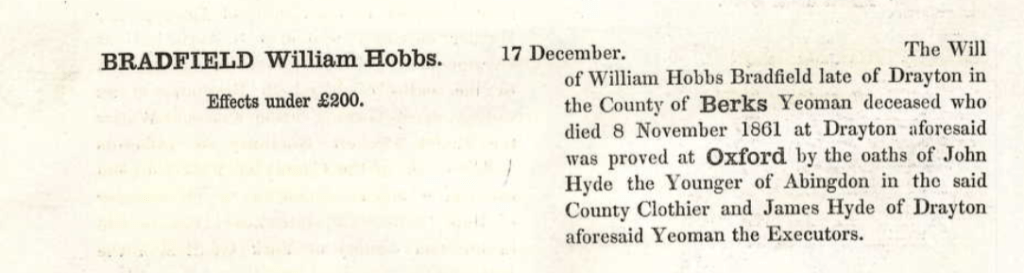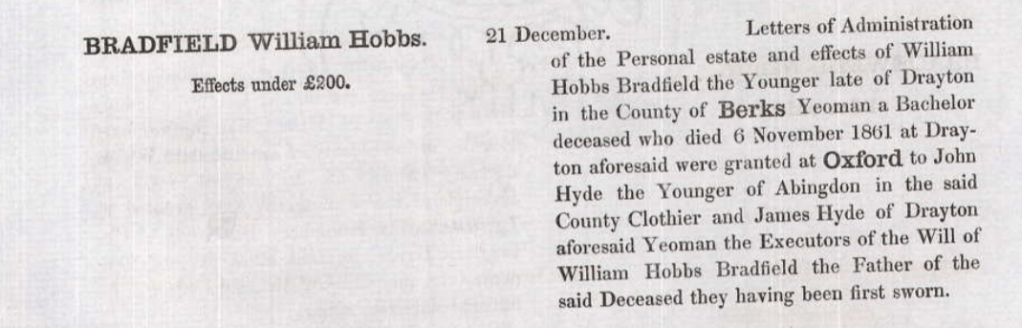
I truly believe that every family history is filled with stories waiting to be discovered. And even the driest of documents can open a door to uncovering those stories. Case in point: I recently researched a name on an old document in my possession, and soon discovered some deaths with unusual circumstances.
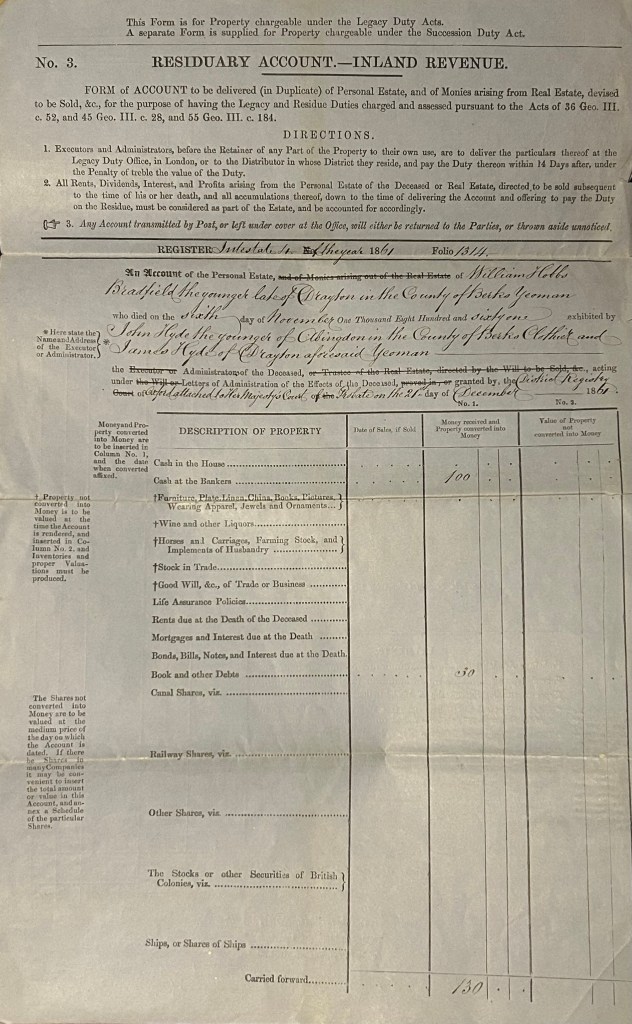
In a collection of old papers from the family who built my house, there’s a large blue document from 1861. It is a residuary account form, which was used to record any property of a deceased person that was chargeable under the Succession Duty Act. At first glance it didn’t look very exciting, and the family I’m researching are only named as executors. But on inspecting the sparse details, my interest was piqued …
The deceased was William Hobbs Bradfield the younger, a yeoman of Drayton, Berkshire, who died intestate on 6 November 1861. From this brief information, I knew that there was also a William Hobbs Bradfield the elder, and that the younger of these namesakes had died first. Were they father and son, and what had happened to the younger man?
Since he had a distinctive name, I did a search of historic newspapers online and quickly found a death notice in the Berkshire Chronicle, 16 November 1861. Despite its typical format, it gave me quite a surprise:
DIED …
Nov. 6, at Drayton, after a fortnight’s illness, Mr. William Hobbs Bradfield, to the great grief of his friends, aged 24. Nov. 8, Mr. William Hobbs Bradfield, father of the above, aged 74.
The older William Hobbs Bradfield, who was indeed the father, had died just two days after his son! It must have been a terrible shock for their family. I wondered if they had both died of the same infectious disease, and my curiosity prompted me to download their death certificates.
I learned that the younger William had died of typhoid fever after 14 days with the illness. Typhoid was a scourge in many parts of the world that year. It killed thousands of soldiers in the American Civil War, and just five weeks after William’s death it claimed the life of Queen Victoria’s beloved Prince Albert. Learn about typhoid in the Victorian era from Oxford’s History of Science Museum.
Death certificate of William Hobbs Bradfield the Younger
But typhoid was not given as the cause of death of the older William. Rather, he’d been paralysed for five days, and the condition had begun three days before the death of his son. It is difficult to know if the paralysis was caused by typhoid, or perhaps a stroke. In recent years the INTERSTROKE study showed that strong negative emotions (such as being very upset because your son is gravely ill) increase the risk of a stroke.
Death certificaye of William Bradfield the Elder
William Hobbs Bradfield Sr. had written a will before his death. I don’t know when he wrote it, or its contents, and as the cost to order a will has recently increased from ยฃ1.50 to ยฃ16, for now this will have to remain unknown. What I do know is that probate was granted on 17 December to his executors John and James Hyde. And that the same men were granted letters of administration on 21 November for the estate of William Hobbs Bradfield the Younger. Father and son both had effects worth less than ยฃ200.
Only eight months before their deaths, the two William Hobbs Bradfields appeared together in the 1861 census.1 William Sr. was a farmer of 15 acres in Drayton, and was a widower. The household also included William Sr.’s 26-year-old unmarried adult daughter, Esther. I later learned she was named after her mother.
After the deaths of both Williams, Esther continued to run the farm herself. In 1871 she farmed 13 acres, living only with her widowed elderly aunt2, and in 1881, she was living with her sister in law, an annuitant, and farming 15 acres3. Then in 1887, at the age of 51, she got married!
Her husband was Robert Langford, a 63-year-old, recently widowed coal merchant from Somerset, who had the main contract to supply coal to the train station at Steventon, immediately south of Drayton. Robert had started life as a labourer but had become a ‘gentleman’ and had built several houses in Steventon village, including Timsbury Villa and an adjacent row of cottages, Timsbury Terrace. Thanks to Steventon History Society I know that Timsbury was the name of the village at the centre of the Somerset coalfield that had made Robert rich.
Tragically, just a few weeks after the wedding, Robert died ‘rather suddenly’ after becoming breathless. An inquest was held on his body in Steventon’s Wesleyan school room, and evidence was heard that he’d had diabetes for many years, and had suffered with a bad cold for 13 weeks. In fact, he had ‘never enjoyed the best of health’. Given Robert’s known medical problems, the coroner ruled it a death by natural causes. ‘His death however was altogether unexpected, and much sympathy is felt for Mrs Langford, who has been forced into widowhood after but a few weeks of married life.’4 I can’t help wondering if anyone harboured suspicions, rather than sympathy.
After Robert’s death, Esther Langford lived comfortably in Timsbury Villa, ‘on her own means’.5 She died in 1905 aged 70, leaving effects valued at ยฃ2647 (ยฃ281k today). Her will instructed the sale at auction of several properties, brewery shares and furnishings. However, there were no heirs to her estate, and in 1907, a national newspaper ad sought her Bradfield kin:
NEXT OF KIN And Others Wanted to their Advantage. … Langford, Esther, widow, late of Steventon, Berks, deceased. Heir-at-law wanted.
Bradfield, Thomas, Jonathan, and William Hobbs, all of whom went to America some years ago, or their descendants are believed to be interested in the estate of the said Esther Langford.
(Midland Mail, 23 November 1907)
Thomas and Jonathan were Esther’s uncles. But who was this William Hobbs Bradfield who had emigrated? And did any of Esther’s relations in the United States claim the inheritance?
The wonderful thing about family history is that there is always more to find out!
1861 Census of England, The National Archives, RG 9/735, Folio 31, Page 6.
1871 Census of England, The National Archives, RG 10/1266, Folio: 32, Page 1.
1881 Census of England, The National Archives, RG 11/1286, Folio 30, Page 1.
Witney Gazette and West Oxfordshire Advertiser, 2 April 1887.
1891 Census of England, The National Archives, RG 12/981, Folio 60, Page 5 and the 1901 Census of England, The National Archives, RG 13/1134, Folio 52, Page 18.
In William and Frederick: Case 1I went on the trail of my elusive 2x great grandfather. By piecing together a variety of sources I was able to show that he used multiple names throughout his entire life โ including ‘Fred/Frederick Homan’, ‘William Homan’ and ‘William Taylor’. And after exploring his upbringing in a blended family and his adult relationships, I was able to suggest reasons for these aliases. I was also able to use DNA to substantiate my research.
By a strange coincidence, my husband also has a 2x great grandfather for whom there are records of multiple first and last names, including William and Frederick! I’ve attempted to make sense of the confusing paper trail to try to establish if this was another case of one man using several aliases, or multiple men. And if it was more than one, who was my husband’s biological ancestor? I’m still working on this conundrum, but I invite you to come along with me on my research journey so far. In this blog, I’ll be presenting the documentary and DNA evidence I’ve gathered to date, and sharing a theory of what might have happened โ and I would love to hear your thoughts!
Although this blog sets out to solve the puzzle of a father’s identity, I also want to tell the story of the people at the heart of this complicated situation โ my husband’s 2x great grandmother, Amelia, and her children. At their lowest point, Amelia and her two little daughters were admitted to the Workhouse. The youngest, just 18 months old, was my husband’s great grandmother, Alice.
The search for Alice’s origins
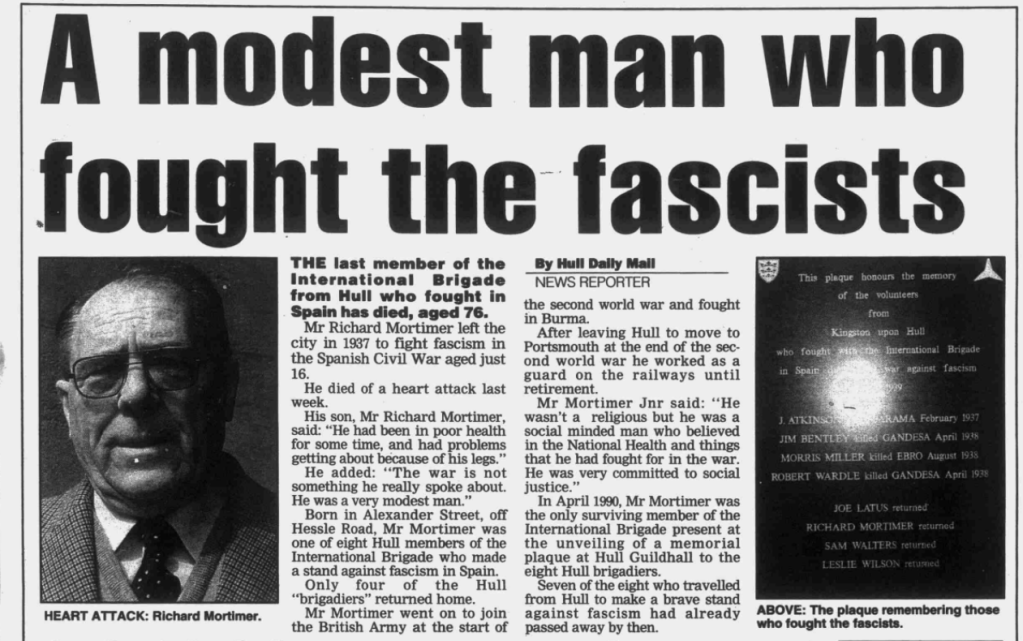
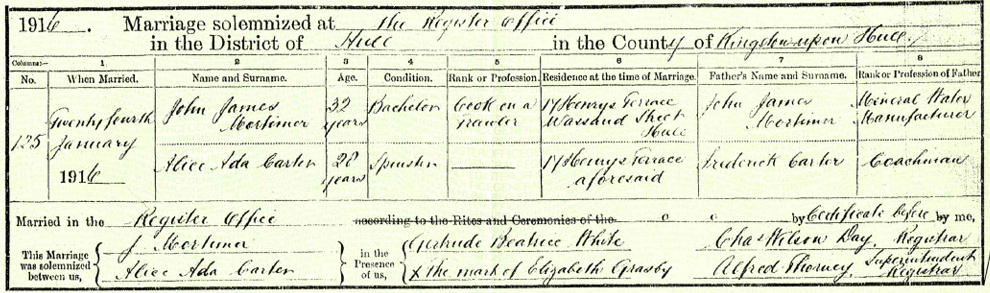
My husbandโs great grandparents, John James ‘Jack’ MORTIMER and Alice Ada CARTER, married in Hull during the First World War. The marriage certificate stated that Aliceโs father was Frederick Carter, a Coachman.
Marriage certificate of Alice Ada Carter and John James Mortimer
I knew that Alice was born in 1887 in Bermondsey. I was able to find an Alice Ada Carter in the 1901 census in Camberwell (next door to Peckham), who fitted the bill. She was 13, born in Bermondsey, and her father was Frederick William Carter. Other family members were Frederick’s wife Amelia, and his daughters Rose Minnie, 17, and Florence Ethel, 9.
I was fairly confident this was the right family, but Frederickโs occupation was Night Watchman rather than coachman, and he had a middle name that wasn’t included on the marriage certificate. Since Carter is a common name, I wanted to be sure. I hoped that a birth certificate for this Alice Ada Carter would match the birth date of my husband’s great grandmother Alice Ada Mortimer in the 1939 Register (22 June 1887). Frustratingly, I was unable to find a birth registration for Alice, or for her older sister Rose. But their younger sister Florenceโs birth record showed that their mother Ameliaโs maiden name was HATTON.
Using the FreeBMD site I found two births for an Alice Ada born in St Olave Southwark district (which included Bermondsey) in Q2 and Q3 1887: Alice Ada CROSS and Alice Ada SNELLGROVE. I was then able to use the GRO database to look at the mother’s maiden name for these two births, and found that Alice Ada Cross had the MMN of Hatton. The birth certificate showed that her birthdate matched that of my husband’s great grandmother. So I had found the right Alice, but she had been born with the surname Cross, not Carter, and her father was William Cross, an Engineer. Had her mother, Amelia, been married before?
Birth certificate of Alice Ada Carter
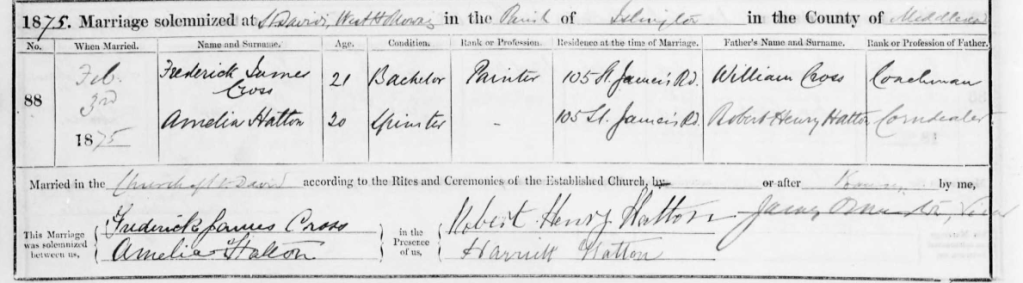
I discovered that 12 years before Alice’s birth, Amelia Hatton had indeed married a Mr Cross, but rather than an engineer called William Cross, as per Alice’s birth certificate, Amelia’s husband was Frederick James Cross, a painter.
Marriage register entry of Frederick James Cross and Amelia Hatton London Metropolitan Archives; London, England, UK; London Church of England Parish Registers; Reference Number: P83/DAV/010; via Ancestry.co.uk.
In 1891, 4-year-old Alice was was recorded in the census as ‘Alice A Carter’, living with her parents Frederick and Amelia Carter in Peckham. I therefore assumed that Amelia had been widowed and remarried between Alice’s birth in June 1887 and the census in April 1891. However, I was unable to find a marriage for Amelia Cross (or Hatton) and Frederick Carter then, or at any other date.
And the more I delved into the family, the more perplexing it got. I could find no evidence for an engineer called William Cross, and had little to go on to find out more about Frederick Carter and Frederick Cross. It didn’t help that Frederick Carter had numerous completely different occupations and gave inconsistent ages and places of birth.
To tackle this type of family history puzzle, I find it really helpful to be very methodical โ to pull together as much evidence from records as possible and organise it chronologically. Below, I’ve shared information about this complex family, through three phases of the family’s development. In each phase, I have summarised key events. For those of you who enjoy the nitty gritty I’ve also included a chronological list of records, and in each record, the name, age, occupation and place of birth of the father is highlighted in red.
1875-1882: Amelia andFrederick James Cross
A few months after marrying in Islington in early 1875, Amelia and Frederick Cross had a son, Edwin, in Ware, Hertfordshire. I believe Frederick had connections in that town. Two more children were then born in London (Ernest in 1877 and Stephen in 1880) but by the spring of 1881, Frederick and Amelia seem to have been living separately (though possibly only 2 miles apart). Meanwhile, their first two sons, Edwin and Ernest, were alone in Ware Union Workhouse โ at just 3 and 5 years old. Had they been taken into care for their safety? Or did their parents take them there out of desperation?
Amelia may have spent time in Fulham Road Workhouse before the death of their third child, Stephen, in 1882, just before his second birthday.
Records:
3 Feb 1875, St David’s, Barnbury (Islington): marriage of Amelia HATTON, 20 and Frederick James CROSS, 21, a painter. Frederickโs father was William CROSS, a coachman.
25 May 1875, Ware, Hertfordshire: birth of Edwin George Fred CROSS.
25 July 1875, Christchurch, Ware, Hertfordshire: baptism of Edwin George Fred CROSS to Frederick James CROSS, painter and Amelia CROSS.
Q1 1877, Islington district: birth registration of Ernest Arthur CROSS.
15 July 1880, West Ham registration district: birth of Stephen John CROSS.
15 August 1880, St Saviour’s, Walthamstow: baptism of Stephen John CROSS to Frederick James CROSS and Amelia CROSS.
3 Apr 1881 (1881 census), 15 Watson St, South Hornsey: Amelia CROSS, dressmaker, 26, married, b. Essex; [Stephen] John CROSS, ? months. No husband present. Two miles away, at 27 Wynford Rd, Islington, a Frederick CROSS, carman, 28, b. London, was enumerated as a married lodger, with no wife present. Although not a painter, could this be Ameliaโs husband? In the same census, Edwin CROSS and Ernest CROSS were in the Ware Union Workhouse, aged 5 and 3.
23 August 1881, Fulham Road Workhouse: Discharge from workhouse of Emily CROSS, 25; Could this be Amelia? If so, she wasn’t with her infant son Stephen.
9 June 1882, 25 Spenser Road, South Hornsey: death of Stephen John CROSS, aged 1 year and 11 months, son of Frederick James CROSS, painter; cause of death was measles and pneumonia (buried Abney Park Cemetery, Stoke Newington).
1884-1889: Amelia and Frederick James/William Cross
In about 1884 Amelia relocated to south London, and that year she registered the birth of a child in Greenwich: Rose Minnie Cross, daughter of Frederick James Cross, a Builder. But the following year she registered the birth of her daughter Alice with the father William Cross, an engineer, and that same father’s name and occupation were recorded in the baptism register. The occupation of engineer is specific, and different from any occupations recorded for Frederick Cross or Frederick Carter, suggesting a real and distinct person, but I have been unable to find anyone called William Cross in the 1881 or 1891 census with that occupation.
Birth certificate of Rose Minnie Cross
Amelia and her daughters spent time in more than one workhouse in 1888 and 1889, and the reason given by Amelia for their predicament was desertion by her husband, which had left them destitute.
Admission to and Discharge from Woolwich Road workhouse, 1889 London Metropolitan Archives; London, England, UK; London, England, Workhouse Admission and Discharge Records, 1764-1921; Reference Number: GBG/250/19; via Ancestry
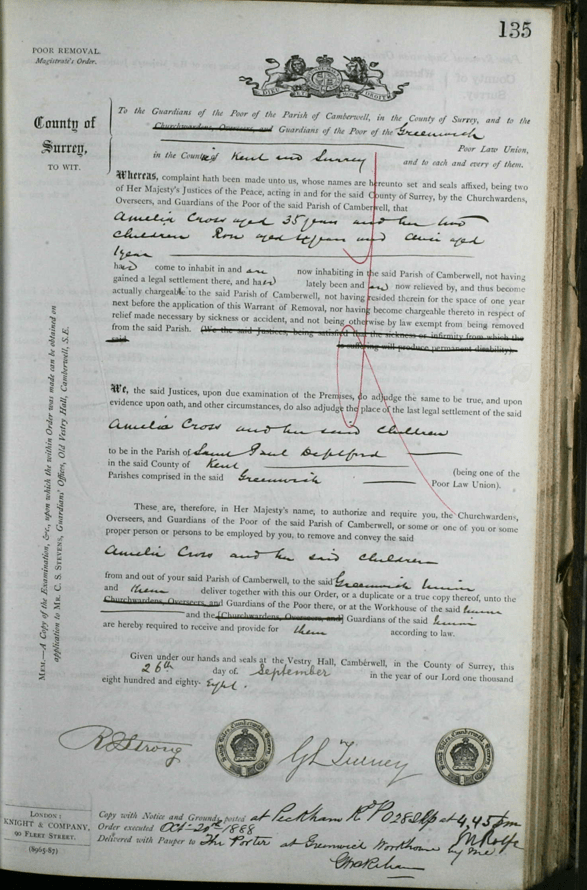
Within the Poor Law collections held by The London Archives that have been digitised in Ancestry, a few have been indexed (primarily admission and discharge registers), but many have not, and these unindexed collections can be a treasure trove of information. In the collections London, England, Selected Poor Law Removal and Settlement Records, 1698-1922 and London, England, Poor Law and Board of Guardian Records, 1738-1926 I was able to find more records about Amelia and her daughters. A settlement examination of several pages from 1888 revealed that although Amelia had been residing in Camberwell since the prior year, it was not long enough to have secured settlement there. She had previously lived in the parish of Deptford in Greenwich Union for ‘upwards of three years’, at more than one address, and she was still the responsibility of that Union. An order was then issued for Amelia, Alice and Rose’s ‘removal’ to Greenwich โ a reminder of how little control Amelia had over her own life, even when she was without a partner.
Amelia’s predicament reminds me of the story behind one of the pictures of the ‘Spitalfields Nippers’ โ very poor East-End children who were photographed in the early 1900s. It shows two young girls of similar ages to Rose and Alice when they were admitted to the workhouse, and is the featured image I’ve chosen for this blog. Their mother, Annie, had been in a relationship that had produced 8 children, half of whom had died, and she had been abandoned by her partner. One of her boys had been taken away and placed in a workhouse. You can learn more about the image at the end of this blog.
Select pages of the Poor Law Removal Order for Amelia, Rose and Alice Carter from Camberwell to Greenwich
It has been very challenging tracing Frederick Cross before or after his relationship with Amelia. However, a possible candidate is the Frederick Cross who was living in Ware in 1871, aged 17, an Ag Lab. He was baptised in Stanford, Norfolk in 1853 (now one of the deserted ‘battle churches‘), the son of William Barton Cross (a labourer, not a coachman) and Eliza (nรฉe BOWERS). His mother remarried to Edward BOUTLE in 1867. As well as the Ware connection, Frederick’s step-father was a house and barge painter, so Frederick could have learned that trade from him. Eliza and Edward were living just outside Ware in 1881, so if this is the right family, why did they not take in her grandchildren, Ernest and Edwin?
Records:
10 March 1884, 73 Napier Street, Greenwich district: birth of Rose Minnie CROSS; father is Frederick James CROSS, builder.
22 June 1887, 189 Drummond Road, Bermondsey: birth of Alice Ada CROSS, my husbandโs great grandmother; her father was William CROSS, engineer.
31 July 1887, Clare College Mission church, Bermondsey: baptism of Alice Ada CROSS to William CROSS, engineer, and Amelia CROSS, of 189 Drummond Road, Bermondsey.
20 March 1888, Brighton Road School, London: school admission of Rose M CROSS; sent from Camberwell Union; nearest relation is her mother, in Gordon Road [Camberwell] Workhouse.
20 October 1888, Greenwich Union: admission to Woolwich Road Workhouse of Amelia CROSS, 35, Rose CROSS, 4, and Alice CROSS, 1. Amelia and her children had been removed from Camberwell, since they were not settled there. She was the โwife of Frederick a decoratorโ and they had been โdesertedโ.
28 May 1889, Greenwich Union: discharge from Woolwich Road Workhouse of Amelia CROSS, 34 and Alice CROSS, 18 months; they came from Norwood and were โdestituteโ. On 7 November Rose was re-admitted and sent to the Infirmary.
1890-1916: Amelia and Frederick William Carter
By the time Rose Minnie started school in 1890, the school register recorded her as Minnie Carter, daughter of Frederick Carter. She was also baptised as Frederick Carter’s daughter the following year at the age of 7. In the 1891 census in Peckham, Frederick Carter was the head of the family, and Amelia was shown to be his wife. Two weeks later, Alice also started school, and her father was ‘Alfred Carter’.
Amelia and Frederick had three more children between 1892 and 1898, but only one, Florence Carter, survived. When Florence started school in 1897 her father’s name was given as ‘Fred Carter’. In 1901 the family was living in Camberwell.
I have not been able to find any definite records of Frederick William Carter before he came on the scene in 1890, as the personal information he gave varied significantly. He was said to be 35 in 1891 but only 38 in 1901. And he was born in either Ipswich, or Burnt Fen โ both places are in Suffolk but 50 miles apart. He might have been the Frederick Carter who was a 21-year-old railway porter from Ipswich, lodging in Lewisham in 1881. Coincidentally, Amelia Hatton had three siblings who married Carters. Two of those Carters were the children of William Carter, a farmer in Comberton, Cambridgeshire. The other came from Aston in Hertfordshire. But neither of these Carter families seems to be a fit for Frederick.
Frederick had many different occupations over the years (seedsman, merchants clerk, clerk to seedsman, carman, night watchman, window cleaner, coachman). The change from a clerk to more manual occupations could be put down to a change in fortunes, although being a coachman was a skilled position and not something you could dabble in! I find the wide range of jobs rather implausible and more than a little fishy! It’s also worth noting that Frederick Cross was possibly a carman in 1881, and was the son of a coachman, and Frederick Carter also worked as a carman and coachman. Coincidence?
Amelia’s first-born sons, Edwin and Ernest, do not seem to have ever returned to live with their mother. They were were boarders together in Hoddesdon, Herts, in 1891. Ernest’s great granddaughter has told me that they had been told their mother had died of alcoholism. Ernest emigrated to Ontario in 1893 at the age of 16, as part of Britain’s ‘Home Child’ programme, while Edwin stayed in England.
Frederick Carter lived with his youngest daughter Florence in 1911 and was stated to be a widower, though I have not yet found Amelia’s death. After 1911, Frederick disappears from my view, although his daughter Alice seemed to think he was still alive when she married in 1916.
Records:
27 May 1890, Colls Rd School, Peckham: school admission of Minnie CARTER, b. 10 March 1884; father Frederick CARTER of 30 Loden Street.
25 March 1891, St Jude’s, Peckham: baptism of Rose Minnie CARTER to Frederick William CARTER, seedsman and Amelia CARTER of 50 Clifton Crescent, Peckham; Rose was 7 years old.
5 April 1891 (1891 census), 50 Clifton Crescent, Peckham: Frederick CARTER, merchants clerk, 35, b. Ipswich; Amelia CARTER, 34, b. ?, Essex; Rose M CARTER, 7, b. London New Cross, Alice A CARTER, 4, b. Bermondsey. In the same census, ‘Frederick’ [Edwin] CROSS, aged 16 and Ernest CROSS, 14, were boarders in Hoddesdon, near Ware.
27 April 1891, Colls Rd School, Peckham: school admission of Ada Alice CARTER, b. 22 June 1887; father Alfred CARTER of 50 Clifton Crescent, Peckham. [perhaps if he went by ‘Fred’, the clerk assumed he was an Alfred rather than a Frederick].
Q1 1892, Camberwell district: birth registration of Florence Ethel CARTER.
10 January 1892, St Jude’s, Packham: baptism of Florence Ethel CARTER, b. 25 November 1891, to Frederick William CARTER, clerk to seedsman, and Amelia CARTER, of 50 Clifton Crescent.
Q1 1893, Camberwell registration district: birth registration of Leonard CARTER.
Q2 1894, Camberwell registration district: death registration of Leonard CARTER.
9 April 1895, Camberwell registration district: birth of Martha Eleanor CARTER.
18 April 1894, Camberwell Old Cemetery: burial of Leonard CARTER, aged 14 months.
11 November 1895, St Jude’s, Peckham: baptism of Martha Eleanor CARTER to Frederick William CARTER, carman, and Amelia CARTER, of 21 Honiton Street.
2 November 1897, Waller Rd School, New Cross: school admission of Florence Ethel CARTER, b. 25 November 1891; father Fred CARTER of 30 Loden Street.
Q3 1898, Camberwell registration district: death registration of Martha Eleanor CARTER, aged 3.
7 July 1898, Southwark: burial of Martha Eleanor CARTER.
31 March 1901 (1901 census), 57 Evelina Rd, Camberwell: Frederick William CARTER, 38, Night Watchman, b. Burnt Fen, Suffolk[50 miles from Ipswich]; Amelia CARTER, 41, b. Romford, Essex, Rose Minnie CARTER, 17, b. Deptford, London; Ada Alice CARTER, 13, b. Bermondsey, Florence Ethel CARTER, 9, b. Camberwell.
26 December 1908, St Katherine’s, Rotherhithe: marriage of Rose Minnie CARTER to William Henry TAYLOR; Rose’s father was Frederick William Carter, window cleaner.
2 April 1911 (1911 census), 87 B Ewart Road, Forest Hill: Frederick William CARTER, 54, widower, window cleaner, b. Ipswich; Florence Carter and a lodger.
24 January 1916, Hull Registry Office: marriage of Alice Ada CARTER to John James MORTIMER; Alice’s father was Frederick William Carter, coachman.
After 1911
I have been able to follow the next steps of three of Alice’s siblings:
Ernest Cross settled in Ontario, Canada and I was delighted to find that my husband is a DNA match with his granddaughter, Cindy. She told me that sadly, Ernest lost touch with his older brother Edwin when he emigrated, and despite family members travelling to England to search for him, the brothers never saw each other again.
Rose Minnie Cross/Carter married in 1908 but separated from her husband after 1911. In the 1921 census she was a musician, and the wife of a Bohemian musician (he was actually from Bohemia!) though they did not really marry until 1930.
Florence Carter emigrated to Vancouver, Canada, where she married.
Ernest, Rose and Florence all had children, and this has resulted in valuable DNA data …
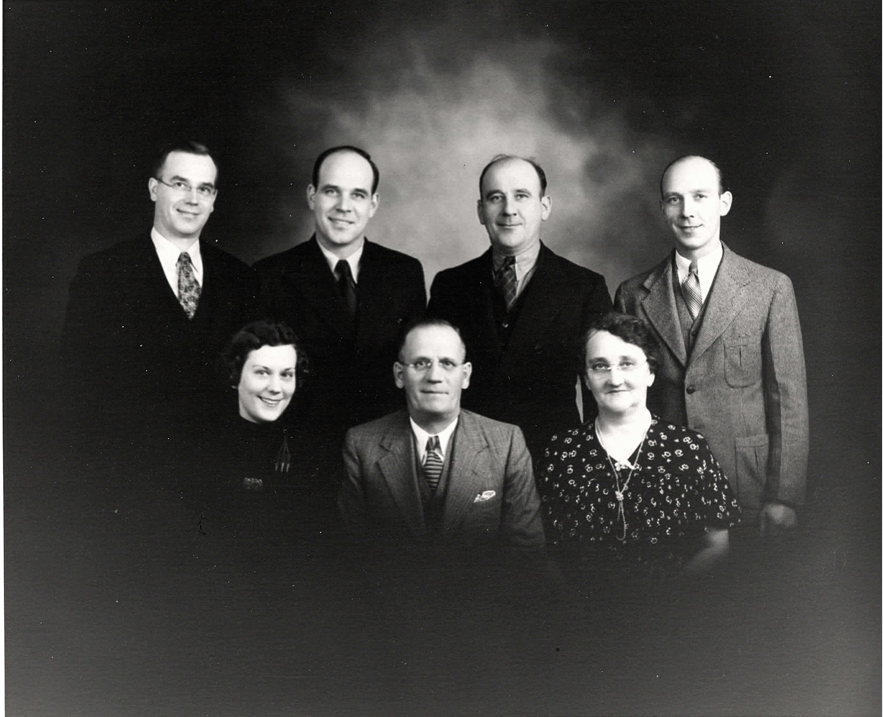
Ernest Arthur Cross (front centre) with his wife and 5 surviving children, Ontario, 1930s (photograph kindly shared by my husband’s third cousin, Cindy)
DNA evidence
Ancestry DNA’s Thrulines feature has helped me to find matches between my husband and father-in-law and descendants of two of Alice’s siblings, Ernest and Rose. Descendants of Ernest Cross are all ‘half’ cousins; they include two predicted half 3rd cousins of my husband (sharing 30-54 cM) and a half 2nd cousin of my father-in-law (sharing 15 cM). I have only one match to a descendants of Rose Carter, which is a predicted [full] 2nd cousin of my father-in-law (sharing 60 cM).
Based on these estimated relationships, it appears that Alice and Rose had the same father (i.e. they were full siblings) but Ernest had a different father (i.e. he was Alice and Rose’s half brother).
If this is correct, I assume that Frederick James Cross was the father of Ernest, but who was the father of Alice and Rose? Was it the mysterious William Cross, or Frederick William Carter?
A theory
My research suggests that a) Frederick Cross and Frederick Carter were two distinct individuals, despite having similar names, similar places and dates of birth, and some of the same occupations and b) that William Cross was a fictional character. However, I still don’t know the identity of my husband’s biological 2x great grandfather.
It’s clear that Amelia and Frederick Cross were unhappily married, and separated. Their separation and financial hardship presumably led to them giving up their two firstborn children. Amelia then had a relationship with another man, and Alice and Rose were born from that affair. Although Amelia initially passed Rose off as her husband’s daughter (at least in the official paperwork), she was unable to do so for Alice, so to give the illusion of legitimacy without the risk of stating the real father’s name, she fabricated a fatherโs name for Aliceโs birth certificate and baptism. The name ‘William Cross’ could have been a combination of her married surname Cross and the given name of the biological father, or Amelia could have given the name of her father in law (though hopefully he was not the father!). I think it’s very possible that Frederick William Carter was Rose and Alice’s biological father, especially as William was his middle name.
After this ‘infidelity’, Frederick Cross deserted his wife (though they may in fact have been separated for several years already) and they ended up in the workhouse. Even if Frederick Carter was the father of Rose and Alice, he might not yet have been in a position to live with them or support them financially.
Amelia then met or moved in with a new partner, Frederick William Carter. They lived as husband and wife, although she remained legally married to Frederick Cross. Even if Frederick Carter was not Alice and Rose’s biological father, he became their de facto father, even being named as such at Rose’s baptism.
This narrative seems plausible but I am still far from getting to the bottom of this case. Searching for common names in London is always a challenge, but the two Fredericks seem especially slippery. Was there something more murky going on than an affair and illegitimate births? Perhaps the numerous unrelated occupations and inconsistent names, ages and places of birth were designed to evade detection, not of an unmarried couple, but of criminal activities?
My DNA analysis suggesting there were two separate fathers is certainly not conclusive, and at least one other researcher on Ancestry believes that Frederick James Cross and Frederick William Carter were one and the same person โ just like my example in Case 1. But what do YOU think?
There are quite a few avenues of research I would like to pursue when time and finances allow, including looking at more workhouse records, ordering more birth, marriage and death certificates, and reaching out to more DNA matches. Meanwhile, if you have any ideas, do drop me a line at ckirkancestors@gmail.com or post a comment below. Thank you!
Bonus mystery
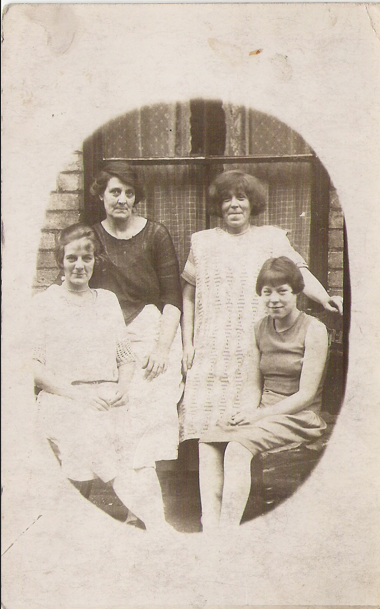
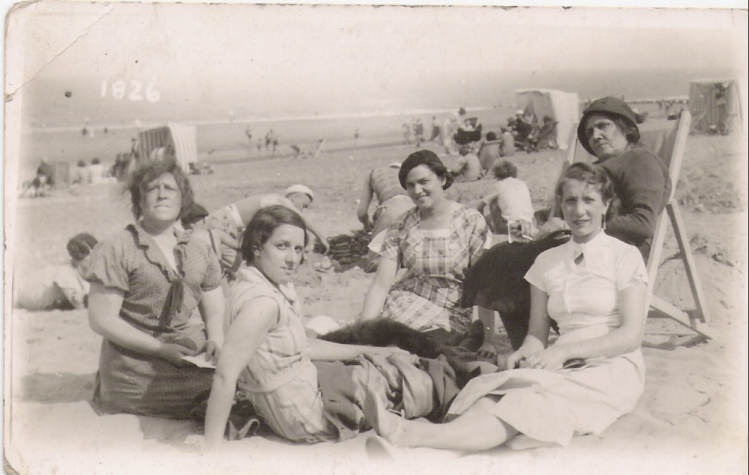
I have no photographs of the mysterious Fredericks and no known photo of Amelia. However, in two family group photos that include a middle-aged Alice Mortimer in the 1920s/30s, she is with an older unidentified woman (as well as some other mystery women). Her mother-in-law had died in 1912, so could this be her mother, Amelia? Amelia would have been about 70 in 1924, so this probably doesn’t fit. But I am still searching for Amelia’s death …
Alice stands at the back on the right next to an unknown older woman (though the woman in the front left is also unidentified), circa mid 1920s.
Alice sits on the left and the same unknown older woman sits in a deckchair (though the other women are also unidentified), circa early 1930s.
Spitalfields Nippers: Annie and NellieLyons
An amateur photographer, Horace Warner, captured haunting photographs of some of London’s poorest children in the early 1900s for use in fundraising by a Quaker mission. The images highlighted their extreme hardships but also their character and resilience. Some of these images have become iconic, including the photograph of Annie and Nellie Lyons that I have chosen to be this blog’s featured image. It comes from my own copy of Spitalfields Nippers (Spitalfields Life Books, 2014).
The excellent Spitalfields Life blog has posted an account given by Annie and Nellie’s mother of her situation:
โMy name is Annie Daniels, I am thirty-five years old. My occupation is a street seller. I was born in Thrawl St to Samuel Daniels and Bridget Corfield. Around fifteen or sixteen years ago, I met William Lyons who is thirty-eight years old, at this time he was living at 4 Winfield St. He is a street hawker. The last known address for William is Margaretโs Place. I have had eight children: Margaret born 1888 in Beauvoir Sq. William born 1889 in Tyssen Place. Joseph born 1891 in Whiston St. William born in Tyssen Place died. James died in Haggerston Infirmary. Annie born in 1895 at Hoxton Infirmary. Lily born April, one year and four months ago at Bakerโs Row. Ellen born April, one month ago at Bakerโs Row. About ten or eleven years ago, I had a son called John. He was sent away around seven years ago to the Hackney Union House. My eldest daughter Margaret is living with my sister Sarah and her husband Cornelius Haggerty. My son Joseph is living with my other sister Caroline and her husband Charles Johnson. I have moved from various addresses over the last ten years and have been lodging with my sister Mary for three years in Dorset St previous to Lilyโs birth.โ
Several recent episodes of The Family Histories Podcast have featured stories of men who had an alias, i.e., an alternative name or identity. In ‘The Marine‘ (series 8 episode 5), Richard Holt told the story of his naval ancestor, who was baptised Matthew Buyrn but later used the name John Dunmore. And in ‘The Secretive‘ (series 9 episode 1), Ron Williams introduced the tantalising tale of his grandfather, Alfred Victor Williams, who also went by Roy Hammond (a story so full of twists and turns that it inspired him to research and write a book in 2024). Genealogist Judith Batchelor (‘Genealogy Jude’) has an excellent 2-part blog about ‘chameleon ancestors‘, looking at some of the reasons why people changed their names or used multiple names, including illegitimacy, nicknames and adoption, or deliberate identity changes, whether for legitimate or nefarious purposes! Whatever the reasons our ancestors had for these choices, it can make it much harder to trace them.
My 2x great grandfather, William Taylor, was a bricklayer, and also a family history ‘brick wall’! A few years ago I finally broke down the wall, when I discovered that he had used more than one name. In this blog I share my research into his origins and alternative identities and uncover the real life story behind a puzzling paper trail. This is also the first of two case studies that look at remarkably similar family history mysteries, but with very different truths behind them …
My maternal grandfatherโs mother had an surprisingly grand name for the daughter of a bricklayer: Dorothy Georgina Alexandria Taylor (known as ‘Georgina’). Born in 1905, Georgina’s birth certificate names her parents as William TAYLOR and Edith Matilda Taylor (nรฉe LANKFORD). (Edith’s maiden name was occasionally written ‘Langford’).
Despite the information in the birth certificate, William and Edith weren’t actually married. If my great grandmother didn’t know as a child that she was illegitimate, she would certainly have found out when she got married in 1925. Although she signed her name in the register with the surname ‘Taylor’, the vicar who completed the register entered her name as ‘Dorothy Georgina Alexandria Langford (known as Taylor)’. Furthermore, in the space where her father’s name and occupation should have been entered, he wrote ‘Edith Matilda Langford (mother) known as Taylor’. Georgina’s father William Taylor had died the previous year; perhaps his death had brought his unmarried status to light, and the vicar disapproved!
Marriage certificate of Dorothy G A Lankford/Taylor
In 1911, aged 6, Georgina (recorded as ‘Dorothy’) appeared on her first census, in Aylesbury, Buckinghamshire, with her parents William Taylor (b. c 1867, Waddesdon), a bricklayer, and Edith Taylor (b. c1878, Hatfield). Georgina was one of five Taylor children, all born in Aylesbury. However, the family also included John, Ada and Elsie Clara HOMAN โ aged between 16-21 and all born in Waddesdon โ who were also stated to be William Taylorโs children.
William and Edith appeared to be married but the marriage was stated to have lasted 23 years, and as Edith was reported to be 33 years old, this would have meant sheโd got married at about the age of 10. She was also reported to have had 8 children, all still living, which matched the number of children in the household, though clearly, the ages of the older children meant they could not have been hers.
Partial transcription of data for the family of William Taylor in the 1911 Census of England and Wales; The National Archives RG 14/ 7932, Sch 205
It’s not uncommon for the marriage and children columns to have been completed incorrectly, as many people found them confusing, so I thought it likely that the 23 years of marriage and 8 children applied to William, not Edith, and that she was probably only the mother of the Taylor children โ starting with Gladys, born in about 1898. But my interest in the Homan children was immediately piqued!
I located the family a decade earlier, in Aylesbury. This time, the family had six children, all with the surname Taylor. However, John, Ada and Clara (2nd, 4th and 5th children โ shaded in the transcription below) matched the three children who’d been enumerated with the surname Homan in 1911. Another discrepency was Edith’s age. She had been 33 in 1911 but was said to be 27 in 1901. As I had observed in 1911, the older children’s ages meant it was unlikely that she was the mother of all of them.
The possibility of William having a previous wife who’d died, sadly, wasn’t uncommon. And if she had been a widow who’d already had children with a Mr Homan, it wouldn’t have been unusual for them to adopt their step-father’s surname. But why would they have used ‘Taylor’ in 1901 and ‘Homan’ in 1911?
Partial transcription of data for the family of William Taylor in the 1901 Census of England and Wales; The National Archives RG 13/1355, Folio 183, Page 32 (Note that their boarder, Victor Lankford, will pop up again later in this blog!)
Going back in time again to 1891, things started to get rather strange. I was unable to find William Taylor but I was able to locate two of his older children: John Homan (who had been John Taylor in 1901 and John Homan in 1911) and Pollie Homan (who had been Polly Taylor in 1901) โ shaded in the transcription below. They were living in Waddesdon but their parentsโ names were Frederick (an agricultural labourer)and Sarah Homan. They also had an older sister, Lizzie Homan.
Partial transcription of data for the family of family of Frederick Homan in the 1891 Census of England and Wales; The National Archives, RG 12/1147, Folio 76, Page 17
At this stage, before searching for the children’s birth records, my theory was that William and Edith Taylor had adopted the children from Frederick and Sarah Homan, perhaps relations. I found a death for Sarah Ann Homan in Waddesdon, 1896, aged 29, so the idea that some or all of her children were then taken in by another couple seemed plausible.
However, when I researched the Homan children’s births, I found that it wasn’t possible to draw a clear line between them and the Taylors. There were five children who had been given the name Homan in at least one census โ Annie Elizabeth (‘Lizzie’), John, Mary (‘Polly’), Ada, and Elsie Clara. All of their births were registered with the mother’s maiden name of ‘Haines’. However, whereas the three oldest were registered at birth with the surname ‘Homan’, Ada (the fourth) was registered with the surname ‘Taylor’ and the fifth child, Clara, was registered with the surname ‘Homan’.
Researching their parents uncovered yet more inconsistencies. I obtained a marriage certificate for Frederick Homan and โAnn Hainsโ in Aylesbury reg. district in 1887. However, a newspaper announcement of the marriage gave the groomโs name as โWilliam Homanโ. I also found newspaper articles about the inquest into Sarah Ann’s sudden and untimely death. Although in the 1891 census her husband was Frederick Homan, an Ag Lab, the newspapers in 1896 named her as the wife of โWilliam Homan, a bricklayerโ.
A sad account of Sarah Homan’s death in the Bucks Herald, 4 July 1896; Digitised image from the British Newspaper Archive
The mystery deepened when a search for later evidence of Frederick Homan (e.g. censuses or a death) drew a blank. Likewise, I had been unable to locate a birth record for William Taylor, and searching for him in earlier censuses was also proving a challenge. His ages in later censuses varied, putting his birth between 1865 and 1870.
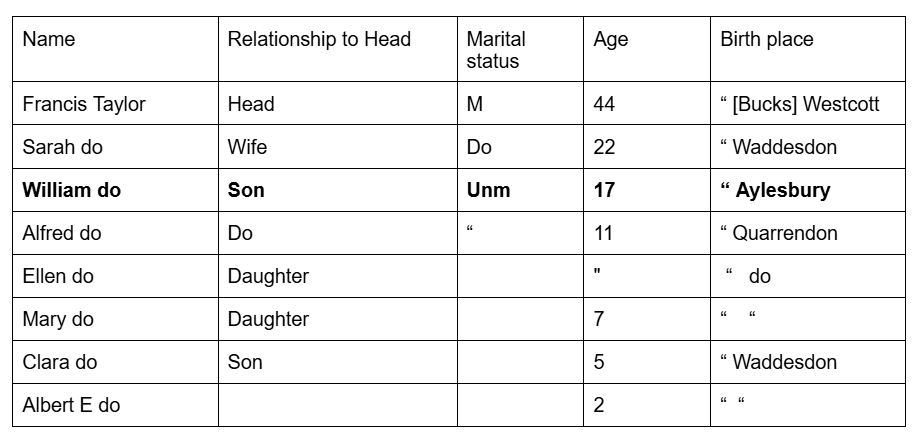
I was unable to find him in 1891 but in 1881 I found a close match in Waddesdon โ William Taylor, age 17 (born about 1863). He was living with parents Francis and Sarah Taylor and five younger siblings. Was this my William?
Partial transcription of data for the family of Francis Taylor in the 1881 Census of England and Wales; The National Archives, RG 11/1475, Folio 106, Page 18
I was able to find a marriage registration in 1865 for Francis TAYLOR and Sarah HOMAN. Sarah’s maiden name pointed to this being my family. But Francis and Sarah had married two years after William was born, so was he an illegitimate child whose birth was registered with the surname of his mother? I searched birth indexes and found no records for William Homan, but I did find a record for Fred Clark Homan, and his birth certificate showed he had born on 12 June 1863 at Aylesbury Workhouse โ the son of Sarah Homan. Bingo. Although censuses from 1891 onwards gave William’s birthplace as Waddesdon, rather than Aylesbury, William grew up in Waddesdon, and may simply have believed that is where he had been born as well.
The middle name, โClarkโ, suggests that Francis Taylor was not his biological father, and this is supported by DNA evidence that I’ll get to a little later in this blog. I wrote about some potential candidates for his father (with surname Clark) in my blog, ‘Five reasons why ancestors used surnames as middle names‘, but I have also considered the possibility that ‘Fred Clark’ was a mistranscription of ‘Frederick’. ‘Fred’ was usually a nickname rather than a birth name, and there are no examples of him using that shortened form later in life. Furthermore, I have not come across any examples of him using the middle name Clark. It would be interesting to examine the original birth certificate from Buckinghamshire Archives in the future.
GRO birth certificate of Fred Clark Homan
By now I was convinced that William Taylor, Frederick Homan, William Homan and Fred Clark Homan were all the same person. It wasnโt at all uncommon for someone born outside of wedlock to use more than one surname, including their motherโs surname, biological fatherโs surname, and step-fatherโs surname. So it made sense to me that he used both his birth surname (Homan) and the surname of the man who raised him (Taylor).
But what about the first name? If he had been born with the name Fred (or Frederick) why did he also use the name William? And when did he start to use that name?
The likely answer came from the first census to document William โ 1871.
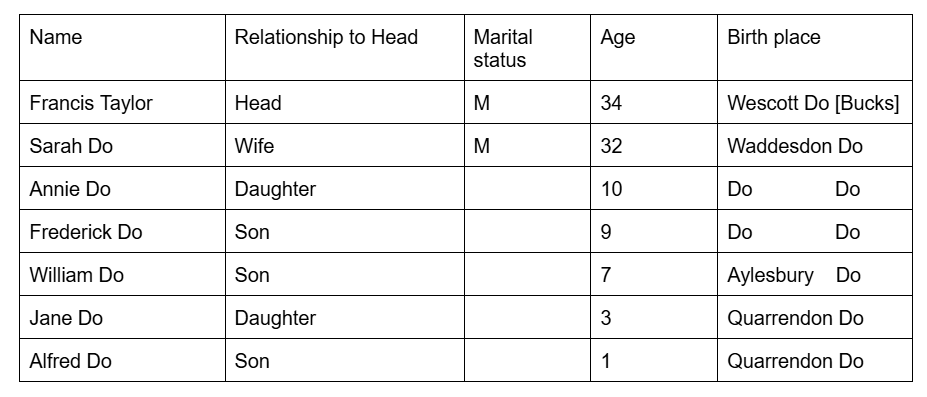
When the 1871 census was taken, Francis and Sarah Taylor lived in Quarrendon, between Waddesdon and Aylesbury. William Taylor’s age (7) and birthplace (Aylesbury) matched the birth for Fred Clark Homan, but confusingly they also had a 9-year-old son called Frederick Taylor, b. Waddesdon. William also had an older sister, Annie Taylor, aged 10. All three of these children were born prior to Francis and Sarah’s marriage in 1865.
Partial transcription of data for the family of Francis Taylor in the 1871 Census of England and Wales; The National Archives, RG 10/1414, Folio 77, Page 3
It turned out that Annie (Ann Homan) was another illegitimate child of Sarah Homan. However, Frederick John Taylor was the legitimate son of Francis Taylor, through a previous marriage; Francis had previously been married to Louisa BECK, and she had died just two months before his marriage to Sarah. Francis and Louisa had three children, but two had sadly died earlier that year, and only Frederick had survived.
Therefore, when Francis married Sarah, he was a widower with a child, Frederick Taylor (aged about 3), and Sarah was a single woman with a son, FredHoman (aged 2), and a daughter, Annie. The 1871 census shows that Annie and Fred took on the Taylor family name*, but Francis already had a son called Frederick (another indicator that Fred Homan was probably not his biological son), and I believe that is why Fred Homan was given a different first name: William. Nevertheless, although he was only a small boy at that time, he didn’t forget his birth name, and continued to use both names at different times in his life.
*It is possible that the census enumerator simply assumed that all children in the household were Taylors, just as they assumed they were all ‘son’ or daughter’ rather than ‘step-son’ or ‘step-daughter’, but since Annie and William continued to use the name Taylor into adulthood, it suggests that they were in effect adopted by their step-father and used his surname from an early age.
DNA Evidence
Despite the many pieces of evidence from birth and marriage records, censuses and newspapers, which together make a strong case, I have not found a single record that definitively states that Frederick Homan and William Taylor were the same man. However, as well as traditional research, DNA offers the potential to provide unequivocal evidence that links me to the Homan family. Sarah Homan was born nearly 200 years ago, five generations before me, and the amount of shared DNA between myself and another descendant of Sarah, or of her siblings, would have to be small. Nevertheless, there are genetic matches to myself and my mother that support my theoretical paper trail!
Most significantly, my mum shares 36 cM with a grandson of Sarah Ellen Taylor โ a daughter of Sarah Homan and Frederick Taylor (she is listed as Ellen in the 1881 census transcription above). Sarah Taylor would have been Fred Homan/William Taylor’s half sister, so Ancestry’s prediction that the relationship of this match to my mum is ‘half second cousin 1x removed’ is spot on. My mum is also related to a descendant of a Homan born in Waddesdon the 1700s. And I match a descendant of the wonderfully named Herodias Homan, born in Waddesdon in 1813.
Now that I’ve worked backwards in time, and put the pieces of the jigsaw back into place, I’d like to briefly tell my 2x great grandfather’s life story from beginning to end, this time going beyond mere names and dates.
Fred Homan/William Taylorโ a Biography
Fred Clark Homan, born in 1863, was the second child of single mother Sarah Homan, who also had a daughter called Annie. Sarah was the daughter of John Homan, a labourer and a pauper. As a child she lived with her grandparents and worked as a lace maker. Sarah had two sisters, both of whom also had illegitimate children.
Sarah married widower Francis Taylor on Christmas Day 1865, becoming step-mother to his son Frederick Taylor, and by 1871, her son Fred Homan was using the name ‘William Taylor’. (Annie also took on the surname Taylor, but in 1890 she married her cousin, Tom Homan, an illegitimate son of Sarahโs sister, so she became Annie Homan again!)
Fred/William married Sarah Ann Haines in 1887 using the name ‘Frederick Homan’, which suggests that he still considered that his legal name. Their marriage certificate is very unusual, because both of them were illegitimate, so rather than the names and occupations of their two fathers, we have the details of two mothers who were both ‘single women’ when their children were born! If I had ordered a copy of the certificate sooner I would have spotted that Frederick Homan’s mother’s name was ‘Sarah Taylor’ (her married name) but there was no clue to that in the index.
Detail from the marriage certificate of Frederick Homan and Sarah Ann Hains
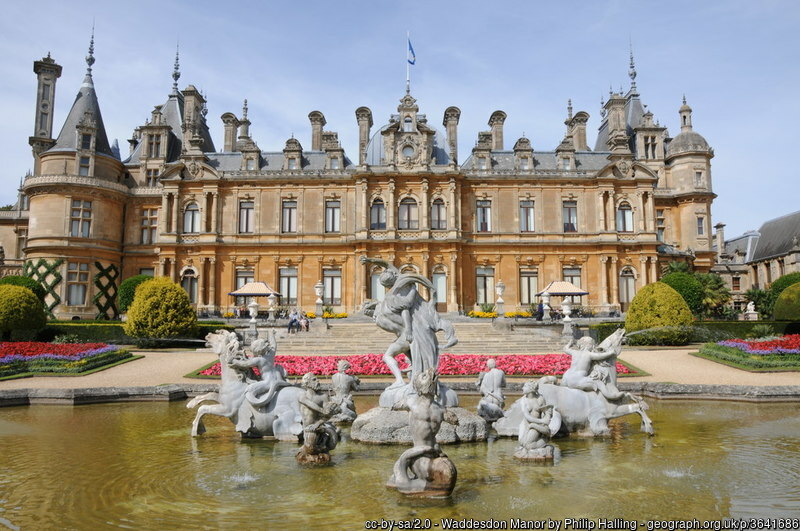
At some point between 1891 and 1896 Fred/William changed occupation from agricultural labourer to bricklayer. I have wondered if this change of career was prompted by the construction of magnificent Waddesdon Manor, which was built on a bare hillside by Baron Ferdinand de Rothschild between 1874 and 1889. In the 1890s Queen Victoria paid a visit and in the following years several new buildings were erected in the town. The church tower was also rebuilt in 1891/2.
Waddesdon Manor
In 1895 Fred/William’s mother Sarah died, and the following year, his wife Sarah Ann died suddenly, collapsing on the floor of her home. She had suffered a uterine hemorrhage and had a weak heart. My 2x great grandfather was left a widower with five young children, from 18 months to five years old. From about this time he began to use the name ‘William Taylor’ much more than ‘Frederick Homan’. Perhaps it reflects an increased closeness to his step-father Francis Taylor and his step- and half-siblings at that difficult time.
In the aftermath of this family tragedy, Edith Lankford first came into the household to help look after the children. She would have been just 16-17 years old. Edith came from Hatfield, more than 30 miles away. Her grandfather had been an auctioneer but the family’s fortunes had declined and her father, the youngest of nine, was a pheasant breeder-turned-beerhouse keeper. At some point, she began a relationship with William, and became his commonlore wife. She gave birth to their first child in 1899, ten days after her 20th birthday. By 1901 the family had moved to the nearby, much larger town of Aylesbury, so it might have been easier there for William to let go of the Homan name and also to convince everyone that they were a lawfully married couple. I don’t know why William didn’t marry Edith, but perhaps she was unable to obtain her parents’ consent to marry him (which she would have needed due to her young age), and as time went on, it was far easier to act as if they had always been married. They went on to have nine of their own children (two died in childhood).
The Taylor family was large, and it can’t have been easy for William and Edith to support so many children. Newspapers reveal that they were often in trouble with the authorities. Throughout the Great War William was repeatedly called to Aylesbury Petty Sessions due to his children’s non-attendance at school. It was unfortunate for William that a school attendance officer, Victor Kerr, lived just a few doors away! In 1918, the court heard that one of his children had only attended school on 22 out of 104 days, and that he had been summoned for the same offence on seven previous occasions. He was fined ยฃ1. I haven’t found any further charges for non-attendance after 1918, but perhaps that is because the school attendance officer sadly died of war wounds in 1919. In March 1922 Edith was one of several children and adults in trouble for stealing wood. In fact, they had simply found some branches lopped from trees along the canal path. The pompous Chairman said that ‘grown up people should certainly have known that people did not have trees cut down for the purpose of giving the wood away, especially such large pieces.’ Edith was fined 10s for this ‘theft’.
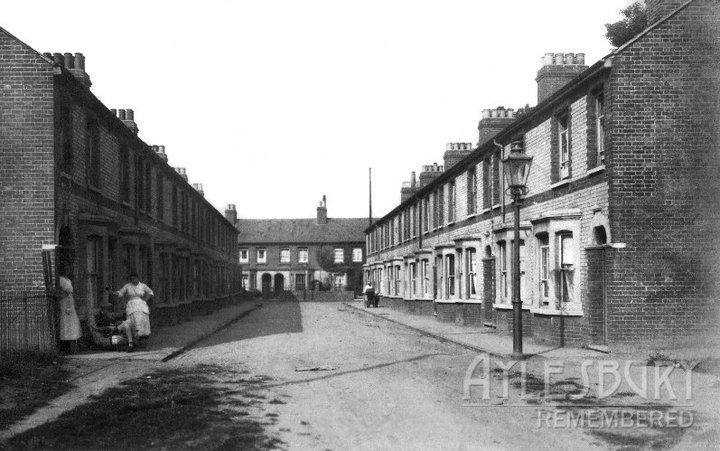
The 1921 census shows that William Taylor was still working as a bricklayer in his late 50s, and living with 7 of his children (in total, he had 14). He died at his home, 9 Grecian Street, Aylesbury, on New Year’s Day 1924, from cardiac disease, asthma and bronchitis. His lung problems were probably caused by his work, which had exposed him to brick dust and other chemicals for about 25 years. William’s ages were rarely consistent in official records (whether due to genuine confusion or evasion), and in typical style, his age at death was given as 56, though he was actually 60. The death certificate names him William Taylor.
Death certificate of William Taylor
Edith was present at his death, and was described on the certificate as his widow. 15 years later, in the 1939 register, she was still ‘Edith Taylor’ but was a ‘single woman’. According to family stories, in the ‘Thirties she had a ‘fancy man’.
Grecian Street circa 1920
For the last 20+ years of his life my great great grandfather had favoured the name William Taylor, but he was clearly comfortable using the name Homan when appropriate. His children with Sarah Ann continued to use the name Homan into adult life, and this led to the unusual 1911 census return, with William having both Homan and Taylor children in the same household. When his Homan children married, they named their father as ‘William Homan, Bricklayer’. The first was Lizzie, who in 1909, rather unconventionally, married her step-mother’s younger brother, Victor Lankford (he’d been boarding with them in the 1901 census), and the last was Elsie, who in 1923 married … a Taylor! (not a relation as far as I can tell, but certainly confusing).
Marriage certificate of Elsie Clara Homan
John Homan was the only one of William’s sons with that surname. After marrying in 1916, he had a son, Charles Arthur Homan, born the following year. Tragically, John died of Influenza in 1918, just four days before the end of the War, and the Homan name ended with Charles, who was childless by his death in 1991. My mum, William’s great granddaughter, knew many of her Taylor relatives in her youth, but had never heard the name Homan in connection with her family.
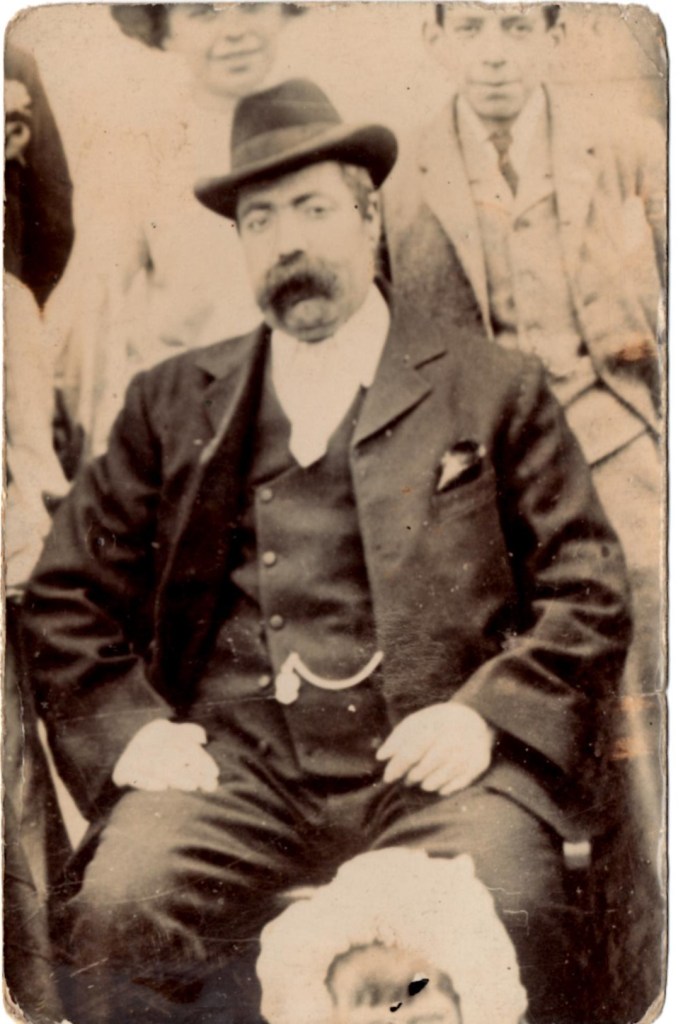
In 2020, I was able to connect with another of William’s descendants (my mum’s second cousin), Jane, who generously shared her excellent research report with me (it was very reassuring to find we had found the same key evidence and come to the same conclusions). Jane also kindly provided me with a photograph of our elusive ancestor, William Taylor aka Frederick Homan; he was a rather solid man wearing a bowler hat and sporting a thick mustache. Presumably he’s surrounded by some of his children. I also have one picture of Edith in my own collection. She lived until 1968, and reached the age of 88.
My sincere thanks to Jane, my second cousin once removed and a great granddaughter of William and Edith, for her research, stories and photograph.
Thank you also to genealogist and civil registration expert Antony Marr for his insights into my great grandmother’s marriage certificate.
CASE 2Preview
In Case 2 I’ll be sharing the search for my husband’s 2x great grandfather, born around the same time as William Taylor/Frederick Homan. In a bizarre coincidence, the records for this mysterious ancestor also feature the names Frederick and William and two different surnames. Was his name Frederick William CARTER, William CROSS or Frederick Cross? And was this another case of an ancestor with an alias?
Find out more in William and Frederick: Case2, coming soon …
My story begins with a journey from Burslem in Staffordshire to Toxteth in Liverpool in November 1796. A group of 40 to 60 potters and their wives and children left behind the life they knew in Staffordshire and travelled more than 50 miles along the Mersey-Trent Canal to the bustling port town of Liverpool (which was more than 10x the size of Burslem). It was the same route that the goods made at the renowned Staffordshire Potteries took before being exported throughout the world. The waterway, which opened in 1777, had been championed by Josiah Wedgwood and engineered by James Brindley (I learned about Brindley just a few weeks ago, after spotting a memorial fountain to him in a field in his birth parish of Wormhill, Derbyshire).
Route of the Trent & Mersey Canal in its current context, from UK Waterways Guide
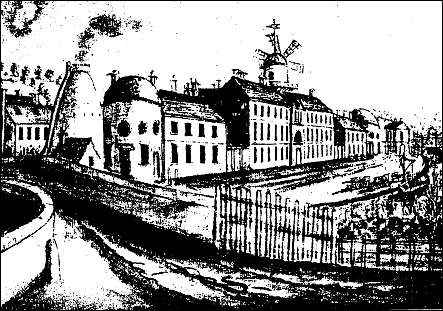
The ease at which pottery wares could be brought from Staffordshire on barges led to such a boom in Liverpool that many Staffordshire potteries had offices and agents at the Liverpool docks. The result was that by the 1790s Liverpoolโs own potteries were in โsevere declineโ. But in stepped Samuel Worthington, a savvy businessman who began his career in the silk-weaving trade and then made his fortune in slate mining in North Wales. He saw an opportunity to revitalise Liverpoolโs pottery industry by the creation of a pottery factory far bigger than the small potteries currently in operation. Samuel had recruited skilled potters from Staffordshire to get his venture off to a flying start. He also coordinated the materials needed for the pottery from across Britain โ including coal from Lancashire, clays from the southwest, colours and moulds from Staffordshire, flint from North Wales and stone from Cornwall. To set his new business apart from the small-scale potteries that were named after their street or owner, he also gave it what we would now recognise as an aspirational brand โ inspired by the contemporary passion for Classical antiquity, it would be called Herculaneum.
Dingle Point view of the Mersey showing the pottery kilns of Herculaneum Pottery, 1825, Joseph Mayer; Liverpool Record Office via The Priory and the Cast Iron Shore
The journey of Herculaneumโs founding potters was recounted more than 50 years later in charming (and rose-tinted) fashion by the Victorian antiquary Joseph Mayer FSA* in his essay โOn Liverpool Potteryโ. I think itโs really lovely so Iโm going to share it in full here:
โฆ the little group of emigrants, who were chiefly from Staffordshire, being ready to start, their employers gave them a dinner at the Legs of Man public house, at Burslem, to which a few of their friends were invited. There they spent the parting night in jollity and mirth; and at a late hour, in conformity with an old Mercian custom, still prevalent in some parts of Staffordshire, the parting cup, was called for, and each pledged the other to a loving remembrance when absent, and a safe journey, with a hearty goodwill.
Next morning, at an early hour, they started on their journey, headed by a band of music and flags bearing appropriate inscriptions, amongst which was one, “Success to the Jolly Potters,” a motto still met with on the signs of the public houses in the Staffordshire pot-districts. When reaching the Grand Trunk canal, which runs near to the town of Burslem, after bidding farewell to all their relatives and friends, they got into the boats prepared for them, and were towed away amid the shouts of hundreds of spectators. Now, however, came the time for thought: they had left their old homes, the hearths of their forefathers, the joys of acquainted neighbours, and were going to a strange place.
Still the hopes of bettering themselves were uppermost in their thoughts, and they arrived at Runcorn in good spirits, having amused themselves in various ways during their canal passage, by singing their peculiar local songs, which, as “craft” songs, perhaps stand unrivalled in any employment; for richness of material, elegance of thought, and expression of passion and sentiment, and it is to be regretted that many of them are daily becoming lost. Amongst other amusements was one that created much merriment โ drawing cuts for the houses they were to live in, which had been built for them by their emplovers; and as they had not seen them nor knew anything about them, the only preference to be striven for, was whether it should be No. 1, 2, 3, &c.
At Runcorn they stayed all night, as the weather was bad and the river very rough, after one of those storm-days frequent in the Mersey, when the waters are lashed by the wind into such fury that few boats dare venture out, and many who had never seen salt water before, were afraid to trust themselves upon it in a flat. Next morning, November 11, 1796, the wind had subsided. They embarked on board the flat, and at once, with a fair wind, got into the middle of the Mersey where it becomes more like an inland sea surrounded with lofty mountain ranges. This much surprised the voyagers, alike by its highly picturesque beauty and the vast extent of water. They had a pleasant voyage down the river, and arriving at their destination were met on their landing by a band of music, and marched into the works amidst the cheers of a large crowd of people who had assembled to greet them. Thus commenced the peopling of the little colony called Herculaneum, where, a few years ago, on visiting the old nurse of my father, who had accompanied her son there, I heard the same peculiar dialect of language as is spoken in their mother district, in Staffordshire, which to those not brought up in that locality is nearly unintelligible.
*Joseph Mayer was a Staffordshire man himself, born in Newcastle-under-Lyme in 1803. In his twenties he also made the journey to Liverpool, where he became a goldsmith by trade, and a collector, museum owner, philanthropist and pottery historian for pleasure. In 1857 a photographic portrait of him was the first ever to be โmade the size of lifeโ. Heโll pop up again a couple more times in this blog โฆ
The Herculaneum Pottery opened on 10 December 1796 at the site of a former copper works on the shore of the Mersey. Worthington was clearly a canny marketeer because the opening was marked by a military band, who paraded from the Works along the docks and streets bearing two colours (flags with pictures), one showing a view of the new โmanufactoryโ. The Works launched with about 60 employees. The first production was earthenware, including creamware. According to Mayer, the very first piece made was a blue-printed chamberpot! Another very early piece, now in a private collection in the USA, is a jug of 1796 which features portraits of George Washington along with Chinese-style decoration and a humorous inscription at the centre of the bowl, celebrating ‘A Wonder! An honest Lawyer!!’ As Herculaneum was founded only 20 years after the birth of the United States, exporting patriotic American pieces was good business.
John Edwards of Madeley
One of the most prominent migrant families at the Herculaneum Pottery was the family of John Edwards โ my husbandโs 4x great grandfather. John was not one of the original โlittle group of emigrantsโ but he followed the same path (well, probably a canal) about six years later. Peter Hylandโs informative book, The Herculaneum Pottery: Liverpoolโs Forgotten Glory (which draws on an earlier book by Alan Smith),gives some context for the decision of Staffordshire potters like John to migrate to Liverpool and suggests how they would have heard about employment opportunities:
To produce the volume and quality of wares which would make the venture worthwhile, a fairly large and experienced workforce would be needed. There would undoubtedly have been some active or retired pottery workers in Liverpool, but these would not have been numerous and they would not have had the up-to-date knowledge and specialist experience of the potters centred in Staffordshire. Samuel Worthington therefore recruited in Staffordshire, and must have presented an attractive option of working in a new factory on a river-bank amid rolling green fields, and perhaps living in a new cottage. The wages offered must also have been competitive. โฆ For Samuel Worthington to have drawn on Staffordshire sources for his skilled labour force was โฆ not a new idea, though the scale on which he did it was probably unprecedented. The method of recruitment in Staffordshire is not known, and there are no records of advertisements by Worthington in local newspapers. It is likely that an agent was used.
So, itโs likely that John was already a skilled potter before he left Staffordshire, but where did he come from exactly?
John Edwards was baptised in Madeley, Staffordshire on 16 May 1773, the son of a single woman, Sarah Edwards. Sarah had already had another illegitimate child five years earlier. Shortly before John’s birth, Sarah was subjected to a ‘bastardy examination’, where she reported to two Justices of the Peace that the father of her unborn child was Matthew Bedson Junior, a husbandman. Thankfully, Matthew agreed to provide financial support, and a few months after Johnโs baptism, Sarah and Matthew (then a labourer) were married. Despite being raised by his biological father, John used the name Edwards throughout his life. I don’t know anything concrete about Johnโs early life but he may have had an elementary education; there was a day school in the Methodist meeting house and a Sunday School at Madeley Wood. Madeley was also being reshaped by the Industrial Revolution. The year that John was born, the first proposal was made to construct an iron bridge which would link Madeley with Brosley and Coalbrookdale. The eponymous Ironbridge was opened in 1780. Despite this boom in local industry, John’s family was not well off; when his grandfather Matthew Bedson Senior died in 1788, he was a pauper.
Ironbridge in 2023 (my own picture)
At the age of about 23, John married Mary Griffith(s) (bp. 1773, Madeley); they tied the knot at St Gilesโs, Newcastle-under-Lyme on 23 May 1796. Less than seven months after John and Maryโs wedding, the first wave of potters embarked on the trip to Herculaneum.
The first record of Johnโs employment at Herculaneum is in 1807 โ by then 150 people worked there and the factory was producing porcelain and bone china. However, he is thought to have come to Liverpool in around 1802, aged about 29. This tallies with the baptisms of his children. There are some possible children baptised to John and Mary in Madeley โ Ann in 1796 and Mary in 1799 โ but the first child I can attribute to them with confidence is Margaret, baptised in Stoke on Trent in 1798. John, baptised in Stoke in 1799, was also probably their child, but the first son I can be sure of is James Hardy Edwards, baptised in Stoke in 1800. The next known child, Ann, was born in 1802 (place unknown) but wasnโt baptised until 1806, at St Nicholasโs, Liverpool โ suggesting a major upheaval for the family between those dates. The baptism register entry for Ann shows that the family of John Edwards, Potter, lived at North Shore. Later baptisms give the family’s residence as Toxteth Park and ‘Pottery’. Since the pottery was in Toxteth Park and on the north shore it’s probable that they lived in pottery housing throughout all of these events. However, Hyland notes a listing in an 1816 directory of Liverpool for a John Edwards, โChina manufacturerโ with a specific address at 103 Dale Street, though he cannot be sure this is the same man. Dale Street was about 2-3 miles north of the pottery, within the Borough of Liverpool.
Baptism of Ann Edwards, 26 Jan 1806, St Nicholas, Liverpool; Liverpool Record Office; Liverpool, England; Liverpool Church of England Parish Registers; Reference Number: 283 NIC/1/8; Ancestry.co.uk.
A Herculaneum enameller
Although John was recorded generically as a ‘potter’ and possibly ‘china manufacturer’, physical evidence of his work shows that John worked at Herculaneum specifically as an enameller. Enamel could be applied as a single colour over a whole piece or part of a piece, or colours could be combined into highly sophisticated works of decorative art. According to Hyland and Smith, there is only one documented piece that has been attributed to John Edwards; an enamelled porcelain plaque depicting Telemachus and Calypso in the collection of the Museum of Liverpool. John produced the piece in about 1815-20 and it was donated to the museum by Joseph Mayer. I contacted the museum to ask if they would be willing to send me a colour photograph, and when the Curator of Decorative Art responded I got a lovely surprise โฆ They actually have TWO of Johnโs plaques in the collection: one depicts Telemachus being conducted by Mentor to the Isle of Calypso and its companion piece illustrates Telemachus relating his adventures to Calypso, the Goddess of Silence โ both events recounted in Homer’s Odyssey. Hyland calls them โthe work of a highly schooled artist in the classical tradition.โ
Plaque images ยฉNational Museums Liverpool, Walker Art Gallery
Given that John was born into a working-class family I find the quality of his painting quite remarkable. Itโs even more impressive when you consider that to make the images, John had to apply powdered glass to the unfired ceramic surface. Only when fired would it melt and transform into a painting that bonded to the ceramic to produce the finished piece.
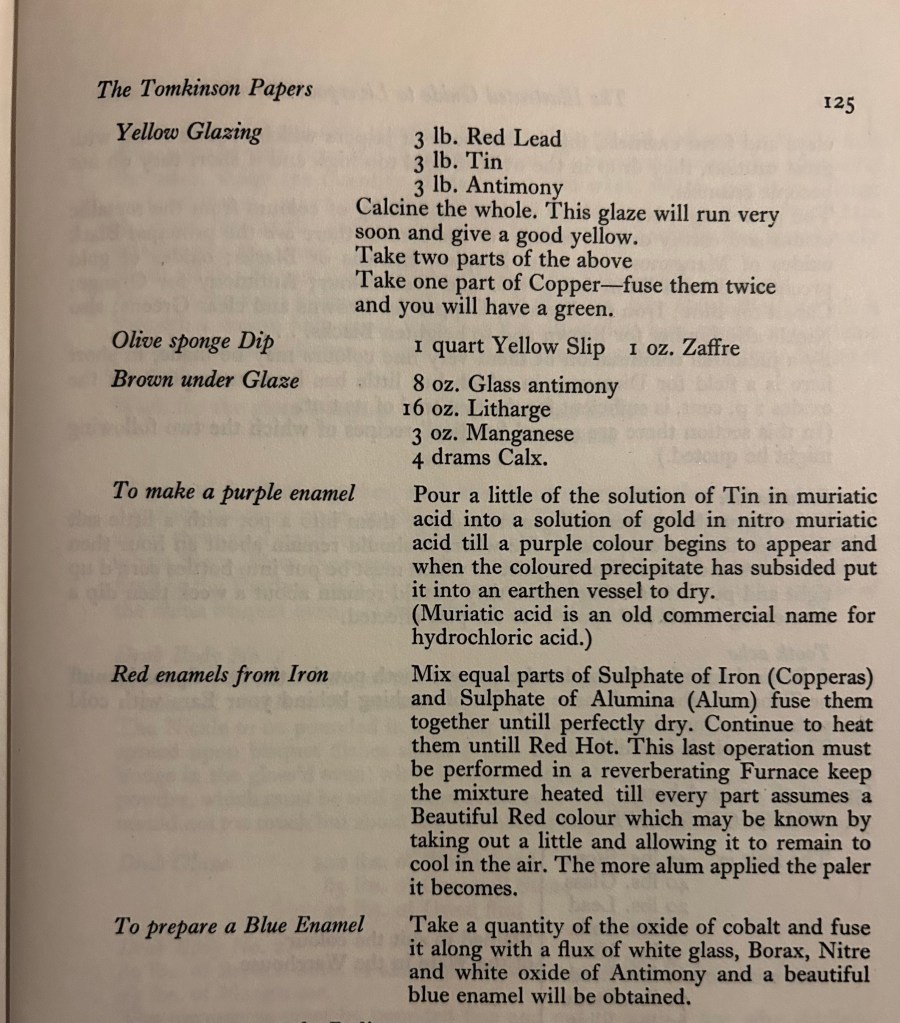
The chemical recipes for several colours were written into a notebook in a collection of papers from Herculaneum (and I assume John would also have had the skills to mix them himself):
Recipes for enamels in the Tomkinson papers; reproduced from Liverpool Herculaneum Pottery
Only the finest and most expensive ceramics were hand-enamelled โ with purely decorative items such as John’s plaques at the most luxurious end โ whereas more humble wares would have been transfer-printed. Shawโs History of the Staffordshire Potteries, published in 1829, tells us that the art of enamelling initially developed separately from the potteries, particularly in tile production. At first it was simply an application of a white glaze, but over time the demand grew for ‘ornamented productions’ and consequently ‘a few of the more opulent [pottery] manufacturers’ brought the skills in house.
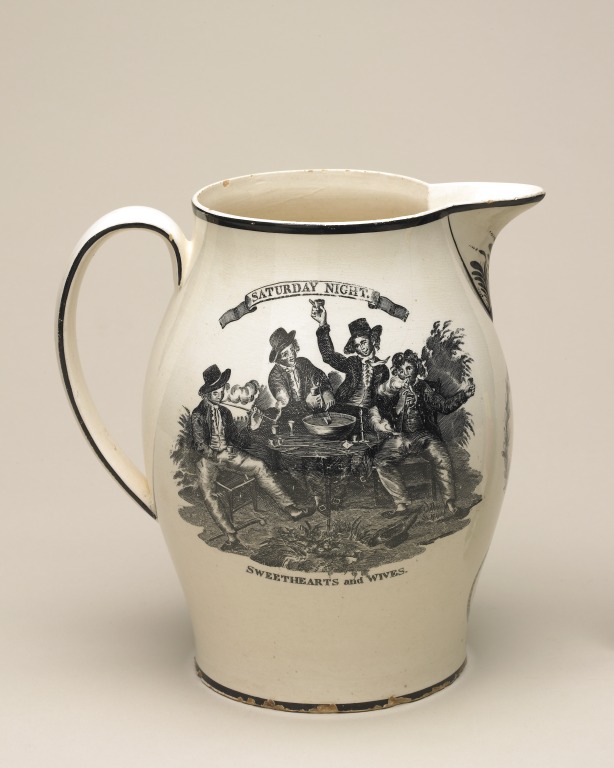
Where did John Edwards learn such an intricate and refined craft? Another item in the collection of the Museum of Liverpool is connected with an intriguing testimonial about his training. Itโs a creamware jug made in about 1800, decorated with a scene of sailors making merry on Saturday night while toasting their ‘sweethearts and wives’ (it’s not clear if some sailors had both!). This lovely piece, which was last exhibited in 2015, belonged to John Edwards (and is therefore believed to have been made at Herculaneum) and was passed down in his family, eventually being gifted to the museum by Miss Diane Edwards of Widnes, Lancashire. According to Diane, John had been apprenticed to Flaxman at Etruria before leaving Staffordshire for Toxteth.
ยฉNational Museums Liverpool, Walker Art GalleryยฉNational Museums Liverpool, Walker Art Gallery
The Etruria Works in Hanley was the ceramics factory of Josiah Wedgwood, in Stoke on Trent (the location also tallies with the baptism of his children Margaret and James Hardy in 1798/1800). It opened in 1769, and produced Wedgwoodโs fancier wares (the previous factories in Burslem continued to make more useful objects). John Flaxman was Etruriaโs most famous designer, as well as being a celebrated sculptor (mainly of funerary monuments), draftsman and book illustrator โ all despite fragile health due to a curved spine. John would likely have been apprenticed to Flaxman from about 1787-1794*, mastering his trade before marrying Mary in 1796. He perhaps then worked at Etruria until moving to Liverpool.
The Etruria factory from the canal bridge at Etruria Road in 1794 (thepotteries.org), showing the potters’ mill, used for grinding flint and bone; today, Etruria Industrial Museum has the last steam-powered potters’ mill in Britain. Herculaneum once also had a mill.
*Unfortunately thereโs no record of John Edwardsโ apprenticeship in the apprenticeship books that record stamp duty paid from 1710-1811 (The National Archives series IR 1) or in Staffordshireโs apprenticeship names index (which is mainly pauper apprentices). Perhaps there are some answers in the V&A Wedgwood Collection Archives in Stoke on Trent, which include some articles of apprenticeship, or in Newcastle-under-Lymeโs Guild apprentice records. I think it’s likely that his apprenticeship was funded by charity. More research is needed!
John Edwards may have technically been an enameller but he was also considered one of Herculaneum’s small number of ‘painters’. A factory minute book shows that in 1822, a gilder called Jesse Taylor was appointed as the ‘foreman of the painters’, with a salary of ยฃ2 10s. per week. John Edwards is one of four painters at Herculaneum that have been identified, and I assume that he would have been among the most well paid and respected potters.
In about 1820, a list was made of ‘persons to be engaged’ at the pottery, suggesting that the potters were contracted year by year. According to this list, John Edwards was to be assigned to Coffee Pots! If this was my John, it is hard to know if this was a desirable role or a demotion. Although only in his forties, it’s possible that he was in poor health at that time.
Life at Herculaneum
What was it like to live and work at Herculaneum? As Hyland points out โthe joyous events which marked the opening โฆ should not disguise the fact that work in a busy pottery around 1800 was both dirty and dangerousโ and that due to the risks from machinery and toxic materials, โpotters everywhere were not long livedโ. Chronic silicosis, dubbed ‘potter’s rot’, was the results of prolongued exposure to flint dust; it caused serious breathing problems and even blue skin, and it also made potters more susceptible to tuberculosis.
Nevertheless, Worthington seems to have been a considerate owner for the period. Many of the workers could rent cottages with scenic views across the water, and the management provided rewards and incentives for good work, a financial safety net for poor employees, a Sunday school and monetary support for a local free school. The Pottery also had a Benefit Society, established in 1804, which put on monthly social events and helped pay for burials. In 1813 the town was illuminated to celebrate the defeat of Napoleon, and the men at the Herculaneum works were all treated to bread, cheese and ale. Herculaneumโs proprietors also built a small Methodist chapel for the workers, since many of the families from Staffordshire were Wesleyans. A chapel account book from 1815 includes expected expenses such as bibles and sacramental wine, as well as haircutting, boat hire, leeches, and a โlovefeastโ (the mind boggles!!)
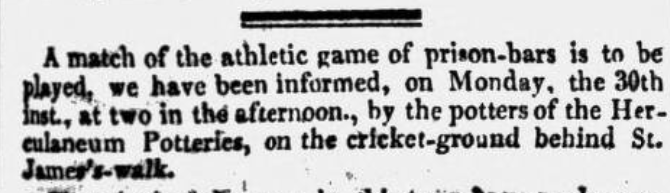
In 1815 the area also gained a new Anglican church, St Michael in the Hamlet in Aigburth (originally built as a chapel-of-ease to the church at Walton on the Hill). In keeping with the industrial innovation of the time and place, it was one of the first buildings in the world to be constructed using cast iron. The first service held there was one of Thanksgiving for the victory at Waterloo. The community at Herculaneum was extremely tight-knit, and the parish registers of St Michaelโs are full of the same names; โthere was evidently much intermarriage between the families forming the Pottery community.โ The Liverpool historian J A Picton wrote that the Herculaneum potters โlong continued a separate and isolated people, preserving their own manners and customs and still retaining their Mercian dialectโ. The location of the pottery, in an extra-parochial and sparse area outside of the town, would have contributed to this strong sense of community. A newspaper announcement of a ‘match of the athletic game of prison-bars’ (a bit after John’s time) shows that the ‘potters of the Herculaneum Pottery’ had a distinct identity, but they weren’t cut off from the town, and they were able to have some fun!
Liverpool Saturday’s Advertiser – Saturday 21 June 1828; British Newspaper Archive.
The Edwards family: potting connections
Following the birth of Ann Edwards in 1802, John and Mary had four more children in Liverpool: Isaac (1805), Aaron (1807), Elisha (a boy, 1812), and lastly Emma (1815) โ my husbandโs 3x great grandmother. The baptism registers consistently record John’s occupation as simply ‘Potter’. Unsurprisingly, John and Maryโs children, and grandchildren, maintained strong connections with Herculaneum and the pottery trade:
Margaret Edwards married George Ibbs, a potter, and they lived in the Herculaneum Pottery. The Ibbses were an important Herculaneum Staffordshire family. In fact, 14 members of the family were early potters at the factory and one of them later ran the biscuit factory (as in biscuit ware). Tragically, Margaret buried her husband less than a month after they baptised their first and only child, George, and then young George died at the age of 3. More than a decade later Margaret remarried to Henry Byram, a shipwright (not a surprising occupation for Liverpool, but an outlier in this family!). But despite being 16 years her junior, and safe from the hazards of the pottery, he died after just three years of marriage. He was buried in the Wesleyan cemetery.
James Hardy Edwards married Rachel Roberts, the daughter of Edward, in 1822. Edward Roberts must have one of those first โmigrantsโ, because he is the potter who produced that pioneering chamberpot! When James married, he was a potter, but in the 1841 census, he was an โAccountantโ, and thereโs evidence to suggest that he was the Manager of Herculaneum in the mid 1820s! This was noted by Peter Entwhistle, Curator of the Mayer Collection in the Liverpool Museum in the early 1900s. Unfortunately, few Herculaneum records survive from the 1820s as many were destroyed in the Blitz, so this canโt be verified. James must have been a prominent member of society as he served as Secretary of the Liverpool Dispensaries. In 1834, James was elected as Governor of the Workhouse, with Rachel becoming its Matron. He died in 1845.
Isaac Edwards married Ann Roberts, another daughter of Edward, in 1835, and they immediately moved to Burslem, where Isaac worked as a potter. After a few years in Bovey Tracey in Devon, they returned to Staffordshire. By 1861 Isaac was a Commissioners Agent and by 1871 a Pottery Manager. Some of their 14 children were also potters, including Lawrence, a pottery figure maker.
Ann married Edward Roberts, a potter, in 1823 at Walton on the Hill. I think itโs very likely he was the son of Edward โchamberpotโ Roberts. Edward Jr. died in 1844, and in 1851, Ann was a widow living in Hanley, Staffordshire. Her daughter Ann, aged 20, was a potter. Ann Srโs twice-widowed sister Margaret Byram was also living there, and also worked as a potter. Itโs important to remember that many women worked in the potteries. As Michael Sharpe writes in Tracing Your Potteries Ancestors, ‘The pottery industry was unusual for the period in that men and women worked alongside each other. Women generally had the lighter but less agreeable work.’ In one Staffordshire pottery in the early 1840s, 45% of the 348 employees were women and girls (the industry also employed large numbers of children).
Sadly, Aaron Edwards died at the age of 20 in 1827 and Elisha aged 16 in 1828. Their burial records at St Michaelโs state that their abode was โPotteryโ. Whether they worked there as well isnโt recorded, but it’s highly likely.
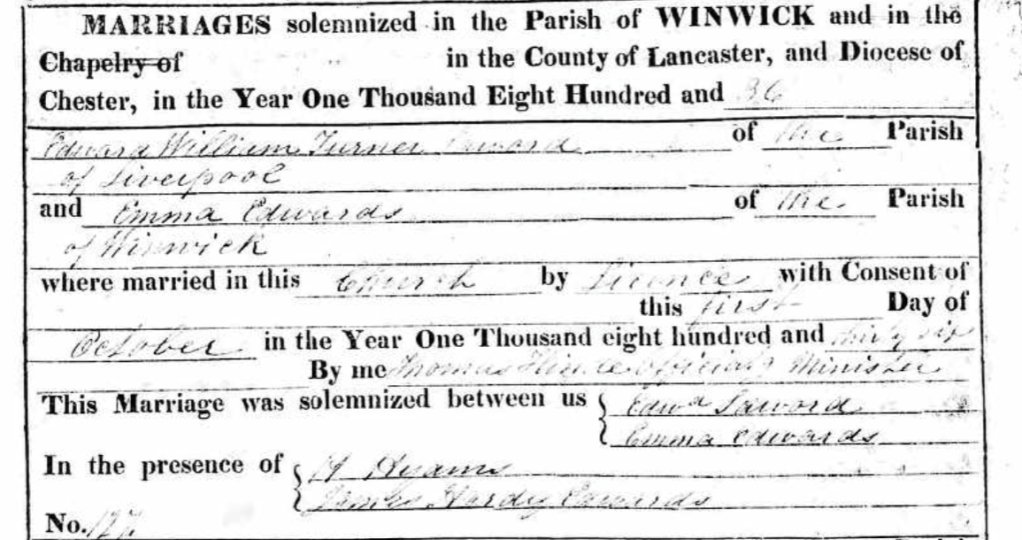
Finally, Emma Edwards, my husbandโs direct ancestor, married Edward William Turner Saword in Winwick, her parish of residence, in 1836. Edward was a Greenwich-born merchant based in Liverpool. Winwick is nearly 20 miles from Liverpool, and as far as I’m aware Emma wasn’t a potter. None of Emma’s children or descendants were potters either, but thanks to James Hardy Edwardsโ signature as a witness in the marriage register, I can be certain that she was the daughter of John and Mary Edwards of Herculaneum. Since confirming her parentage I’ve also identified the person who registered her death in 1849 as her sister, Margaret Byram of Hanley, who I now know worked as a potter. Very sadly, no beautiful (or even plain) potterywares have been handed down in the family!
Marriage of Emma Edwards and Edward Saword; Bishops Transcripts for Winwick; ‘Lancashire, England, Church of England Marriages and Banns, 1754-1936’; Ancestry.co.uk
Potters turned to clay
In 1824, the Herculaneum Benefit Society purchased a small parcel of the churchyard of St Michael in the Hamlet, enough space for seven burials. The โpottersโ graveโ is marked by a stone tablet on the ground near the vestry door, inscribed with the following touching verse:
Here peaceful rest the POTTERS turn’d to Clay
Tirโd with their labโring lifeโs long tedious day
Surviving friends their Clay to earth consign
To be remoulded by a Hand Divine.
John Edwards was laid to rest at St Michaelโs on 1 April 1825. He was 51. His wife Mary was buried there on 10 April 1840 and their eminent son James Hardy in 1845. Mary, James Hardy, Aaron and Elisha share a ledger stone. A free burial index for the church shows that 16 burials of an Edwards took place between 1821 and 1865. At 68, Mary Edwards was the longest-lived. There were also numerous marriages, and 23 baptisms all the way up until 1908. The later generations of the Edwards family may well have attended a major historical exhibition that was held to celebrate Liverpoolโs Sept-Centenary Anniversary in 1907. Both of Johnโs plaques were displayed alongside some โpapers by John Edwards, relative to the establishment of the Herculaneum Potteryโ. These papers were owned by Jaggard & Co, a Liverpudlian bookseller and printer. I would love to know if the papers have survived somewhere! However, knowing that they existed is confirmation enough that John was a key member of the Herculaneum pottery from its earliest days. It must have made his descendants very proud.
The Herculaneum Pottery continued in production until 1840. Unlike the sudden destruction of the ancient city of Herculaneum, there was no cataclysmic event that brought production to an end. Rather, the business changed hands a couple of times, and finally wound down. The land was later used as Herculaneum Dock (until 1970), and the site is now occupied by small industrial units and a business park. The last pottersโ houses were pulled down in the 1960s. Only a local pub, the Herculaneum Bridge Hotel, hints at the behemoth of a pottery works that was once an almost self-contained community of hundreds of people, and sent its wares all over the world.
My sincere thanks to Nicola Scott, Curator of Decorative Art at National Museums Liverpool for providing images of John Edwards’ ceramics and additional insights into his work.
Select sources/Further reading
Peter Hyland, The Herculaneum Pottery: Liverpoolโs Forgotten Glory (National Museums Liverpool and Liverpool University Press, 2005) (a digital version is available to ‘borrow’ at archive.org)
Alan Smith, The Illustrated Guide to Liverpool Herculaneum Pottery (Barrie & Jenkins Ltd, 1970)
Michael Sharpe, Tracing Your Potteries Ancestors (Pen & Sword, 2019) (this book is focused on the Staffordshire potteries)
Staffordshire Name Indexes: free access to 26 indexes to the holdings in Staffordshire Archives, including illegitimacy, apprenticeships and asylum patients
thepotteries.org: website about the Staffordshire potteries, with an A to Z index index of pottery works, guides to ‘how it was made’, pottery terms, pottery occupations and much more
In this blog post I’ll be investigating a story about a man who was reported to have had 30 children, and sharing some methods for finding children who were born in England in the 1800s to early 1900s. If you are looking for a ‘missing’ child or simply to add another generation of offspring to your tree, I hope that you’ll find this helpful.
While researching for a client recently, I discovered a remarkable story about their ancestor, William Wilson (b. 1808). I’d already established that William had married twice, and censuses included the names of 15 children. So, this was already a large family. However, I was taken aback to find a newspaper article from 1866 that announced the birth of William’s 30th child! He’d reportedly had 22 with his first wife and eight with his second. And since I knew of three more children who were born to William after the date of this article, it meant that he might have had 33 children (or more)! I was delighted that my client encouraged me to spend some time searching for his other children in online sources. Could I track down the ‘missing’ boys and girls?
Westmorland Gazette and Kendle Advertiser, 27 October 1866; digitised image from the British Newspaper Archive
Evidence from the censuses
Many of us start to build a new generation of our family tree using census records. And this was my starting point for recording the children of William Wilson with his first wife, Hannah, and second wife, Dinah.
William was born in Whitehaven, Cumberland on 21 April 1808 and he was the second in what would become a four-generation printing/book-selling/stationer’s business in that town. He married Hannah CARR (b. c1807, Hull) in Liverpool on 3 January 1828.
In the 1841 census, we find William living in Whitehaven with Thomas Wilson, age 8 and WilliamWilson, age 3. Hannah’s whereabouts are unknown. In 1851 William and Hannah were in Whitehaven with Thomas and William (now stated to be William’s sons) and three more children: Luisa [sic] Wilson, Isabella Wilson and Goodfrid Wilson. I noted that Hannah was not only a mother of five but also a straw bonnet maker (she actually had her own shop!)
TIP:
The 1841 census does not record relationships within a household. So additional evidence is needed to be confirm a parent-child relationship. From the 1851 to the 1921 censuses, relationships were recorded between each household member and the head of the household โ typically a working, married man. Although his wife was usually the biological mother of any children in the household, this might not be the case; for example, they might be the children of a previous wife. A family historian still needs confirmation from another source.
Hannah died on 2 March 1856, and within a few weeks William had remarried to Dinah MOORE (b. c1833, Distington, Cumberland).
In the 1861 census, we find William and Dinah in Distington (next to Whitehaven) with four children. The oldest child, John Moore, is described as ‘wife’s son’ and the rest, Martha Wilson, Harold Wilson and Harriet Wilson, are William’s son and daughters. In 1871, the family, still in Distington, had six children, including a girl called Bertha Wilson, aged 15, and three born since 1861 โ Herbert Wilson, ErnestWilson and the unusually named Gulielimus Wilson. Gulielimus is a Latin form of William, so it seems that William Sr. was already running out of names for his children!
William died on 21 January 1878, and in the 1881 census, Dinah was living with four children, two of whom had been born between the 1871 census and William’s death (Loo Wilson and Horace Wilson).
Getting my ducks in a row
It was tempting to get stuck in right away chasing after the missing children. But I knew that I would be able to do this more efficiently and accurately if I first spent some time gathering more evidence about the 15 children I already knew about, starting with the censuses, and then civil registration (births/deaths) and parish registers (baptisms/burials).
TIP:
Summarising ages and places of birth across the censuses will help to locate birth and baptism records (or, sadly, death/burial records), and makes it easier to spot any discrepencies. For example, if there’s a John aged 1 in 1851, and a John aged 8 in 1861, that might mean that the first John died in about 1852, and another baby was born and given the same name soon afterwards. I only compiled information on William’s children while they were living in his household (or with Dinah after his death) but to be more thorough I could have also inputted census data from his children when they lived elsewhere.
Children of William Wilson living with him in the 1841-1871 censuses, or with his widow in the 1881 census
Observations and questions:
I noticed that Martha and Bertha appeared in subsequent censuses (Martha only in 1861 and Bertha only in 1871) but they were both estimated to have been born in 1855-56, in Whitehaven. It was probable that they were one and the same child. (and if so, my count of children would decrease, not increase!)
John Moore had a different surname than William and was said to be his ‘wife’s son’. However, it was possible that he could have been an illegitimate child of William and Dinah.
Martha/Bertha and Harold could have been born to either mother. Since the newspaper article stated how many children were born to each of William’s wives, I would need to establish who the mother of these children was.
Loo was said to be 11 in 1881, so she should have been a baby in the 1871 census. It’s possible that she was staying elsewhere when the census was taken, though it would have been unusual for an infant not to be at home with her mother.
None of these children match the details of William’s 30th child โ a daughter whose birth on 11 October 1866 was celebrated in the local news. So, who was she?
I noted that there were gaps between many of these children long enough for other children to have been born in between.
Tracing birth registrations
Thomas, the oldest child in census records, was born about five years before Civil Registration began in 1837. The next oldest, William, was born just as Civil Registration came into law (b. 1837-8), and his birth might have been registered. Their younger siblings should all have birth registrations. So, I set out to locate birth registrations for as many of them as possible.
TIP:
Two of the best online databases to help with finding birth registrations are the GRO Online Index (gro.gov.uk) and FreeBMD (freebmd.org.uk). Each has its pros and cons. GRO enables you to directly search the official government index to birth registrations. One major advantage is the ability to view and search by maiden name (this is only available in FreeBMD for records from 1911 onwards). However, each search is limited to a time period of just five years and you must select male or female for each search, so it can be time-consuming. In contrast, FreeBMD enables a search of a much broader time period (for an uncommon name, a single search can cover 1837 to the present day) and does not require a sex to be entered. FreeBMD also has better functionality for non-exact and wildcard name searches.
By using the GRO and FreeBMD databases I was able to find birth registrations for 12 of the children listed in censuses:
Observations:
Loo Wilson’s birth year was later than expected. However, given that she was not listed in the 1871 census, and the lack of any other registrations with her unusual name, I believe that her reported age in the 1881 census was wrong, and have confidence that this is the correct birth registation.
I found that John Moore was illegitimate, and ordered a digital download of the certificate. Although he was indeed the son of Dinah Moore, no father was named.
I was able to confirm that Harold was Dinah’s son, but I couldn’t find a birth for Martha or Bertha Wilson. However, I found a registration for an illegitimate child, Bertha Moore, in Cockermouth (not far from Whitehaven) in Q4 1855 and downloaded the certificate. The mother’s name was Dinah Moore, so I knew that Bertha had been born illegitimately to Dinah Moore prior to her marriage to William Wilson. With no records for a Martha Wilson (or Moore), I also felt confident that her name was Bertha, and that the name ‘Martha’ had been a one-time entry error.
Birth registration for Bertha Moore
The first additional child is found!
Using the GRO search, I was able to identify William’s 30th child (whose birth was announced in the newspaper). Her name was Amy Wilson, and her birth was registered in Q4 1866. Sadly, Amy died in Q4 1867, which is why she didn’t appear in any censuses.
The search for more children
After building on the details from censuses and the newspaper clipping, I could attribute 13 children to William with confidence. There were still question marks over the paternity of Bertha Moore and John Moore, and about half of William’s children were still unaccounted for. It was time to don my detective’s hat and use a variety of sources to track down as many more of them as possible …
Birth indexes
As well as using birth indexes to help find the births of known children, we can use them to look for other children born to a particular set of parents. As mentioned above, for children born after 1911, FreeBMD is an excellent resource for a single search for children based on the surname and mother’s maiden name. However, since William Wilson’s children were born in the 1800s, I needed to use the GRO database to search by maiden name, and this meant performing multiple searches for both female and male children over the relevant period of time: from 1837, when civil registration began, until 1879, a year after his death. Since William and Hannah were married nine years before civil registration there was no way to do this search for that first phase of their marriage.
TIP:
The GRO search form requires you to enter a single year between 1837 and 2022 (excluding 1935-1983) and you can choose to include matches for up to two years before and two years after that year. So, each search covers five years. That means that if you’re searching over a longer period, you can skip forward or back five years in each search. For example, a search of 1885 +/- 2 years covers 1883-1887. The next search of 1890 +/- 2 covers the years 1888-1892. For a common combination of surname and mother’s maiden name, narrow the search by selecting the county or registration district. To allow for spelling variations, especially with names that were likely to be mispelled, try searching with phonetically similar or similar sounding names, or searching with the surname and registration district but no mother’s maiden name.
A thorough search of the GRO birth index added six more Wilson children to my list. A search of the death index found that all had died as infants before the 1841 census or between later censuses:
Goodfred Wilson b. Q2 1839 d. Q1 1840 (MMN CARR)
Bertha Wilson b. Q2 1842 d. Q1 1846 (MMN CARR)
Emma Wilson b. Q3 1845 d. Q4 1845 (MMN CARR)
Ruben Carr Wilson b. Q4 1846 d. Q4 1846 (MMN CARR)
Herbert Wilson b. Q1 1859 d. Q4 1859 (MMN MOORE)
Amy Wilson b. Q2 1862 d. Q1 1863 (MMN MOORE)
(all births and deaths registered in Whitehaven)
Unfortunately, extremely high child mortality in the 1800s mean that many of us researching our family history in this period will find evidence for children who lived for just a short time between censuses. The child mortality rate dropped by a half from 1800 to 1900, but it was still all too common into the 20th century.
TIP:
For those of us researching into the Edwardian era, the 1911 census provides a unique source of information on families; it asks married women how many children had been born alive to that marriage, and how many of those children were still living, or had died. If the mother was an older woman, she may have had adult children who had died, but in a younger family, this can provide a vital clue to look for missing children from your tree.
2. Baptism and burial registers
Unfortunately, there are no digitised or indexed parish registers for Whitehaven available online. The registers are held at Whitehaven Archive and Local Studies Centre, and I was unable to travel to see them. However, thanks to an Ancestry user researching the Wilsons, who is local to Whitehaven, I know of another child baptised there to William and Hannah prior to civil registration and the censuses: William Wilson, bp. 1 Feb 1835; the National Burial Index showed that he was buried as in infant in Whitehaven on 25 Feb 1835.
Nearly three years after baby William’s death, William and Hannah baptised another William at Whitehaven: William Carr Wilson, on 10 December 1837. This is the William who appeared on the 1841 and 1851 censuses (and thanks to his middle name I know that he died in Bendigo, Australia in 1860, possibly while pursuing the gold rush that began there in 1851).
โDEATHSโ, Whitehaven News, 21 February 1861; digitised image from British Newspaper Archive
If I was able to extend my research, I would have gone to the Whitehaven Archives to peruse the baptism and burial registers for other potential children.
3. Other databases
If you’re like me, you have a preferred primary commercial database that you usually turn to first for basic searches. However, it’s always a good idea to search in multiple free and subscription-based databases, since many contain unique data. FreeReg and FamilySearch are both free databases that include a wealth of English parish register entries. In this case, FreeReg didn’t produce any more children, but in FamilySearch, I found a baptism record for AlexanderWilson, son of William and Hannah, at Brampton, Cumberland, 14 September 1830. Brampton is nearly 50 miles from Whitehaven. However, other evidence confirmed that this was the same family. Alexander was living in Whitehaven with his Wilson grandparents in 1841 and 1851. In his teens he joined the family bookselling business, but he died from consumption at the age of 20 in 1853. His death was announced in newspapers, where he was stated to be the ‘son of Mr Wilson of King Street, Whitehaven’.
I was also surprised that my search results included indexed records of two baptisms that took place on same day in Newcastle. Hannah Wilson and Thomas Wilson were christened on 9 April 1827 to William Wilson and Hannah Carr. Perhaps they were twins. Newcastle may sound too far, but I knew that William and Hannah had married in Liverpool and that Hannah came from Hull, so this family certainly moved around considerably. Moreover, from looking at a map I could see that Brampton, where they had baptised Alexander, was almost exactly halfway between Whitehaven and Newcastle. It also made sense that William would name his first child Thomas, since that was his father’s name.
So, it is perfectly plausible that William and Hannah baptised two children in Newcastle prior to their marriage in January 1828. It might be that they lived in Brampton but chose to baptise their children at a distance due to being unmarried. Or they may have been living in Newcastle in the late 1820s; if so, what took William there? William’s father Thomas was a bookseller, and later in life William followed in his footsteps. But he started out as a printer, and by the time of his marriage, when he was about 21, he was a printer residing in Liverpool. Perhaps prior to working in Liverpool, he had served an apprenticeship in Newcastle. It would be interesting to look at some trade directories or at Newcastle’s freeman or guild records..
OpenStreetMap, via maps.nls.uk
I noted that one of the Newcastle baptism records was catalogued as non-conformist; since the two children were baptised on the same day it is very likely that both were baptised in the same non-conformist chapel. Frustratingly, the transcribed records did not state the name of the place of worship where the baptisms took place. In 1827, Newcastle had a great many chapels of many denominations, including Presbyterian, Baptist, Methodist, Unitarian, Swedenborgian, Congregational and Independent, as well as a Quaker meeting house. Since some non-conformist baptism registers provide rich family history information, a trawl through surviving baptism registers, as well as other records, such as minutes, would be worthwhile (but was not possible in this project).
TIP:
Although it’s a commonly held trope that people in the past rarely left their village, it’s also well-known that the industrial revolution triggered mass migration across the British Isles, especially to larger towns and cities. Building comprehensive timelines, creating visual maps of our ancestors’ known whereabouts, and studying trades in different towns and regions can help us to understand the journeys they might have taken. And in turn, this can help verify possible children born in unexpected places.
4. Newspapers
Newspapers are a great source for simple announcements of births, marriages and deaths, but they can also lead to some fascinating discoveries, just like the article about William’s 30th child that set me off on this research project. Earlier in this blog we looked at whether Bertha Moore, who was described in censuses as Dinah’s daughter, was also William’s daughter. I had found a birth registration in Cockermouth and was able to confirm that this was the right child. Bertha had been baptised in Workington on 11 November 1855. But both her birth and baptism records only named her mother, Dinah Moore. I considered ordering her marriage certificate, but since she had grown up in William’s home, it was likely she would name him as her father even if she wasn’t his biological daughter. I wasn’t expecting to be able to confirm her paternity, so I was surprised when the truth about Bertha was uncovered as a result of a family scandal that made it into the local news.
After Hannah’s death from tuberculosis in March 1856, William had rapidly remarried to Dinah Moore, a miner’s daughter and agricultural labourer, who was 25 years his junior. They married at Gretna Green in May, and a week later their marriage was announced in the Whitehaven Advertiser.
Cumberland Pacquet, and Ware’s Whitehaven Advertiser, 3 June 1856; digitised image from British Newspaper Archive
Their decision to go to Gretna Green points to disapproval from their family or community, and three weeks later, the same newspaper that had announced the marriage reported on ‘A Family Fracas’. Two of William’s oldest children, Thomas and Louisa, by then older than their new step-mother, had strongly objected to the marriage, and the disagreement had led to a violent physical altercation between the adult children and their father. Crucially, the report stated that ‘his present wife had one child by him before his first wife died.’ Given that Bertha had been born in late 1855, a few months before Hannah’s death, everything fitted. And then finally, William’s will (see below) removed the last element of doubt; I could add one Moore child (๐), BerthaMoore/Wilson, to our list.
I had also hoped to find an obituary to William printed in newspapers, as surely, I thought, that would have provided some details of his life and a final count of his children. However, the British Newspaper Archives was missing the relevant issues of the Cumberland Pacquet for 1878, so I contacted Cumbria Archives. They consulted the papers on my behalf and let me know that a notice of William’s death did appear in that paper and in the Whitehaven News, but unfortunately, it only included his name, age and abode.
5. Wills
A will made after civil registration began in 1837 is unlikely to reveal previously unknown legitimate children. However, William’s will of 1876 did confirm that he was the father of Bertha. An equal share of his estate, split 11 ways, was to go to his ‘”natural daughter” [i.e., illegitimate daughter] Bertha Taylor, the wife of James Taylor of Distington’. Furthermore, although Bertha was not a beneficiary of his mother’s will, he directed that the other children arrange for her to receive an equal share.
Excerpt from William Wilson’s will
William’s will also provided useful information about nine of his surviving children who were his legatees, as well as two glaring omissions: Thomas and Louisa, who had fought with him after his re-marriage (though Louisa’s daughter was a beneficiary). It was poignant to note that a codicil mentioning his son Goodfrid was written without the knowledge that Goodfrid, a Private in the 40th Regiment, had actually drowned in India just nine days earlier.
Carlisle Patriot, 14 September 1877; digitised image from the British Newspaper Archive
6. Other family trees
We should always carry out as much of our own independent research as possible, finding and recording evidence from primary sources. However, occasionally, another researcher might have some knowledge or records that can be illuminating.
I’ve mentioned above that I was grateful to another researcher for the work he had done searching for William’s children in the parish registers of St Nicholas’s, Whitehaven. This same Ancestry user also had evidence of another child, Mary Wilson, who died in Whitehaven on 20 June 1836. Although he could not recall the source of this information, a search for the name in the British Newspaper Archive led me to a notice of her death in the Cumberland Pacquet, and Ware’s Whitehaven Advertiser. She was the ‘eldest daughter of Mr William Wilson, printer’ and sadly died at the age of 7. I had not found this in previous newspaper searches (based on the father’s name, surname and place), and without browsing the trees of other researchers interested in the same family, I would not have known about Mary’s existence.
After hunting for children in birth indexes, baptism registers, newspapers and wills, I had been able to identify 13 further children โ 10 more born to Hannah (including the two illegitimate children baptised in Newcastle that were very likely to be hers) and three to Dinah (including her illegitimate daughter Bertha). Of the 22 children that Hannah was said to have had, I had found 14. And I had found all of Dinah’s eight, in addition to the three she had after the newspaper report. In total, I have been able to find 25 children born to William Wilson, spanning nearly 50 years.
Where were the other children?
My search was not comprehensive โ there are other sources I could have looked at, many of which are mentioned above โ so it’s certainly possible that there is evidence of other children of William Wilson and his two wives that I have not been able to find.
It’s also possible that the news story that started this project is wrong. Perhaps William was simply exaggerating his virility!
However, it is most likely that the missing children were not recorded in official records because they didn’t live long enough, or at all.
The newspaper article about William’s 30 children stated that they had ‘been born’ or that his wife ‘bore’ them. However, it does not say that all of the children were born alive, or at full term. The average total fertility rate for a woman in the UK between 1825 and 1875 ranged from 4.76 to 5.52. But that underrepresents the actual figures for pregnancy/birth. As Dr Sophie Kay says in her excellent and very personal blog, The pitter patter of ghostly feet, ‘officially speaking, stillbirths generally represent a partial blind spot in the official record until we reach 1927 in England and Wales, when the civil registration of stillborn children was legally enacted.’ Sophie shares testimonies of mothers of large families in the early 20th century who had also experienced pregnancy loss; it is a reminder that even in large families, or perhaps especially in large families, official records only tell us part of the story.
We family historians can attest that many women of child-bearing age in the 19th century were giving birth about every other year. Dinah managed to have 11 children in 19 years; that’s one birth about every 20 months. There were no obvious gaps between her children before William’s 30th child was announced. Only in her later years did the frequency of births go down slightly. In the early years of Hannah’s marriage there was perhaps space for one more child to have been born (c1833). But between 1835 and 1848, Hannah produced nine children โ about one every 15 months! It left little room for additional pregnancies, although given that her first children might have been twins, multiple births in which only one baby survived are a possibility. Hannah’s last known child was born in 1850, when she was about 42, and for the last six years of her life after that, no births were registered. If she did get pregnant during that time, it’s pertinent to note that in addition to the increased risk from her age, she was in poor health, and tuberculosis has been linked to increased rates of miscarriage.
If some of the children that William was including in his count had been stillborn, it means, poignantly, that those children had not been forgotten. They counted. Sadly, a great many of his documented children also died as infants, children or young adults. It’s quite shocking that only two of Hannah’s 14 known children lived past the age of 30.
Although I’ve used the story of William’s 30+ children to illustrate some techniques for finding them in records, and have focused on him as the prolific father, I’d like to end by acknowledging the strength of the two women who brought all of these babies into the world. Pregnant for most of their adult lives, they raised houses-full of children while supplementing the household income, battling disease, appeasing aggrieved family members and enduring substantial loss. So, here’s to Hannah and Dinah, two extraordinary mothers.
Over the past several years, around the time of Remembrance Day, Iโve shared the stories of six men in my family who served in WW1. This year I would like to tell you about another brave soldier, Percy Kirk, but this is also a story about his resilient and devoted wife, Hannah, and the impact that the Great War had on both of them. I’ll also be looking at Pals battalions, zeppelin air raids in Hull, and the close bonds that formed between siblings in two ‘blended’ families.
Percy Kirk, my husbandโs great grandfather, was born in Hull on 3 May 1887. His father Henry had steady work for many years as a railway guard, but once Percy had completed his education at 12, he began contributing to the household income, working as an errand boy. At the age of about 21, Percy had attempted to join the Military, but was rejected for unknown reasons. However, two years later, the 1911 census shows us that Percy, aged 23, was the manager of a fruit shop.
Percy Kirk and family, 1911 Census of England, RG14/487
The 1911 census also gives us a snapshot of a โblendedโ family. Percy had two sisters and five brothers. However, his mother, Mary Ann, had died when he was 15, and three years later, his father had remarried to Hannah. Percy’s step-mother had been married and widowed twice before โ she had a daughter by her first husband and three sons by her second husband. In 1911, Percy lived with three of his Kirk siblings as well as his three step-brothers, who had the surname Jackson.
When war broke out in August 1914, Percy, 27, was a ‘Colour Works Labourer’ at Blundell Spence and Co, a Hull paint manufacturer. On 7 September, just a month and three days after Britain declared war on Germany, Percy was one of thousands of Hull men who rushed to volunteer for the new Hull ‘Pals’ battalions. Percy enlisted as a Private in the East Yorkshire Regiment (service number 11/30). He was to serve in the 11th (Service) Battalion (2nd Hull), commonly known as the ‘Hull Tradesmenโs battalion’.’
Pals battalions were conceived by General Sir Henry Rawlinson, who suggested that men were more likely to enlist if they knew they would be fighting alongside their friends and brothers. At the outbreak of war, Percyโs family included six young men โ three Kirks and three Jacksons. All but one, 17-year-old Dick Jackson, were of eligible age to sign up. By 1917 four of his brothers/step-brothers were serving, and at least one was in the same battalion, so itโs probable that several volunteered together.
Despite enlisting early, Percy wasn’t deployed overseas until late 1915. And by the time he left England, he was married.
Percy Kirk and Hannah Thacker were probably sweethearts before war broke out in August 1914. Like Percy, Hannah was born and raised in Hull, though her parents John (a brassfinisher and later, hotel porter) and Elizabeth came from Birmingham. It is a marvel that Hannah survived infancy โ within three weeks before she was born, on 5 May 1891, four of her siblings died of infectious diseases. But survive she did, and in 1911, aged 19, she was a domestic servant just around the corner from Percyโs home. Hannahโs employer was a fruit broker, and itโs likely that he sold fruit to Percy.
This elegant picture of Hannah possibly dates to her engagement, although the style of her hair and clothing points to around 1910, perhaps when she first entered domestic service.
Percy and Hannah were married at St Lukeโs, Hull on 29 August 1915. A few weeks earlier, at midnight on 5 June, a German zeppelin carried out the first air raid over Hull. Today we are all too familiar with the idea of air attacks and ‘The Blitz’ but in 1915 the sheer sight of a massive zeppelin in the sky must have been truly terrifying. As the zeppelin approached the city, it became silent and motionless, before dropping 2,762 lbs of high explosives and incendiaries.1 25 civilians were killed. Many of the Hull Pals were home on leave at the time, so perhaps Hannah and Percy experienced the attack together. One Private from the 12th Bn. who was on leave in Hull that night was so traumatised by the air raid that he was discharged from service and admitted to an asylum, where he died in 1918.2
Four pages of Percyโs service record have survived but they are in poor condition, providing only some scant details of his service, his eye colour (grey) and hair colour (brown). Thankfully, David Biltonโs book, Hull Pals (Pen & Sword, 1999), provides a fantastically detailed account of the entire war for the Hull Brigade โ 10th (‘Commercial’), 11th (‘Tradesmen’), 12th (‘Sportsmen’) and 13th (‘T’others’!).
After many months of training, in August of 1915 the Hull Pals were assigned to the 31st Division: 92 Infantry Brigade. On 3 December, Percy was appointed a Lance Corporal, which meant that he would oversee some other Privates. The 2nd Hulls set sail on 10 December and arrived at Malta nine days later. Conditions on board were cramped, especially as the men were sharing space with horses and mules. Food was poor and the menโs seasickness was compounded by the side effects from cholera vaccinations. At Valletta, Malta, they learned that their destination was Egypt, and their task to defend the Suez Canal. They arrived at Port Said on Christmas Eve. Their time in Egypt was monotonous and often unpleasant โ with sandstorms, dysentery and water shortages โ but they saw very little action. However, the posting to Egypt was short-lived; just three months later, in March 1916, the Hull Pals were transferred to France.
Meanwhile, back home, Hannah was starting married life without her husband. The address Percy gave for his wife in his service records was just a few doors away from where Hannahโs parents had lived in 1911, so she may have been living with them as a newlywed. She would have needed practical and financial support, because by the time that Percy arrived in France, she was six months pregnant. And the day before he disembarked at Marseilles and boarded a train north to the Western Front, Hull was hit by a second air raid, with at least ten high explosive bombs and up to 50 incendiary bombs falling on the city. Lighting restrictions imposed for safety made Hull ‘the darkest city in England’.3 Many streets in Hull had ‘street shrines’ with a roll of honour and lists of those who had died.4, which must have provided a constant reminder to Hannah of the dangers Percy faced, especially after 28 March, when, having been issued an uncomfortably heavy helmet and a gas mask, Percy descended into the trenches for the first time, at Auchonvillers in the Somme.
On 6 June Hannah gave birth to a son, Henry, who would be known throughout his life as Harry โ my husbandโs grandfather. Less than a month later, Percy found himself in one of the most lethal offensives of the Great War โ the Battle of the Somme. However, all of the Hulls Pals battalions were kept in reserve on the first day of the Battle of Albert, on which 57,470 British servicemen lost their lives. Air raids continued in Hull. On 8-9 August, when Harry was two months old, the ‘Selby Street Raid’ killed a dozen people including two mothers and their daughters and a three-year-old boy. Many people from Hull spent the night in fields and parks.
Birth certificate of Henry ‘Harry’ Kirk
Over the following months, I am sure that Hannah would have written to Percy to tell him about their baby son and about life back home, including the air raids. In return, he sent a postcard portrait home from ‘Somewhere in France’ (left below). Percy is the soldier on the right, and I suspect that the seated soldier is his younger brother Fred Kirk. I am sure that Percy would have been proud to tell Hannah that on 13 November he was made a Corporal, commanding a section of soldiers. However, he may not have mentioned that on the same day, the 11th Bn. commenced fighting in the Battle of the Ancre. It’s possible that Percy was injured during his service; the Kirk family photo album contains a mysterious image of a military hospital as well as another photograph of a soldier with a rifle, who may or may not be Percy.
In early April, the division moved to Arras. In the early hours of 3 May 1917, after leaving German trenches they had been living in, they participated in the โThird Battle of the Scarpe’, specifically in the Battle of Oppy Wood. The attempt to capture this one-acre piece of woodland was primarily a diversionary tactic. The wood was elaborately fortified and defended by experienced German troops. Worse still, a full moon and ‘very lights’ (extremely bright search lights) made the men extremely vulnerable as they advanced up a slope towards the wood. Once in the wood, they became entangled with barbed wire and found themselves under constant machine gun fire.
The 11th battalion diaries (National Archives WO/95/2357) paint a vivid and chilling picture of the events: To get to the assembly line positions Coys had to go over the top of a rise within 100 yds of the Bosch with a moon low in the sky behind them. Also while they were assembling German VERY LIGHTS were falling on the W. side of them. Therefore it was not to be surprised at that at 1-40 AM the Germans started an intense barrage on the Battalion which never really stopped all day. โฆ Zero hour was at 3-45 AM. At this hour the Battalion had been lying out in the open under a very heavy hostile barrage for 2 hours 5 minutes. โฆ Our own barrage started at 3-45 AM advancing at the rate of 100 yds in four minutes and the Battalion followed 50 yds in rear of the Barrage. It was dark, the smoke and dust caused by our barrage, and the hostile barrage, also the fact that we were advancing on a dark wood made it impossible to see when our barrage lifted off the German trench. Consequently the Hun had time to get his Machine Guns up. Machine Guns were firing from within the wood from trees, as well as from the front trench, nevertheless the men went forward, attacked and were repulsed. Officers and NCOโs reformed their men in โNO MANโS LANDโ under terrific fire and attacked again, and again were repulsed. Some even attacked a third time, some isolated parties got through the wood to OPPY VILLAGE and were reported there by aeroplanes at 6 AM. These men must have been cut off and surrounded later. The Battalion was now so scattered and casualties had been so heavy that it was decided to consolidate the only assembly trench we had when the Battle started. The casualties were as follows:-
The Oppy Wood battle was the deadliest for the 11th Bn. in the entire war, with 56 men killed at Oppy Wood that day (200 from the combined Pals battalions). One of them was Hull FC rugby league player Jack Harrison, who was posthumously awarded the Victoria Cross.
Another was Percy Kirk. He had been killed in action on his 30th birthday.
A newspaper article in the Hull Daily Mail reported Percyโs death, and provided an account of his final courageous actions provided by his step-brother Albert Jackson, who was perhaps serving with him. Percy was making his way to safety when he had heard a pal shouting for help, and had gone to his assistance, ‘and then it was that he met his death’.
Hull Daily Mail – Friday 25 May 1917; The British Newspaper Archive
The report also states that Percy was โburied on the birthday of the widowโ โ Hannah turned 25 two days after Percyโs death. However, I am not convinced that Percy had a burial, as he has no individual grave marker; he is commemorated at the Arras Memorial, Bays 4&5. Percy is also remembered in Hull on the city’s war memorial and on a brass plaque for employees of Blundell Spence and Co Ltd. Other memorials include one at the site of the battle, and The Battle of Oppy Wood, a living war memorial of 18,000 trees at Cottingham, just outside Hull.
I took some comfort in reading that Percy had ‘recently been home on leave’; it meant that he must have met his baby son Harry, who was just 11 months old when Percy was killed. I hope this gave Hannah some comfort too.
In the same issue of the Hull Daily Mail, in the Roll of Honour, Percy’s ‘sorrowing wife and baby’ and many of his siblings shared their tributes to this ‘hero brave loving and kind’. He was clearly much loved by his extended family, and although he had been 18 when his father remarried โ almost an adult โ I noted that there was no distinction in these tributes between his biological and step-siblings. All of the young men, most of whom had a shared bond of fighting for their country, were his brothers.
Hull Daily Mail – Friday 25 May 1917; The British Newspaper Archive
On 12 April 1918, one of those brothers, Private John William ‘Jack’ Jackson, was killed in the Battle of Estaire or Hazebrouck. Jack also served in the Hull Tradesmenโs battalion (service number 11/419). His death was especially tragic as he had got married just a few weeks before. Jack Jackson is remembered at Ploegsteert Memorial, Belgium.
Widow Annie Jackson’s tribute in the ‘Roll of Honour’, Hull Daily Mail – Monday 13 January 1919; British Newspaper Archive
As far as I know, all of Percy and Jack’s other brothers came home. However, about half of the Hulls Pals (2000 men) never returned. Many families, villages and neighbourhoods across Britain suffered catastrophic losses due to Pals battalions, as so many that enlisted and fought together also died together (and many of those who survived had life-changing injuries). After the Battle of the Somme, no more Pals battalions were raised.
The last air raid in Hull took place in March 1918. There had been more than 50 warnings and at least eight attacks on the city, with 160 casualties, and extensive damage. But as the war finally came to an end, Hull came under attack from yet another enemy: ‘Spanish flu’, which had reached the city in about June 1918. Within a year, 1,261 died, nearly half of them in October and November.5 Health officials carried out door-to-door visits to young mothers in the poorest areas of the city. Was Hannah Kirk among them?
It is difficult to know how Hannah managed financially. Between November 1917 and December 1919, the Register of Soldier’s Effects for Percy shows that she received three payments, including the widows’ War Gratuity, totalling about ยฃ19 โ ยฃ1100 today. It was a meagre amount for the loss of her husband and the father of her child. The 1921 census shows Hannah and five-year-old Harry at Mayo Terrace, Stanley Street in Hull. Harry is described as an orphan. Hannah had no paid employment, so perhaps she was being supported by family.
Hannah and Henry Kirk, 1921 England Census, RG 15/23790 Sch 46
For ten years after Percyโs death, on the anniversary of his death (and his birthday), Hannah placed memorials in the Hull Daily Mail. When I discovered that she had honoured him in that way for so long, I was very moved. The notices even continued for a year after she remarried in 1926. As she wrote in the 1921 memorial, ‘Love and remembrance last forever.’
One of many annual messages ‘In Memoriam’: Hull Daily Mail, 3 May 1920; British Newspaper ArchiveHull Daily Mail, 3 May 1923; British Newspaper ArchiveThe final newspaper memorial to Percy, on 3 May 1927; British Newspaper Archive
Hannahโs second husband, Jesse Callis, was a widower with three children. He was a deep sea fisherman who’d served with the Royal Navy in the war (Hull’s fishing fleets were commandeered by the navy to become mine sweepers). Hannah and Jesse went on to have two children of their own. So, just like Percy, Harry Kirk grew up in a mixed family, with half-siblings and step-siblings (a fact that was unknown to his own son until he met some of the brothers at Harryโs funeral in 1998). We tend to think of blended families as modern phenomena, but Percy and Harry’s families show that families in the past could also be complex, often after the loss of a parent, and especially after the upheaval of war.
It is very sad that at some point before 1939, Hannahโs husband Jesse was committed to Hull City Mental Hospital, where he remained until his death in 1967. Iโve wondered if his wartime experiences were the cause of his problems, and I hope one day to examine his records. So, Hannah spent another war living apart from her husband. However, in 1939 she was living in Filey; if she stayed there throughout the war, she at least wouldnโt have been subjected to the intense air raids that bombarded Hull yet again, from 1940-45 (with far more casualties and damage than in WW1). Despite all of the hardships that Hannah endured, she lived until 1974, the year before my husband, her great grandson, was born.
We should never forget the millions of young men who lost their lives in the First World War โ they experienced hell on earth and were denied the chance to grow old. The fact that Percy died on his 30th birthday has always been particularly poignant to me. But there is an idea that the families back home were getting along with their daily lives as normal, while servicemen suffered overseas. In many parts of the UK, this was simply not true. It is also important to acknowledge the strength and endurance of the families that had to carry on after the war without their loved one, and more practically, without their breadwinner. This included upwards of 200,000 women in Britain who became war widows6 and 350,000 children who lost their father7. Unfortunately I know much less about Hannah’s long life than I do about Percy’s tragically short one, but I have found it meaningful to contemplate the devastating impact that war had on this young family.
Lucy Worsley’s new podcast series, Lady Swindlers (which follows two series of Lady Killers) looks at the lives and crimes of some notorious female criminals and con-artists in the UK, America and Australia. Inspired by their stories, I decided to revisit an old blog with a fresh perspective. Back in 2020 I published a detailed account of the life and career of George Read, a self-made Detective Inspector with the Metropolitan Police Thames Division who served from 1855-1888. Detective Read tackled crimes committed on or next to the River Thames, most in East London. Among the many shady, cunning or just desperate characters who’d crossed his path were three women. Now, I wanted to see if I could find out more about them.
Please note: I’ve transcribed full news articles in this blog, as I find them absolutely riveting. But if you’re short on time, I’ve highlighted some of the juciest bits in bold.
First up, we meet ANN GILLIGAN, a habitual offender whose house was โa nursery of crime and dissipationโ. An article from the Morning Advertiser describes her trial on 13 September, 1870:
POLICE COURTS. THAMES.
IMPORTANT CONVICTION FOR SELLING BEER AND SPIRITS WITHOUT A LICENCE. – Ann Gilligan, aged 38 years, was brought before Mr. Lushington, charged with illegally selling beer and spirits without a licence on Saturday night, by which she had incurred a penalty not exceeding 100l. George Marsden, a Thames police-constable, No. 190, stated that on Saturday night, at half-past twelve o’clock, he was on his way home with another constable, when they were accosted by two prostitutes, who asked them to treat them to drink. He said it was too late, as all the public-houses and beer-houses were closed. The women said that was no matter, as they knew a place where plenty of gin, rum, and beer could be obtained. They accompanied the women to the house of the prisoner, No. 2, Angel court, Shadwell, where they saw eight or nine men and women drinking gin and beer supplied by the prisoner, who took the money for the same. They were supplied each with a glass of gin, for which the prisoner charged 3d. per glass. He and his brother constable then had a pint of beer, for which 3d. more was charged. He complained of the price, and the prisoner said, “Recollect it’s after hoursโyou must expect to pay a little more.” George Read, Inspector of the Thames Police, said he went into the prisoner’s house after the last witness left it, and there found in a drawer four bottlesโtwo containing rum and two gin. He also discovered two casks of beer under a box, and seized the whole. Inspector Rouse, of the K division, said the prisoner had been in custody for every offence in the statute-book, not even excepting murder, and had been convicted many times.She had recently come out of prison after a nine months’ sentence. for an offence under the Habitual Criminals Act. He had received innumerable complaints of the prisoner carrying on an illegal traffic in beer and spirits, but he could not detect her. Sailors had been inveigled into her infamous house, made drunk, and stripped of all they had. At last he consulted with the Thames police, and a ruse suggested by Inspector Read proved successful. The prisoner, in defence, said she never sold anything. She expected five sailors home from the ship Ocean Maid, and provided some gin, rum, and beer for them. Some friends brought in two men, and she gave them a little gin and beer. Mr. Lushington said he had no doubt whatever that the prisoner had been for some time, and habitually, carrying on the illegal traffic in gin and beer and other liquors, and that her dwelling was the nursery of crime and dissipation. He fined her 50l., which was half the maximum penalty, and in default of payment three months’ imprisonment and hard labour.
I was able to find ‘Ann Galligan’ in the 1871 census (seven months later), still at 2 Angel Court in the parish of St Paul Shadwell (Tower Hamlets). Ann, 38 and unmarried, clearly felt she had nothing to hide, as her occupation is recorded as ‘Brothelkeeper’, and her four female lodgers (Catherine Sullivan, 30, Ann O’Brian, 25, Annie Learey, 28, Mary Ann McGinnis, 28) had the occupation of ‘Fallen’! All of them came from Ireland. The household that night also included three single male lodgers, who might have been clients. Lastly, there was a female servant from Hull.
None of their immediate neighbours reported being engaged in sex work. They included a costermonger, shoe black, labourer, sackmaker and even post office telegraph. However, that the neighbourhood was poor is clear from the records two doors away of two beggars from Bombay, described as ‘black men’. One was called ‘Sick Abraham’ and the other ‘Niel Niger’.
Occupations of five women in Ann Galligan’s house, 1871 England Census; Class: RG10; Piece: 544; Folio: 103; Page: 13; via ancestry.co.uk.
I’ve studied several street maps from around 1870, as well as Charles Booth’s ‘Poverty Map’ of 1889, and none show Angel Court. However, I know that it was located between Cable Street and Shadwell High Street and was enumerated in the census right before Angel Gardens, which I have highlighted in Charles Booth’s map below. Parallel to Angel Gardens was Albert Street, which was rated ‘black’ โ defined as ‘lowest class, vicious and semi-criminal’. The enquiry’s police notebooks described the street: ‘women ragged, several brothels, children dirty ragged hatless, one only shoeless.'(1) Of the 30 houses on Albert Street in 1871, almost every single one was a ‘bad house’, inhabited by ‘fallen’ women and sailors. A National Archives blog looks at another very similar Shadwell street in the same census ‘Piece’ in 1871: Albert Square.
A more detailed OS map surveyed in 1862-73 reveals a number of unlabelled narrow courts and passageways between Angel Gardens and Albert Street, which must have included Angel Court. The Thames Police Court on Arbour Street was less than half a mile away.
Excerpt from Maps Descriptive of London Poverty from Charles Booth’s Inquiry into Life and Labour in London https://booth.lse.ac.uk/mapOrdnance Survey Essex Sheet LXXXI, surveyed 1862-73, published 1870-82 (National Library of Scotland)
It’s a shame that the court registers for the Thames Police Court (Magistrates Court), in the London Archives, only go back to 1881. However, one criminal record that could well be for Ann, is in the Quarterly Returns of Prisoners in Hulks and Convict Prisons, June quarter, 1861. Specifically, Ann Gilligan was an inmate of the Female Convict Prison in Brixton โ Britain’s first women’s prison. She was 27 and had been sentenced for three years for the offence of ‘Larceny [against a] person’ in Westminster, August 1859. Her behaviour that quarter was ‘Good’ and she was moved to Fulham on 18 June 1861.(2)
Another likely record for Ann is in Middlesex House of Detention Calendars (found in The Digital Panopticon) in 1868. The House of Detention was built in Clerkenwell in 1847 and held prisoners awaiting trial. Said to be 34 and married, with ‘imperfect’ literacy, Ann Gilligan was accused of stealing a coat and a handkerchief (value 20s., the property of William Emsley), and tried on 31 August 1868 for larceny and receiving after a previous conviction. However, she was acquitted.
A search for Ann in London’s Morning Post located a report on the trial that had sent Ann to prison under the Habitual Criminals Act. According to this article of 22 October 1869, hers was the first case of its kind โ the charge being that she was allowing thieves to gather in her house โ to be prosecuted under the act. Bizarrely, she was described as an elderly, white-haired woman, although if her age in the 1871 census is to be believed, she was only in her late thirties.
THAMES. THE HABITUAL CRIMINALS ACT.-A NEST OF THIEVES
Ann Gilligan, an elderly women with white hair, was summoned before Mr. Paget, under the 10th clause of the Habitual Criminals Act, with knowingly permitting and suffering thieves to meet and assemble in her house. This was the first case of the kind presented under the new act, which in likely, it rigidly enforced, to be productive of immense good to the public. The 10th clause of the Habitual Criminals Act applies to “every person who occupies or keeps any lodging-house, beer-house, public-house, or other place where excisable liquors are sold, or place of public entertainment or public resort.” The prosecutor in this case was Inspector Rouse, K division, who proved by the evidence of Stimpson, 21, Cox, 45, and Smith, 47, sergeants of the same division, that the prisoner kept an “abominable den,” as it was termed by the magistrate, at No. 2, Angel-court, Shadwell, where robberies and outrages of every description had been committed; that she cohabited with a notorious thief, named William Scott; that both had been frequently convicted of felony; that she was once sentenced to three years’ penal servitude: on her release she recommenced her career of crime; and on one occasion she was charged with murder under circumstances of grave suspicion, but the case failed and she was discharged. Johanna Hayes, one of the defendant’s lodgers had been lately convicted of a robbery committed in her house, and sentenced to 18 months’ imprisonment and hard labour, and Ann Craven, another of her lodgers, was, after repeated convictions for felony, convicted for wilfully breaking a pane of glass value 4l., in the house of Mr. Stephenson, a licensed victualler, and sentenced by Mr. Paget on Saturday last to two months’ imprisonment and hard labour. On the last visit of the police to the house they found Scott, the defendant’s paramour, and several other thieves assembled there. It was the worst house in the district. On Saturday night and Sunday morning, while the licensed victuallers’ houses and beer-houses were closed, spirits and malt liquors were sold there to the prostitutes and thieves of the district. The defendant, in reply to the charge, said she did not keep a lodging-house as charged in the summons, but that she kept a common brothel, in which two women of loose character were lodging, who frequently brought home strangers who paid her for temporary accommodation. She certainly cohabited with Scott, who was a thief, and she was one herself, but there were many others just as bad. She attributed this prosecution to vindictive motives on the part of Stimpson, because sbe refused to divide 10s. with him, which she received from the captain of a ship for the restoration of his papers. This charge was investigated, and found to be totally unfounded. Mr. Paget said he had no doubt whatever of the vile character of the prisoner, and that her abominable den was the harbour of thieves and reputed thieves. He knew that frequent robberies and outrages had taken place in her house; that she and her paramour were thieves; and that her house was an abominable den of infamy and crime. The only thing he had been in doubt about was whether a brothel was a lodging-house. He reviewed the history of the defendant’s house and the purpose to which it was applied, and said that on reading the definition of a lodging-house in the Common Lodging-houses Act, he was satisfied that her dwelling came under the definition of a lodging-house. He convicted her in the full penalty, 10l., and in default of payment he sentenced her to be imprisoned and kept to hard labour for two months, and to find sureties in the sum of 20l. to keep the peace, and be of good behaviour for six months. The prisoner was committed.
I love the way that Ann brazenly said that she wasn’t running a lodging house; she was just running a brothel! However, it’s useful to have some historical context about the legality of sex work and brothel-keeping in this period. Prostitution was then, as now, not a crime, albeit viewed by many in society as immoral. However, in the 1860s, sex workers were targeted by several Contagious Diseases Acts, which empowered police to arrest and detain women suspected of having venereal diseases. These acts were still in force in 1870 (they were repealed in 1886). In 1870 it was also legal for Ann to run a brothel; her business would not be threatened until the Criminal Law Amendment Act of 1885, designed in part to suppress brothels.
So, Ann was not committing a crime by running a brothel. However, she also admitted, without qualms, that she was a thief, as was her partner, but argued that they were no worse than plenty of others! But it was Ann’s role as a lodging house keeper that was finally landed her in gaol. It was clear that she was enabling criminals to convene at her house. So, Ann was sent to prison as a habitual offender, but we know that this spell behind bars did nothing to make her change her ways.
Given that Ann was said to have been ‘convicted many times’, and even charged with murder, we would expect to find many more records and reports of her crimes and punishment. There may well be a treasure trove of evidence to be found in archives. The next time I visit the National Archives I’ll take a look at the Habitual Criminal Register (PCOM 2). However, another newspaper article from more than a decade earlier reveals one reason that Ann might have eluded records: she had at least one alias.
In the Morning Advertiser, 6 August 1859, a story titled ‘A FOOL AND HIS MONEY’ described a theft of banknotes and sovereigns committed by a group of five women. The victim, Mr Christopher Schnackenberg of Stepney, had been on his way to deposit the money in the bank, when he was induced to enter a pub, and ‘being a little the worse for liquor, treated a most infamous woman, named Gilligan, alias Hall, now under remand, with gin.’ Several women then led him to ‘one of the worst places in the district, Angel Court’, where he was hustled and robbed. Poor Mr Schnackenberg.
At the Thames Police Court, two of the women โ Catherine Dwyer alias Devine, and Mary Ann Birkett โ were brought before the judge. But a witness who knew the accused women gave evidence that Dwyer “was not in the robbery at all. It was her sister, Sir, Ann Gilligan alias Hall, was the principal in the robbery.” It seems that Ann was the ringleader of this female gang, unless, of course, her present incarceration made her an easy scapegoat.
I wondered if I could find out anything about Ann’s early life and I discovered that she might have come to London as the daughter of an Irish Private in the British army. In 1841, an Ann Gilligan aged 10 was living in Deptford Barracks with her soldier father, Joseph, her mother Julia, and a younger sister Margaret. Ann and her parents were all born in Ireland, and Margaret, aged 3, in London, which suggests that the family had come to London in about 1837.(3) However, a brief search for her in the 1851 and 1861 censuses of England drew a blank.
Ann’s criminal career did not carry on for long after Inspector Read’s ruse led to a conviction; her death was registered exactly a year after the 1871 census. She died on 1 April 1872 at number 4 Angel Court in the presence of Johanna Reece, who lived on neighbouring Victoria Street. The cause of death was ‘Phthisis Pulmonalis’ (TB), and she was still said to be 38. When Johanna registered the death, she claimed that Ann was the wife of James Gilligan, a merchant seaman. Was Ann really a married woman who ran a brothel while her husband was away at sea? Or had her neighbour chosen to give her a more socially acceptable identity?
Death certificate details for Ann Gilligan
After Ann’s death it seems likely that 2 Angel Court continued to be a ‘nursery of crime’, and a place law-abiding people avoided, as in the 1881 census, the entire street, except for number 1, was left blank.
Angel Court, Shadwell; 1881 England Census; Class: RG11; Piece: 460; Folio: 118; Page: 8; via ancestry.co.uk
The next ‘lady criminal’ I investigated was MARY JONES, a ‘masculine-looking’ smuggler who specialised in hiding contraband in her purpose-made petticoat. The following report was made in the Morning Post on 30 August 1879:
POLICE INTELLIGENCE THAMES
Mary Jones, 50, a tall, masculine-looking woman, was charged with carrying and conveying 16lb. of compressed foreign manufactured tobacco, the same being liable to duty. Detective-sergeant Howard, of the Thames Division, stated that the previous afternoon he saw the prisoner in the Commercial-road. Knowing the character she bore, he followed her for some distance, watching her clothes, and at length, being satisfied by their appearance thas she had something about her, he stopped her in Three Colt-street, Limehouse, and asked if she had anything about her that was liable to duty. She professed to be very indignant, and said that she had not. Witness however, took her to the Arbour-square station, when the female searcher was fetched to her. Defendant then, in the presence of Chief-Inspector Steed, produced a quantity of cakes of compressed tobacco, amounting in all to 17lb. These cakes she bad slid into a number of slits in a heavy quilted petticoat she was wearing, and which had evidently been made for the purpose of conveying smuggled goods. Detective Inspector Read, of the Thames Division, said that he knew the prisoner, who resides at Gainsford-street, Horselydown, asa regular old smuggler. She had been previously convicted, but he was not then prepared to prove the conviction. She was in the habit of collecting the goods from persons who managed to bring them from abroad, and then disposing of them here. It was through the inducements held out to them by such persons as the prisoner that sailors and others carried on smuggling to such an extent. The single value and duty of the tobacco found on defendant was ยฃ4 10s. 8d. Inspector Woodley said that prisoner had ยฃ17 in cash on her when she was charged. Mr. Lushington fined defendant treble value and duty, viz., $13 12s., or in default one nonth. Defendant said she would not pay it, and was then removed.
(As a slight aside, I found it fascinating that the police had a ‘female searcher’ to search Mary for contraband, and would love to know more about that woman as well. A book on this subject, The Mysterious Case of the Victorian Female Detective, was published by Dr Sara Lodge just last month!)
I was able to find another report on the same case, in the Southwark and Bermondsey Recorder, a week later (6 September). This one provided an exact address for Mary:
A ST. OLAVE’S FEMALE SMUGGLER
At the Thames Police Coart, on Friday, Mary Jones, living at 2, Tooley Street, was charged wilh smuggling a quantity of tobacco. James Howard, a Thames Police sergeant said that at nine o’clock on Friday morning he followed the defendant from Horselydown to Three Colt Street, Limehouse, where he stopped her and found 17lb. of foreign manufactured tobacco ingeniously concealed about her. Inspector Read, Thames Police, said the defendant was a most notorious smuggler and she had a petticoat specially made to carry contraband goods. On the last occasion the police seized two cwt. of tobacco in her possession, and she was charged at the Southwark Police Court, but he was not prepared to prove the conviction. Mr. Lushington fined the defendant ยฃ13 12s., or, in default of payment, one month’s imprisonment.
The second article gives Mary’s address as 2 Tooley Street, whereas the first states she lived on Gainsford Street. Both are close to the river.
Tooley Street and Gainsford Street in Horsleydown, OS Map, 1880 (National Library of Scotland)
Frustratingly, I was not able to locate 2 Tooley Street in the 1881 census. And in a search for the name Mary Jones on Tooley Street, only one came up, at number 150, and she was just five years old. There was noone called Mary Jones on Gainsford Street. However, there were dozens of adult Mary Jones’s living in the parish of St Olave. Our Mary Jones was well-known to the Thames river police, and the newspapers give us a striking image of her appearance, but unfortunately, with such a common name, it is very difficult to link our Mary to any other records.
Our final female offender is MARGUERITE SHMYTHE, a German tobacconist with a business on West India Dock Rd.
POLICE INTELLIGENCE THAMES
CHARGE OF SMUGGLING AGAINST A POPLAR TOBACCONIST. โ Miss Marguerite Schmythe, a tobacconist, carrying on business at 94, West India Dock-road, was summoned at the instance of Mr. Starkey, of H.M. Customs’ Office, for “harbouring” a quantity of foreign manufactured tobacco and cigars, the same being liable to duty.โMr. Beverley appeared in support of the summons, and Mr. Charles V. Young defended.โIt appeared from the evidence that on the 2nd inst. Detective-inspector Read, of the Thames division, visited the defendant’s premises, in company with Detective-sergeant Horlock. On examining the place Inspector Read discovered 24lbs. of shag and 4lbs of Cavendish tobacco, which he at once detected by its appearance as having been packed in small parcels in the way this foreign tobacco is brought to this country. He also found 4lbs. of foreign manufactured cigars. When questioned as to where she had got these, the defendant stated that she had taken them in payment of a debt of 11s. that some woman, who lived in Leman-street, owed her. The tobacco had been bought of a man who lived with the woman in question, and she had given 3s. 1d. per lb. for it. Inspector Read seized the whole of the tobacco and cigars, and told the defendant that she would probably hear more of the matter.โMr. Beverley said that the single value and duty would be ยฃ9 13s. 4d, but the Board elected to sue for the full penalty, viz, ยฃ100.โMr. Younger cross-examined Inspector Read at considerable length, especially with regard to the fact of the tobacoo being of foreign manufacture. โThe inspector said he had no doubt at all aboat the matter. Tbe tobacco he seized had the “knotty” appearance which tobacco that had been compressed and packed in small parcels always had; besides, when he seized it, the tobacco was moist and warm. this evidently being due to the fact of its having been “steamed,” a process that tobacco of that class was generally subjected to, so as to loosen it after packing, before it was sold. The ordinary duty would be 4s. 4d. per lb.โMr. Young made an earnest appeal on behalf of his client, who, he said, was a German, and probably unacquainted with the laws. He ventured to submit that she had not been guilty of “knowingly harbouring” the tobacco. If, however, his worship thought there was sufficient evidence to convict the defendant on, he begged that he would exercise his discretionary powers given him by the Act, and reduce the penalty to the minimum amount, viz., ยฃ25, as the defendant was a femme sole and merely in a small way of business.โMr. Saunders said that after the evidence he was bound to come to the conclusion that the Customs authorities had made out their case. He was forced to convict the defendant, but would give effect to what had been urged by her advocate on her behalf, and merely fine her ยฃ25. [East London Observer, 17 May 1879]
Unlike Ann Gilligan and Mary Jones, Margueurite Schmythe was addressed as ‘Miss’, so seems to have been viewed as more respectable than the those two women, and no mention is made of any previous convictions. Assuming that my ancestor Detective-Inspector Read really knew his stuff (or should that be his snuff?), and that she had indeed taken in goods that had evaded import duties, it would have been very daring of Marguerite to sell it openly, since Customs House was on the same street! It is possible that she was genuinely unaware that she had something wrong, as her legal representative asserted. He claimed that since she was a German she was simply unfamiliar with local laws. However, it was her status as a single woman (a ‘feme sole‘), just running a small business to support herself, that ultimately brought her some leniency from the magistrate … though ยฃ25 was still a considerable fine โ about ยฃ2600 today.
I was intrigued to find out whether Marguerite had been born in Germany, and when she had come to London. I suspected her surname would have been Schmidt, and this is indeed how it was spelled in the Post Office Directories of 1880 and 1882. I noted that in the earlier directory she was a ‘Mrs’ and later ‘Miss’. Her first name was given as Margaret.
Post Office London Directory, 1880; ancestry.co.uk Post Office London Directory, 1882 [Part 3: Trades & Professional Directory]; University of Leicester Special Collections
However, in the 1881 census, at the same address, she was recorded as ‘Magie Smith’, unmarried, and her birthplace wasn’t Germany … but Harrow.
Perhaps she had indeed been born in Harrow, but to German parents. I’ve found evidence for several women called Margaret Schmidt in London, including baptisms at Britain’s oldest Lutheran Church, St George’s in Whitechapel, that are just a little bit too early or late โ but show that the name was being given by German immigrants to their London-born daughters. However, if Margaret had been born in England, it was a stretch to claim that she was not up to speed with the duties on foreign imports that she was selling in her shop. Perhaps she was not as innocent as she seemed.
Alternatively, could someone have misunderstood the place of birth she gave when the census was taken? In 1861, a 20-year-old woman called M Schmidt, born in Hesse-Darmstadt, was a domestic servant in Islington. Hesse does not sound very much like Harrow, but you never know!
A Margarethe Schmidt married hairdresser William Henry Hoflin in 1882; both Germans by birth, they settled in Hackney. And in 1884, Margaret Schmidt, daughter of Adolf but born in Marylebone, tied the knot at St Pancras. Did our Margaret Schmidt go from ‘femme sole’ [sic] to ‘femme mariรฉe’?
Name spellings varied frequently in the 19th century and a foreign name was even more likely to be mispelled. Furthermore, many first- and second-generation immigrants adopt anglicised versions of their names, and often use both, choosing the one that best fit the circumstances. So, she could have been Margaret Schmidt in business, but Maggie Smith to her friends and neighbours. But it’s also possible that Margaret wasn’t German at all, and that she used the name Schmidt to conceal her true identity โ a criminal alias, perhaps.
By 1891, the tobacconist shop at 94 West India Dock Road was in the hands of the Sutherland family. Had Margaret married? Returned to Germany? Or assumed another identity and carried on selling smuggled goods elsewhere? For now, Margaret Schmidt’s origins, and her whereabouts after 1881, remain a mystery.
The Poor Law Union Correspondence preserved in series MH 12 at the UKโs National Archives provides a fascinating window into social welfare and public health in the Victorian era. The records are focused on the busy administration and operations that went into providing โreliefโ to the poorest members of their local communities, in particular through workhouses, but they’re also a treasure-trove of individual human stories.
The records span, roughly, two-thirds of a century โ from 1834, when Poor Law was radically overhauled and the Poor Law Unions set up, to 1900. The series comprises nearly 17,000 volumes but only 200 have been fully catalogued. Partial indexes survive in companion series MH 15 โ to learn how to use these series, you can refer to one of TNAโs own guides: โA Studentโs Guide to: Researching nineteenth century public health at The National Archivesโ.
Back in 2021 I was searching through a few volumes for evidence of my ancestor Harriet Horlock, a nurse who worked for several London unions. Browsing through hundreds of official letters, receipts, posters, pamphlets and other records took me into the visceral physical world of Victorian London, from certificates issued to Bone Grinders and Dissolvers, to concerns about washhouses, vaccination guidelines and emergency responses to disease epidemics. In Poplar, 1881, there was such a surge of hospital admissions due to smallpox that the Union recruited four paupers from within the workhouse to work as Assistant Nurses in the smallpox wards (a female silk weaver whose child was being cared for by friends, a man formerly in โHM serviceโ, a widowed laundress and a cabman). They would be paid a shilling per day in addition to the resident rations.
However, it was individual handwritten letters that particularly captured my sympathy and imagination. One of those was found in volume โPoplar 282Aโ (MH 12/7697), which contains the correspondence of the Poplar Union from 1881-1882. The entire letter that caught my attention is shown and transcribed below …
Royal Courts of Justice
April 3d, 1882
My Lords โ
Permit me to draw your attention to the Workhouses โ On Saturday April 1st I left the Poplar Workhouse Female Lunatic Department after a wretched sojourn there of 12 days โ I have not to complain of the Doctor โ or other officials, they did what they could for me & sympathised โ but what comfort can a poor lady have who is suffering from an internal strain, in a place where the beds are so narrow โ short & hard that one cannot even turn without falling out, as was my case the second night โ The food is very well for workhouse fare, but was too coarse for me to digest. & the other patients cried & begged to go home โ most miserable company This Lunatic Ward is considered a Trial place to ascertain if persons are โlunaticsโ โ It is a means for relations to get out of the way all those who are in their way โ or who from any cause are indisposed โ They thrust in anyone who is low-spirited โ nervous. or excited, affirming these persons are suffering from โdelusionsโ or wish โto commit suicideโ โThese unfortunate beings, who have simply the aches and pains common to human nature are detained whether willing or unwilling, & can be conveyed to a Lunatic Asylum & โput awayโ without anyoneโs knowledge โ This, as more than one patient said to me โ enough to drive them mad โThey sit still from morning to night & count the hours & cry. We all cried one morning.
May I ask if this is a free country? What right have such institutions to exist?
What right have members of a free nation to be considered โlunaticsโ because they do not all think โ feel โ & do alike?
What right have persons to be told they have โdelusionsโ simply because they cannot prove all they assert? What right have persons to make their fellow creatures lives harder and bitterer than they even are? I was told that at the regular Lunatic Asylums they beat the patients with wet cloths โ so as to leave no mark The more one sees of the English nations, the more one feels what brute creatures they naturally are It ought to be made criminal for anyone to be called a โLunaticโ In many cases they give the patient something to excite or upset them and then say they are mad
I have the honour to remain your humble servant,
Catherine Bouchier Phillimore
I must also observe that as patients are admitted at all hours of the night โthe wards are never quiet โ Ought they to be admitted after 10pm?
This powerfully emotive letter was written by a woman whose voice โ literate and self-assured โ suggests a background of much greater education and comfort than would have been experienced by most workhouse inmates. The 1881 census for Poplar workhouse, transcribed by Peter Higginbotham, shows that the vast majority were working class labourers, craftspeople or servants.
Catherineโs privilege comes across in her complaints about the beds and the โcoarseโ food. Many of her fellow inmates would have been used to harsh sleeping arrangements and poor quality food (if they could afford to eat at all), and although the discomfort of the workhouse would have been extreme even to most of them, they would rarely have had the means, or the time, to complain about it. However, her privilege also empowered her to shine a light on unfair and cruel practices and to stand up for the rights of all those who had been in the same situation. In 2024, it seems obvious to us that people with mental health problems, including the ones โcommon to human natureโ, such as depression and anxiety, will not thrive in conditions that are noisy and disruptive, or grim and austere.
I’m not able to judge whether Catherineโs complaints about Poplarโs lunatic ward were justified. However, I learned that the ward was quite new, as an entirely new workhouse building had replaced the old one only a decade earlier1. And the lunatic ward may not have been crowded, as in the 1881 census, only one inmate (male) was stated to be a lunatic, and eight were noted to be an โimbecileโ. Nevertheless, Catherine’s letter indicates that many more might have been treated as suspected โlunaticsโ, like herself.
Despite having been considered insane, and, in her own words, ‘suffering from an internal strain’, she sounds like a voice of reason. I had to find out more about her!
Catherine Phillimore appears in several admissions and discharge registers. They reveal that her spell in the workhouse in March 1882 was neither the first nor the last time that she’d been admitted to an institution.
‘Bow Road Infirmary Admissions and Discharges’ show that she had been admitted to Bow Workhouse Infirmary on 11 October 1881 and discharged on 22 November 1881.2 Within the same dates, she also appears in ‘Admissions and Discharges of Paupers’ for Homerton Workhouse and โAdmissions and Discharges of Imbeciles & Lunatics in Bowโ. These records show that she was then 40 years old (in fact she was 44), a single woman, had no โcallingโ (occupation), and was not able-bodied (no more details are given about her disability). She was admitted by the order of J C Webb and had entered via the Casual Ward, but was discharged on her own request.
‘Phillimore, Boucher Catherine’, Admissions and Discharges of Paupers for Homerton Workhouse, London Metropolitan Archives; London, England, Workhouse Admission and Discharge Records, 1764-1921; Reference Number: Cbg/334/008. Via ancestry.co.uk.‘Phillimore, Catherine Boucher’, Admissions and Discharges of Imbeciles & Lunatics in Bow, London Metropolitan Archives; London, England; Poor Law School District Registers, 1852-1918; Reference: CBG/355/001. Via ancestry.co.uk.
Then, on 13 May 1882, just six weeks after Catherine wrote the letter, she was admitted as a private (i.e., paying) patient to St Andrewโs Asylum in Northampton. Sadly, she remained there almost 20 years, until her death on 6 January 1902.
‘Phillimore, Catherine B’, CountyAsylums and Hospitals, 1881 Jan-1882 Dec, The National Archives of the UK; Commissioners in Lunacy, 1845โ1913. Lunacy Patients Admission Registers, Series MH 94; Piece: 26. Via ancestry.co.uk.
So who was Catherine Bouchier Phillimore and what had caused her to be taken to the workhouse lunatic ward, and then to an asylum?
Catherine had been registered at the workhouse as a pauper … but her father was Sir John Phillimore, a Naval Captain whose service in the French Revolutionary and Napoleonic Wars led to his knighthood in 1821. Sir John married at the age of almost 50 in 1830 to Catherine Harriet Baronin von Raigersfeld โ daughter of a baron and granddaughter of the Austrian minister at the Court of St James’s. They rapidly had eight children; Catherine Bouchier, the sixth, was born at the family home, The Ray, at Cookham, Berkshire, on 30 September 1837.3 Several children had been given the middle name ‘Bouchier’, named after the Rev. Richard Bouchier, their neighbour and godparent, who left ยฃ15,000 to the six surviving Phillimore children. Sadly, Sir John Phillimore died in 18404, two weeks before the birth of his eighth child, and Lady Catherine died in 1841, making Catherine an orphan at the age of four. In the will of Dame Catherine Harriet Phillimore, she left Catherine her topazes, her small watch, and all of the pictures hanging in their home except the portraits of Sir John. She appointed her brother in law, Dr Phillimore of Shiplake House (near Reading), and his son Robert Joseph Phillimore, as her children’s guardians as well as her executors. Another executor was Almeria Phillimore, daughter of her brother in law William Phillimore.5
William Phillimore was a barrister whose father-in-law was a director of the Bank of England. Dr Phillimore was Joseph, Sir John’s eldest brother, and a prominent ecclesiastical lawyer and MP. And his son Robert was also a barrister. By the time that Catherine wrote her ‘lunatic letter’ in 1882, Sir Robert Phillimore had become Judge of the High Court of Admiralty (the position also oversaw Probate and Divorce, and he was the last to hold that post after 400 years). Robert’s son Walter (later 1st Baron Phillimore) was also an eminent eccesiastical lawyer. These relations, and the family’s pre-eminence in Law, are central to Catherine’s story …
Newspapers reveal that as an adult, Catherine had a very strained relationship with several family members. In her late thirties, she lived with her unmarried sister Rebecca Bouchier Phillimore, who was one year older than Catherine. But in 1878 Catherine was summoned to court for assaulting and threatening Rebecca. She had approached Rebecca in a school quadrangle and, without provocation, hit her twice on the head with clenched fists, after which she said she regretted that due to wearing gloves, she didnโt hurt her as much as sheโd hoped! She also told their landlady that the next time she saw her sister she would throttle her. Catherine wrote to the local Magistrate about her sisterโs cruelty and spite, wishing that God would punish her, and she wrote to a vicar wishing that her sister would be struck by paralysis the next time she took Communion!
Catherineโs defence attorney claimed that this was in response to โtemper and excitement, and real or supposed injuryโ, which strongly suggests that Catherine was suffering with poor mental health. Rebecca had been advised by a close male relation (probably their cousin, Sir Robert) to take her sister to court, since Catherine had โpursued a system of annoyance to Miss Rebecca and and other members of her family, till it was thought she was not answerable for her actsโ. Two medical men had examined Catherine, but had not agreed on whether or not she was compos mentis. Catherine had even signed a document stating that she would receive a guinea each week as long as she didnโt โmolestโ her family, by word or deed. But she continued to harass them. At the outcome of this trial, she was bound over for ยฃ50 and had to provide a surety of ยฃ25 for three months of good behaviour.6
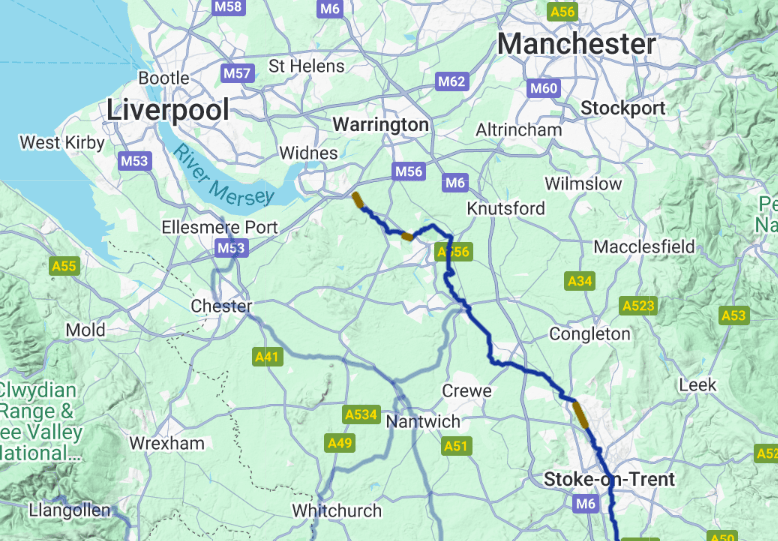
In November 1880, Catherine was in court again, but this time she was the plaintiff โsuing her cousin Sir Robert. Not only was he a respected member of the establishment, but he had been one of her legal guardians. According to Catherine, Sir Robert had agreed in writing that she would receive a weekly allowance, which he hadn’t paid, and she was therefore owed 70 weeks of payments at ยฃ1 10s per week and 207 weeks at ยฃ1 1s per week. In Phillimore v. Phillimore, at the Court of Common Pleas, Catherine conducted her own case; she had not employed a counsel because she had ‘no money whatever’. She explained that she was the daughter of a distinguished naval officer who died when she was two, was a ward of the Admiralty, and had received a small pension of ยฃ14 per year from the Admiralty (about ยฃ1400 today).
Catherine had produced 43 subpoenas to summon people to court as witnesses, and she had hand-delivered many of them herself. Writs were served to her cousin, Rev. George Phillimore (a son of barrister William); sister Rebecca and cousin Almeria; Lord Northbrook, First Lord of the Admiralty; Lord Shaftesbury; Sir Francis Truscott, Lord Mayor of London; John Walter, MP for Berkshire; and Sir Robert’s lifelong friend โ the Chancellor of the Exchequer and past and future prime minister, William E Gladstone! Unfortunately for Catherine, her most illustrious witnesses failed to show up and she was unable to provide even โa tittleโ of evidence that would prove the specific agreement she was suing for.
However, two documents were made available: the agreement, mentioned above, to pay โKateโ a guinea a week, and another to pay her ยฃ52 1s a year, both contingent on her good behaviour. The latter had been drawn up by a family friend and signed by Kate in the presence of her cousin Almeria. However, it was revealed that she although she had received some of the money, she had invested it unwisely, and when she became threatening, they had withdrawn the allowance.
Presiding over this case was Lord Chief Justice of England, Lord Coleridge. In Catherine’s final statement she declared that she had been “hunted through the country like a dog.” When she attempted to also raise a complaint about her sister’s conduct, Lord Coleridge said, “I cannot try that case; it is as much as I can do to try this one, you see.” (Laughter). Catherine was unable to prove that Sir Robert owed her any money. Unsurprisingly, she lost the case.ย 7
Sir Robert Phillimore
In December 1880 Catherine brought an action against her cousin Mrs Almeria Lake, who had been one of her mother’s executors. Almeriaโs barrister father William Phillimore had, incidentally, been a Commissioner in Lunacy and the ‘Chancellor’s Visitor of Lunatics for Middlesex and Hertfordshire’ โ roles that oversaw the treatment of mentally ill people in county asylums. Almeria had taken the witness stand in the previous trial to explain that Catherine had agreed to ‘hold her tongue’ in order to receive an allowance. Phillimore v Lake returned to this contract, and to Catherine’s claim that her cousin had not made all of the payments. According to the newspaper report, Catherine talked at length about her family, sharing โextraneous detailsโ. She even claimed that she had been assaulted while trying to secure witnesses for her case, but yet again, โthe judge told her she had altogether failed in establishing any claimโ.8
Two months before Catherine wrote the letter about her treatment at Poplar, she took her cousin Sir Robert to court again, this time for libel. By this time, Robert had been made a Baronet. Catherine’s grievance was that he had imputed that she was a lunatic and not a responsible person. It was evidently not her first appearance in court on this matter: โMiss Phillimore now appeared in person in support of one of her numerous applications in the causeโ. The application in the case of Phillimore vs Phillimore, Bart. was dismissed for the third time, and she was discouraged from taking it further. Sir Robertโs lawyer (who had also represented him and Mrs Lake in 1880) asked โin kindnessโ for her to pay the costs, to which she replied โI do not want any kindness. I have no money, but you do not know what powerful friends I have.โ9
Just a few days later, Catherine significantly upped the ante, bringing a case against the Admiralty! Catherine appeared at the Queenโs Bench in the case of Phillimore vs. Northbrook and Others, in front of a Special Jury, claiming that the Admiralty had illegally detained pension papers belonging to her (perhaps the ones she had been unable to locate for the previous hearing). Senior members of the Admiralty were called as witnesses, as was the Lord Chief Justice! Sir Robert said that he didnโt know what papers she was referring to, while Mr W H Smith (former First Lord of the Admiralty and the second generation of the famous stationer’s business), said he had seen no papers of hers, but that he had ordered his secretary to โwrite to the plaintiff to the effect that she had no moral or legal right against her relations, and to beg that he and his family should not be subjected to voluminous correspondence, which must at once ceaseโ. Catherine then said she would like to call โMr Justice Bowen, Sir Edmund Henderson, the Chief of Police, who had caused her great annoyance, and all the defendants.โ However, when asked if she could provide any evidence, โshe said she thought not, as the documents had been torn up.โ So, once again, the judge found in favour of the defendants.10
Although we donโt hear from Catherine herself through the newspaper accounts, the descriptions of her speech and actions suggest that she was probably not, to use an antiquated term, โin sound mindโ. About three weeks after losing her case against the Admiralty, Catherine found herself in Poplarโs female lunatic ward.
โThe Phillimore Claim against the Admiraltyโ, St James’s Gazette, 23 February 1882, p9. Via britishnewspaperarchive.co.uk.
Having learned more about Catherineโs behaviour leading up to this event, the picture I now have of her is much more complex, and it is hard to sympathise with her actions. Her social status, and her knowledge of the legal system, enabled her to take personal grievances to the highest courts, but based on the newspaper accounts, she had no real cases to bring. She was self-important and was clearly a relentless letter writer, and had hounded a leading politician and his family with โvoluminousโ correspondence. What’s more, if her family is to be believed, she was physically and verbally abusive towards them.
On the other hand, there are many reasons to sympathise with Catherine as a person. She’d been orphaned at a very young age and may not have had a happy childhood under the guardianship of her uncle and cousin. In adulthood, despite her ostensibly elevated position in society, and her remaining unmarried, she was not financially independent. Her family made her allowance contingent on her submissive behaviour, and withheld money from her when she didn’t comply. We also know that she wasnโt fully able-bodied, which would have further limited her independence. And it must have been frustrating to be an intelligent and dynamic woman in a family full of male high-achievers who had a wealth of opportunities not available to her. She couldn’t go to university, become a barrister, join the Navy or participate in politics and governance. Her insistence on taking her enemies to court could be viewed as impaired judgment but also suggests that she was trying to gain some power, control and respect.
It’s interesting to compare her case with that of another indignant letter-writer in the family โ her cousin, the Rev. George Phillimore. While travelling first-class by train in 1838, he’d been ‘collared’ by a train employee and policeman, who accused him of not having a valid ticket, and fined him seven shillings. He penned numerous letters to the railway company, but was dissatisfied with their response, and threatened to take them to court. However, in the end, rather than litigation, he sent bombastic letters about his experience to The Times. His public letter was met with popular support and an editorial in the Northampton Heraldthat portrayed him as a gentleman-hero. It’s true that he had more genuine cause for complaint than Catherine did when she took her relations to court, but as a man, a gentleman, and a clergyman, he was given a mouthpiece for an individual complaint and then applauded for making a mountain out of a molehill.
So, Catherine faced disadvantages despite her family’s titles. But I also sympathise with her because she was suffering from mental illness in an era where this was only just beginning to be understood. And rather than finding a safe and comfortable place for her where she could do no harm to herself or others her family chose to place her in a paupers’ asylum. Why?
Newspaper accounts make frequent reference to her relationships to celebrated men in her family, including a powerful judge (her cousin), a Naval hero of the Napoleonic wars (her father), and a lauded Naval Captain (her brother, Rear-Admiral Henry Bouchier Phillimore). However, within the family, there had also been scandals: Catherineโs oldest brother, John Bouchier Phillimore, had been bound to keep the peace after threatening a fisherman with a gun, and in 1865 was murdered while collecting rent. And a generation earlier, her uncle George Phillimore, a Lieutenant on HMS Polyphemus, had been mortally wounded in a duel with Lieutenant John Medlicott.11 These events must have been mortifying for the family.
Given the importance to the family of their public reputation, their decisions to take her to court for assault, and to a workhouse rather than straight to a private asylum, are surprising. Perhaps a public demonstration of her mental instability helped them to reinforce the claim that she was not capable of managing her own affairs (or, by implication, to inherit money). And perhaps admitting her to a workhouse lunatic ward was meant to punish and cow her after she had launched acts of public litigation against a high-profile family member and the Admiralty. It’s also probable that Catherine was truly penniless, and that for a time, her family was unwilling to provide any financial assistance. Catherine found herself powerless to prevent her family from forcing her into an asylum (a place where “relations … get out of the way all those who are in their way“). But despite her harrowing experience at the pauper lunatic ward, Catherine did spend her final years in a private asylum that had been founded to provide ‘‘humane’ care to the mentally ill‘. St Andrew’s hospital was within an elegant 106 acre estate, with a chapel designed by Sir Gilbert Scott (whose son later became a patient).
Catherine Bouchier Phillimore at St Andrew’s Hospital, 1901 census. For privacy, she was recorded as ‘C B P’. Her birthplace was unknown and she was a ‘Lunatic’. The National Archives, Class: RG13; Piece: 1424; Folio: 196; Page: 15; via ancestry.co.uk.
It was very interesting to discover that Catherineโs sister Rebecca also spent time in asylums, but only, as far as I know, received private care. She had been admitted to Peckham House as a private patient in August 1882, just a few months after Catherine had been admitted to St Andrewโs, and she was discharged from that institution in May 1883.11 She died in another private asylum (the cutting-edge Barnwood House Hospital in Gloucester) in 1902, only six months after Catherine. Unlike Catherine, Rebecca made a will. Her executor was the author of a book about the Phillimore family, which describes Rebeccaโs devotion to church work but only gives the briefest mention of Catherineโs life.
It seems that Catherine was an embarrassment to her family, and has been almost written out of her family history, but her letter, tucked within one of 70,000 volumes of correspondence, still resonates with fiery intelligence and a passion for justice. Catherine addressed the letter about her treatment at Poplar to the Lords at the Royal Courts of Justice. Itโs unlikely that they saw it before it ended up in the files of Poplar Union, or that any action was taken in response to her valid critiques. Nevertheless, the document was initialled by several people, who might not have given an impassioned letter from a less distinguished person as much of their attention (the irony is not lost on me that I have also focused my attention on a letter from an unusually wealthy workhouse resident).
Her father, who she never really knew, was said to be โgenerousโ, โgentle and justโ, with a โlove of truthโ. His ear was always open to the โpoor and unfriendedโ, and he was the first person to suggest street refuges (writing to The Times with his recommendation). Catherine had her own axe to grind, but I think she also genuinely hoped to make a difference for people like her, at all levels of society, who were being treated so inhumanely. “What right have members of a free nation to be considered โlunaticsโ because they do not all think โ feel โ & do alike?”
How many more peopleโs stories can be found in the fascinating Poor Law Union Correspondence … still waiting to be told?
***
Updates:
As I was putting the final touches to this blog I discovered that Catherineโs letter is part of TNAโs online classroom resources on workhouse women. You can view it along with seven other letters that highlight the treatment of women here.
A few weeks after posting this blog, I was contacted by Catherine’s great nephew, Edmund Phillimore, a grandson of her brother Henry Bouchier Phillimore. Edmund very kindly shared with me a detailed account he has written of Catherine’s life, as well as his transcriptions of family letters and diaries. So, here follows some ‘bonus material’ …
I learned that although on paper, Joseph and Robert Phillimore were the guardians of Catherine and her siblings, the children seem to have been raised by their uncle and aunt, William and Almeria Phillimore. Catherine lived with them until the age of 21 (except when she was away at school). William and Almeria’s eight children were adults when Catherine was orphaned. The eldest of their children was Catherine’s cousin Almeria, who features in my article. Edmund believes that Almeria took a close and life-long interest in the welfare of her orphaned cousins.
Catherine and Rebecca attended school together in Hadley Green (from at least 1848-1851) and they lived together in 1861. However, later in life, before being admitted to asylums, they lived apart. Edmund told me that ‘Rebecca was closely involved with one of the Maidenhead Churches, whereas my impression is that Catherine did not share Rebeccaโs zeal!’
A collection of Henry Bouchier’s letters is in Hampshire Archives. In these letters he refers to his sisters with affection, including ‘Kate’. However, as Edmund writes:
From HBPโs letters it is evident that during the subsequent decade [after 1861], Kate upset a number of relatives and friends. She seems to have increasingly sorry for herself, imagining that as the daughter of a distinguished Naval Officer and grand daughter of a Baron she deserved to be better supported by the Admiralty, relatives and friends than she was. I suspect that having lost both her parents and the security of their love before she was 5 years old, Kate craved attention and looked for status. Living in London she might have become envious of her elder cousins who were prosperous and were well established in society?
In two of HBPโs letters written in November 1876, Cate has been upsetting people and bothering Augustus at his office (Eventually Admiral Sir Augustus Phillimore, HBPโs first cousin). On his return from the West Indies in 1873, HBP had found that she was making free use of the names of two Admiralty Board members, Mr Goschen and Admiral Sir Alexander Milne. HBP had spoken to both of them. While Mr Goschen was not pleased, Admiral Milne had been more understanding, having pity for both Kate and her younger sister Fanny. In the second of these letters HBP assures Augustus that that he has written to Kate telling her โthat unless she kept her promise to Admiral Drew more strictly, she would force me to discontinue my weekly guinea.โ He has received ยฃ101.2.0 for her support from relatives and friends. My guess is that this is Admiral Andrew Drew, who had served under Sir John and wrote the fullest biography of him that I have. HBP discusses Cateโs support in a letter written from Dublin in 1879. He has arranged an overdraft of ยฃ50 with Stillwells, his agent in London. But does not wish to inflict Cateโs affairs on his agent. Cate has recently received a legacy from Lady George Gordon, but he does not know how much.
Writing from Somerset in August 1880 he refers to Cateโs law suit scheduled for November. He details the contributions he has received towards her support, but has ceased to send her money partly because of a conversation with his cousin Charles and partly because Kate had threatened to put the law in force against him. It seems that Kate had become increasingly alienated from her closest relatives.
The letters also reveal that Henry’s three unmarried sisters were costing him some ยฃ320 annually. His annual salary was ยฃ600, and he had his own wife and children to support, so this was a huge financial responsibility. Many other family members contributed to ease the burden on Henry. Edmund believes that it would have been Henry who had Catherine admitted to an asylum. However, he states that Henry took the responsibility of caring for his sisters seriously. And until coming across my blog he was not aware that she had been in a pauper asylum.
I was delighted that Edmund was able to share photographs of Catherine and Rebecca. The lead image in this blog is now a portrait of Catherine.
With sincere thanks to Edmund Phillimore for his gracious contributions to my blog post about his fascinating ancestor.
London Metropolitan Archives; London, England; London Poor Law Hospital Registers; Roll Number: CBG/323/001
Morning Post, 4 October 1837, p4
A eulogy-like announcement of his death can be found in the Reading Mercury, S28 March 1840, p3
Will of Dame Catherine Harriet Phillimore, The National Archives; Kew, Surrey, England; Records of the Prerogative Court of Canterbury, Series PROB 11; Class: PROB 11; Piece: 1958
โContending Sistersโ, Brief, 15 November 1878, p13; Western Gazette, 22 November 1878, p2; and โExtraordinary Conduct of a Ladyโ, Western Gazette, 22 November 1878, p6
ย โAn Extraordinary Caseโ, Dublin Evening Telegraph, 17 November 1880, p4; ‘Remarkable Action against Sir R Phillimore’, Manchester Times, 20 November 1880, p7; and ‘Phillimore v. Phillimore’, The Times (date and page unknown; transcription from Edmund Phillimore). Note: Gladstone is only named as ‘Mr Gladstone’; Catherine had handed a subpoena to his private secretary. Given the high status of other witnesses, and William E Gladstone’s close friendship with Sir Robert Phillimore, I believe this must have been the future PM.
London Daily Chronicle, 3 December 1880, p3
โAction against Sir R Phillimore by his sisterโ (family relationships are frequently incorrect in news coverage of Catherine), Manchester Evening News , 18 February 1882, px and Weekly Dispatch (London), 19 February 1882, p10
โAction against the Admiraltyโ, Globe, 23 February 1882, p5 and โThe Phillimore Claim against the Admiraltyโ, St James’s Gazette, 23 February 1882, p9
The National Archives of the UK; Commissioners in Lunacy, 1845โ1913. Lunacy Patients Admission Registers, Series MH 94; Piece: 5
Further Sources:
In addition to the embedded links and footnotes, I have learned about the Phillimore family from the following online resources:
Today marks the end of UK Disability History Month (UKDHM). The theme for 2023 has been โDisability, Children and Youthโ.
In honour of this event I would like to share what little I know of my husbandโs second great grandaunt Eliza Saword. Eliza only lived a short life, and appears in very few records, but she has made a lasting impression on me. The 1871 census revealed that Eliza, aged 13, was โparalysedโ. Ever since seeing that note for the first time, I have wondered what caused her disability, and how it affected her life.
Eliza Saword was born in June 1857 at 1 Fortess Terrace, Kentish Town. (Iโve not been able to obtain a birth certificate with the exact date because the digital download was misaligned). She was the daughter of my husbandโs 3x great grandfather, Edward William Turner Saword, an East India Merchant, and his second wife Sarah (nรฉe Gibson).ย Edward Saword was a prolific father, having had eight children with his first wife Emma (three surviving infancy) and nine or ten more with his second wife, including one pair of twins (nine surviving infancy). Eliza was the 12th of at least 17 Saword children.
The family did not have deep roots in Kentish Town. Edward came from a respected Greenwich family, and had married his first wife in Cheshire. The family had lived for several years in Liverpool and Birkenhead. After Emmaโs death, Edward remarried to Sarah Gibson, who was 20 years younger than him and had recently immigrated from Ireland to Liverpool. In 1851, the newly-weds, with two children from Edwardโs first marriage and one new baby, had emigrated from Liverpool to Boston, intending to settle in America. But by 1853 they had returned to England and made their home in London. More children quickly followed.
Fortess Terrace, where Eliza was born, has not survived. However, a decade before her birth, London watercolourist Edward Henry Dixon captured the view of Highgate Church from the fields opposite Fortess Terrace โ an idyllic scene, with people walking through tall grass sprinkled with wildflowers. It may well have still looked much like this when Eliza was born. However, by the 1860s, this semi-rural area was criss-crossed by railway lines.
Edward and Sarah baptised their baby daughter Eliza at St Johnโs, Islington, on 22 August 1858. The long gap of 14 months between her birth and baptism may be significant, although I have not found baptisms of her other siblings in London for comparison. It is likely that Sarah was a Roman Catholic, and I notice that Fortess Terrace was close to a Catholic chapel. Was Elizaโs baptism delayed due to religious preferences, or health problems?
Baptism of Eliza Saword, St John’s, Islington; London Metropolitan Archives; London Church of England Parish Registers; Reference Number: P83/Jne/001; via Ancestry.
Between 1860 and 1861, the family had moved again โ returning to Cheshire. In the 1861 census they were living at South Seacombe Terrace in Poulton cum Seacombe. Eliza was three years old. The family, with seven children, was able to afford a servant.
Saword family; The National Archives; Kew, London, England; 1861 England Census; Class: Rg 9; Piece: 2649; Folio: 101; Page: 6; via Ancestry.
However, within two years they were back in London. And we next find the family in the 1871 census at 25 Union Road, South Hackney, in what appears to be a less comfortable situation than in 1861. Edward was absent, and Sarah was the head of the family, which included five children aged between five and 13; three young adults, two of whom (the men) were working โ one as an East India Colonial Broker and one as a West Indian Merchant; and Sarahโs 89-year-old mother in law, also called Sarah. Next door (or opposite) at number 26 was Sarahโs step-son Charles (my husbandโs great great grandfather), his wife and six children, and a widowed 59-year-old nurse. Thatโs 19 people in two houses, and it would have been 20 when Edward was home as well. Union Road still has a row of Victorian houses, each with four stories. These homes would have provided sufficient space for a large family. However, no domestic servants are present in this census.
Saword family (page 1); The National Archives; Kew, London, England; 1871 England Census; Class: RG10; Piece: 333; Folio: 41; Page: 5; via Ancestry.
Itโs possible that the family was struggling financially, since Edward was a patient at St Markโs Hospital, a โHospital for Fistula and other Diseases of the Rectumโ. Family letters record that he had travelled to India in 1869 with expectations of making ยฃ1000 a year, but he had returned prematurely โฆ with a serious and very unpleasant illness and the stated occupation of just โbookkeeperโ. Edwardโs mother Sarah had been financially independent since becoming a widow 56 years earlier, but perhaps, having reached the age of almost 90, her funds had run out.
But letโs return to Eliza, who was 13 years old in 1871, the age my son is now. Elizaโs younger siblings were scholars (school children), but the education act of the previous year had only made it compulsory to attend school until 12 (and the application of that law was patchy). So, she wasnโt attending school, but she had no occupation either. The only detail giving any insight into her life at that time is found in the furthest right-hand column of the census. This column recorded if someone was โDeaf-and-Dumb, Blind, Imbecile or Idiot, or Lunaticโ. Although there was no intention to capture physical disabilities, Eliza has a note in her entry: Paralysed.
Looking back at the 1861 census, no entry about her health had been made. However, the equivalent column, then only labelled โWhether Blind, or Deaf-and-Dumbโ, was even narrower in scope than in 1871, and was not intended to record any other type of information.
Tragically, the only other document I have for Eliza โฆ five years later โฆ is her death certificate. On 13 May 1876, she died at her home, 13 St Thomas Place, South Hackney (another four-story property). She was 17. Elizaโs cause of death reveals a lifetime of suffering: Paralysis from Infancy, Epilepsy Gangrene 14 days Her painful end was witnessed by her father, who was present at her death. (so, he had presumably recovered from his previous illness, but after Elizaโs death, Edward mysteriously disappears from the records.)
Death certificate of Eliza(beth) Saword
Without any medical records, and lacking medical expertise, it is not possible (or, perhaps, ethical) for me to accurately โdiagnoseโ Eliza. However, by drawing on contemporary sources and modern research into Victorian medicine, Iโve learned about some of the possible causes and treatments of her medical conditions.
The term โparalysisโ was used for several conditions and a wide variety of symptoms in the 1800s. You might have come across the term โgeneral paralysisโ, or โgeneral paralysis of the insaneโ, which was used for people suffering from the final stages of syphilis, who were often inmates in โlunatic asylumsโ. Some types of paralysis had their own names, such as โapoplexyโ (after a stroke) and โpalsyโ, which indicated partial paralysis, or uncontrollable shaking. However, most of these conditions developed over time, and primarily affected adults. Some other paralysing conditions could be caused in utero, or during birth, such as Littleโs Disease/Cerebral Paralysis (cerebral palsy), which was discovered in 18531. However, according to Elizaโs death certificate she had had paralysis since infancy.
In 1869, Dr Mathias Roth, a Hungarian refugee and osteopathic surgeon, published On Paralysis in Infancy, Childhood and Youth, and on the Prevention and Treatment of Paralytic Deformities. This book can be viewed in its entirety via Archive.org. I donโt know how influential the book was at the time, but it offers one window into medical knowledge, treatment and attitudes towards paralysis in the 1860s-70s (although the descriptions of autopsies, and examinations of living children, make for unpleasant reading).
Dr Roth begins by listing numerous causes of different types of โinfantile paralysisโ, which he had observed tended to affect children between the ages of four months and five years. He states that the majority of cases had occurred after a fever, caused by infections such as diphtheria, typhoid fever, scarlatina (scarlet fever), and measles. Other causes of paralysis included epilepsy, injury, and toxins, especially lead and mercury. Many of these causes hold up to modern science. However, his theories on causes of paralysis in adolescents also blamed masturbation and โtoo frequent abuse of the sexual functionsโ.
Surprisingly, Dr Roth doesnโt mention polio as a cause. The British doctor Michael Underwood first described this disease in 1789, within A Treatise on the Diseases of Children, noting that the disease ‘usually attacks children previously weakened by fever; rarely those under one year of age, or over four years of age.’ Polio was more formally identified in 1860 by German orthopedic surgeon Jacob Heine, who named it โInfantile Spinal Paralysisโ.2 The polio virus spreads through the blood stream to the central nervous system, where it attacks nerve cells, leading to paralysis. However, it was widely ignored by medical practitioners in the second half of the 19th century.
It is certainly possible that Eliza had contracted a viral or bacterial infection in her first few years of life, which had left her paralysed. However, Eliza also had epilepsy. Could a seizure have left her permanently disabled?
Two of her half-siblings had died of convulsions as infants many years before her birth (Edward, aged three months in 1839 and Frances Anne aged one month in 1844). And according to University of Chicago Medicine, 30-40% of epilepsy is caused by genetic predisposition.3 However, the term โconvulsionsโ was frequently used in association with newborn deaths, and the majority of these would not have been caused by epilepsy. Convulsions, such as those caused by fever, were symptoms of many of the conditions and illnesses that sadly caused high infant mortality in this period.4
Whether caused by an infection, a seizure, physical trauma, or toxins, infant paralysis could result in local paralysis (eg one limb), or, in more severe cases, leave children unable to walk. It could also affect children’s ability to communicate. The extent and nature of Eliza’s paralysis is unknown, but it was considered serious enough that her family noted it in the census. With a significant physical disability, as well as epilepsy, what would Elizaโs life have been like?
Elizaโs father could afford to receive care in a hospital, but as Eliza wasnโt a breadwinner, I don’t know if she would have received any professional medical care. In 1859, a new hospital opened in Westminster: The National Hospital, Queen Square, for Diseases of the Nervous System including Paralysis and Epilepsy. People who could afford treatment paid seven shillings a week.5 This would have been a significant distance to travel for Eliza, however.
If Eliza did receive any medical care, Dr Rothโs book reveals that this might have included electric treatments and surgeries, or gentler therapies such as warm baths and physical manipulation. Roth advocated for the latter; he saw little evidence that electricity improved patients’ conditions, and believed that โmany a paralytic or deformed patient can be saved from being victimised by that class of orthopedic or other surgeons, whose panacea is but the screw and the knifeโ. However, Roth was a homeopathic practitioner at a hospital for the poor (as well as a foreigner) and his views were probably not widely endorsed.
Mechanical supports could also be used to aid movement and walking, such as leg braces and boots. Famously, Dickens’ character Tiny Tim, in A Christmas Carol (1843), suffered from a crippling condition that required him to use a crutch and wear metal braces on his legs. American pediatric pulmonologist Col. Charles Callahan has explored Tiny Tim’s possible diagnoses, including tuberculosis and Potts Disease (tuberculosis of the spine). Edward Saword’s first wife Emma had died of TB, and it’s possible that others in the family were infected.
‘How mechanical supports are to be used’, On paralysis in infancy, childhood, and youth, Mathias Roth, p. 94; via Archive.org.
Numerous dubious treatments for epilepsy were on offer in the mid 1800s; many were promoted through newspapers, such as the ‘sure cure’ from Prof. O Phelps Brown of Covent Garden.
Cosmopolitan – Thursday 18 July 1872; via BNA.
Brown, a quack doctor who had made a small fortune in New Jersey, published his Treatise on Epilepsy or Fits in 1869. The entire book, which also includes a treatise on treatment of tuberoculosis, can be viewed online via the Wellcome Collection. After a lengthy introduction about the power of herbal remedies and planetary influences, we see the ingredients for one of his epilepsy remedies …
The first effective anticonvulsive treatment for epilepsy was developed in 1857, using potassium bromide.6 This might have been available to Eliza. However, epilepsy was also very stigmatised. It was hard for people with epilepsy to find jobs, and social pressures to segregate people with epilepsy meant that many ended up in asylums and workhouses.7 In the mid 1800s, epilepsy was the second most common reason for admission to an asylum.8 In the minds of some doctors, the condition was linked to sexual deviancy โ a belief that was reinforced by the discovery that potassium bromide also made patients (male and female) impotent.9
Whether or not Eliza benefited (or suffered) from the latest medical developments, she would have needed extra care at home. Itโs possible that the nurse who lived in her half-brotherโs house next door could have provided care to her as well as to her nieces and nephews, and perhaps also to Elizaโs elderly grandmother. Elizaโs mother Sarah, and perhaps Elizaโs unemployed older sister, Mary, would also probably have been carers to Eliza, among their many other responsibilities. In a crowded house with limited accessibility features (and four floors), and with no public healthcare provision, it must have been a challenge for the whole family.
Would Eliza have attended school? By the time school was a legal requirement, she was already older than the minimum leaving age. Her older brothers who worked as clerks must have received an education, but her older sister Mary may not have been so fortunate; unfortunately, none of the Saword children appear in Ancestry’s collection of School Admission and Discharges for schools in London, 1840-1911, sourced from the LMA. In the 1890s, schools sprang up in London for children who were blind, deaf, epileptic or ‘defective’.10 But in the 1860s, Eliza didn’t have those options. If she was unable to walk, she would probably not have been able to travel to school. Early ‘invalid wheelchairs’ did exist in the 1870s, but these were primarily used by the wealthy (see the newspaper advertisement below). There were also makeshift contraptions, so it’s not impossible that Eliza had a means of going to school, church or shops.11 However, the possibility of seizures may have made her completely house-bound.
There is no indication from the census that Eliza had learning disabilities, or any vision impairment, and many members of her family worked in jobs that required literacy, so I think it is plausible that if she could hold a book, she could have learned to read, giving her a pastime. She might have been able to do other seated activities, such as needlework. All of this is conjecture, but helps me paint a fuller picture of what her life might have been like (while also being aware that it might have been much less fulfilling).
Wiltshire Times and Trowbridge Advertiser – Saturday 21 April 1866; via BNA.
Despite Elizaโs disabilities it seems likely that of the three conditions listed under Cause of Death, gangrene is the one that ended her life. And itโs a horrible disease to contemplate: โFew medical words strike as much terror in the clinician and the public as gangrene with all its associations of rotting, corruption, and putrefaction.โ12 Gangrene could develop at the site of a wound after a surgery or after an injury, if infection set in. However, it can also be a complication of conditions that reduce blood flow, such as diabetes and Raynaudโs Syndrome, and is linked to some viral infections, such as meningitis. Reader rowleyregislosthamlets has pointed out that people who are bed-bound can develop pressure ulcers (bed sores). Even today, these can lead to gangrene13. It is very likely that there were co-morbidities between Eliza’s conditions, and that her immobility caused the gangrene, but it’s also possible that the conditions were unrelated.
Despite advances in treatment during the American Civil War, which greatly improved the survival rate of wounded soldiers who developed gangrene, it continued to have a high mortality rate until antibiotics were developed in the 20th century. If Eliza received any medical treatment for the infection, it would probably have been Bromine, applied topically or injected, which was painful, and could cause other side effects.14 Perhaps the surgeon who certified her death, Dr Hacon of Hackney, had also attended to her over the previous fortnight, or throughout her life. His partner, Dr Toulmin, was Consulting Surgeon to the Infant Orphan Asylum at Wanstead and Surgeon to the Invalid Asylum for Respectable Women in London and Its Vicinity in Stoke Newington, which makes me think that this was a practice that truly cared for women and children.
I find it very sad that I know so little about Elizaโs 17 years of life. And now that I have two healthy teenagers of my own, with their whole lives ahead of them, I find her story even more poignant.
However, whereas some Victorian children with physical and neurological disabilities ended up in asylums, workhouses or on the streets, Eliza was, at least, able to live at home with her family. Her family was far from wealthy, but they had more financial security and and a higher standard of living than many others. Perhaps if Eliza hadnโt developed gangrene, she would have lived many more years, and left more records. Although the majority of this blog post has been about her disabilities and death, I wanted to try to humanise Eliza, because her life was so much more meaningful than the medical problems that dominated official records. I am sure that in her short life she was greatly loved by her family and friends, and experienced joy and laughter. I hope she had a chance to walk, or sit, in tall grass sprinkled with wildflowers.
Eliza Saword was buried on Tuesday 16 May 1876 in the City of London and Tower Hamlets Cemetery. Her death certificate gives her the name โElizabethโ, and the same name is recorded in her burial record. I like to think that rather than this being a mistake, it reflects Elizaโs preference to be called โElizabethโ as she became a young woman โ a small piece of her personality, shining through.
Burial register entry for Eliza(beth) Saword; City of London and Tower Hamlets Cemetery Registers, 1841-1966; via Ancestry. The address in the burial record, 13 Church Terrace, does not match the address in the death certificate, 13 St Thomas Place.
As a final word, I have learned a lot from researching this blog, but it made me realise how little I knew, and how little I still know, about what life was like for disabled people in the past. I was surprised not to find a book on the subject, for example in the popular ‘My Ancestor was a …’ series from the Society of Genealogists. If anyone has any suggestions on resources, I’d be very grateful. Also, do check out the resources on UKDHM.org, which include this fascinating visual history of wheelchairs.
In this blog Iโll be sharing the experiences of a soldier whose WW1 service left him chronically unwell and unable to return to work.
When war broke out in August 1914, William Walter Talmer โ an experienced member of the British Army Reserve (Territorial Force), was one of the first men to be mobilised. But two years later, William wrote desperately to the Middlesex Appeal Tribunal to request exemption from further service, which would โmean great hardship and lossโ.
William โ a cousin of my great grandfather Alfred Talmer โ was born on 30 April 1886 in Amersham, Buckinghamshire. His mother Clara Jane Talmer was a single woman who raised William and his brother Sidney Ayers Talmer (b. 1893) alone, until she married James Keen in 1897. At the age of 14, in 1901, William was an apprentice blacksmith, but on 4 June 1903, claiming to be 18 years old (a year older than his real age), he enlisted at Oxford as a Private in the Oxford and Bucks Light Infantry. Williamโs extensive service records (which have been preserved within WW1 pension claims at The National Archives) state that he was a sawyer by trade (though he cannot have had much experience as a sawyer) and that he was 5 feet 6.5 inches tall, with light brown hair and hazel eyes. After two years in England, which included extra schooling, he spent more than six years with the Colours in India and Burma.
In the 1911 census, taken just two days after William returned from India, he was recorded as a 24-year-old Private staying in the home of his uncle in The Lee, Bucks. A month later, with eight years of military service under his belt, he transferred to the Army Reserve. William then began working at the Brentford Gas Works. The company had been founded in 1821, supplying 200 customers in its first year of operation, and by 1926 it provided gas for lighting and cooking for 124,000 customers. Williamโs job was to paint and repair gas stoves and cast iron work, skills he might have gained in his partial apprenticeship.
On 5 Feb 1912 William married Florence Margarette Nash at St Paulโs, Brentford. They welcomed a daughter, Emily Margarette, in 1913 and a son, Sydney Walter, in 1914. But family life was turned upside down on 4 August 1914, when Britain declared war on Germany. William, as an army reservist, was called up on 14 September, reported to his unit in Portsmouth and was deployed to France on 23 November as a Private with the Ox and Bucks 2nd battalion. This return to active service could hardly have come at a more difficult time for the family: Walter and Florenceโs daughter had just had her first birthday, and their son was less than two months old. Even worse, Florence was chronically ill with Brightโs disease (an inflammatory disease of the kidneys now known as chronic nephritis).
William initially served in France for six months, although in December he spent time in a convalescent camp (reason unknown). Then, in May 1915, he sprained his ankle in action (possibly at the Battle of Festubert), and was transferred to hospital in England. Soon afterwards he fell ill with ‘gastritis’ and pain in his right side. He was at Emsworth hospital when the National Registration Act was passed on 15 August 1915. Despite still being unwell, he was drafted back to France in September, and served for another eight months. When he was discharged in June 1916, having served his full โperiod of engagementโ, his military service was said to be โexemplaryโ and he was described as โa thoroughly steady, sober and reliable manโ.
Williamโs return to civilian life, and to his job at Brentford Gas Works, must have been a huge relief to his wife. However, William was not the man he was before the start of the War. A medical report reveals that after being discharged he was often unwell, was still having pain in his right side, and had to take days off work now and then. William might not have known it yet, but he had contracted tuberculosis. This highly contagious disease โthrived in the dirty and cramped conditions of trench lifeโ1 and 55,000 British soldiers who served in the First World War returned home with the infection.2
In January 1916, the Military Service Act had introduced conscription in the UK, which meant that all healthy men between 18-41, except those in protected occupations of national importance, were considered part of the army reserve. Although William had already served his two years as a reservist with the regular army and had returned to his civilian job, he was potentially eligible to be called upon and sent overseas once again.
Williamโs efforts to support his family and to remain on the home front are revealed in a very moving 23-page file among the Minutes and Papers of the Middlesex Appeal Tribunal, 1916-1919 (within National Archives series MH 47). The tribunal was set up to consider appeals of men who put forward a case for exemption from military service. More details of the history and functions of the Central and Middlesex Tribunals are provided by the National Archives. Williamโs file shows that as well as suffering with an increasingly debilitating and potentially fatal infectious disease, he had to deal with the relentless bureaucracy of the war machine, and the continual push to do his patriotic duty.
On 7 December 1916, William applied to the tribunal for an exemption from service. He laid out four reasons, none of which mention his own health:
“Having wife who suffers from Chronic Brights Disease“ Florence would have needed medical care, and Williamโs young family also depended on him not just financially, but forpractical care.
“Eldest son of widowed mother with 3 children unable to work whom I generally give assistance“ Williamโs mother Clara had been widowed in 1913 leaving her with four children between the ages of two and twelve. The oldest was still just 16 in 1916.
“Have served 13 years in H.M. Army 6 years 2 months in India & Burma 14 months in France. Have one brother in France one being called up in March.“ William makes the point that he has already given many years of service to his country, and that members of his family were also serving. It must have been Williamโs half-brother Sydney Ayers Talmer/Keen, aged 23, who was in France, possibly with the Honorary Artillery Company. His next oldest half-brother, Arthur James Keen, had recently turned 18, when he would have received his conscription draft. The absence of these young men, and their salaries, would have made their motherโs situation even harder.
“Would mean great hardship & loss if called up again as I have lately purchased my house on installment system, and my home was broken up on mobilisation, my wife having to go home on account of illness, most of my furniture being spoilt.“ William had bought his house with a loan agreement. Iโm not quite sure what that has to do with his home (i.e., his family life) having been โbroken upโ, or what exactly happened to their furniture after his wife went home (presumably to her parents), but it was clearly a very difficult time for the family.
Five days later, a representative of the Military, having received a copy of Williamโs application, wrote to the tribunal to protest: โI OBJECT to the application and contend that no serious hardship will ensue if this man is called up for Army Service.โ
Nevertheless, on 22 December the tribunal reached a verdict, and granted William an exemption until 22 April 1917, on the condition that he present himself at the Employment Exchange within 14 days to find work of โEssential national importanceโ. William had already returned to work at the gasworks, but this ruling would mean that he would have to leave his employment to find work that was considered essential to the war effort.
Once again, the Military contradicted the decision. A few days after Christmas, F J Chapman, a military representative from Drill Hall, Hounslow, wrote again to the Heston & Isleworth Tribunal to dispute the exemption. Chapman argued that William should be put to essential work immediately. โIf he is exempted from Military Service I contend that his services should be immediately available for work of national importance.โ This confusing communication suggests that during the four months of temporary exemption, William would have been able to continue to do non-essential work. However, Chapman pressed for him to do his bit for his country immediately. On 31 January William was called back before the Tribunal at the Guildhall, Westminster. His case would be heard at 2.30pm on Tuesday 6 February 1917.
Meanwhile, Brentford Gas Works contacted the Tribunal to make the case that Williamโs work was of National Importance: โโHe is engaged at these Works principally in carrying coke from the retort houses, and he is one of the few men left to us who is capable of such important work as coke-carrying, purifier changing, etc. Although Talmer was, on his discharge from the army last year, put to his old job in the stove-repairing and Cleaning Shops, he was some time back transferred to the Manufacturing side of the Works, where practically every man was badged by the Ministry of Munitions in 1915. We are toluol-washing and making shells on these works, and a large percentage of the gas and coke produced are consumed in Government and Munition Works in the 95 square miles of District supplied by us.”
In response to the Militaryโs demand for immediate patriotic work, and the Gas Worksโ persuasive letter, the Tribunal amended the terms of Williamโs exemption: Firstly, he would have to continue in his current job (which they evidently agreed was of National Importance) or find another job of National Importance. A letter was sent to the Gas Works to advise them that if William ceased to work for them, it was their duty to report that to the tribunal promptly. Secondly, William would have to report every three months to the local military representative. However, since the Tribunal had determined โthat it is expedient in the national interestsโ for him to do work of national importance rather than be deployed again, he had won the right to remain on the Home Front.
Two days after the hearing, William saw a doctor at Hounslow Barracks, who found that William had not recovered from the effects of active service. He was categorised as C2, which meant that he was free from serious organic diseases, able to stand service in garrisons at home, could walk five miles and see and hear sufficiently3. However, a couple of weeks later, William was at work at the gasworks when he suddenly began coughing up blood, which lasted several days. After a few weeks in Hounslow and Hammersmith hospitals he was transferred to a sanatorium.
Williamโs gruelling job at the gasworks would have constantly exposed him to coal dust and chemicals, and the thought of him doing that work while suffering from a serious infectious disease in his lungs is very distressing. However, he had a young family to support.
On 26 June 1918, William wrote to the Tribunal from the Grosvenor Sanatorium in Kent. His letter reveals that he had been unable to appear in person (presumably at his three-month check-in with the Military Rep) due to being in an institution (i.e., TB hospital). As a result, the Tribunal was trying to remove his exemption. He assured them that he was willing to see the Medical Board (for an examination) providing he was fit to travel. I find it extremely sad that William was having to deal with such unfeeling red tape, while ill in hospital.
He wrote to the Tribunal again in about September to explain that he had been unable to do his job for six months due to pulmonary tuberculosis, and was no longer capable of doing the work he had done before the war. His doctors had advised him to find other employment. Ever polite and respectful, he asked the Tribunal to โvary his conditionsโ again to allow him to do lighter work.
William underwent a thorough medical examination at Duke of York’s HQ in Chelsea on 22 October 1918. Although he was โa well developed man of good physiqueโ, his degree of disablement was 30%. The medical officer in charge of his case wrote a detailed and very sympathetic account of William’s medical history since the start of his service in 1914, repeatedly stressing that he had carried out all his duties despite his illness. Critically, the opinion of the Medical Board was that this disability had been caused by service during this war.
In early October, the Tribunal consented to William finding lighter work of national importance. They instructed him that when he had found work, he had to submit to them for approval. Even with so many fit and healthy young men serving overseas, it canโt have been easy for William, who had limited civilian experience and education, to find a job that was considered vital and yet was not physically demanding. However, within just two weeks, William secured work at the Ministry of Munitions Aircraft Engine Instructional Works at Twickenham. He wrote again to the Tribunal for their approval. They approved โ providing his employer could vouch for his hire and provide details of the work โ noting on his letter, before filing it, that he was โtubercularโ and needed โlighter work than gasworksโ. A copy of their decision was sent to the National Service Representative.
Exactly a fortnight later, Germany signed the armistice to end the war. William had made it through the ‘Great War’, and I hope he joined millions who celebrated in the streets across Britain and around the world. He certainly celebrated with his wife at home, because nine months later, William and Florence, despite their health problems, welcomed a third child, Vera Doreen Chester Talmer. At her christening, William gave his occupation as โMechanicโ.
William continued to have regular examinations with a medical officer. Although repeated laboratory tests found no TB in his sputum, in March 1919, William was granted a military pension for one year due to โtubercle of lungโ. He still had a good colour and fresh complexion but was suffering from pain in his left side, shortness of breath, frequent coughing, poor sleep, and had experienced several bouts of haemoptysis (coughing up blood). His degree of disablement was now 50%.
Despite being seriously ill, he had been employed as a fitterโs mate on a tram car for three months. Perhaps the monthly allowance from the government meant that he could finally take some leave from work …
But Iโm sorry to say that this story doesnโt have a happy ending.
William Walter Talmer died on 22 Jan 1920, aged 33, of โphthisisโ (TB), leaving behind his wife Florence and three children, the youngest still a newborn. His death was classified as a war death. Of the 55,000 British soldiers who came home with TB, 18,000 of them had died by 19224.
According to the Bucks Examiner, William was buried at Isleworth Cemetery โwith full military honoursโ. He later received a war grave from the War Graves Commission (now CWGC).
Buckinghamshire Examiner – Friday 6 February 1920
Sadly, William and Florenceโs oldest child, Edith, died later that year. She was only seven, and although I donโt have her death certificate I wonder if she had contracted TB from her father, making her another war casualty. William’s widow, Florence, only outlived him by seven years.
William is commemorated on Isleworth War Memorial, a large square stone clock tower topped with a wheel cross that was unveiled on 22 June 1922. Unfortunately his surname is mispelled as TALMERS W W. I was disappointed to find that he was not included on the memorial plaque for employees of Brentford Gas Works, perhaps because he had left the company for employment elsewhere before he died.
I am grateful to the Isleworth 390 Project, a community project to research the lives of 390 men and women remembered on the war memorial. A PDF about William Walterโs life shows his gravestone and his house at 25 Nottingham Road, Isleworth .
Williamโs brothers Sydney and Arthur survived the war, got married and lived long lives. However, two of Williamโs cousins, my great great uncles Harry and Charles โCharlieโ Talmer, were both killed in action in the summer of 1916. An โHonour Boardโ at Lee Common School commemorates all โold boys from this schoolโ who served in the Army & Navy in WWI, including Harry, Charlie, and William Walter Talmer (mispelled ‘Talmar’).
The document images in this blog, unless otherwise stated, are from the following primary sources:
William Walter Talmer’s pension claim documents (including his service records): The National Archives, WO 364/4071; viewed digitally on pp4585-4606 of British Army WWI Pension Records 1914-1920, via ancestry.co.uk.
William Walter Talmer’s case papers (Middlesex Appeal Tribunal non-attested case papers): The National Archives, MH 47/54/51, Case Number: M2846 (digital download).