
Workhouses have a reputation for cruelty and despair. After watching the BBC’s edgy new production of a Christmas Carol yesterday, and the (not at all edgy) Muppet version today, I’ve been reminded of Scrooge’s famous commentary on the workhouses; his appalling lack of empathy for the poor still resonates in 2019:
“At this festive season of the year, Mr Scrooge, … it is more than usually desirable that we should make some slight provision for the Poor and destitute, who suffer greatly at the present time. Many thousands are in want of common necessaries; hundreds of thousands are in want of common comforts, sir.”
“Are there no prisons?”
“Plenty of prisons…”
“And the Union workhouses.” demanded Scrooge. “Are they still in operation?”
“Both very busy, sir…”
“Those who are badly off must go there.”
“Many can’t go there; and many would rather die.”
“If they would rather die,” said Scrooge, “they had better do it, and decrease the surplus population.”
So I was surprised to come across this newspaper article from about a Victorian Christmas dinner at Knaresborough Workhouse:
‘Christmas Day was celebrated at the Union Workhouses, Knaresbro’, in the usual manner; the inmates being entertained to a Christmas dinner consisting of roast beef, plum pudding &c. After dinner each person was presented to a small sum of money subscribed for by the ex-officio and elected members of the Board of Guardians. On Christmas Eve the inmates had a “Christmas tea;” after which the children were congregated in the dining hall and gifts, consisting of toys, dolls, bags of marbles, small Santa Slaus stockings, mufflers, mittens and other useful articles … were much appreciated by the delightful children. … The recipients showed their appreciation of these gifts by their hearty cheering.’
Knaresborough Post, 29 December 1888
Was this a one-off? A search for ‘workhouse Christmas’ in the British Newspaper Archive revealed many other similar stories, such as ‘Workhouse Christmas Cheer’ at Ashton-Under-Lyne Workhouse — when a local grocer donated ‘a quantity of figs to the children’ on Christmas Day, and ‘also presented 12lbs. of nuts, 13lbs. of apples, 138 oranges, and a Christmas Tree stocked with a variety of things for the amusement of the little ones.’ (The Ashton Weekly Reporter, 26 December 1868). In London, inmates of the workhouses at St Luke’s, Chelsea, St George Hanover Square, and Kensington all enjoyed a Christmas dinner in 1859, including roast beef, plum pudding, tea and porter. At St George they were also given two days of holiday. At Kensington, a Greek merchant donated a large gift of currants. (West Middlesex Advertiser and Family Journal, 31 December 1859).
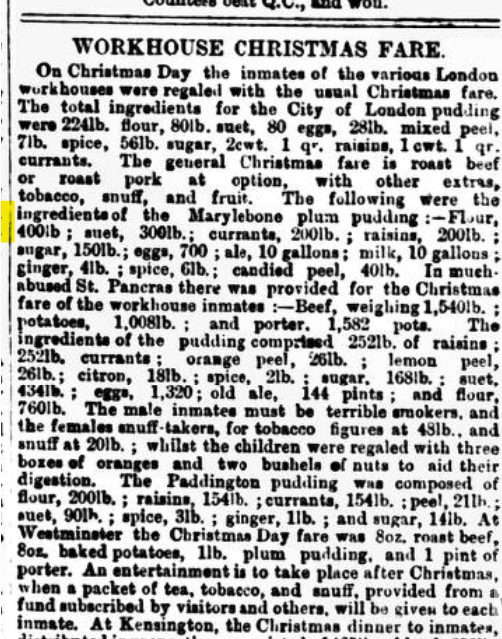
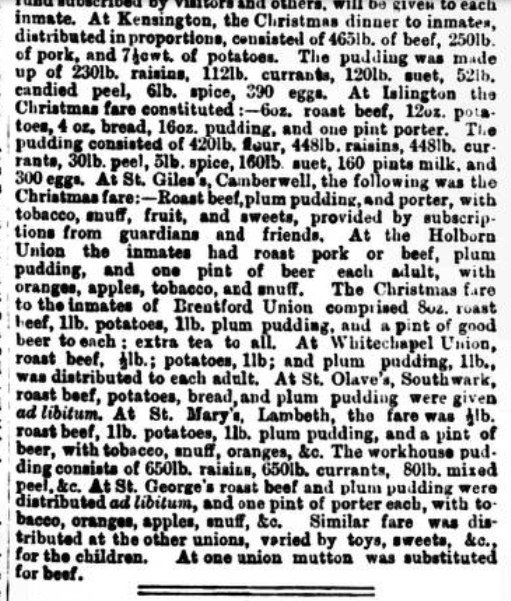
The huge amounts of food donated to the poor were news-worthy, and the size of London’s workhouses demanded Guinness-world-record-size quantities of ingredients. On 1 Jan 1876, readers of the Norfolk News could be wowed by reports from London workhouses, such as the 1540lb. of beef distributed in St Pancras, where ‘the male inmates must be terrible smokers, and the women snuff-takers, for tobacco figures at 48lb. and snuff at 20lb’, and the ingredients of Marylebone’s plum pudding: 400 lb. flour, 300 lb. suet, 400 lb. currants and raisins, 150lb. sugar, 700 eggs, 10 gallons of ale, 10 lb. ginger and other spices, and 40 lb. candied peel! Norfolk News readers could also enjoy reports on Christmas dinners at workhouses in their own county, such as at Norwich, Lingwood, St Faith’s, and Swaffham — where the inmates not only enjoyed their ‘usual’ Christmas fare, but were also gifted two dozen rabbits from the Marquis of Townsham. You can read a selection of clippings on these festive meals below.
From the same publication, I learned that poorer residents of Norfolk outside the workhouse also received Christmas meals and gifts. For example, at Burnham, ‘all the poor widows of Westgate had a bountiful supply of roost beef and pudding, through the kindness of Mrs. Clarke of the hall’ while at Bungay, 50 poor families of Ellingham were treated to joints of prime beef, ingredients for a plum pudding and a parcel of tea, by their ‘excellent rector’. Also at Bungay, the annual ‘Christmas dinner for the aged poor’ fed almost 300 elderly people — 200 dined at the Corn Hall, and the rest, who were too infirm or unwell to attend, received their meals at home. A dozen old folks at one table were said to have a combined age of 1040 years! Churches also offered support, such as the Gospel Hall in Norwich, a Pentecostal church, which provided a Christmas meal for more than 300 of the town’s poorest; the repast ended with ‘a bountiful supply of hot plum puddings (weighing 16 pounds each) steaming from portable coppers in the yard at the back of the hall.’
At many of these events, visitors and volunteers were said to be motivated only by the desire to do good. However, no doubt, giving to the poor was also a good PR exercise, and often done as publicly as possible. One anonymous letter-writer to the Shields Daily News on 23 December 1890 had this to say:
‘Sir.- Much has been discussed at various times respecting the “appendages” at the Workhouse Christmas Dinner. There are some “appendages,” however, which I think could well be dispensed with. I refer to those which are usually described in the newspapers as the “Guardians and their friends,” who assemble at the dining hour, to watch the inmates do away with what has been provided for them. Now, it does not follow, because a person wears a pauper’s uniform he is devoid of feeling, and I have no doubt that many of the poor people would feel more comfortable, and enjoy themselves better if “the friends” were only “present in the spirit.” … It seems to be quite the rage now, at all charity dinners, teas, etc., for a large portion of the public to assemble, in order to see (as the menagerie man would put it) the “lions feed.”‘
Whatever the motivation for these acts of charity, it has made me smile to know that for some workhouse inmates at least, Christmas brought a little bit of comfort and joy.


Featured Image: plum pudding Christmas card from https://olddesignshop.com/2016/12/victorian-boy-plum-pudding-postcard/
Updated on Christmas Eve, 2024 with the addition of some Norfolk workhouses and other charitable Christmas meals in Norfolk.
 Dig Up Your Ancestors